Name
2000
  • Dot-Colonization

    09/24/2021 - 11:44 by Anonymous (not verified)
    Original Author
    root
    Original Body

    San Francisco Planning Department is
    allowing the rapid Dot-com
    development. Mission Residents stage
    large protest.

    by Anna Morrow

    "Over the last four years gentrification in the Mission
    has gotten completely out of hand! .....now it’s time we
    take things into our own hands! "

    The emotionally charged words came from Lisa
    Hernandez who told the crowd of mission residents,
    artists, tenant advocates and recently homeless San
    Franciscans, that her mother, a long time San Francisco
    resident, had been forced out of her home by the
    voracious appetite of the dot com dollar.

    The crowd around 1660 Mission St. bursted into
    cheering and clapping ; a rolling of Congo beats lifted up
    into the air. The emcee of the protest, Oscar Grande of
    PODER asked the crowd to raise their voices when they
    felt compelled by one of the many speakers telling their
    stories of eviction and/or gentrification. The target of the
    angry voices were on the fifth floor of the large gray
    concrete building at 1660 Mission st. A Mr. Gerald
    Green Director of the San Francisco Planning
    Department was concurrently presented with a letter from
    five members of the Mission District Anti-Displacement
    Coalition (MAC). The demands of the letter were:

    1.Mr. Green and all staff members, including
    senior staff members, attend a community
    meeting scheduled for Wednesday June 28th, to
    answer the demands of the community.

    2.that zoning in the Mission be changed
    immediately to protect our community from
    further displacement

    3.that there be no more development, including
    pipeline projects, until permanent controls are in
    place in the North East industrial zone and
    protections are in place for the Mission Street
    corridor and 24th Street corridor.

    For the past four years, the Mission District as well
    as other low income and working class multi-cultural,
    immigrant, communities of color have borne the
    brunt of gentrification caused by the booming
    economy and un-checked development of live -work
    lofts of high-tech multi -media offices. All parts of
    our community, from small community serving
    businesses to low income renters and non-profit
    community based organizations, have been displaced.
    The Planning department and commission have done
    little to protect the most vulnerable residents,
    businesses, and community based organizations. The
    Department and Commission have blindly followed
    the demands of powerful lobbyists and developers
    and have overlooked the concerns of the low income
    communities like the Mission.

    As protesters raise their voices in sympathy and
    solidarity to the stories being told by various speakers
    it is clear that the plight of the Mission district is yet
    another verse in

    the song whose chorus is " Economic Boom For
    Whom?????"

    This is happening in the midst of a booming economy
    that is increasing the gap between rich and poor, with
    little if any response from city officials.

    Last month the Planning Commission approved the
    Bryant Square project despite the objections of
    community residents. This 150,000 + square foot
    project slated for 19th and Bryant streets would be
    located right next to a residential area in the Mission.
    Over 100 community members mobilized to oppose
    the development believing that it would further
    displace residents , erode community culture, and
    increase traffic-- jeopardizing the safety of children,
    seniors and families. Strong arguments made by the
    community prompted a majority of Planning
    Commissioners to agree that the project would cause
    displacement and other problems in the
    neighborhood. However the commission then
    proceeded to approve the project by a 4 to 1 vote.

    Like most of the people here today I represent one
    generation of a multi generation San Francisco
    family. I am sickened , saddened and outraged by the
    careless handling of the our City’s destiny. The
    essence of what makes San Francisco San Francisco,
    the diversity which draws people from across the
    globe, is being eroded and traded in favor of the
    dollar. I am proud that we are here, taking a stand to
    fight for what is rightly ours: the future of our lives
    and communities, in our home - San Francisco.

    Tags
  • Sense-Less Crimes

    09/24/2021 - 11:44 by Anonymous (not verified)
    Original Author
    root
    Original Body

    by Leroy Moore

    This is my third article on the increase of racial attacks, police
    brutality and senseless crimes toward disabled people of color and I wonder,
    am I talking to myself?! I ask this because racial attacks and brutality
    continue to happen to disabled people of color, but no one is picking
    up the mantle and voicing this issue. This issue hit home for me last year on my birthday, November 2nd. I was standing in a San Francisco Muni bus, and suddenly an African-American man pushed his way to the front of the bus, yelling. He grabbed my shoulder bag, dragging me to the steps of the bus.

    I grabbed the inside pole, fearing that if he pulled me off the bus, it
    would be all over for me. Fortunately my bag broke, and he fell off the bus, leaving my bag and my self inside.

    As I sat down, tears came to my eyes. The man's girlfriend had been the only one who tried to stop him, and not one other person on the bus spoke up. The driver closed the doors and continued on her route.

    I escaped that attack with only two deep scars on my neck, a broken bag and a new outlook on how I am an easy target because of my physical disability. I also thought about my disabled brothers and sisters who are not alive today because of racial attacks and police brutality.

    Recently I've been keeping a list of incidents of police brutality, racial attacks and other senseless crimes towards disabled people of color, and every day this list grows like a weed.

    The latest case brought tears to my eyes when I read it in the San Francisco Bayview Newspaper. A 13-year-old African-American boy with cerebral palsy was approached by two white teens during class. They asked him if they could tie him up. The boy firmly said,"No," but the two teens proceeded to tie him up and then placed a noose around his neck,and joked about tossing the rope over a pipe to hang him. What is even more shocking is the teacher witnessed the thirty-minute ordeal and did nothing. The boy's mother was quoted as saying "If my son was white, everybody in Texas would know about his case." This comment tells me that when you add race to the picture, it becomes even harder to one's your case.

    My list of crimes towards disabled people of color is so hard to research because, until recently, the disability was not reported when a person with a disability was a victim of a hate crime. Many leaders in the disability rights movement refuse to talk about this issue, especially when it comes to disabled people of color, and so it goes unnoticed.

    Almost five years ago Kathi Wolf authored an article entitled "Bashing the Disabled:the New Hate Crime" in The Progressive. The article reported that the Hate Crimes Statistics Act was amended to include bias on disability. The FBI has collected data about disability-based hate crimes, as well as those based on race, ethnicity, religion and sexual orientation. In this same article, Mr. James Nolan, a coordinator of the FBI hate-crimes programs, said that his department will work with disability groups to understand and identify hate crimes, and will also work with police departments and law-enforcement agencies to make them more knowledgable and sensitive about disability issues.

    Now, five years later, we have many documented cases of police brutality and hate-crimes against disabled people of color. For example a recently published book
    entitled "Stolen Lives, Killed by Law Enforcement" recorded many cases
    of police brutality and hate-crimes among disabled people of color. The
    following are some cases:

    1997: shooting and killing of Kelvin Robinson, a Black deaf man who was shot three times in the back by LAPD and bled to death because the officers refused to call the paramedics.

    April of 1998: an Ethiopian man in Maryland was shot and killed by officer George Byce, a White cop with a history of racism and hostility toward mentally impaired people.

    Last year Magaret L. Mitchell, a Black homeless woman with mental illness, was shot to death by a LA police officer.

    Many people are surprised when I tell them that James Byrd, the Black man who was dragged to his death behind a truck in Texas, had a disability!

    According to an LA Times study last year, since 1994 LA police officers have shot 37 individuals who had some symptoms of mental illness. Many were people of color. The study also found that LA police recruits receive only four hours of training on how to deal with people with mental illness.

    On June 21, 2000, the San Francisco Chronicle ran an article entitled "Senate Okay's Broader Hate Laws." The Senate voted on June 20th to strengthen federal hate-crime laws by extending civil rights era protections, for the first time, to include violence based on gender, sexual orientation and disabilities, but it's hurdle is in the House. If the Bill becomes law, it will provide the first major expansion of hate-crime law since the original bill that was passed in 1968, which covers only crimes involving race, color, religion or national origin.

    Although this expansion will include people with disabilities, the real voices behind this Bill are gays and lesbians, not people with disabilities. The same article mentioned James Bryd, but did not identify his disability as part of his identity, and the article also talked about Matthew Shepard, a gay college student who died after being beaten into a coma and tied to a fence. The article did not identify a disabled victim of a hate-crime.

    I have many questions regarding the inclusion of people with disabilities when it comes to hate-crimes, but one sticks out to me. Why are the feds giving local authorities grants to help them deal with these crimes? A
    great portion of these crimes among disabled people of color are at the hands of local authorities, i.e. law enforcement, the INS and prison guards!

    Have disabled organizations voiced their opinion and advocated on hate crimes since 1995? My research on this issue has mainly come my way via mainstream media and the ethnic press, not through disabled organizations.

    With the silence of the disabled community and local authorities inadequately training themselves on hate-crimes dealing with people with disabilities, no wonder things are worse since the Kathi Wolfe article of 1995. Reva Trevino, of the Los Angeles County of Commission on Human Relations Network Against Hate Crimes, was quoted in the Wolfe article. He said that while it is well organized on other concerns, the disability community hasn't yet organized around the issue of hate-crimes.

    It is the year 2000 and Trevino's words are still true. Five years later
    and still nobody is reacting while many of our disabled brothers and sisters continue to be under attack, and many were forced to leave this earth.

    By Leroy F. Moore Jr.,

    Founder of Disability Advocates of
    Minorities Org.,DAMO

    (415) 695-0153

    Tags
  • Who Are These People???

    09/24/2021 - 11:44 by Anonymous (not verified)
    Original Author
    root
    Original Body

    Calworks Moms protest new fingerprinting
    program in State Welfare System.

    by Scott Clark

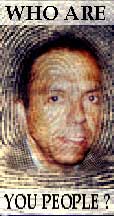
    "You have no right to be here, who are you people?",
    said Will Lightbourne, director of San Francisco
    Department of Human Services. This statement was
    his first attempt to dislodge a small group of
    protesting mothers and their advocates from his
    office.

    The recent passing of Mother's Day seemed to add
    considerable weight to an action against the
    Department of Human Services (DHS). On May 15,
    2000, at 1:30pm, a group of about twenty
    demonstrators met in the small office of POWER
    (People Organized to Win Employment Rights), 126
    Hyde St. in San Francisco. The protestors consisted
    of Mothers on TANF (Temporary Assistance for
    Needy Families), working poor Mothers, former
    TANF recipients, Foodstamps recipients, and family
    welfare advocates.

    The reason for the meeting was to plan an action in
    response to the implementation of a rigorous
    fingerprinting system for recipients of CalWorks
    (TANF) and Foodstamps, which was announced by
    DHS to be taking place this very same day. The main
    concern with the new fingerprinting system is that
    DHS will share fingerprint data with other
    government agencies, such as the INS (Immigration
    and Naturalization Service) and CPS (Child
    Protective Services).

    The meeting proceeded with a roundtable of
    introductions in English and Spanish, followed by a
    few minutes of strategizing and answering questions
    in the same bilingual fashion. By 2:15pm the group
    had split into two factions. The groups were about
    equally sized, one headed off to the office of Will
    Lightbourne at 170 Otis St., the other to sit in on the
    regular Monday 2pm Board of Supervisors meeting
    at City Hall.

    The conference with Will Lightbourne was brought
    about with some argument from Will himself. To his
    understanding, he had done the right thing in an
    expedient fashion, putting his new fingerprint system
    to work as quickly and substantially as possible,
    justifying the departmental outlay of the money it
    took to purchase the system. In doing this, he was in
    accordance with state law, which allows counties to
    implement fingerprinting and share the information
    with other counties in order to prevent fraud. So,
    when this collection of families and advocates
    showed up without an appointment and demanded to
    meet with him, he did his best to shoo them back out
    of his personal offices.

    They, however, refused to leave. It was unlikely that
    Mr. Lightbourne would have showed up for an
    appointment....... even if they had had one. He had a
    reputation for not showing up when anyone had any
    complaint at all. And they had come to do some
    serious complaining.

    The mere process of getting to his offices and then
    getting him to acknowledge their presence had caused
    the group to expend considerable creative effort.
    They had bypassed the front desk security by coming
    in through the parking lot elevators. Up to the eighth
    floor went the bulk of the procession; the drivers of
    the three cars they had come in were still parking. By
    the time that the last two members of the group,
    Steve Williams and another member of POWER, had
    arrived upstairs, Mr. Lightbourne had made the
    escape from his own front office, and was attempting
    to hide (or maybe just take a deep breath) in the hall
    bathroom. He might better have picked one with a
    lock on the door, because Steve found him soon
    enough. Steve calmly told him "Look, we're here
    because we need to talk to you, and we're not going
    away."

    So the two of them headed back to the front office. Once
    there, Will totally ignored the group, and again attempted
    avoidance via the connected employees’ offices. The group
    followed him, asking what the problem was, and why
    wouldn’t he talk to them. He mumbled something about not
    having an appointment and having to get back to work.
    They came back around full circle again to the front area,
    which included his personal office. He slipped in there and
    attempted to close the door on them, but instead
    encountered someone's foot, which kept the door from
    closing.

    Rebecca Vilkommerson of the Homeless Prenatal Program
    (HPP) responded; "We have every right to be here, and
    you need to find time right now to talk to us, because we’re
    not leaving until you do." The group had brought signs
    denouncing Mr. Lightbourne’s methods in respect to
    making changes in DHS, not only as regards
    fingerprinting. They were there to argue with his self-will;
    he had paid no attention thus far to requests by this same
    group of people to apply for a waiver from the state. This
    waiver would allow for delaying fingerprint requirements
    for up to two years. He had also ignored the waivers that
    had been granted or were being requested by a number of
    surrounding counties in Northern California.

    These failings were pointed out to him again after he had
    led his opponents into the building auditorium to proceed
    with their griefs. They hung their signs on the walls and
    took to the front of the room, while he took a front and
    center seat, a wary or weary-looking audience of one. He
    listened to them mostly in silence. At one point in the
    discourse he started to try to respond to some things being
    said by a mother with her toddler-aged daughter; he got as
    far as "But, but, but...", before the mom resumed
    speaking; then she was cut off by her baby repeating, "buh,
    buh, buh". Everybody but Will thought this was pretty
    funny.

    To follow up on the action at 170 Otis St., this group was
    to rendezvous with its other half, the complainants who
    were to present these same problems to City Hall. The
    Supervisors meeting had been dragging along on some land
    use issues, and had not yet come to the portion of the
    agenda allowing for public comment. This situation turned
    the day’s momentum to an advantage.

    The protestors who had just arrived from Otis St., when
    they got to the City Hall building, went first to the office of
    Tom Ammiano, who has been the City’s #1 responsive ally
    when it comes to issues of family and immigrant rights.
    There, they found Brad Benson, Tom’s assistant. They
    explained their situation, and what had happened at DHS.
    Brad agreed to work with them to write up a resolution for
    presentation to the Board of Supervisors. They gathered the
    rest of their consort from the Board conference room, and
    Brad seated everybody comfortably in Tom’s spacious
    office. He addressed the group briefly, letting them know
    he was out to help them get this situation dealt with today in
    an agreeable fashion. There were two lawyers present
    within the group; Julia Greenfield from the Lawyer’s
    Committee, and Eve Stotland from Bay Area Legal Aid.
    They, together with a CalWorks mom (and member of
    POWER) and Brad, collaborated to get the resolution typed
    in legal language for presentation to the Board. When it
    was typed and printed, the group in Tom’s office listened
    to it read, and voted, approving it unanimously. The
    resolution was for the Board to order the DHS to delay
    fingerprinting, and to apply for a waiver from the state until
    such a time as controls could be implemented, disallowing
    the DHS from sharing such information with other
    unapproved agencies, either Federal or State.

    The lateness of the afternoon, however, did not allow for it
    to be brought before the Board on that day so a promise
    was garnered from Brad, and in Tom Ammiano’s name, to
    present it to the Board at the next regular meeting of the
    board. The group left the scene happily, looking as if
    Mother's Day had been extended an extra day.

    For more information call POWER at (415)776-9379 or
    HPP at 546-6756.

    Tags
  • "An Altercation..."

    09/24/2021 - 11:44 by Anonymous (not verified)
    Original Author
    root
    Original Body

    Homeless resident of UN Plaza shot by federal
    police officer

    by Maurice J., Darrin Lewis and Tiny

    It was late.... so late and so dark, even the streetlamps started to fade
    and flicker in that disturbing way they do at dusk and dawn. In this hour
    of darkness something happened to a homeless friend of mine at the United
    Nations Plaza in San Francisco..something that left him.in critical
    condition..something that involved my friend and several police
    officers...


    a knife.." an altercation".... a shooting .


    I didn't see my friend hurt. hardly anyone was around..... I did see the faint
    glow of police searchlights flicker in tandem with the flickering streetlamps.
    The birds, sparkling charcoal clouds and moist brick sidewalks whispered
    to me that something was wrong but I was hidden and it is o hard to find
    a good place to sleep when you are living outside that I denied what might
    have been going on around the corner.


    As a homeless not-resident of UN Plaza it is very clear to me, that between
    the Mayor's office, the sheriff's department and the federal police, WE
    ARE NOT WANTED HERE! Further, my opinions on this event and/or that of
    any homeless witnesses, will not hold any weight, suffice to say we know
    through personal experience, poor people are rarely believed, and their
    opinions are rarely legitimized My neighbors and friends are saying it
    was attempted murder by a federal police officer who wants us out of here
    - my neighbors and friends are very scared because they feel like its
    just a matter of time before they are the next "altercation" The FBI,
    the branch of government who are "Handling this investigation" have released
    the following statement:


    At approximately 10:00 pm on Thursday, August 10th, an as yet unidentified
    federal police officer encountered an as yet unidentified individual in
    the small alleyway in UN Plaza, behind the fountain, that leads to McAllister
    street. As per federal regulations the investigation is now being handled
    by the FBI.The individual pulled a knife and proceeded to attack the officer.
    After sustaining several cuts the officer then pulled his weapon and shot
    the man in self-defense. The suspect is still in General Hospital while
    the officer was treated and released that night.


    At this point the homeless residents of UN Plaza have no official statement,
    so far it is only that, "we are scared"


    Tags
  • CLASS CLEANSING THE ZEPHYR WAY

    09/24/2021 - 11:44 by Anonymous (not verified)
    Original Author
    root
    Original Body

    Senior and disabled tenants protest unjust
    evictions by Zephyr Realty

    by PNN staff

    One flyer from Zephyr Realty advises landlords that
    they can raise the value of their buildings by 20% if
    they sell buildings that are empty of any tenants.
    Another flyer lists property bought a few years ago
    and then re-sold in the last year at huge profits-the
    flyer notes "Come In And Ask About Ellis
    Evictions."

    These practices, and the involvement of Zephyr
    Realtor’s buying buildings, evicting tenants and
    converting the apartments to condos was the focus of
    a tenant protest and picket at Zephyr Reality in Noe
    Valley.

    Zephyr is one of the leading players in real
    estate speculation in San Francisco leading to
    the evictions of tenants for condo
    conversions. Their ads for condos often say
    "VACANT" or "DELIVERED VACANT."
    These condos are being sold empty because
    the tenants have been evicted, usually under
    the state Ellis Act. Real estate investors are
    buying up buildings, evicting tenants under
    the Ellis Act, and then using loopholes in the
    condo conversion law, the units are sold as
    condos-usually for about $425,000 per
    apartment (with the real estate speculator
    typically getting $500,000 profit per
    building).

    These evictions-for-condos are the leading
    cause of evictions in the city.

    Using the state Ellis Act, real estate have evicted
    about a thousand tenants in the past year for the
    purpose of condo conversion.

    Even though the city’s condo conversion law limits
    conversions to 200 a year and prohibits senior
    evictions for condos, these real estate investors utilize
    loopholes in the condo law to convert thousands of
    units. The Tenants Union is putting a measure on the
    November ballot to bring all types of
    "condominium-type" conversions into condo law.
    When such a law is passed, all rental units which are
    sold as condos will be covered by the condo law,
    regardless of how the sale is structured or recorded
    on the deed.

    INFORMATION:

    Ted Gullicken 282-6543

    Pager: 791-1528

    558 CAAP STREET- SAN FRANCISCO,
    CA 94110 - PHONE (415)
    282-6543-FAX:(415) 282-6622

    Z

    ZEPHYR

    NOTABLE ZEPHYR FACTS

    Zephyr officers and realtors are very active as landlords and
    real estate speculators. The 1998 effort to repeal rent
    control was led by Zephyr: Iise Cordoni-a longtime Zephyr
    agent & officer and currently a Director of the California
    Association of Realtors was the largest single donor to the
    anti-rent-control campaign, giving $25,000. Zephyr
    President and Founder William Drypolcher-who had
    residential property holdings worth $2.5 million in 1998
    valuation, gave the anti-rent-control-campaign $5,000.

    Zephyr preaches the philosophy of DELIVERED
    VACANT. The current issue of Zephyr’s newsletter says:
    "Buildings which are delivered vacant sell for considerably
    more than those which are partially or wholly tenant
    occupied. The question is how much is a vacant unit
    worth?" "20% more, Zephyr says." The newsletter goes to
    give and example of a two unit occupied building which for
    $569,000. The sale fell through in escrow and the building
    was put back on the market empty and sold for $100,000
    more, for $670,000. One Zephyr realtor’s flyer lists a
    number of buildings bought and then re-sold for 50-100%
    more in the same year, followed by "Call and ask me about
    Ellis Evictions.

    SOME BUILDING EXAMPLES

    348-350 SCOTT

    Tenants were evicted under the Ellis Act in Late
    1998 by Zephyr realtor Bonnie Spindler. Spindler
    bought the property in May of 1998 for $430,000;
    in September, she gave tenants an Ellis Eviction
    notice (this is typical of most Ellis evictions: a real
    estate investor buys the rental units and
    immediately files an Ellis eviction to remove the
    units from the rental market). By February of this
    year, she had sold all 4 units for a total of
    $975,000 (yielding her a profit of over half
    a-million dollars. Spindler has been an active real
    estate speculator in the past and besides this Ellis
    eviction she’s doing an "owner move in" eviction
    on another building in the Lower Haight which is
    being converted to condos and previously did an
    OMI eviction for herself at 1500 Fell.

    362-366 SANCHEZ

    This 6 unit building was bought by a Zephyr
    Realtor in 1998 who began converting it into
    condo-type units. Two tenants were evicted for
    "owner move in" and then the realtor/landlords
    (Tuan Tran and George Uyeda) did an Ellis
    eviction to complete conversions of the
    apartment units into condo-type units.

    273-277 HERMANN

    Three unit building created as condos via OMI
    evictions in 1997. In May Zephyr was offering
    one of the condo-type units for $345,000
    Evictees included a 20+ year rent tenant.

    Greed, Avarice, OUT OF CONTROL
    PROFITS.

    IT’S ABOUT HOW MUCH $$$$$$ CAN
    BE MADE OUT OF REAL ESTATE MARKET
    SPECULATION. INSPITE OF HAVING MORE
    THAN ENOUGH TO LIVE ON, FORCING OUT
    TENANTS BECAUSE THEY CAN. WHERE
    AND WHEN DOES THIS FISCAL
    INSANITY END? WILL YOU BE
    ‘ELLISSED OUT NEXT IS ANYONE
    SAFE?

    Tags
  • "Live" Notes from the Democratic National Convention

    09/24/2021 - 11:44 by Anonymous (not verified)
    Original Author
    root
    Original Body

    by Aaron Shuman

    ....Stories about provocateurs in the crowd is true, though there's been
    some exaggeration about the materials thrown over the fence separating
    delegates from the protest zone. black-clad anarchists were pressing against
    the fence and giving cops the finger, and the lapd was using "supersoakers"
    to douse the crowd with pepper spray to force them back, though don't
    know who's chicken, who's egg. police directed protesters out of the protest
    zone and up figueroa; then a cavalry of officers on horseback came riding
    down figueroa, driving protesters back into the zone. they attempted to
    herd protesters against the fence separating them from the delegates and
    drive them out one exit. a toronto globe-mail reporter caught up in it
    told me it was a "run the gauntlet" type situation, with police lined
    along a narrow fenced-in corridor, delivering verbal and physical abuse
    (kicks, batons). the protesters emerged onto olympic; some were given
    contrasting directions from police lines, told to go east, then to go
    west, then to go east again.

    A freelance news photographer recognized homeless activist ted hayes
    lying "semi-conscious or unconscious" in the street, surrounded by folks
    from his encampment trying to tend to him or get him up. when the photographer
    circled to get a clear shot of hayes's face, police charged and started
    beating everyone in the circle. by the end of the night, the photographer
    got three rubber bullets and a baton blow, one of which shattered the
    filter over the lens of his camera.

    I saw lots of wounds last night, and with one exception, all of them
    were in the back. rubber bullets break the skin, btw, at close range.


    I saw lots of wounds last night, and with one exception, all of them
    were in the back. rubber bullets break the skin, btw, at close range.

    Tags
  • NO PARKING between pm and 6:00 am

    09/24/2021 - 11:44 by Anonymous (not verified)
    Original Author
    root
    Original Body

    Vehicularily Housed residents in California
    fight eviction, gentrification, and police
    harassment

    by Kaponda

    Like a barge on water, the quaint abode plodded
    along the narrow, city road. In tandem with the
    seasoned vehicle that slogged ahead, it signaled the
    last vestige of free will. Its eyes pored in every
    direction in search of a piece of parcel on which to
    rest. Even an old-fashioned drive-in would provide
    sufficient relief to cool its engines.

    But the signs posted on most of the streets -- "No
    Parking Between 2:00 PM to 6:00 AM" -- represented
    the disdain which most residents of China Basin have
    towards homes on wheels. Neither will Officer
    Swiatco, the code enforcement officer who represents
    the San Francisco Police Department at the Bayview
    station, show any compassion for this mobile home
    in distress. A tacit contract has been put out on
    vehicles used for sleeping or camping in California.

    Officer Swiatco of the San Francisco Police
    Department has been turned loose by the Bayview
    Station in San Francisco on vehicles that are used as
    homes. He aggressively pursues any vehicle which
    exceeds the 72-hour parking law, or that fails to
    display the proper registration. Swiatco, however, is
    a puppet, dangling from a strategically vast
    conspiracy of economics.

    Invoking the time-honored proverb, "The love of
    money is the root of all evil", these words could have
    been written just for planners and developers in
    Silicon Valley and other "growing" areas of
    California. Not too long ago, inexpensive trailer
    courts and mobile home parks were sprawled along
    cities from Sunnyvale to Los Gatos. But the real
    estate boom in California has curbed the growth of
    these mobile home communities. Developers are
    literally snatching the ground from underneath
    vehicularly housed residents' wheels.

    An article in the San Jose Mercury, dated Thursday,
    June 1, 2000, by Laura Kurtzman, states the
    deplorable extent to which developers will push for
    the love of money. According to Kurtzman's article, a
    91-year-old woman, Antonia Telles, a former migrant
    worker who lives on $830 a month from her late
    husband's Social Security, was given an eviction
    notice after having resided for 50 years at the
    Campbell Trailer Court in Campbell, California. To
    further accentuate the evil visited upon her in the form
    of the notice to vacate, according to Kurtman's
    article, Ms. Telles' space is beside the cemetery plot
    of her deceased husband.

    In Los Gatos, Doug McNelly, owner of Los Gatos Mobile
    Home Park, admits that it would be very difficult for a
    person to find other housing in the California runaway real
    estate market. McNelly has put a moratorium on renting
    spaces and has negotiated the buyout of every mobile home
    resident on his property. He has cleared the way, along
    with the hopes and aspirations of many poor people whose
    only resort is to find housing in mobile home parks, to sell
    his land to a developer, Barry Swenson. Again, both
    McNelly and Swenson will probably earn huge amounts of
    money in view of the real estate boom in California. But
    their financial gains will displace poor and low-income
    people throughout Silicon Valley, because most cities are
    not creating space for vehicularly housed residents. Santa
    Cruz, however, is an exception.

    As of May 23, 2000, the first reading of legislation to
    decriminalize sleeping in vehicles or outdoors at night was
    approved by the Santa Cruz City Council. For years, Santa
    Cruz had had a draconian sleeping ban. According to the
    June edition of the Street Spirit, in an article written by
    Robert Norse of Homeless United for Friendship and
    Freedom (HUFF), so severe was the Sleeping Ban,
    "...that the City1s own Interfaith Satellite Shelter Program
    (ISSP), which has had homeless people sleeping on the
    floors of churches for 13 years, is itself illegal in the City
    (since churches are not considered domiciles under the
    law)."

    The recently approved proposed legislation is the product
    of a combination of aggressive protests by Campaign to
    End the Sleeping Ban (CESB) and bold actions by HUFF.
    According to Norse's article, the new law, if sanctioned at
    the second reading, scheduled for June13, 2000, "would
    throw out entirely the Blanket Ban, which now bars
    covering up with blankets at night...". It would also
    "...establish legal areas to which the police could direct
    homeless sleepers, giving everyone (in theory) a legal
    place to sleep within City limits. For those without
    vehicles, that would be on thin strips of pavement unless
    private property owners granted them access to industrial
    lots. Private property owners would be freed for the first
    time in 22 years to allow sleeping anywhere on their
    property, provided the activity does not create a public
    nuisance or violate zoning laws."

    The cause of the vehicularly housed was taken on by
    activists such as Robert Norse, Becky Johnson of HUFF
    and David Silva of CESB. These individuals
    single-heartedly committed themselves to the struggle
    against the injustice thrust upon one-third of the homeless
    population in the City of Santa Cruz. They braved the
    mean-spirited attitudes of the people and leadership of
    Santa Cruz to gain this historic victory.

    Tags
  • People were dragged out...

    09/24/2021 - 11:44 by Anonymous (not verified)
    Original Author
    root
    Original Body

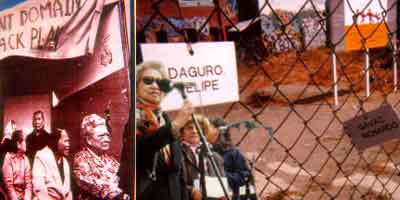
    Evicted San Francisco residents commemorate the 23rd anniversary of
    the International Hotel eviction.

    by Kaponda

    The melodic sound waves from the Xylophone and
    Gardigan instruments did not, alone, inspire the expressions of exultation.
    Nor could the warmth of the brilliant sun claim all the credit for the
    joyous faces. The groundbreaking ceremony and commemoration of the 23rd
    anniversity of the eviction of Asian tenants from the International Hotel
    fashioned the smiles on the faces of the many people at the juncture of
    Kearney and Jackson streets.

    "One of the things that we are very committed to
    do is to make this happen, come hell or high waters. Many
    individuals died because of the International Hotel." Supervisor Leland
    Yee was very emotional as he expressed his thoughts during an interview
    with me after he had addressed the predominantly Asian-Amercian audience.
    "There memories cannot go in vain. The reason it is important to build
    this project is so that their memory and legacy will live on from now
    and into eternity." Although the Housing and Urban Development had awarded
    $7.7 million and the Mayor's Office of Housing had committed another $5.5
    for construction of an affordable housing project, there was still a tone
    of skepticism in Supervisor Lee's voice as we talked. I asked if a groundbreaking
    of the new building at the site where the International Hotel had been
    located would occur during the Fall of 2000? "This is a done deal to the
    extent that all of the plans and all of the agreements are there, but
    we have still not somehow pulled it all together yet. But somehow and
    some way we've got to make it happen. There are still some last glitches
    in terms of right-of-way and so on that will be dealt with."

    The Internatinoal Hotel was built during the 19th
    century on the corner of Kearney and Jackson streets. Its occupants were
    single Filipino and Chinese men who worked as longshoremen and seamen.
    Due to its proximity to the wharf, the International Hotel provided a
    convenient location for the Filipino and Chinese community. Since a single
    room rented for $45.00 per month, it provided affordable housing as well.
    Between 1960 and 1977, during the golden age of the Kearney street corridor,
    the Filipino community stretched more than four blocks. This enclave was
    dubbed, "Manilatown" and the International Hotel would play a key role
    in the Asian Community.

    Like a shark in a frenzy from the scent of fresh
    blood, in 1968, commercial developers sensed huge profits along the Kearney
    Street corridor. Since that time, construction of buildings such as the
    Holiday Inn, Transamerica and Bank of America have taken place. In 1968,
    notices to vacate were given to nearly 200 residents of the International
    Hotel. It was learned that a permit to demolish the hotel was issued,
    so that construction of a multi-leveled parking lot could began. The tenants
    -- most of whom were elderly -- were only given until January 1st of the
    new year of 1969 to pack up and move out. That eviction notice was the
    catalyst of a cohesiveness that would propel a fierce, nine-year battle
    in the Asisan community over racism and civil rights.

    After nine-years and three mayoral administrations
    of legal gridlock, on August 4, 1977, at three o'clock in the terror of
    the morning, the elderly and all other tenants of the International Hotel
    were forcibly evicted from their homes. It was a night when injustice
    and racism bellowed every aspect of their tyrannous power. The forced
    evictions would result in the dispersal of the historical and cultural
    roots of a first-generation of Filipinos whose origin went back to the
    beginning of the 20th century.

    A resident of the International Hotel in 1977,
    Emil De Guzman, who is now affiliated with the Manilatown Heritage Foundation,
    a community-based organization formed to assist in the development of
    a new Manilatown Center, shared with me his first-person experience of
    that night. "On August 4, 1977, 200 police, sheriffs and firemen forced
    their way through thousands of protesters into the International Hotel.
    The San Francisco Fire Department trucks were used to hoist policemen
    onto the rooftop of the International Hotel. People were dragged out of
    the building."

    The Reverend Cecil Williams of Glide Memorial called
    the hole in the ground where the International Hotel had been, "The most
    important civil rights' issue in San Francisco." Furthermore, he went
    on to state as he spoke on the raised platform at the 23rd anniversary
    of the forced eviction, "We have to make sure this will never happen again."

    I remembered the words of Gandhi, "If the cause
    is right, the means will come," when I heard Nancy Hom of the Kearney
    Street Workshop, encourage the crowd by stating, "When the cause is right,
    the human spirit will prevail....Its what's in the heart that matters."
    Many people were in the audience who were personally involved in the struggle
    from its beginning.

    Bill Sorro, an organizer, activist and former tenant
    was married at the International Hotel. He had lived there since May of
    1970. Bill did not disguise his frustration while discussing his feelings
    with me. "Quite frankly, more and more people need to say, 'screw you,
    I ain't leaving' [to any future landlords with plans for gentrification].
    I know a lot of people who were there and were hurt. During the
    '70's, horses were a legal weapon used to control crowds, and so policemen
    came into the crowds on horses wielding billy clubs."

    Peter Rubin of Local 261 acted as a member of a
    security team outside of the hotel that helped form the barricade around
    the hotel to deter the police from storming the building on the night
    of August 4, 1977. Many members of Local 261 were sympathetic to the people's
    struggle to resist the vacate notices by the owners of the International
    Hotel because the members of Local 261 understood the nature of the struggle.
    According to Peter, "The sheriff himself came down here and smashed in
    some of the doors to get to the tenants who were locked inside their rooms.
    When we found out that the police were coming we set up our barricade
    around the building. It was six-people deep around the building. The police
    came from Washington Street. The San Francisco Fire Department occupied
    the adjacent parking lot so that police units and sheriffs could successfully
    occupy the roof. The police were pretty violent. Police were riding on
    horses, swinging their clubs"

    Marshall Werner, a part of the San Francisco community
    at-large, shared her thoughts with me about the night of August 4, 1977.
    "It was not just activists who were involved. Rather, it was a citywide
    effort that saw people from all of the Bay Area providing support to tenants
    of the International Hotel. This act [of eviction] by the hotel owners
    was viewed as a precedence for developers in San Francisco to seize land
    from tenants and the working class for commercial development. Looking
    back, historically, it has become true. In addition, the emergence of
    greed began to gain politically power among local politicians. We are
    no longer able to form the alliances to stop the rapid displacements in
    all of the districts in San Francisco. "

    As the band, Scratch Pickles, filled the air, I
    watched Pearl Ubungen and Wailana Sim Cock interpret the International
    Hotel eviction through a dance performance on the barren sidewalk filling
    the atmosphere with hope, resistance and revolution.

    "By virtue
    of its nature, change must occur. Whether a radical or positive force
    effects that change depends on you
    ......" Kaponda, August 8, 2000.

    Tags
  • bare minimum necessities

    09/24/2021 - 11:44 by Anonymous (not verified)
    Original Author
    root
    Original Body

    The ACLU lodges lawsuit against The State
    of California for unjust distribution of
    wealth in California school districts.

    by Kaponda

    The zephyr bored through the thin layer of protective
    shelter and pelted the young lad as his eyes opened to
    the dawn of another school day. It carried the noxious
    elements of the naval shipyard to woo the uncorrupt
    lungs of the middle school senior. Yet, Jimmy has
    known for quite awhile that his generation has had to
    endure the brunt of unfulfilled commitments by
    virtually every institution of America.

    The sparse surroundings of Jimmy's bedroom
    bounced off his eyes through the mirror, as he
    prepared to encounter another struggle at Luther
    Burbank Middle School. In an effort not to frustrate
    his schoolmaster, Jimmy had begun his journey at the
    customary time. Looking at the abutting structures
    from the window, Jimmy watched as his house
    drowned in the distance, as the bus accelerated past
    the density of drab houses. He mused over whether
    anyone within that enclave of southern migrants --
    from which he, too, is a proud product ñ- has ever
    enjoyed anything other than substandard living
    conditions since their arrival to the Bayview-Hunters
    Point District at the height of World War II.

    As he expectorated the noxious residuals from the
    wind that had earlier swirled around his residential
    community, Jimmy peered at a rodent, which bolted
    off into a separate entrance of the Luther Burbank
    Middle School. His eyes made a futile search of the
    halls for anything that had not been riddled by decay.
    The first battle for Jimmy will be to find a seat after
    he enters his classroom, as there are not enough to
    accommodate each student. There will not be a need
    for him to check his coat because it will help insulate
    him from the extremely cold classroom due to the
    broken heating system. Jimmy has always focused on
    completing his studies and passing his advanced
    placement examination to continue his education at a
    competitive university.

    The substandard learning and living conditions to
    which Jimmy is exposed may pose a threat to his
    plans to further his education. For example, the
    curricula offered at schools such as Luther Burbank
    do not adequately prepare Jimmy for advanced
    placement examinations. In addition, his problems are
    compounded by a sense of inferiority, which affects
    the motivation of a child to learn. These wretched
    conditions were not hatched over night. Rather, they
    are the result of years of Federal and State neglect.
    Furthermore, these substandard learning conditions --
    in which Jimmy must struggle to realize his hopes ñ
    violate the laws of California, which require the State
    to ensure the delivery of basic educational
    opportunities for every child in California and vest the
    State with ultimate responsibility for the Stateís public
    elementary and secondary school system.

    Neglect by the State of California to improve substandard
    learning conditions in schools for people of color can be
    traced as far back as the early 1950ís, when the majority of
    schools for people of color were far inferior to the schools
    of their white counterparts. The neglect of the State of
    California to provide equal access to public education
    regardless of race, color or national origin is rooted in the
    May 17, 1954, Brown v. Board of Education, unanimous
    decision, read by Chief Justice Earl Warren of the Supreme
    Court.

    In California, schools in economically disadvantaged
    communities were underserved so severely that on May
    17, 2000, the 46th anniversary of Brown vs. Board of
    Education, civil rights groups and attorneys in California,
    coordinated by the American Civil Liberties Union, lodged
    a historic class-action lawsuit on behalf of students in 18
    schools. The lawsuit charges that California has failed to
    provide the "bare minimum necessities" required for an
    education. According to the Complaint, the state of
    California has allegedly "...reneged on its constitutional
    guarantee to provide all students with at least the bare
    essentials necessary for an education...."

    The indictment of gross negligence underscores the reason
    that supports the probability that Jimmy will never achieve
    an education comparable to that of his white counterpart.
    Furthermore, people of color in schools throughout
    California have been subjected to the following conditions
    as part of their everyday educational experience, according
    to the Complaint:

    • Lack of Materials and Basic Resources;
    • Inadequate Instruction; and
    • Massive Overcrowding.

    California has recently adopted a system of statewide
    educational standards. It entails a criterion that must be
    satisfied by each student before being promoted to the next
    rung of learning. However, ìofficials of the state of
    California charged with carrying out educational
    obligations have failed to develop or implement appropriate
    procedures to identify and correct the substandard
    conditions at the schools attended by Plaintiffs,î according
    to the Complaint.

    Furthermore, according to the class-action lawsuit lodged
    by the ACLU, ìAlthough the State has established
    academic standards that students must meet, the State has
    failed to meet its responsibility to ensure that schools
    provide teachers who are adequately trained to prepare
    students to satisfy those standards, has failed to provide
    sufficient materials to enable students to have a reasonable
    chance to pass tests that measure their performance, and
    has failed to provide facilities in which students can safely
    learn the materials they need to meet the State-mandated
    standards. In other words, the State has established a
    system for education but has abdicated its responsibility to
    oversee and superintend that system to ensure it functions.

    Jimmy was not born during the decision of Brown v.
    Board of Education by the Supreme Court. However, the
    Board of Education of California continues to preclude him
    from any hope of attaining to the same educational level of
    equality and justice as his white counterpart. Through
    sheer determination, Jimmy may be one of the few among
    people of color who succeed in passing the Advanced
    Placement examination by rising beyond the seemingly
    insurmountable obstacles of inadequate instructions,
    massive school overcrowding, too few textbooks, no
    access to libraries, as few as 13 percent of teachers with
    full teaching credentials, chronically unfilled teacher
    vacancies, and substandard living conditions.

    Tags
  • Letter from the Republican Correctional Facility

    09/24/2021 - 11:44 by Anonymous (not verified)
    Original Author
    root
    Original Body

    by 24 inmates of the Curran-Fromhold Correctional Facility

    >We are 24 male prisoners currently held
    at Curran-Fromhold Correctional Facility for our participation or attempted
    participation in the August 1st non-violent direct actions against the
    Republican convention in Philadelphia. The carefully choreographed conventions
    of both major parties have nothing to do with democracy. They are corporate
    sponsored pageants designed to legitimize a system of corporate class
    rule that crushes the human spirit and that is destroying the planet.
    The criminal justice system of cops, courts and prisons that targets poor
    and working class people in general and people of color in particular
    is a cornerstone of a system that serves the rich and maintains their
    rule. Our actions in the streets of Philadelphia were intended to shine
    a light on the incarceration of 2 million people in the U.S., on the systematic
    use of police brutality to terrorise whole communities, on the racism
    and cruelty of the death penalty, on the many political prisoners, including
    Mumia Abu-Jamal, who are caged for their commitment to social justice.
    Our actions were aimed at disrupting the Republican convention to the
    best of our ability. While weíre sorry any inconvenience we may
    have caused the people of Philadelphia, we are proud of what we did to
    expose this rotten system.

    >From the moment of our arrest we have
    experienced and witnessed

    the workings of a system designed to dehumanize
    people. Many of us were brutalized in the course of arrests. Some of us
    were beaten or peppersprayed after we were handcuffed. In jail as many
    as nine people were packed into cells designed for two people. People
    with dietary restrictions went without food for up to 48 hours. In some
    cases our hands and feet were cuffed together and some of us had our cuffs
    so tight that we lost feelings in our hands or bled as a result.

    >We were denied the opportunity to meet with
    our lawyers prior to arraignment and were arraigned in a court room closed
    to the general public with the exception of select members of the capitalist
    media. We were arraigned with a court appointed public defender serving
    as counsel despite our explicitly and repeatedly stated desire to be represented
    by our own counsel who were denied access to the proceedings. We were
    charged with a variety of misdemeanors and in a few cases with felonies.
    Our individual bails have been set at between $10,000 and $1,000,000.
    Many if not all of the charges against us are either greatly exaggerated
    or completely falsified.

    >At Curran-Fromhold Correctional Facility
    County Jail-we have been placed in a special pod where we have little
    contact with other prisoners. While we regard our conditions here as dehumanizing
    we recognise that we are receiving special treatment such as extra food.
    So far we have not been beaten or physically hurt by personnel here.

    >Throughout this process we have sought to
    resist and stand in solidarity with each other to the best of our abilities.
    Almost all of us have refused to give our names. Many of us have had to
    be physically dragged through the various stages of this process. We have
    kept our spirits high through singing and chanting and pounding on our
    cell walls. We developed systems for communicating with each other and
    for reaching decisions by consensus. Many of us ripped the bracelets intended
    to identify us off our wrists. We resisted fingerprinting and attempts
    to photograph us. Some of us have refused food. In jail we stripped naked
    to make our processing more difficult. In the course of all this we have
    discovered strengths we never knew we had and have built a wall of solidarity
    based on profound love and respect for each other. We have drawn particular
    strength from the proud defiance of the sisters whose loud voices we have
    heard and whose acts of resistance we have occasionally been able to witness.
    While our access to information is restricted we are aware of the efforts
    of those on the outside to assist us. We love you all. We are in here
    for you and know that you are out there for us.

    >We believe that our experiences so far strongly
    vindicate us in our decision to take powerful action to expose the brutality
    and injustice of the so-called criminal justice system. As we go through
    this process we are learning personally of the mistreatment people experience
    every day in this country. As a group of mainly white and mainly middle
    class men we know full well that the treatment routinely received by poor
    people, people of color, and other marginalized people is much worse than
    what we have received.

    >While we have had little contact with other
    prisoners, that contact has been overwhelmingly positive, they know why
    we are here and they let us know in many ways that they support our actions
    and respect our commitment and solidarity. In turn we are learning from
    them about the workings of the prison and their own traditions of resistance.
    They have our respect, admiration and solidarity. So far the efforts of
    some personnel to cultivate distrust and antagonism between us and the
    other prisoners have failed.

    >We are political prisoners:

    >We are being held on outrageous charges,
    in many cases with no foundation whatsoever in our actual actions; Our
    bail figures are far out of proportion even for the crimes we are falsely
    accused of; We are here because of our political commitment and because
    we dared to defy the corporate powers that be as they were attempting
    to give a veneer of popular support to the rule of the few.

    >We call on those who support us to continue
    to put pressure on the Philadelphia authorities to win our quick release.
    We urge you all to continue to organize protests on our behalf and to
    write and call the mayorís office, the prosecutors and the prison
    authorities to demand:

    >1.Our immediate and unconditional release
    on our own recognizance

    >2. That all charges be dropped and

    >3. That prisoners with dietary restrictions
    (vegans and vegetarians) be provided with adequate food that they can
    eat.

    >Call these officials and let them know that
    you support our demands:

    >District Attorney Lynne Abraham 215-686-8701
    Mayor John Street 215-686-2181

    >City Solicitor Ken Trujillo 215-683-5003

    >30 of us have gone on hunger strike to win
    these demands. We want everyone to know that we are in good spirits and
    remain strong in our solidarity. We come from a variety of backgrounds
    and perspectives, but we are united in our commitment to genuine democracy
    and an end to corporate rule in general and to the criminal injustice
    system in particular.

    >FREE MUMIA ABU JAMAL AND ALL POLITICAL PRISONERS
    STOP POLICE TERROR

    >TEAR DOWN THE PRISON INDUSTRIAL COMPLEX
    END THE DEATH PENALTY

    >Write to us:

    >John Doe ìJDî Professor

    >John Doe ODB

    >John Doe Wolfman

    >John Doe 6010 ìDingerî

    >John Doe ìThatís not good
    for businessî John Doe Slick

    >Camilo Viveiros Jr.

    >John Doe 6013

    >Christopher Hartley

    >John Doe Mac

    >John Doe Mango

    >John Doe ìB.A.î

    >John Doe Sparky

    >John Doe Flea

    >John Doe ìHank H. Partsî

    >John Doe ìWispî

    >John Doe Tennessee/Jimnikov

    >John Doe Buckshot

    >John Doe GOD

    >John Doe Switchblade

    >John Doe Ms. Pac Man

    >John Doe Zeke

    >JD Lovebug

    >J.D. Kowbone

    Tags
  • Hellth Care..Pt 2....Health-Care..!!!

    09/24/2021 - 11:44 by Anonymous (not verified)
    Original Author
    root
    Original Body

    Low-income patient chronicles her experiences with private non-profit hospitals in San Francisco- and Charity Care ordinance IS PASSED by The San Francisco Board of Supervisors!!!

    by Rodessa Garcia

    "But it is an emer.....gen.............." the last part of
    my sentence was cut off by my own saliva which was
    draining into my throat at a rate of three gallons per
    second.

    "No Miss Garcia, I don't think so"..... the admitting
    clerk mistook my choking pause for uncertainty, and
    proceeded to start shaking her head from side to side
    while she filled the silence with her persistent rant, "
    We can only see you if it is a life threatning
    emergency, and of course that is only if there is no
    other county facilities available."

    "I'm.....tell...ing.....you....I can't..... breathe.....It
    is an emer....." She was still shaking her head. I
    managed to spit out one last sentence. "Can you ask
    your sup...ervis..or..?!"

    At this point she made a small snort of
    frustration/confusion and walked away.

    It had been several months since I had had an asthma
    attack quite this bad and when I had the last one I
    vowed to never go to an emergency room due to an
    example of what I call "Hellth-care" which included
    sitting in a County funded emergency room for no
    less than 16 hours before I recieved any treatment.
    Unfortunately illness is an untameable beast which
    strikes unexpectantly when you are least
    prepared....and for poor people that is always.

    But this day started simply. The sun was cool and
    flat....Mountain and ocean breezes from opposite
    ends of the sky collided in the San Francisco
    atmosphere refreshing my pores. And then......all of
    sudden....... a slice of fresh pollen coupled with
    several hundred wayward dust mites entered my nose
    and mouth.

    It began as just a difficulty breathing and proceeded
    into a monstrous cough/ wheeze, at that point, logic
    and all other normal thoughts disappeared in place of
    adrenalin fueled terror and extreme states of anxiety. I
    walked into the emergency room of a hospital owned
    by Catholic Healthcare West, a private non-profit
    corporation, and began an odd sort of battle to prove
    the emergent nature of my illness.

    The supervisor returned with the admitting clerk who
    was still shaking her head, in a permanent state of
    no...... "Miss Garcia...we will admit you this time
    but....." The supervisor's voice was loud and
    smashed through the glass window between us "
    because you have no insurance we will have to bill
    you...." I thought this was a strange comment from
    the admitting nurse's supervisor but somehow it
    meant I could be considered "an emergency"

    After this 45 minute financial diagnosis I was able to
    recieve care. I saw the doctor for four minutes,
    hooked up to breathing machine for ten minutes, and
    recieved a prescription for an inhaler. Two weeks
    later I recieved a bill. It was for several hundred
    dollars.

    I called the hospital billing office after recieving the bill, "
    After a full minute of annoyance laced pleasantries between
    me and the billing clerk, I began my tirade, " I told the
    admitting clerk I was unemployed and homeless, I told her
    I had no money to pay for services...I told her I wanted to
    recieve services under the Hill- Burton act......why am I
    recieving this bill? "

    Many non-profit hospitals have an obligation to provide
    charity care because of their use of low interest rate
    financing from the federal government through the
    Hill-Burton program.Approved by congress in 1946, the
    program extends to hospitals and other health facilities
    money for construction and modernization. In return,
    recipients of Hill-Burton funds are required to provide a
    reasonable volume of services to persons unable to pay and
    also make their services available to all persons residing in
    the facilities area.

    "Well Ms. Garcia, we know someday you will be able to
    work and until that day we will continue to bill you"

    "You are not hearing me...! ...I said I am very low income
    and I asked to be treated under the Hill-Burton Program."

    "I told you what we will do......click

    After that phone call....I began recieving bill after bill, until
    the blue and green colored envelopes turned into hues of
    pink and red. Billing turned into collection....and
    eventually collection locked in my cycle of poverty
    culminating with a landlord refusing to rent to me because I
    they thought I was a "bad credit risk"

    Despite the growing numbers of medically uninsured San
    Franciscans, the city's three largest private hospitals (St
    Mary's Medical Center and St Francis Memorial Hospital
    of Catholic Healthcare West and California Pacific Medical
    Center of Sutter Health reduced their rate of charity care
    spending by 15.7 percent during the past four years. In
    1998, the three hospitals spent less than half of one percent
    of their revenues on charity care- approximately one-sixth
    the national average for tax exempt hospitals. Together
    these hospitals control more than half of the city's licensed
    hospital beds.

    All hospitals --for profit and non-profit alike-- have an
    obligation to serve the sick and uninsured. Tax-exempt
    hospitals are further bound by a basic social contract with
    the general public due to their tax-exempt status. In
    exchange for receiving millions of dollars in tax breaks,
    tax-exempt hospitals are expected to provide charitable
    services to poor and uninsured patients. Tax-exempt
    hospitals' tax breaks include exemptions from property and
    income taxes, access to tax-free bonds issued through
    government agencies, and access to tax-deductible
    donations from the public.

    PT 2 HEALTHCARE..!!!

    On June 26, 2001 At the Board of Supervisors Health Committee Hearing, Sup. Sophie Maxwell who has been working with SEIU local 250 on this issue, introduced an ordinance that requires private hospitals to notify patients of their right to apply for charity care. The ordinance also requires hospitals to file an annual report with DPH describing how many people applied for charity care, received charity care and were rejected, as well as cost info, etc. The ordinance establishes financial penalties to be levied against hospitals for failing to comply.

    This ordinance will help hold hospitals accountable and is a first step towards establishing greater public accountability.

    The ordenance was passed by the full board on Monday, July 2, 2001


    "Charity Care Policy Reporting and Notice Ordinance"
    (print this and keep it with you, poor folks!!)

    I. Purpose: According to the ordinance, its principal purpose is to provide City agencies with adequate information to plan for the provision of health care to city residents and "to maximize the access to charity care within the community and to enhance the health of the public by informing individuals of the availability of charity care.

    II. Provisions: This ordinance would add language to the San Francisco Health Code requiring San Francisco's private hospitals to:

    Notify patients about their right to apply for charity care;
    Submit annual reports to the San Francisco Department of Public Health describing each hospital's provision of charity care.

    Patient Notification Requirements:
    Hospitals would be required to verbally notify patients during the admissions process about the availability of charity care and any process necessary to apply for charity care.
    Hospitals would be required to post multilingual notices about their charity care policies in several prominent locations within the hospital, such as the emergency department, billing office, and waiting rooms.

    Public Reporting Requirements:
    Hospitals would be required to file annual reports with the San Francisco Department of Public Health containing the following information:
    The dollar amount of charity care provided during the year, as measured in terms of costs to the hospital;

    The total number of applications for charity care received by the hospital, as well as the numbers of acceptances and denials, including visit code of each patient's residents;
    The number of people applying for charity care who were referred to other facilities, including the name of the facilities to which they were referred;
    The description of the type of services delivered to charity care patients (i.e., emergency, inpatient, outpatient or ancillary medical services);
    All of the hospital's charity care policies, including but not limited to explanations regarding the availability of charity care and the time periods and procedures for application, determination, and appeal; any application forms used; and the hospital locations and hours at which the information may be obtained by the general public;
    Other information that the Department of Public Health requires.

    III. Enforcement: The ordinance would establish a penalty of up to $500 per day for hospitals that violate the ordinance.

    IV. Applicability: The ordinance would cover all private acute-care hospitals in San Francisco. Kaiser Foundation Hospital San Francisco would be covered by the notification provisions of this ordinance, but would be exempt from the reporting provisions because Kaiser hospitals, which operate on a pre-paid basis, do not have billing systems capable of collecting the data required by the reporting portion of this ordinance. This mirrors a similar exemption for Kaiser hospitals under state law.

    The ordinance was passed
    by the full board on Monday,
    July 2, 2001.

    Tags
  • THE SHAMEFUL WALL OF EXCLUSION

    09/24/2021 - 11:44 by Anonymous (not verified)
    Original Author
    root
    Original Body

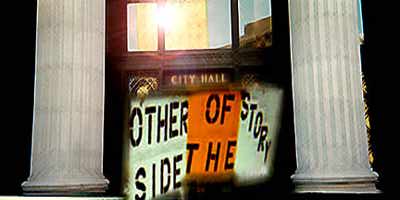
    "The Other Side" Rally on the Tenth birthday of the AmericanÕs with
    Disabilities Act (ADA)

    by Kaponda

    Radiating bitter condemnation, the eyes of Leroy Moore, Jr. conducted
    the crowd through years of disappointment experienced by disabled people
    of color. His suggestive indictment of the exclusionary policies of the
    Americans with Disabilities Act cast a pall of gloom over its 10th Anniversary
    ceremonies around the country. The people at City Hall listened that Wednesday,
    July 26, 2000, as the president and founder of Disability Advocates of
    Minorities Organization (DAMO) told the other side of the ADA story.

    Shepherded through the 101st United States Congress on July 26, 2000,
    the Americans with Disabilities Act (ADA) is a broad and wide-ranging
    instrument intended to make American society more accessible to people
    with disabilities. Its aim is to provide the 50 million Americans with
    disabilities the kind of quality of life that other Americans have been
    enjoying. The ADA legislation also offers protection against the widespread
    discrimination that had demoralized disabled people for so long.

    On the other hand, people who are homeless, poor, women, immigrants and
    of color have been disproportionately affected by ADA. "Then-President
    George Bush," stated Leroy, as he continued his assault on the ADA, "During
    his proclamation of the ADA, uttered to the multitude, 'Let the shameful
    wall of exclusion finally come tumbling down!'" Leroy appeared to be gripped
    in a gust of emotion as the soft particles of sun embraced his body. With
    the massive structure of the granite building in his background, Leroy
    continued to speak.

    "California has a diverse makeup of ethnic groups. Nonetheless, there
    is no platform for people of color to come together. We have no organization.
    We have no support group, consequently, we continue to be divest of power.
    However, DAMO will advocate for and educate those people of color who
    have not been empowered by ADA. In closing, let me leave you with the
    words of Dr. Martin Luther King, 'HOW LONG? TOO LONG!'"

    Plucked from the hand of someone in the crowd by the wind, only a blue
    sheet of paper swirled amid the enthralled gathering as Leroy Moore, Jr.
    thanked everyone for their support and concern of the plight of people
    with disabilities. There were representatives of many different organizations
    in attendance. Unlike the San Francisco Police Officer who, after walking
    around several people in wheelchairs, demanded from my editor Lisa Gray-Garcia
    an event permit, the representatives at the Other Side Rally expressed
    sincere compassion.

    Hector Mendez, Director of La Familia, shared his thoughts with me on
    the steps of City Hall. According to Hector, "Although the ADA has been
    a monumental piece of legislation, communities with minorities such as
    Latinos, Asians, African Americans and Native Americans and all other
    multicultural communities in the country who will face the challenges
    of disabilities have not fully benefited. These groups contribute to a
    large percentage of unemployment in this country....We strongly feel that
    those who are benefiting from ADA are the architectural firms receiving
    major contracts to modify facilities around the country [in compliance
    with the ADA]. America has a good rap [about ADA] but does not follow
    through. Community advocates organize families with disabled kids. It
    is a family movement without much support from the ADA."

    Disabled women of color have also been excluded from the thrust of the
    ADA movement. Their voices have been suppressed in many conferences as
    well as in framing issues for media consumption. Disabled women of color
    lack protection in securing housing and health services. Furthermore,
    they are all too often easy targets for police aggression.

    Title II of ADA has mandated that local and state governments provide
    the same services to people with disabilities as to other people on the
    same basis. In October of 1999, an ADA office was opened at City Hall.
    Since that time, 300 ADA complaints have been lodged of which the vast
    majority have been resolved. The complaints involved housing (accessible
    housing) and public right-away (including curb ramps, parking, and construction
    on the sidewalks). Approximately 10 percent of the 300 complaints included
    employment discrimination. Two of the ADA attorneys at City Hall attended
    the event. Susan Mizner and Walter Park are charged with making sure The
    City hires people who are disabled.

    I asked Walter Park to explain the role he plays in City government on
    behalf of disabled people. Parks stated that he ensures that "The City
    promotes people who are disabled as well as provide reasonable accommodations
    to City workers who become disabled so that they can stay on the job."

    While she tirelessly maintained the placard, Mary Kate Connor, Executive
    Director, Caduceus Outreach Services, poised herself as she prepared to
    deliver a compelling argument for the many disabled people who have been
    boxed in by violators of the Americans with Disabilities Act. After Mary
    Kate had finished speaking, I asked her to talk about the conditions of
    disabled people in America.

    "During the last 60 years, people with disabilities have been rounded
    up and killed. The same thing is basically still happening in San Francisco
    today because of the poverty to which people with disabilities are consigned,
    and, as a result, are also consigned to homelessness," stated Mary Kate.
    She went on to explain that "There are an estimated 40 percent of people
    with psychiatric disabilities. For these estimated 40 percent, there are
    no housing, treatment or access to any kind of public programs. Because
    of this, these people are therefore consigned to death -- the same way
    that people were consigned to death by the Nazi Regime. This is neglect
    that is very benign, but as it was once said, 'Evil is benign.' It is
    the benignity of evil to allow this to continue. We are not going
    to take it anymore
    . We are going to use the ADA as a sphere and
    weapon to beat some sense into people that make policy and have money
    to let them know that we are not going to take it anymore.'"

    Tags
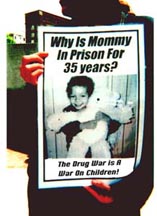
  • WHY IS MOMMY IN PRISON

    09/24/2021 - 11:44 by Anonymous (not verified)
    Original Author
    root
    Original Body

    MOTHERS DAY RALLY SHEDS LIGHT
    ON THE SITUATION OF INCARCERATED
    MOTHERS AND THEIR CHILDREN.

    by Kaponda

    I felt like I had been atop Mount Everest, as I listened
    to the small child in front of the United Nations Plaza.
    Even the raised concrete structure on which the
    beautiful, three-year old girl stood did not make her
    appear any taller. The sound of her voice resonated
    out of a loudspeaker as the breeze caused the unfurled
    banners to cradle her body. True to the proverb, "Out
    of the mouth of babes and suckling," it was she who
    had provided me the insight into the significance of
    the event held on Friday, May 12th, when she
    uttered, "Happy Mothers Day to all of the Mothers in
    Prison."

    "Mothers in Prison -- Children in Crisis" was
    sponsored by Families with a Future, an organization
    founded by the mother of the three-year old wonder,
    Ida McCray. Now in its sixth year, Mothers in
    Prison, Children in Crisis is the first and only
    national organizing campaign that seeks to establish
    alternatives to incarceration as the sentencing norm
    for women with dependent children. Based in the
    state of New York, it has a broad-based community
    of supporters around the country whose mission is to
    use compelling statistics to demand legislators to
    overhaul current sentencing regulations.

    According to statistics gathered by Campaign 2000
    JusticeWorks Community, there are now 146,600
    women incarcerated in United States prisons and
    jails. An astounding statistic by the U.S. Department
    of Justice: Bureau of Justice Statistic, states that of
    the 146,000 women incarcerated, 75% are mothers.
    Furthermore, two-thirds of these women have
    children under the age of 18.

    A formerly incarcerated woman, Ida McCray had
    spent 12 grueling years in the California Prison
    System, California Youth Authority and Federal
    prisons. I asked her what she would most like to
    express to the people concerning the rally at Civic
    Center Plaza. "We need more places that will help
    families. Monies have been appropriated to fragment
    families. We need money to build families,"
    according to McCray. Standing firmly on her
    commitment to end the separation of biological
    families, McCray continued to express her feelings,
    as the wind gingered up her healthy dreadlocks, "This
    is a form of genocide which is being given no
    attention. A glaring example is our children." Unlike
    many incarcerated mothers, Ida McCray did not lose
    her children during her time in prison.

    Children are the first casualties when their mothers
    are incarcerated. According to a statistic by the U.S.
    Department of Justice: Office of Justice Programs,
    "Women currently in prison or jail are mothers to
    more than 250,000 children, the majority of whom
    are under 18 years of age." "While children usually
    remain with their mother during the incarceration of
    their father," according to a study by The Obsborne
    Association, "Children of incarcerated mothers are
    much more likely to experience a change in primary
    caretaker."

    The strategic efforts of the supporters of the Mothers in
    Prison, Children in Crisis movement have opened the
    doors of people in high places. Acting under authority of
    the State of Iowa, Governor Thomas J. Vilsack proclaimed
    May 7, 1999 as Mothers in Prison -- Children In Crisis
    Day." Also, acting under authority, Governor Mike
    Huckabee of Arkansas, during a rally in May of 1999,
    proclaimed May 9th through May 11th of 1999, "Mothers
    in Prison, Children in Crisis Weekend."

    One of the speakers at the rally was San Francisco District
    Attorney, Terrence Hallinan, who gave the onlookers hope
    when he stated that he would like to, "Declare an end to the
    war on drugs. A war on drugs is not the solution, as it
    causes more problems and much more misery." Hallinan
    further stated that "Women are being incarcerated for
    victimless crimes...."

    An official for the Department of Health, Jimmy Loyce,
    gave a passionate speech before the crowd at the Civic
    Center Plaza. "Every day a mother does in prison, her
    child does in prison [also]," Loyce stated. He added that
    "The only crime is a disease called alcoholism and drug
    addiction," implying that a connection exists between
    women who are incarcerated and their addiction to drugs
    and alcohol.

    A recent study by the U.S. Department of Justice: Office of
    Justice Programs has determined that, "Women in prison
    are more likely than men to have ever used drugs, to have
    used drugs daily the month before their offense, to have
    been under the influence of drugs while committing the
    offense and to have committed the offense to get drugs."
    "Less than 10% of those who need substance abuse
    treatment in prison actually receive it. Seventy-five percent
    of the general population who seek substance abuse
    treatment, never receive it," according to The Nation1s
    Number One Health Problem.

    Claire Campbell of Jelani House, Inc., a refuge for
    pregnant women, underscored the misappropriations of
    funds to criminalize offenders of victimless crimes by
    stating, "Women are in jail for nonviolent crimes, like
    holding drugs for others." She called for women to stay
    tuned in to each other.

    The Executive Director for Standing Against Global
    Exploitation (SAGE) provided recommendations to
    changing the system. She stated that "Since changing
    institutions is very difficult, we must change the minds of
    individuals inside the system, and expose them to
    alternatives to incarceration."

    According to the Mothers in Prisons, Children in Crisis1
    Fact Sheet, "Alternatives to incarceration have been
    legislatively endorsed for more than 20 years. The
    understanding which guided the early movement towards
    alternatives was that penal institutions are destructive to the
    humanity of prisoners, guards, administrators and the
    community. Thus, alternatives were designed to keep
    people out of jail and prison.

    The recommended alternatives to incarceration of women
    would probably decrease rapidly increasing separation of
    biological families. There would be more children in the
    warm embrace of their loving parents. It is a concept that
    would give Mothers Day a whole new meaning.

    Tags
  • A Million New Homes!??!

    09/24/2021 - 11:44 by Anonymous (not verified)
    Original Author
    root
    Original Body

    Truth vs. lies in the Housing Crisis

    by James Tracy

    The U.S. Department of Housing and Urban Development (HUD) recently released
    a report entitled "Waiting In Vain: America's Housing Crisis." It "revealed"
    what most U.S. renters, especially the working poor, could have told them
    for free: our housing crisis is nationwide, and housing affordable to
    low-income people nearly extinct.

    Never mind that the crisis is hardly accidental. Many local and state
    governments have eliminated or weakened rent control. Public housing demolitions
    have eliminated over 23,000 housing units nationally. The expiration of
    HUD Section 8 contracts threatens 2.1 million homes. Lack of a housing
    safety net for those most in need pushes everyone's rents up by eliminating
    supply and increasing competition for scarce resources. In cities flooded
    with the "dot.com" money these decisions spell eviction.

    Hoping to counteract nearly a decade of cuts in U.S. housing spending,
    the National Coalition for the Homeless (NCH) has proposed an innovative
    solution - the Community Housing Investment Trust (CHIT). This legislation
    will create and subsidize one million units of housing that is affordable
    to families and individuals whose annual incomes are less than $10,700
    per year. Current federal housing programs primarily aid households whose
    incomes are between $20,000 to $60,000 per year.

    Nationally, there are at least 11.3 million households with incomes of
    less than $10,000. Personal-based Section 8 vouchers are useless in every
    area where demand for housing is high and vacancy rates are low. Landlords
    usually take the opportunity to rent to higher-income, non-subsidized
    tenants.

    This federal resource pool allows local communities to develop, acquire,
    rehabilitate or subsidize housing units. This means that cities can meet
    the specific needs of their area CHIT would be funded from the interest
    from existing federal bonds, meaning that no one's taxes will be increased
    automatically. Individual taxpayers would be able to make contributions
    to CHIT by checking off a box on their income taxes. The legislation also
    provides for matching funds from private institutions maximizing the $50
    billion federal contribution.

    Housing shortages are nothing new in San Francisco, or in any market
    economy. At the end of World War II, returning service people faced a
    severe housing crisis that even the New Deal had failed to address completely.
    The International Longshoreman and Warehouse Union led actions - including
    office occupations and work stoppages - to force federal representatives
    to build new affordable housing. Their accomplishments include many of
    the same housing programs that are being dismantled by Democrats and Republicans
    today.

    This campaign is an important step in the fight for housing and other
    crucial social needs. Although homelessness is a complicated problem,
    its leading remedy should be embarrassingly simple: more housing. New
    housing can also create jobs and further social stability.

    To endorse the Community Housing Investment Trust and get active in the
    campaign please contact James Tracy, Coalition on Homelessness Housing
    Workgroup (415) 346-3740.

    Tags
  • Standing Together!

    09/24/2021 - 11:44 by Anonymous (not verified)
    Original Author
    root
    Original Body

    PNN staff writers march for Justice for
    Mumia

    by Jesaka Irwin

    I see this battle as only growing in strength, as it
    broadens and deepens it1s reach; and as it challenges
    Capital1s lust for death; and as it supports the cause
    of life, of freedom, and of Justice.I salute You!

    -Mumia Abu Jamal-

    On Saturday May 13th the world stood together to
    fight a racist judicial system....the world stood
    together to fight the Death Penalty... the world stood
    together to free it1s political prisoners. .....the World
    Stood together to Free Mumia Abu Jamal.

    I rose early, anticipating the union of events today. 70
    countries mobilizing for many reasons in the name Of
    Mumia Abu Jamal. The sun had decided to support us
    despite a rainy forecast. I met up with my fellow
    journalists at PNN and proceeded to the "March for
    Mumia" in downtown San Francisco.

    As we arrived, there was an overwhelming amount of
    information being dispersed from every direction.
    The mobile stage projecting words, and sounds of
    inspiration before the March down Market Street to
    the Civic Center.

    Around noon the March began. 9,000 people strong,
    not including the lines of policemen who walked
    beside us with their helmets in hand, and billy clubs
    attached to their sides. The Chants were strong "
    FREE MUMIA ABU JAMAL.... AN INJURY TO
    ONE IS AN INJURY TO ALL!" and increased in
    volume through the one mile march lead by POOR
    Magazine's own; Kaponda.

    As I marched many thoughts journeyed through my mind.
    I tried to imagine what it would be like to be sentenced to
    death for a crime I didn't commit. During my own
    incarceration in the State of Florida I remember straining
    my eyes through the fence covered windows searching for
    a piece of sky. I remember the anxiety I felt waiting for the
    guard to scream my name and tell me to grab my stuff;
    "You're free to go." I didn1t know how long I would be
    there, but I prayed everyday for freedom.

    Black, political, and a journalist, Mumia was framed for
    these reasons along with the fact that he exposed a corrupt
    police department in one of Americas most unjust actions,
    the bombing of the MOVE house in Philadelphia.

    When we arrived at the civic center the many banners that
    streamed over head as we marched made a circle in front of
    the stage. Over 32 people spoke and 6 bands performed.
    Many organizations were represented, one being The
    National Federation of Teachers, who are fighting to teach
    their children about Mumia and the Death Penalty. Another
    being Longshoremen from across America who shut down
    many ports on April 24th in the fight to free Mumia. I was
    also extremely moved by Michael Franti of Rage Against
    the Machine, who1s words and poetry painted a picture
    that still lingers in my mind.

    I ended the day with my own poetic rant on the stage;

    "We need to realize who really has the power, and break
    free from the nineteen inch screen torturing our minds with
    the mundane so we don1t go insane over things WE
    BELIEVE are out of our control. Wake up people! and
    smell the democracy distorted and dismissed; Why do you
    think it was the FIRST ammendment."

    As I wandered down 10th street on my journey home I
    was consumed by the reality of how many peoples lives
    are resting in our hands. Mumia is just the beginning of a
    long fight for Life, Freedom, and Justice.

    Tags

Latest

test