Story Archives

Primero de Mayo Marcha / May 1st March

09/24/2021 - 09:45 by Anonymous (not verified)
Original Author
root
Original Body

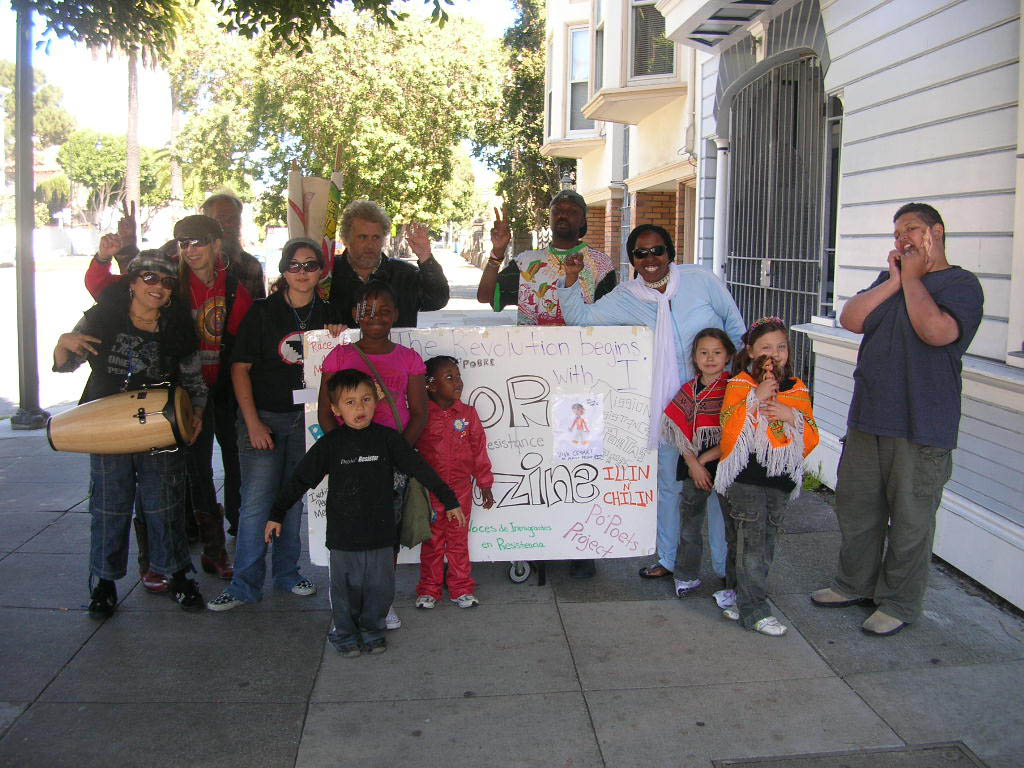
Exigiendo Nada Menos de lo Que Se Merece: Preparación para la Marcha del 1ero de Mayo para los Derechos de Migrantes en Oakland

Demanding Nothing Less Than What Is Deserved: Preparation For The May 1st Rally For Migrant Rights In Oakland


Exigiendo Nada Menos de lo Que Se Merece: Preparación para la Marcha del 1ero de Mayo para los Derechos de Migrantes en Oakland

Demanding Nothing Less Than What Is Deserved: Preparation For The May 1st Rally For Migrant Rights In Oakland


by Chloe Auletta-Young/Race, Povery and Media Justice Intern

Scroll down for English

“No estamos pidiendo algo enorme,” comento Sagnicthe Salazar, “estamos exigiendo nada menos de lo qué nos merecemos.” Salazar es Coordinadora Líder de Huaxtec, una organización de base para la juventud de la Raza y una organización miembra de Oakland Sin Fronteras. Huaxtec es también una de las muchas organizaciones que patrocinan la marcha y la reunión del 1ero de Mayo contra las violaciones de los derechos humanos sufridos por los migrantes indocumentados que viven y que trabajan en los E.E.U.U.

El programa comenzará a las 3:30 p.m. el viernes 1ero de Mayo en la Plaza de Fruitvale. A las 4:30 p.m. comenzará la marcha hacia la plaza de Frank Ogawa, en el ayuntamiento de Oakland, terminando aproximadamente a las 6:00 p.m. El tema del acontecimiento será derechos humanos para cada uno, moratoria a las detenciones y las deportaciones, y vivienda, cuidado médico, y educación para todos.

Salazar tomaba el liderazgo en una de las reuniones de planeamiento que hubo el lunes 20 de abril en la Clinica De La Raza en Fruitvale. Los líderes de una pequeña cantidad de otras organizaciones que patrocinaban vinieron juntos para discutir la programación, alcance, seguridad, limpieza, hospitalidad, etc. Toda la conversación era bilingüe, en español y el inglés y las ideas de todo/as fueron escuchadas. Nunca he tenido la experiencia de tal unión de las organizaciones de base que se juntaron para planear un acontecimiento singular. “Para mí como adulto joven y migrante, es mi obligación de participar en esto y de comenzar a organizar nuestras comunidades,” dijo Muteado Silencio, un escritor migrante, y miembro del personal de la organización patrocinadora TIGRA, y escritor del personal para la revista POOR, “necesitamos forzar la nueva administración a tomar nuevas acciones, para reconocer a los trabajadores indocumentados.”

Salazar tenía otro propósito sobre la marcha, “en el pasado las demandas legislativas fueron concretas, pero los cambios no han significado mucho. Oakland ha sido una ciudad santuaria anteriormente, nada cambia… No estámos hablando de amnistía porque no hemos hecho nada para que seamos perdonados, nosotros apenas queremos los derechos que la O.N.U nos da, la libertad del movimiento, que hace que la gente pare de verse como inmigrantes y comienza verse como migrantes.” La marcha en Oakland es así una llamada de adentro para afuera, uniendo la comunidad internamente para llamar la atención a la hipocresía de la política de los E.E.U.U. “Durante los años no importa lo qué este sucediendo, sea la economía o lo que sea, los trabajadores indocumentados son el chivo expiatorio, los accusados.” Muteado dijo, “a excepción de los nativos americanos y los Afro-Americanos, que fueron traídos aquí por fuerza, somos todos migrantes. Puede ser que hayamos cruzado la frontera, pero los europeos cruzaron un océano.”

El evento está haciendo una conexión con la comunidad Afro-Americana al acentuar la ejecución de Óscar Grant como ejemplo de la militarización cada vez incrementando dentro de vecindades, reflejando la militarización de la frontera. “Oakland Sin Fronteras conecta la lucha de migrantes con las luchas de todas las comunidades de la clase obrera en todo el mundo, con la guerra, las prisiones, y la militarización de nuestros hogares y vecindades,” Salazar indico.

El programa comenzará con los altavoces de la comunidad y de los funcionamientos artísticos, tales como Danza Azteca y Poetas Pobres de la revista POOR. La marcha no va ser corta, son tres millas para llegar al ayuntamiento desde Fruitvale. Sin embargo, es corto cuando está comparado a la importancia de los mensajes, 3 millas en una lucha contra injusticia. “Es necesario que nuestra gente esté allí,” dijo Salazar, “ello/as sufren la parte más recia de los ataques pero nunca tienen el poder dentro de las discusiones. En este caso, sus cuerpos son su voz.”

--------------------------

Demanding Nothing Less Than What Is Deserved: Preparation For The May 1st Rally For Migrant Rights In Oakland

By Chloe Auletta-Young

“We are not asking for something huge,” commented Sagnicthe Salazar, “we are demanding nothing less than what we deserve.” Salazar is Lead Coordinator of Huaxtec, a grassroots organization for Raza youth and a member organization of Oakland Sin Fronteras. Huaxtec is also one of the many organizations sponsoring the May 1st march and rally against the human rights violations suffered by undocumented migrants living and working in the U.S. The program will start at 3:30pm on Friday, May 1st at Fruitvale Plaze. At 4:30pm the march to Frank Ogawa Plaza at the Oakland City Hall will begin, ending at approximately 6:00pm. The theme of the event will be human rights for everyone, moratorium on detentions and deportations, and housing, health care, and education for all.

Salazar was taking the lead on one of the planning meetings held Monday, April 20th at Clinica De La Raza in Fruitvale. Leaders from a handful of the other sponsoring organizations came together to discuss programming, outreach, security, clean-up, entertainment, etc. All conversation was bilingual, in both Spanish and English and everyones input was heard. I have never experienced such a uniting of grassroots organizations coming together to plan a singular event. “For me as a migrant young adult, it's my obligation to take part in this and start organizing our communities,” said Muteado Silencio, a migrant scholar, staff member of sponsoring organization TIGRA, and staff-writer for POOR Magazine, “we need to force the new administration to take new action, to recognize the undocumented workers.”

Salazar had another purpose behind the march, “in the past their have been concrete legislative demands, but the changes haven't meant much. Oakland has been a sanctuary city before, nothing changes...We are not talking about amnesty because we have done nothing to be forgiven for, we just want the rights that the UN gives us, the freedom of movement, that takes people to stop seeing themselves as immigrants and start seeing themselves as migrants.” The march in Oakland is thus a call from the inside out, uniting the community internally in order to call attention to the hypocrisy in U.S. Policy. “Over the years no matter what is going on, be it the economy or whatever, undocumented workers are the scapegoat,” stated Muteado, “with the exception of Native Americans and African-Americans, who were brought here by force, we are all migrants. We might have crossed the border, but Europeans crossed an Ocean.”

The event is making a connection to the African-American community by emphasizing the execution of Oscar Grant as an example of the increasing militarization within neighborhoods, mirroring the militarization of the border. “Oakland Sin Fronteras connects the struggle of migrants to the struggles of all working class communities around the world, to war, prisons, and militarization of our homes and neighborhoods,” stated Salazar.

The program will begin with speakers from the community and artistic performances, such as Danza Azteca and Poetas Pobres of POOR Magazine. The following march is not a short one, it is three miles from Fruitvale to City Hall. However, it is short when compared to the importance of the messages, 3 miles in a fight against injustice. “It is necessary for our folks to be out there,” said Salazar, “they bear the brunt of the attacks but they never have the power within the debates. In this case, their bodies are their voice.”

Tags

Chevron tries to steal $485,000 from Nigerian Villagers

09/24/2021 - 09:45 by Anonymous (not verified)
Original Author
root
Original Body

Judge rules against Chevron

by From JusticeInNigeriaNow.org

San Francisco, CA - Judge Susan Illston, on Wednesday, denied Chevron Corp’s request to recoup over $485,000 in costs associated with a human rights case filed by Nigerian villagers. The corporation said the plaintiffs owed them the costs - including the cost of photocopies and deposition fees - after they were found not liable last fall. However, the judge disagreed.

“The economic disparity between plaintiffs, who are Nigerian villagers, and defendants, international oil companies, cannot be more stark,” Illston stated in her brief.

Illston compared Chevron’s 2008 earnings of $23.93 billion to the income of the villagers who were plaintiffs in the case citing their respective jobs at a gas station – (earning as much as $100 per month), operating a kerosene business ($867 per month), and odd jobs that involve cutting or selling firewood, fishing, and construction ($60 per month), among other low paying jobs, and stated that ten of the plaintiffs were minors who have no income.

The judge also cautioned against Chevron’s efforts to use the threat of a cost order such as the one requested by Chevron to deter future human rights litigation.

“At root, this case was an attempt by impoverished citizens of Nigeria to increase accountability for the activities of American companies in their country. Plaintiffs’ ultimate failure at trial does not detract from the fact that this was a civil rights case. The threat of deterring future litigants from prosecuting human rights claims in the future is especially present in a case such as this, where plaintiffs have paltry resources and defendants are large and powerful economic actors,” she continued in the brief.

The lawsuit was filed 10 years ago by Nigerian villagers who were peacefully protesting Chevron for the lack of jobs and environmental damage caused by the company in their communities. To quell the protest, Chevron paid for and transported the notoriously ruthless Nigerian military to remove the protesters from an oil platform where the villagers had staged a sit-in. As a result, two villagers were killed and several others were injured and tortured.

On December 1, 2008 a San Francisco jury found Chevron not liable. The plaintiffs have since appealed the decision in the 9th circuit court of appeals.

JusticeInNigeriaNow.org

CONTACT:
Sarah Dotlich
415-575-5521

Tags

Quien es un Amerikkkano? / Who Is An Amerikkkan?

09/24/2021 - 09:45 by Anonymous (not verified)
Original Author
root
Original Body

Un informe de Voces de Inmigrantes sobre una legislacin propuesta para negar partidas de nacimiento a los nios de la gente migratoria

A Voces de inmigrantes report on a proposed legislation to deny birth certificates to children of migrant peoples


Un informe de Voces de Inmigrantes sobre una legislacin propuesta para negar partidas de nacimiento a los nios de la gente migratoria

A Voces de inmigrantes report on a proposed legislation to deny birth certificates to children of migrant peoples


by Muteado, Migrant and Poverty Scholar / PNN

Scroll down for English

La siguiente historia es en respeto al ms nuevo ataque fascista contra sabios emigrantes y de la pobreza. Una legislacin propuesta para las elecciones especiales el 19 de mayo: Negacin de las ventajas pblicas para las personas que no pueden verificar presencia legal. Negacin de las partidas de nacimiento a los ninos de padres indocumentados que no pueden verificar estado legal.

Sigo siendo un americano!!!!

La legislacin que niega las ventajas publicas y partidas de nacimiento a los ninos de los inmigrantes que aparecer en la balota especial de la eleccion el 19 de mayo es un ataque racista contra la gente migratoria.

Vengo de una familia diversa, nosotros somos compuestas de diferentes o raza mixta que tengo Afro-mexicanos, blanco-mexicanos, y Salvadoreo-mexicanos, en mi familia.

En mi familia todos tenemos diversas posiciones jurdica y diversos pigmentos que son invisibles en reuniones de familia, yo como miembro de estas reuniones de familia he sido testigo a que la estancia jurdica de uno en este paes no tiene nada que ver con su capacidad de ser un padre, tener un pedazo de papel no le hace a una persona mejor o a padre mejor. Esta propuesta es como dar su informacion privada y no tener el derecho a su privacidad.

Siento como que esta propuesta es el principio de la determinacion del estado para ver quien es un supuesto verdadero ciudadano americano patriota."

--------------------

Who Is An Amerikkkan?

A Voces de inmigrantes report on a proposed legislation to deny birth certificates to children of migrant peoples


The following story is in regards to the newest fascist attack on migrant and poverty scholars A Proposed bill for the May 19th Special election: Denial Of Public Benefits For Persons Who Cannot Verify Lawful Presence. Denial Of Birth Certificates To Children Of Undocumented Parents Who Fail To Verify Status.

I am still an American!!!!

The Denial of public benefits and birth certificates to children of immigrants legislation which will appear on the upcoming special election ballot of May 19th amounts to a racist attack on migrant people.

�I come from a diverse family, we are differrent tribes put together or mix race I have blackxicans, whitexicans, and salvadorian-mexica, in my family."

In my family we all have different legal status and different color pigment, which is invisible in family reunions. I as a member of these family reunions have witnessed that your legal status has nothing to do with your ability to be a parent, having a piece of paper does not make you a better person or better parent. This proposal is like giving your private information away and not having the right of privacy.

I feel this proposal is the beginning of the state determining who is a so-called real � patriotic American citizen.�

Tags

Diversifying Hip-Hop: Krip-Hop & Homo-Hop: History Process Future

09/24/2021 - 09:45 by Anonymous (not verified)
Original Author
root
Original Body

By Leroy Moore

by Leroy Moore and Chloe Auletta-Young/PNN-ReVieWsFoRtheReVoLuTion

Well finally Diversifying Hip-Hop: Krip-Hop Homo-Hop happened at University of California at Berkeley on April 11th-- a reality and can be looked upon now as we go forward. Now I’m looking back to write and reflect about the history, process and what hope our communities have learned and what could be next.

The whole history of Diversifying Hip-Hop: Krip-Hop Homo-Hop is not only the event but it is deep not only in myself but in my communities, Black & disabled, and my upbringing. Being Black, disabled and an activist I’ve always questioned how race and disability affects all institutions and public arenas we live in. My parents were deep into Black music from Blues, Soul, Disco, Jazz and yes, early Hip-Hop with a record collection that would blow your mind. No wonder after many years, I found myself in the shoes of my parents as an activist and a cultural worker pushing not only my identities but politics, history as a Black disabled man in the arts world including music. As a poet, journalist and cultural worker I’ve learned that activism comes in all forms not only on protest lines but also in the arts, media and writing.

So lets make one thing clear: we all learn from each other and many movements and communities. The disability rights movement had learned techniques from the Black Civil Rights Movement and so on so its not surprising that Krip-Hop Nation (Hip-Hop by artists with disabilities) has studied what Gay & Lesbians & Transgender Hip-Hop artists had formed in Hip-Hop locally and internationally. I’m getting ahead of myself but if you have followed my work and writings through out the years on Poor Magazine and other places you might have some background on what I just jumped into.

Lets continue with the history behind Diversifying Hip-Hop: Krip-Hop Homo-Hop event. I can’t leave out the brief history of the creation of Krip-Hop and although I’m not gay I’ll try to barrow the language from Juba Kalamka who is a Black out Gay man that started the first Gay Hip-Hop Festival, The PeaceOut Festival, in Oakland, CA. Beyond my love of music and my continue quest for information on race and disability, the ideal of Krip-Hop came to life in 2006 at KPFA 94.1 FM when a collective took on my ideal to put a series on Hip-Hop artists with disabilities. After the three part series in 2006 I wanted to do more so I put out a call to do a mixtape series. It has grown into a network of Hip-Hop musicians with disabilities from around the world providing workshops and now our first public event, Diversifying Hip-Hop: Krip-Hop Homo-Hop.

Many people asked why Krip-Hop teamed up with Homo-Hop. The complete history of Peaceout Festival at www.peaceoutfestival.com/history.html can explain some of the reasons from queer point of view. I’ll expand the Krip-Hop side of the history. In 2006 I attended The Peaceout Festival and talked to the creator of the festival, Juba Kalamka. After witnessing PeaceOut and listening Juba, it hit me the similarities between queer and disabled Hip-Hop artists. The vision/mission of Diversifying Hip-Hop: Krip-Hop Homo-Hop was to bring the margins front and center, to expose the struggle of difference, as has always been the legacy of hip-hop, to link the stories, struggles and future work of both movements and to challenge Hip-Hop community, media and academia on what is Hip-Hop. This vision/mission of this event took almost four years to come to reality because education for myself had to happen on both movements. Many people think I, Leroy Moore, founded Krip-Hop Nation but Hip-Hop artists have always been out there like queer artists have been in Hip-Hop from the beginning. I think what Juba and I saw was a lack of platform so all the artists can come together to not only share their talents but also push our communities, the music industry and media around our identities, history, rights and stories as queer and disabled Hip-Hop artists.

Although the PeaceOut Festival was great, at that time there were no books on the issue of Homo-Hop but on the internet there was and still is a growing independent musicians/artists movement going on and that is where I met many Hip-Hop artists who are queer. This same avenue, the internet, was how I met almost all Hip-Hop artists with disabilities from all over the world and recently, through the same avenue, I met the Hip-Hop Gay Spiritual Advisor, Khalil Amani. Khalil Amani wrote one of the first books on Homo-Hop movement, Hip-Hop Homophobes. Amani’s MySpace page was very interesting. He was and is not Gay but a real outspoken voice of the Homo-Hop movement. Amani has been attacked for his support of the Homo-Hop movement and his very activist writings on this topic. Amani’s story reminded me of myself, a straight Black man and a strong supporter of issues facing the Gay, Lesbian and Transgender community. The work of many people like Amani and Kalamka and many others have helped form the vision of Diversifying Hip-Hop: Krip-Hop Homo-Hop event and made me strong to the attitudes and discriminating commitments that I received during the process of organizing and publicizing this event.

So the process and ugliness behind of Diversifying Hip-Hop: Krip-Hop Homo-Hop event has been full of both support and surprising attitudes. Usually, I don’t like to spend time with the negativity but sometimes to shed a spotlight on it teaches the public on what to do in the future. Many people especially some Hip-Hop artists with disabilities thought that Diversifying Hip-Hop: Krip-Hop Homo-Hop event was not my ideal and thought Homo-Hoppers just jumped on the wagon. The shocking thing is some male disabled Hip-Hop artists just could not deal with Homo-Hop movement and some dropped out in the beginning stages. They didn’t know that Homo-Hop is a movement and has collected a lot of media attention and has almost the same story of being rejected from today’s Hip-Hop industry and popular culture as Krip-Hop does. However some of the artists dropped out and others didn’t even want to hear anything about the combination of Krip-Hop and Homo-Hop. One artists thought I was threatening his manhood! No joke! On the other end Homo-Hop artists and their media were supportive of the event from the start. OutHipHop was one of the first media outlets to be a media sponsor with of course Poor Magazine then later KPFA’s Hard Knock Radio show. Knowing that there are many kinds of artists some are activists, organizers and some are just artists, this reality created some hurdles when it comes to event planning with a heavy political vision but all turned out good in Diversifying Hip-Hop: Krip-Hop Homo-Hop event. I also realized that the artists who came and supported the cause had traveled all over on their own dime to be apart of this and stayed in contact throughout this process.

It is hard when you find out one of your favorite musicians you have listened to for a long time can’t support your work. Being a journalist and radio DJ, I have a good fortune to interview some of the musicians I like. I’m not saying any names but I had the opportunity to interview one of the fathers of Hip-Hop (Hint: He has a church in LA) and to my surprise he was down for Krip-Hop but was silent when I mentioned Homo-Hop and the mission of the event. This is only one story of being smacked with people politics, thoughts, comments and complete silence around the event. Like I said in many Facebook postings, the event drew out pity toward the notion of Hip-Hop artists with disabilities and on the other side fear around queer artists in Hip-Hop. Through emails, face to face communication and phone calls around Diversifying Hip-Hop: Krip-Hop Homo-Hop event, people had stripped off the liberal costumes to let out some surprising hatred views about the combination of Homo-Hop and Krip-Hop. I can go deeper into these attitudes or emails I received but I won’t. These attitudes were surprising for me to be in the Bay Area, the home of the Disability Rights Movement and the Gay Mecca.

Let's go on to key friends and institutions that really stepped up to make the ideal of Diversifying Hip-Hop: Krip-Hop Homo-Hop event a reality. The long supportive history of getting my writings on Krip-Hop Nation that led to the paper foundation of the politics of this event is Poor Magazine under my column Illin-N-Chillin. Diversifying Hip-Hop: Krip-Hop Homo-Hop event has really opened my activist eyes and heart to finally realize that I do have a supportive community, individuals and institutions here in the Bay Area. In today’s economy putting on an event like Diversifying Hip-Hop: Krip-Hop Homo-Hop with artists coming from all over the country, gaining an accessible place and all the materials and equipment is almost impossible to do it alone. Sue Schweik, Katherine Sherwood, Kevin Radley and all the student coordinators of University of California at Berkeley showed how universities can collaborate with community advocates to put on a historical event as equal partners.

Like any other big event, I think the real work comes before and after the event. As some know there is so much work to plan an event but there is work after an event especially if the event has roots in community organizing, changing institutional activities, policies and attitudes and long term education goal that Krip-Hop and Homo-Hop is grounded in. So the future goals are bigger then another conference, another documentary, a record label what is even deeper is to continue the work as a collective to change our society and laying down a framework for our communities, for the entertainment industry, for other disabled and queer Hip-Hop artists, for the media and more important for ourselves. We still have work to do knowing that some will do it in the studios others will do on protest lines other will do it in journalism but as a collective it all adds up to change.

Yes it would be great if Diversifying Hip-Hop: Krip-Hop Homo-Hop can go on as an annual or every other year event or any other formation of what was created in the future. We will see, the seed has been planted. Thank you everybody for a wonderful experience. Look forward to the growth.

Leroy F. Moore Jr.

Krip-Hop Nation Founder

Krip-Hop.com

Krip-Hop on Facebook

Krip-Hop on Myspace

Contact: kriphopproject@yahoo.com

Tags

Bringing Margins to the Center: Krip-Hop and Homo-Hop

09/24/2021 - 09:45 by Anonymous (not verified)
Original Author
root
Original Body

By Chloe Auletta-Young / Race, Poverty and Media Justice Intern

by Leroy Moore and Chloe Auletta-Young/PNN-ReVieWsFoRtheReVoLuTion

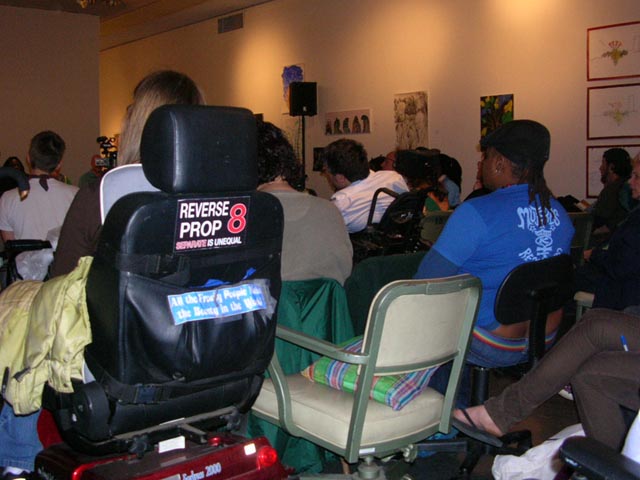
“It’s like the CEO’s at Chevron,” hip-hop artist Miss Money said in response to a question from the audience, “they are all white.” She was referring to the record executives that control what is popular in the world of hip-hop, what is centralized in society’s perspective on hip-hop culture. On Saturday, April 11th, I learned there is much more than meets the eye. I attended, “Diversifying Hip-Hop: Krip-Hop and Homo-Hop,” at the Worth Ryder Art Gallery on the CAL campus, the first symposia ever dedicated to the two movements of hip-hop artists with disabilities and hip-hop artists who are queer. I came to the event carrying my own perspective. I gazed upon the artwork with my own eyes and listened to the panelists with my own ears, processing it all with my own mind. It was a room full of varying and distinctive viewpoints. Some folks were able-bodied, some were not, some were gay, some were not, some were black, white, Asian, Latino, and some were somewhere in between, outside, or a combination. The common thread that wove between the audience and panelists, artists and organizers, was difference, the desire for artistic creation and human connection to supersede difference. The two smallest minority groups within hip-hop uniting to inform, discuss, perform and inspire. “We are individuals,” said Great Scott, disabled rapper and panelist, “but we all do Hip-hop. It’s not a monolith, it’s diverse, a community of unlike minds.”

The event was hosted and coordinated by Leroy R. Moore Jr., writer, poet, hip-hop music lover, disability and race scholar, and founder of Krip-hop, an organization aiming, “to get the musical talents of hip-hop artists with disabilities into the hands of media outlets, educators, hip-hop, disability, and race scholars, youth, and hip-hop conference coordinators, with the goal of raising awareness and disseminating the latest news on musicians with disabilities.” Added to the bill was Homo-hop, a broad movement of Lesbian, Bisexual, Gay, and Transgendered rappers, DJ’s, and hip-hop artists who have grown in the public eye through the PeaceOUT World Homo-hop Festival and the powerful documentary Pick Up The Mic: The Homo-Hop Revolution. “I found out that the stories of rejection to Hip-Hop artists with disabilities was shared by another group of talented Hip-Hop artists,” explained Moore, “they had been speaking out since 2001 and had formed their own movement…It feels so good when you know that there are people that can relate, and have provided a path of support, knowing that we have our differences but share the same goal.” Bringing the two movements together for this event was an effort to “bring the margins front and center,” as it was explained on the press release, “to expose the struggle of difference, as has always been the legacy of Hip-Hop.”

I brought the Krip-hop mix CD home with me. It’s good music, and it can be for everyone. The lyrics are pulled from everywhere, founded in the realities of the artists. “Music is a reflection of society,” said panelist and hip-hop artist Tru Bloo, “you can’t talk about it as if it was created in a bubble.” Hip-hop can be angry because society is angry. Disabled and homosexual artists are creating from their own unique perspectives, inspired by their own experiences, viewpoints which are just as valid and important as any other ‘mainstream’ creator. “We are beginning this dialogue now,” said Tru Bloo, “eventually we will be able to recognize the power in difference.”

As the symposia began, the audience, in all our diversity, slowly began to crowd the small space, spilling out into the hallway, and negotiating spacing with one another, encouraged to yell and clap as loud as we could. There was a contact and honesty about the event that opened up the room and allowed for the revealing of the raw, the roots of the subject matter. I felt this most powerfully during the open discussion with the panelists, as the pleasantries were unwrapped and the multitude of complexities embedded within these communities were revealed. Are you a gay rapper, or a rapper who is gay? A disabled MC or an MC who happens to be disabled? Is hip-hop negative or positive? Do hip-hop artists have a responsibility to make it positive?

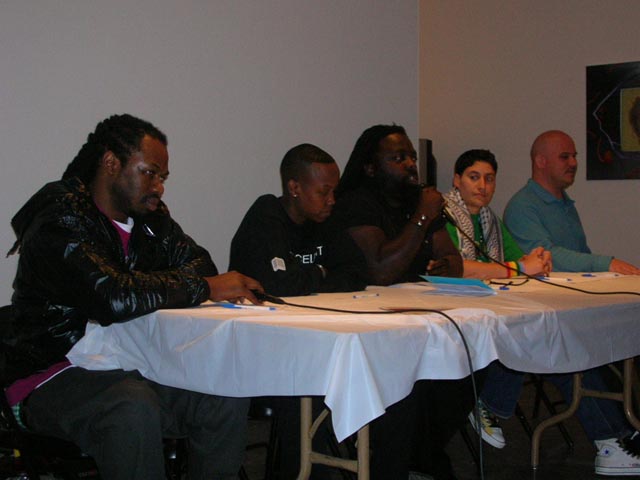
Moderated by the incredible Anita Johnson of Hard Knock Radio on KPFA, all of the guests spoke from their own viewpoints, their own lives. The panelists were Miss Money; a singer, DJ, producer, and rapper from Houston, Texas, who happens to be both gay and disabled, Great Scott; an underground MC from Atlanta, partially paralyzed from a gunshot wound, B-sick; a rapper from Las Vegas rendered blind from a degenerative eye disease, Nyla Moujaes (Tru Bloo); is a public interest attorney, community organizer poet, musician, and MC, hailing from Lebanon and Las Vegas who happens to be lesbian, and Juba Kalamka; a recording artist from Chicago, founder of Deep Dickollective and the label Sugartruck Recordings, Director/Curator of PeaceOUT from 2002-2007, and pioneer of the Homo-hop movement in the bay area, who happens to be bisexual. They truly were a representation of the diversity within Hip-hop. “Part of the function of mainstream media is to distill people into little boxes,” said Kalamka, “we are more complex than that.”

The conversation opened the boxes and revealed these some fascinating complexities. “Hip-hop, at its root, is kind of a culture of angry young men,” says hip-hop artist Dutchboy in Pick Up The Mic, “it’s also a culture of people saying what’s on their mind regardless of whether it’s appropriate or not. In one sense there’s something very beautiful about that, because our society is really afraid of our angry young men, and what they have to say.” That’s also what the industry pays for, what society promotes. “We live in a society that rewards petty tyranny,” commented Kalamka, “mainstream gay culture is racist and classist, at every level of society there is racism and classism. Hip-hop didn’t create homophobia and misogyny, but the industry will allow you these crumbs of privilege with you sign-on and perpetuate it. It’s rewarded and then reflected in hip-hop culture.”

So how do you deconstruct this ideology and reclaim an art form that is being repackaged and fed to the masses? By making great music. “I’m not reclaiming it, I’m making it mine,” Miss Money powerfully responded, “If it doesn’t want me, fine...It’s about ability…Nobody wants gay great, or disabled great. You have to be extraordinary.” Great Scott followed with commenting, “I grew up listening to Elton John, George Michael, never knowing they were gay. When I found out, I didn’t care.” “That always has the most impact,” responded Tru Bloo, “when you make the human connection first.”

It was this theme of the human connection between all of us, able-bodied or otherwise, that kept recycling throughout. Hip-hop is a rope that ties and tangles diverse communities together with the common goal of creating great music. These two communities had a second goal, uniting on April 11th to make the rope a little more flexible and inclusive of all the minority communities. “We need to create a context where people don’t feel tyrannized for who they are,” stated Juba. All too often the voices coming from the angles are silenced by the center. As soon as internalized this, I wanted everyone to start yelling and crowding and spilling and touching far more. Turn the music up, turn the mic up. This is revolutionary. The event was revolutionary. The movements are revolutionary.

Tags

Tent City Residents in Sacramento Rally Against Criminalization and Sweeps!

09/24/2021 - 09:45 by Anonymous (not verified)
Original Author
root
Original Body

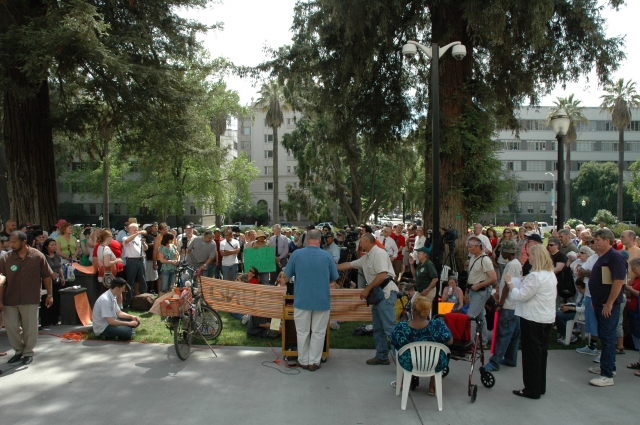
Poverty Scholars and their allies held a rally on the south steps of the Capitol on Tuesday. 300 participants were at the rally and demanded a safe and legal place for homeless people to camp. About 20 people blocked the south entrance to the Capitol

by Mike Rhodes/Special to PNN

From Loves and Fishes - advocates for Poverty Scholars in Sacramento

What is this “Tent City” I’ve heard about?

You may have heard about the Sacramento tent city on The Oprah Show or other news media. The encampment that has received the most attention was the largest in the City, but not the only encampment. The “Tent City” has now been shut down by the City of Sacramento. Most of the campers have dispersed to other less visible areas. All of the encampments in Sacramento are informal gatherings of people sleeping in tents or under tarps. They are considered illegal by the City of Sacramento.

What is this “Safe Ground” you keep mentioning?

Safe Ground is a proposed location where the homeless can camp legally with access to basic needs such as running water, toilets, and trash cans. Safe Ground does not yet exist.

What’s the difference between the “Tent City” and Safe Ground?

The “Tent City” was an illegal and informal gathering of homeless campers on an unsafe and unsanitary site. Safe Ground is an organized location where the homeless can camp legally with access to basic needs such as running water, toilets, and trash cans.
A successful Safe Ground incorporates four things:

1. It is self governed. The campers are responsible for maintaining order and enforcing the rules they choose for themselves.

2. It must be sanctioned by the City and County government. The City and County must give permission for the Safe Ground to exist.

3. It has access to basic sanitation – running water, toilets, and trash.

4. It has a non-profit sponsor.

Why do we need a Safe Ground?

There are over 1200 homeless sleeping on the streets each night. All of the emergency shelters are full to overflowing.. The city of Sacramento has an anti-camping ordinance which makes it illegal for anyone to sleep anywhere but designated camp sites. This leaves over 1200 people with nowhere to go at night. Sacramento needs a legalized Safe Ground with running water, restrooms, and trash cans where people have a safe place to sleep at night.

What is the City doing to help?

The city has shut down “Tent City” and forced everyone to relocate. The city has provided the funds to keep the Overflow shelter open until June and added 50 more beds bringing total capacity to 200. The city is also providing funding for 40 more permanent housing solutions which will be available at a future date. While we applaud the city for moving forward and giving more people the shelter and housing they need, we are also appalled that this accounts for only a small percentage of the 1200 people who are homeless and on the streets.

How Can I Help?

Contact Mayor Johnson and let him know you want a legalized safe ground/tent city. His email address is mayor [at] cityofsacramento.org or phone him at 916-808-5300.
Bring donations of Tents, Tarps, Sleeping bags, and backpacks to Loaves & Fishes or other local nonprofits.
Volunteer at Loaves & Fishes or one of the other local nonprofits already serving the homeless.
Join our Action Alert E-mail list to get timely news on how to help.Click Here to go to the sign up form.

Where is Tent City?

Sacramento has had many tent cities over the years. Because they are considered illegal by the city they typically only last for a few months before being shut down by the authorities. The Tent City featured on most media channels has been shut down by the City of Sacramento. Most of the campers have dispersed to other less visible locations.

Can I bring things to Tent City?

The large Tent City has been shut down, and the campers dispersed. Until a legal safe ground with the proper water, trash, and sewer facilities is established bringing food and other items to tent encampments typically results in loads of trash causing health and safety issues. We recommend not bringing things directly to tent encampments but instead to a local nonprofit who is serving the homeless population. Loaves & Fishes, The Salvation Army, The Union Gospel Mission, and Volunteers of America are all serving the homeless population and are well prepared to give out supplies in a safe, organized, and fair manner.

What is Loaves & Fishes doing to help?

Loaves & Fishes has been providing survival services to the homeless since 1982. Because of the proximity of Loaves & Fishes to many tent encampments many of the campers come to us for basic survival services. We serve 400-700 people a hot lunch everyday, provide over 100 showers each day, and have clean fully stocked restrooms available. On our campus are a dozen programs to help homeless people including a school for homeless children, a daytime resource center for homeless women, a medical clinic, mental health program, recovery program , legal clinic and shelter for mentally ill homeless women.

We are a part of the Safe Ground task force, which is actively exploring how and where to set up a Safe Ground. We are also holding a Safe Ground rally on the Capital Steps on April 21 at 2pm.
Loaves & Fishes also advocates on behalf of the homeless by attending city council and county board of supervisors meetings, alerting the public to urgent issues through our Action Alert Email List, fighting for the rights of the homeless, and by organizing marches and rallies when needed.
To Join the Action Alert List Click Here.

Won’t a sanctioned tent city turn Sacramento into a homeless magnet?

Numerous studies of homeless people in Sacramento have shown that overwhelming majority have lived here 5 years or longer. People become homeless in the same community where they once had an income and a home.

Is safe ground the solution to homelessness?

No, the solution is to recognize that housing is a basic human right and commit ourselves to ensuring that all Sacramentans of all income levels can afford a simple home of their own. However, until we reach that goal, we should provide safe ground for those forced to live outside for lack of a better alternative.
For more info go to:http://www.sacloaves.org/safeground/

Tags

Another Brown MotherF***ker i have to get rid of

09/24/2021 - 09:45 by Anonymous (not verified)
Original Author
root
Original Body

Resisting Homeland Security

Resisting Homeland Security


by SAD BOY

“Another brown motherfucker that I gotta’ get rid of,” is the first thing I heard from the judge as soon as I walked in the courtroom. As soon as I heard this I knew that it wasn’t going to be easy. I knew then that I had to deal with racism and somehow put myself together in the short time to deal with this situation and present my case. My brain was storming with all these emotions from blatant racism in the court. I told my lawyer to ask the judge if we could have a five minute recess so I could pull myself together and judge’s answer was no. When my lawyer asked why, the judge’s answer was “I have a lot of criminals like himself to get rid of and they are the reason why this nation is the way it is.”

It took me 11-12 years of emotional abuse from the court systems to actually get my point across. Even though I’m in the country I know I will always be treated as if I was a ghost. As a person of color I have to be strong because they opened my eyes to the reality that all people of color deal with on a daily basis with the judicial system. It took me back to what my mother and father had to go through across the border for two and a half months for my sisters and I to have a better future.

I knew after that trial that my life had changed. One of the changes I had to make was to take advantage of this new opportunity that God had gave me. Instead of getting angry at the judge or the system, one of the ways I would change was to go to school get educated. I can’t imagine the struggles of my ancestors who came before me had to go through. The majority of them speak only spanish and in some cases only speak in dialects which makes them easy targets for abuse.

This has been going on since the 1930’s, where the government would send any person who looked mexican or latino to the farthest parts of mexico making sure that they could not find a way to come back. Blaming the migrant workers or braceros, for their own dirty business practices was common in these days.

Despite the fact that two million peasants lost their lives in the Mexican Revolution of 1910, the government failed to provide them the resources needed to improve their lives. By the late thirties, when the crop fields began yielding insufficient harvest and employment became scarce, the peasant was forced to look for other means of survival. The Bracero Program was created in which more than 4 million Mexican farm laborers came to work the fields of this nation.

Even though things have changed we can still see how migrant people are targeted. For example, back in the 90s they tried to pass proposition 187 to take away migrants people’s human rights. Even though I was a little kid back then I still remember how difficult it was for my people to take their children to the hospital.

Because I’ve had this experience I believe that if we fight we can get what is entitled to us. I have also learned that we can empower ourselves and take what is negative and turn it positive. We should all be equal and people should not be marginalized because of the color of our skin.

Tags

"I Am" Vinnie

09/24/2021 - 09:45 by Anonymous (not verified)
Original Author
root
Original Body

by Mission Resistors

An Oakland mourning, grayish clouds like the courthouse building.

Looked like a skyscaper to me… As the people walked down the street, they looked scary to me like the building. As I went into the building with my parents to see the judge for his judgment, he sent me to another foster home.

I must have stayed there about 3 weeks before I ran away again. They found me on the streets in the Fillmore with the prostitutes, the pimps and the players of the street life. Everybody used to hang out at Chicken A-Go-Go on Fillmore Street. It was a restaurant for the prostitutes. The prostitutes would give me a dollar to go to school—-for lunch money. They would say, “You make sure you go to school, cuz if you don’t, I’m gonna whip your ass just like your mama. I’m not givin’ away my money for nothing."

They were wearing short mini skirts with high heels. They swayed from side-to-side. I used to sneak into the Fillmore theater all the time, like when James Brown came to town. I’d seen him for free—-and Otis Redding and Sam Cooke. I liked the song, “Please Please Please.” I liked the way he sang it and the way he danced. Sam Cooke would make the women jump up, holler and scream. Back in those days, it was a big dance floor—-everybody would be dancing.

Then I got arrested by a truant officer. I went to Juvenile Hall, then back to court. I then went to a boarding school named Frego Ranch School in San Andreas, California. I tried to run away from there, but instead, got lost and scared. I stayed 6 months at the ranch and later, went back home. I was about 13 years old. I was going to a Jr. High School named Benjamin Franklin for a minute. I would never go to my class and ended up running away from home again. This time, they sent me to Los Angeles to a foster family’s house. I didn’t know anything about LA.

The first day, I arrived at their house, they took us to Disneyland and I was gone again. I ran away... I met a white man going back to S.F. He gave me a ride and dropped me off at the old Greyhound bus station on 7th and Market Street, but the police found me sleeping in the doorway there.

I ended up going back to Juvenile Hall and back to court, when the judge asked me, “What should I do with you?” I answered, “Why don’t you let me live with my real parents?”

He granted it.

Tags

Sayaw Ng Mandirigma (Dancing with the warriors)

09/24/2021 - 09:45 by Anonymous (not verified)
Original Author
root
Original Body

The journey to the homeland for a worker, a father an Escrimador!

by Tony Robles

Jimmy, Jimmy, oh Jimmy Mack

When are you coming back?

--Martha Reeves and the Vandellas

It was 1980 and the thick smell of sugar cane from the factory was heavy in the air. My family had just moved to Waipahu, Hawaii from San Francisco. I would walk the roads with the red clay earth under my feet. I was a newcomer. I didn't know the history of where I was. All I really knew were the messages I got from tourist propaganda. I didn't know about the Hawaiian monarchy and how it was overthrown by the US. I didn't know about the workers who had labored under severe conditions on the sugar and pineapple plantations in the early days. I had no idea that Pilipino workers had shut down the factories to protest inhuman working conditions. All I knew was the dirt under my feet. I tried hard to get rid of it.

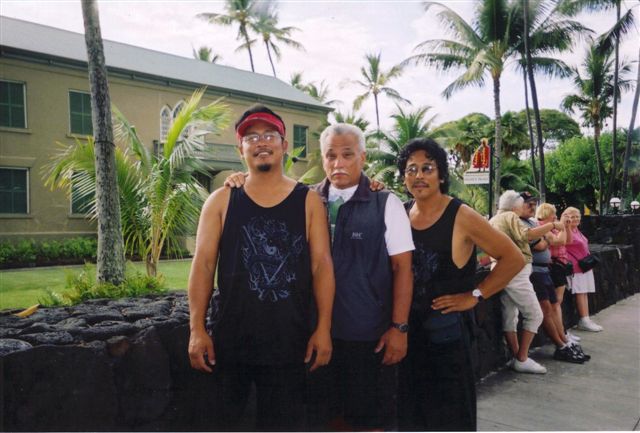
My father, Jimmy Robles, had taken a chance moving to Hawaii. He labored more than 20 years as a janitor for the city and county of San Francisco. One day he said goodbye. He, his wife, my brother and sister and I packed up and moved to Hawaii. My grandmother had warned my father against the move. To her, the smart thing was to remain in his job, retire and collect a pension. Life in Hawaii was hard. The economy was bad and nobody seemed to have any money. My father had started his own janitorial business in San Francisco and brought his equipment to Waipahu. His vacuum cleaner, mops, brooms and floor waxing machine sat idly near a mango tree in the backyard of his father in law's house.

My father walked the same road that I did. He said he was looking for work he wasn't but he was looking for something else, something deeper. Somehow I knew he was looking. And while I was at school listening to a girl say to me, "You talk like one haole" the same red earth clung to the bottom of my father's feet in Waipahu when he came upon a house. Unlike me, he didn't try to get the dirt off his feet.

"I was in Waipahu," my father says as he recalls that day over 20 years ago, "I saw these guys in a garage. It was a beautiful dance. A guy in a ponytail came out. His name was Snooky Sanchez. He knew my father and my brother. I watched these guys sparring and I was inspired. I sought out this art.

What my father had encountered on that day was the Pilipino fighting art of Escrima. Escrima is a Philippine fighting style which utilizes sticks, knives and open hand techniques as well as fluid body movements and footwork. The movements are explosive. The origins of the art predate the Spanish invasion and subsequent colonization of the Philippines. My father explains the warrior's mentality that goes with being a successful practitioner of the art. "To do well, you have to have a war mentality. You have to be strong and in condition. You have to be in total relaxation and from that come a burst of energy. You go down into your spirit; you go beyond your limit."

My father worked at the art and became an instructor, an indigenous warrior scholar who has resisted the American occupation and colonization of his mind, heart and spirit. He befriended another martial artist, Joe Behic, AKA Joe the volcano, and the two experimented with the art, synthesizing different styles, developing their own style that they've named Sayaw Ng Mandirigma, which means "Dancing with the warriors" in Tagalog. "Our style is like a cobra. As we retreat, we're ready to attack at any time. It's a reality-based combat. We developed this system over a period of 5 years."

My father says that in the old days, you learned the art through your family only. Hawaii is an integral center for martial arts people have come from all over for generations, bringing their different styles. "A lot of masters came and planted roots here in Hawaii," dad says. I remember my father trying to pass the art to me. He'd take his sticks and he'd show me the basic strikes, which I still remember. For some reason I didn't take to it. Perhaps it was the bad memories I had of him showing me boxing, with me on the receiving end of more punches than I landed. I ended up gravitating towards writing.

My father was in Hawaii with some of his Escrima students when he was invited to attend an Escrima world championship tournament on the Island of Cebu in the Philippines. My father's parents arrived in the US in the early 1920s. This will be his first visit to the birthplace of his parents. "I'm happy to go to the motherland, the roots. My people came from there. It's gonna be emotional for me. The students he will accompany will be visiting for the first time as well.

It is befitting that this world championship will be held on the Island of Cebu, the place that Ferdinand Magellan was killed by the Philippine warrior Lapu Lapu in an act of resistance to the colonizing of the Spaniards.

He leaves for Cebu on July 16th. When he gets off the plane I'm sure he will have the same red earth on the bottoms of his feet, having arrived just in time to dance that beautiful dance which is his life.

Tags