Story Archives

The Myth of the Pirate

09/24/2021 - 09:45 by Anonymous (not verified)
Original Author
root
Original Body

The truth behind the global corporate theft of Somali resources and the folks who are working to stop the theft.

by Johann Hari/UK Independent

Who imagined that in 2009, the world's governments
would be declaring a new War on Pirates? As you read
this, the British Royal Navy - backed by the ships of
more than two dozen nations, from the US to China - is
sailing into Somalian waters to take on men we still
picture as parrot-on-the-shoulder pantomime villains.
They will soon be fighting Somalian ships and even
chasing the pirates onto land, into one of the most
broken countries on earth. But behind the
arrr-me-hearties oddness of this tale, there is an
untold scandal. The people our governments are
labelling as "one of the great menaces of our times"
have an extraordinary story to tell - and some justice
on their side.

Pirates have never been quite who we think they are. In
the "golden age of piracy" - from 1650 to 1730 - the
idea of the pirate as the senseless, savage Bluebeard
that lingers today was created by the British
government in a great propaganda heave. Many ordinary
people believed it was false: pirates were often saved
from the gallows by supportive crowds. Why? What did
they see that we can't? In his book Villains Of All
Nations, the historian Marcus Rediker pores through the
evidence.

If you became a merchant or navy sailor then - plucked
from the docks of London's East End, young and hungry -
you ended up in a floating wooden Hell. You worked all
hours on a cramped, half-starved ship, and if you
slacked off, the all-powerful captain would whip you
with the Cat O' Nine Tails. If you slacked often, you
could be thrown overboard. And at the end of months or
years of this, you were often cheated of your wages.

Pirates were the first people to rebel against this
world. They mutinied - and created a different way of
working on the seas. Once they had a ship, the pirates
elected their captains, and made all their decisions
collectively, without torture. They shared their bounty
out in what Rediker calls "one of the most egalitarian
plans for the disposition of resources to be found
anywhere in the eighteenth century".

They even took in escaped African slaves and lived with
them as equals. The pirates showed "quite clearly - and
subversively - that ships did not have to be run in the
brutal and oppressive ways of the merchant service and
the Royal Navy." This is why they were romantic heroes,
despite being unproductive thieves.

The words of one pirate from that lost age, a young
British man called William Scott, should echo into this
new age of piracy. Just before he was hanged in
Charleston, South Carolina, he said: "What I did was to
keep me from perishing. I was forced to go a-pirateing
to live." In 1991, the government of Somalia collapsed.
Its nine million people have been teetering on
starvation ever since - and the ugliest forces in the
Western world have seen this as a great opportunity to
steal the country's food supply and dump our nuclear
waste in their seas.

Yes: nuclear waste. As soon as the government was gone,
mysterious European ships started appearing off the
coast of Somalia, dumping vast barrels into the ocean.
The coastal population began to sicken. At first they
suffered strange rashes, nausea and malformed babies.
Then, after the 2005 tsunami, hundreds of the dumped
and leaking barrels washed up on shore. People began to
suffer from radiation sickness, and more than 300 died.

Ahmedou Ould-Abdallah, the UN envoy to Somalia, tells
me: "Somebody is dumping nuclear material here. There
is also lead, and heavy metals such as cadmium and
mercury - you name it." Much of it can be traced back
to European hospitals and factories, who seem to be
passing it on to the Italian mafia to "dispose" of
cheaply. When I asked Mr Ould-Abdallah what European
governments were doing about it, he said with a sigh:
"Nothing. There has been no clean-up, no compensation,
and no prevention."

At the same time, other European ships have been
looting Somalia's seas of their greatest resource:
seafood. We have destroyed our own fish stocks by
overexploitation - and now we have moved on to theirs.
More than $300m-worth of tuna, shrimp, and lobster are
being stolen every year by illegal trawlers. The local
fishermen are now starving. Mohammed Hussein, a
fisherman in the town of Marka 100km south of
Mogadishu, told Reuters: "If nothing is done, there
soon won't be much fish left in our coastal waters."

This is the context in which the "pirates" have
emerged. Somalian fishermen took speedboats to try to
dissuade the dumpers and trawlers, or at least levy a
"tax" on them. They call themselves the Volunteer
Coastguard of Somalia - and ordinary Somalis agree. The
independent Somalian news site WardheerNews found 70
per cent "strongly supported the piracy as a form of
national defence".

No, this doesn't make hostage-taking justifiable, and
yes, some are clearly just gangsters - especially those
who have held up World Food Programme supplies. But in
a telephone interview, one of the pirate leaders,
Sugule Ali: "We don't consider ourselves sea bandits.
We consider sea bandits [to be] those who illegally
fish and dump in our seas." William Scott would
understand.

Did we expect starving Somalians to stand passively on
their beaches, paddling in our toxic waste, and watch
us snatch their fish to eat in restaurants in London
and Paris and Rome? We won't act on those crimes - the
only sane solution to this problem - but when some of
the fishermen responded by disrupting the
transit-corridor for 20 per cent of the world's oil
supply, we swiftly send in the gunboats.

The story of the 2009 war on piracy was best summarised
by another pirate, who lived and died in the fourth
century BC. He was captured and brought to Alexander
the Great, who demanded to know "what he meant by
keeping possession of the sea." The pirate smiled, and
responded: "What you mean by seizing the whole earth;
but because I do it with a petty ship, I am called a
robber, while you, who do it with a great fleet, are
called emperor." Once again, our great imperial fleets
sail - but who is the robber?

Tags

God Woke me up in the Morning

09/24/2021 - 09:45 by Anonymous (not verified)
Original Author
root
Original Body

Racism at Lucas Films

by Byron Gafford/PNN Race and Poverty Scholar

God woke me up at three o clock in the morning, a typical
salutation used by Byron Gafford to greet people in the mornings.
Upon my first introduction with Byron a few months ago, I found him to
be an extremely kind-hearted and friendly man, often with a smile on
his face. The first thing I discovered about him was that he was a
passionate and creative writer. He has written over 80,000 poems and
keeps all of them extremely organized by number, day, and title. He
is a spiritual man who practices positive thinking and enjoys living
life.

On Wednesday, March 25, 2009, he was let go from his position as a
contracted security guard at the George Lucas Building B on 1
Letterman Street in San Francisco, California. Byron was culturally,
racially, and religiously discriminated against based on that greeting
to a female Lucas employee that morning.

"Every day, like I've been doing for the past seven months, when the
employees enter into the lobby I would greet them with Good Morning
and God Bless You and no one ever responded back to me in a negative
way", says Byron. "I greeted everyone the same way. I never knew that
I offended anyone and no one ever mentioned to me that I was offensive
in my greetings to any employees. My supervisors have never expressed
to me that my greetings were inappropriate".

We at Poor Magazine are exposing George Lucas in their blatant
discrimination against Byron Gafford. They have made what Dr. Wade
Nobles defines as a "transubstantive error" by interpreting his
comment as inappropriate, yet they are without explanation or notice
of his termination. They have fired him on an illogical and illegal
basis and we need to put a stop to this hypocrisy. We will not allow
Darth Vader to strike.

Transubstantive error is defined as making a wrong and assumptive
conclusion about a meaning and value of peoples by looking at their
surface behaviors. In the sixties the Assistant Secretary of Labor
Daniel Moynihan was assigned to examine the black family as part of a
welfare study ordained by President Johnson. Upon his assignment he
made a transubstantive error by deeming the black family environment
as, "broken home [that] would cause negative things to occur in the
development of children".

Dr. Nobles is a tenured professor in Black Studies at San Francisco
State University and the Executive Director of the Institute for The
Advanced Study of Black Family Life and Culture in Oakland,
California. He says that Daniel Moynihan made the first mistake by
interpreting their values and behaviors from his own European culture.

"He draws the wrong conclusion", says Dr. Nobles. "So the entire
time he is examining them, there was this whole notion of families
with womyn without husbands raising children, which he deemed a broken
home".

Dr. Nobles goes on to conclude that, "The mistake he was making was
that the instillation of values in the development of children is not
tied to mother-father linkage, it is tied to a system of eldership.A system of eldership does not believe in just a nuclear family to
raise children, but it is the responsibility of both the immediate and
extended families to raise them, including aunts, uncles,
grandmothers, grandfathers, sisters, brothers, cousins, and so on.
Almost like a hierarchy of eldership, all of these elements contribute
to, improving the development of children. And so you have African
American people behaving in a certain way that is uncommon and
unfamiliar to someone with a European background, and it becomes
misinterpreted and seen as broken, or wrong and less than, thus
causing a transubstantive error.

In this particular incident, the female employee of George Lucas
found Byron's morning greeting to be offensive. However, by her
placing that negative judgment upon Byron, like Daniel Moynihan, she is
committing a transubstantive error. She, as a white womyn with a
Eurocentric background, is deeming Byron's entire cultural value
system as inappropriate as he is a spiritual man and an African
American man.

The day started out as a typical day. Byron started his shift at
6:30 a.m. as a security guard at the George Lucas Building B childcare
lobby. He was contracted by Advanced-Tech Security Services and has
been there since September 9, 2008. By 6:45 a.m., he was at his post
and by 7 a.m., the building was open.

At 7:35 a.m., Byron was at his desk performing his post duties when a
Lucas female employee came into the lobby. As is customary, he greeted her politely and commented that "God
woke me up at three o' clock in the morning". A reference to his late night work schedule.
The female employee departed while Byron continued with his duties.

He continued his day and took his first fifteen-minute break at 8
a.m., lunch at 10:30 a.m., and his third break at 1 p.m. However, at
approximately 1:38 a.m., another ATS guard came and told him that Mike
Mitchell, his employer, wanted to see him. Byron went to Mike's
office upstairs, and his other supervisor Jim was also in the office.
Jim then proceeded to get out of his seat and close the door. When
they were all seated, Mike said that a Lucas employee went to the
people higher up and complained about Byron. She said he told her
that "God woke me up at three ˜o clock this morning". Byron told them
yes, he did say that. Yet without any further explanation, Mike and
Jim responded, "We have to let you go". They took his badge, told him
to leave, and told him that would no longer be an employee there,
leaving Byron unclear about the situation.

This incident is an example of cultural digression and it is illegal.
As stated under Federal Law, Title VII of the Civil Rights Act of
1964 (Title VII), it "prohibits employment discrimination based on
race, color, religion, sex, or national origin". Byron is an African
American man and is a spiritual man, and George Lucas is
discriminating against Byron based on his culture, his race, and his
religion, resulting in the loss of his position. They issued him no
write up or any warning, and prior to this incident Byron had no
complaints on his record.

"George Lucas is a media corporation", says Tiny, editor of Poor
Magazine. "They supposedly produce diverse media, but have judged
and decided on someone else's value system and fired him. Byron is a
writer, he is hard working, he is supporting a family".

Byron Gafford was an innocent bystander caught in a transubstantive
error and was wrongly let go of his position under federal
discrimination and without any legal justification. We need to
combine our forces against George Lucas and expose this hypocrisy
before they strike again in our community.

Tags

Byron poem 1

09/24/2021 - 09:45 by Anonymous (not verified)
Original Author
root
Original Body

by Byron Gafford


A Lucas Art employee

That God woke


Me up at 3 o'clock

In the morning

That day.


With any warning

From anybody I


Didn't know that

What I had

Said to her that

She hated God

That much.


That at 1:38pm

I had to lose

My job over

Me thanking God

For waking me

Up this morning

3-25-09 like I

did every morning.

Tags

My Answer is

09/24/2021 - 09:45 by Anonymous (not verified)
Original Author
root
Original Body

Support Lori Phanachone! Stop assimilation of AmeriKKKa.

by Wendy M. Fong

I was born in Santa Clara, California and my first language was Cantonese. I think my first word was “nay,” or milk, because I used to drink a bottle of milk everyday for breakfast. I remember at four years old telling my mom I wanted to "sake phan," or "eat food," while running around the kitchen squeaking and stomping on the emerald tiles in my yellow mouse slippers. Thirteen years later, everyday conversations of "jo san, ney ho?", "sai woon," and "ho liang" became “good morning, how are you,” “wash the dishes” and “very pretty” overnight. We only spoke English. I did not realize what exactly had happened. When did we stop speaking Cantonese? I could barely even remember how to say “sock.” What happened to our language? How did Cantonese slowly disengage itself without any of us realizing that English had conquered our home?

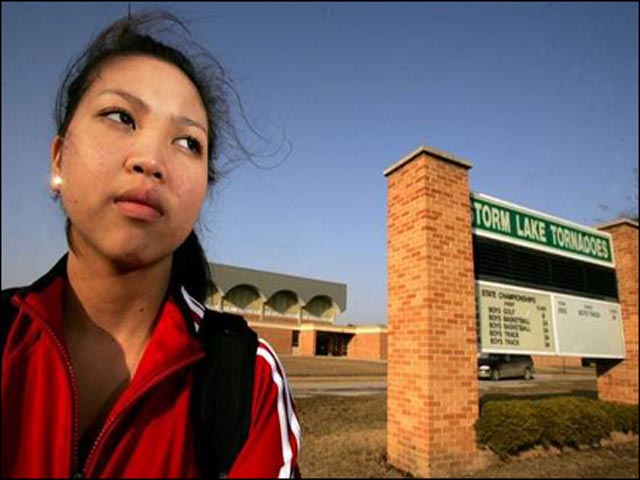
Lori Phanachone was born in California, moved to upstate New York, and a few years ago ended up in Storm Lake, Iowa at Storm Lake High School. She is daughter to migrant parents from Laos and an honors student. Upon enrollment in the beginning of her sophomore year, she received straight A’s, including an A in English. However also upon enrollment and without her knowledge, she was classified as an English Language Learner (ELL) based solely on the fact that she listed “Laotian” as her first language instead of English.

Later that school year, Lori was given an English Language Learner test, which is used to access a student’s progress in English every year. She took the test and answered everything correctly. However, she was still never aware that she was classified as an ELL.

During the following eleventh grade year, she was tested again. In protest, Lori completed the test by filling in all C’s. When she turned in the exam early, she was forced to wait on solitary confinement for more than three hours before being excused. Under Iowa law, if a student is classified as an ELL, they are allowed to monitor him or her for a few years to track their progress. Yet the process was not clear on how a student is considered an ELL in the first place. Also under Iowa provision, students who are bound to be proficient in English are supposed to be technically accessed, but again this process was not clear on whom or not requires this provision. Although Lori did well on the test her sophomore year, Storm Lake misapplied Iowa law by classifying her as ELL because she listed Lao as her home language.

This year is Lori’s senior year, and they asked her to take the test for a third time regardless of her 3.98 GPA and high marks in all her classes— all of which are taught in English. She refused to take the test and was suspended from school for three days. They also did not give a formal written notice of the suspension. When someone is suspended, Storm Lake High School is required to give a written notice before it occurs. They have also threatened to take away her eligibility for scholarships, and participation in school activities including track team, prom and other extracurricular activities; then proceeded to revoke her National Honor Society Membership.

“The school did not access Lori's actual abilities and needs. They made no effort to test her English proficiency formally through a test or informally through an interview,” said Khin Mai Aung, Lori’s the staff attorney at the Asian American Legal Defense and Education Fund (AALDEF). They merely based it on the fact that English was not listed as her native language on her enrollment application.

Presently the story is ongoing. “Storm Lake labeled me an English Language Learner when I enrolled without even bothering to test me. All I want is to continue my education without the school labeling me unfairly,” said Lori. AALDEF demands that Storm Lake High School remove all disciplinary action from her school records, assure in writing statements of further discipline also be removed, written clarification of Storm Lakes’ procedure for classifying a student as an ELL, clarification on how the school assessed Lori as ELL, and Lori’s status to be adjusted as a student proficient in English. “School districts need to have assessments that make sense and are based on students' actual abilities rather than broadly categorize based on blunt criteria,” said Khin.

As of Friday, April 8, 2009, Storm Lake School District reclassified Lori as English proficient and restored her National Honor Society membership. However, the other requests are still pending.

“We still need a lot of answers, but I feel really good that my academic honors have been restored, and I no longer have to worry about being classified as an ELL,” said Lori.

Storm Lake High School is operating under racist assumptions by violating federal and state law. The AmeriKKa system forces students like Lori to take an ELL test after misevaluation and do nothing to help her succeed. It is not for her, but against her. Sometimes I wonder why my parents felt the need for us to prioritize English over Cantonese. Is bilingualism not possible in this country? When they first migrated to the United States in the 70’s and 80’s, it was important to learn English. Speaking English was equated with proudly representing a country and it meant finding a good job. Every time I go home to see my parents, the house is decorated with patriotic paraphernalia proudly displaying red, white, and blue. It was different for my parents coming here as showing patriotism was necessary for survival. However, now is our time to fight back and reclaim our identities, our cultures, our languages. We can no longer allow English to erase us clean like a whiteboard, melt us into a pot until we drown.

Tags

La revolucion comienza con migo!/The Revolution begins with I

09/24/2021 - 09:45 by Anonymous (not verified)
Original Author
root
Original Body

The Story of Mission Resistance

by Tiny aka Lisa Gray-Garcia, co-teacher, poverty scholar and daughter of Dee

My name is Vinnie and I make a living with this," his hands were small and Columbian--coffee brown, each finger rippled with the struggle of homelessness, racism and poverty as he carefully unfolded a 12-inch cardboard sign upon which was meticulously printed black letters stating Starvin Like Marvin. (A reference to one of the famous sayings of middleweight boxing champion Marvin Hagler.)

The indigenous circle of multi-lingual, multi-generational and multi-racial, youth, adults and elders in poverty who produce news rooted in community struggle, art and resistance known as Community Newsroom at POOR Magazine busted into laughter of joy and appreciation at the sight of his sign. Vinnie stayed quiet as his sharp, chocolate eyes scanned the room. Then slowly, tentatively, the corners of his mouth seemingly frozen in a serious stillness lifted to reveal a broad and beautiful smile. He shook his head in tandem with the laughter, and just for a miraculous second, almost unseen, barely caught, Vinnie seemed carefree.

In a powerful collaboration between The Race, Poverty Media Justice Institute (RPMJ) at POOR Magazine, Intersection for the Arts and the Mission Community Council, I and other poverty scholars in residence at POOR Magazine were blessed to meet Vinnie H, Carmen C, Jennalyn S, Rhonda C, Jon T, Carlos L, Raymundo S and many more folks that we at POOR consider poverty, race, migrant, gender, elder and/or youth scholars engaged in different forms of unrecognized micro-business (panhandling, recycling, day laborers, sex work, mothering) and survival.

Through this collaboration, entitled Mission Resistance as it focused specifically on mission based organizations and communities, folks like Vinnie were exposed to the revolutionary concept of poverty scholarship itself, launched by POOR's RPMJ, which honors and recognizes the scholarship of youth, adults and elders in poverty for the knowledge they hold, have earned and continually learn from lives of struggle.

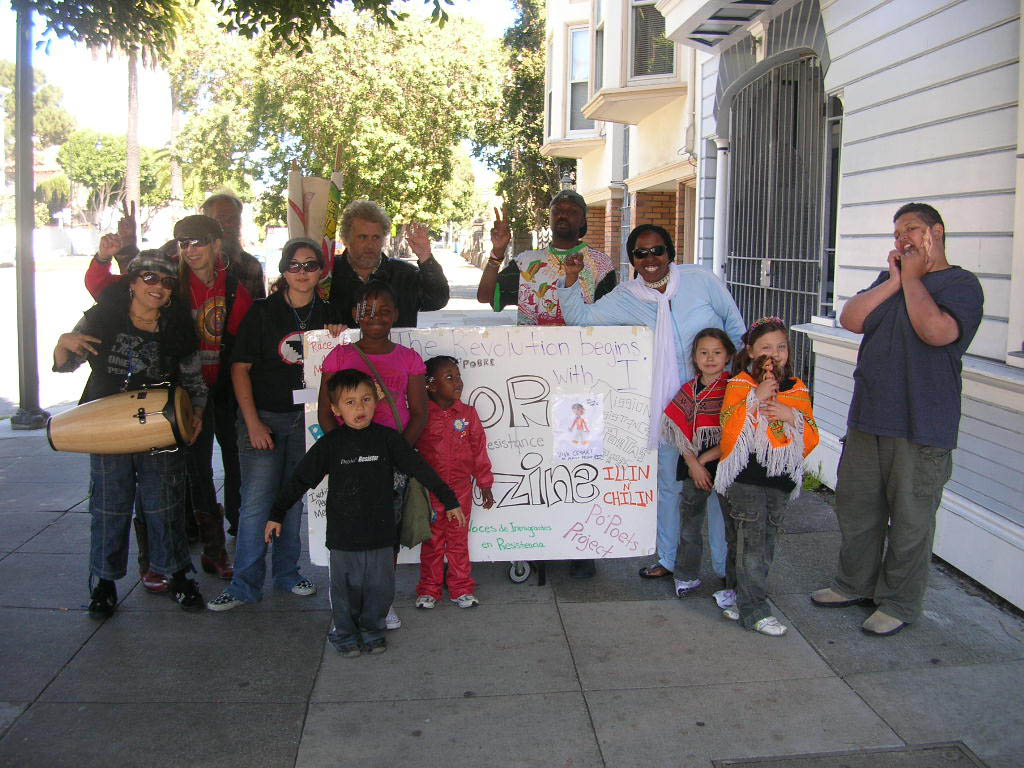
Starting with the first magical day in March, POOR's RPMJ led over 35 scholars from several non-profit organizations such as Mission Neighborhood Resource Center, Delores Street Community Services, La Raza Centro Legal, the Iris Center and St Joseph's Center through an intensive bi-lingual media, arts and organizing workshop in creative writing basics, media literacy, media justice, journalism and poverty scholarship called The Revolution Begins with I.

Your 'I' stories of struggle and survival, to stay housed, to stay employed, to feed your children, to fight systems that are in place to support you and often do the opposite, to find shelter, to keep your families safe and your children educated are valid and significant stories, important community media, and what we at POOR/PoorNewsNetwork consider revolutionary truth media, RPMJ co-teacher and co-editor, Tony Robles explained to the Mission Resistance class on the first day.

I have struggled to be housed with no help from most of the services supposedly in place to help homeless people,Jon T, began his RPMJ I am exercise tentatively, wondering out loud if his story of struggle was valid, or was in fact even media...By the graduation ceremony of Mission Resistance 8 weeks later, he presented his story to get housed, fight eviction and eventually become permanently housed as a story of resistance and triumph.

Your stories of struggle can cause change, can be tools of change, my experience of struggle with the welfare system has helped to change legislation that works against poor parents like me,� co-teacher, poverty scholar and welfareQUEEN Vivien Hain inspired the class with her own poverty scholarship and media resistance.

�I was profiled, stopped and questioned just for being a brown man on my way to get a job,� David M, a soft-spoken young man spoke at the third class of Mission Resistance, barely looking up from his small cup of hot tea. Working three jobs just to save money for housing, David was silently dealing with homelessness and racism while receiving services from Dolores Street Community Services. In addition to the actual struggle related to poverty, David was dealing with a silent and more brutal conflict, the shame associated with poverty, a shame that inhibits dreams, destroys hope and kills spirit. By the last class, a confident and focused David addressed the Newsroom with the subject of his investigative journalism project: �I want to write about the impact of budget cuts on mental health services for poor people of color in the Bay Area,� he concluded without looking down.

Los Viajes/The Journeys - the Mission media of migration

�La revolucion comienza con migo!� (The revolution Begins with �I�) called out Guillermo Gonzalez, co-teacher of the Voces de inmigrantes en resistencia program at POOR Magazine and coordinator of the Los Viajes project at POOR Magazine, a literary and audio anthology of peoples migration/immigration across borders all over the world.

Los Viajes was the concurrent project of Mission Resistance led by POOR Magazine migrant scholars. Taught in Spanish to migrant & poverty scholars from El Salvador, Guatemala, Mexico, Laos, the Carribean and beyond, this project incorporated the revolutionary �I� curriculum as well as beautiful stories of peoples' journeys across borders and lands to help support their families and folks. Through literary and visual art, this project also introduces the UN declaration on Indigenous Peoples � a new lens on migration to migrant communities in the Bay Area and will continue with several workshops and performances until a formal release in September in tandem with the anniversary of the signing of the UN declaration on Indigenous Peoples.

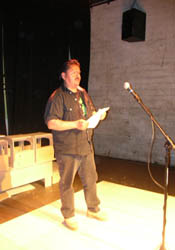
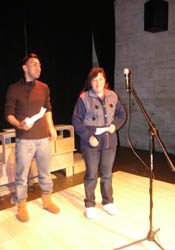
�Yo soy madre inmigrante de tres hijos,� (I am an immigrant mother of three children) Carmen, one of the members of Colectiva de Mujer of La Raza Centro Legal read an excerpt of her journey to the audience at the Mission Resistance graduation ceremony on April 8th. Carmen, who is struggling to feed her children as a working poor migrant mama, added with pride after reading her work of literary art and media resistance. �And, I, am a Poverty Scholar.�

Tiny aka Lisa Gray-Garcia, poet, revolutionary journalist, poverty scholar, welfareQUEEN, co-founder and executive Director of POOR Magazine/PoorNewsNetwork and daughter of Dee, is the author of Criminal of Poverty: Growing Up Homeless in America published by City Lights. She is also the Communications Director for Justice Matters.

POOR Magazine is a non-profit grassroots, arts, organization that provides media access, art and advocacy to youth, adults and elders in poverty in the Bay Area as well as on-site child care and arts education for children through the Family Project For more information about POOR Magazine�s ongoing media, arts and organizing project go on-line to www.poormagazine.org and for more information about our education program for educators, professionals and community members at the Race, Poverty Media Justice Institute go on-line to www.racepovertymediajustice.org.

Tags

Global Climate Change Kills

09/24/2021 - 09:45 by Anonymous (not verified)
Original Author
root
Original Body

Over 1,500 farmers in an Indian state committed suicide after being driven to debt by crop failure, it was reported today.

by From the Belfast Telegraph

The agricultural state of Chattisgarh was hit by falling water levels.

"The water level has gone down below 250 feet here. It used to be at 40 feet a few years ago," Shatrughan Sahu, a villager in one of the districts, told Down To Earth magazine.

"Most of the farmers here are indebted and only God can save the ones who do not have a bore well."

Mr. Sahu lives in a district that recorded 206 farmer suicides last year. Police records for the district add that many deaths occur due to debt and economic distress.

In another village nearby, Beturam Sahu, who owned two acres of land was among those who committed suicide. His crop is yet to be harvested, but his son Lakhnu left to take up a job as a manual labourer.

His family must repay a debt of £400 and the crop this year is poor.

"The crop is so bad this year that we will not even be able to save any seeds," said Lakhnu's friend Santosh. "There were no rains at all."

"That's why Lakhnu left even before harvesting the crop. There is nothing left to harvest in his land this time. He is worried how he will repay these loans."

Bharatendu Prakash, from the Organic Farming Association of India, told the Press Association: "Farmers' suicides are increasing due to a vicious circle created by money lenders. They lure farmers to take money but when the crops fail, they are left with no option other than death."

Mr. Prakash added that the government ought to take up the cause of the poor farmers just as they fight for a strong economy.

"Development should be for all. The government blames us for being against development. Forest area is depleting and dams are constructed without proper planning.

All this contributes to dipping water levels. Farmers should be taken into consideration when planning policies," he said.

This article is from The Belfast Telegraph.

http://digg.com/d1om3A

Tags

The Corporate lies of Gentrification

09/24/2021 - 09:45 by Anonymous (not verified)
Original Author
root
Original Body

A to Z Corporation attempts to defy height restrictions to gentrify the Mid-Market Cooridor

by Bruce Allison and Thorton Kimes/PNN

Readers know I go to many meetings. There are buildings being planned, 2 of them on 7th Street near Mission; one of them will be on the Eastern side in the middle of the block next to the Izabel Hotel, which houses people with chemical and mental illness challenges. Two years of construction would not help any of them with recovery and might make anger management difficult as well as generating the unintended consequence of increased police presence and surveillance.

The main problem with these 2 units is the violation of height restrictions and the percentage of required "affordable housing" units included in the construction. Poor families live in the neighborhood and not only will they not be able to avail themselves of this new housing but also the mainstream tourist trade will experience a loss of housing for the population of folks that drop millions of dollars (and hotel tax monies) into San Francisco's economy every year.

Mission and 7th Street's Western side is at risk too. By tearing down another 50-unit tourist hotel (which also happens to be where locals regularly catch buses to out-of-town casinos--T.K.) and a local pizza parlour, local tax receipts will continue to shrink. This will hurt even more because of property taxes assessed by the city and sent to the state return to the community,but there will be less of that for the 2 years this project will take to be completed.

This project is not deep enough in the pipeline for public comment and outrage to be ignored the A/Z-SF Hotels, LLC has only gotten to the EIS (Environmental Impact Statement study of the impact of their project on the neighborhood) level of activity. If you are a resident of San Francisco and want to stop this project from going forward, write to the staff contact person (Irene Nishimura) of the San Francisco Planning Department at her e-mail address (irene.nishimura@sfgov.org) or by mail mail to 1650 Mission Street, Suite 400, SF CA 94103-2479. The phone number is 415-575-9041.

One more reason for concern/outrage: no resident of the affected block of Mission Street has yet been informed that change is coming to the neighborhood. It would be very helpful if this was mentioned in inquiries or comments by mail, e-mail, or phone calls.

If you want to contact A/Z-SF Hotels, LLC, call Andrew Junius at Reuben and Junius, LLP at 415-567-9000 to ask that Ò114-7th Street construction not happen at all. We donÕt need more housing for the gentry.

This building contractor would be wise to retrieve its investment by making the housing units affordable to 50% of AMI (Area Median Income), with proper tax assistance A/Z-SF Hotels could make a profit and help the blue collar community that really could use more housing. A few units for people making 0-30% of AMI wouldn't hurt! This would also help the city by lowering taxes and getting more folks out of the shelters and off the streets.

The tax money saved by not pursuing this project could be used more creatively to help people get the education and services they need. For more information on this and other housing issues e-mail me at bruce94103@gmail.com.

Tags

I Never Thought This Would Happen... Again

09/24/2021 - 09:45 by Anonymous (not verified)
Original Author
root
Original Body

by Anonymous

I never thought I would be here again. I promised myself, that I would never ever ever let this happen again. Here I was another “victim of violence”, or so I thought.

I remember the first time I saw violence. It wasn’t on TV, or a movie my parents wouldn’t let me watch, it was in my family. I remember the feelings of sadness, violence, and anger hanging in the air of our house as if a permanent fog of violence had settled inside. It was if you could breathe it. I started to breathe it in, as if it were a daily dose of prescription that was given to me every day. “Must experience violence, sadness, or anger at least twice a day. Do not take on an empty stomach”, the prescription would read.

I breathe in that violence many ways, and would breathe it out in ways very opposite. Breathe in... Screams, yelling, door slamming, name calling, hitting… Breathe out… Crying, trying to be the best kid so my parents wouldn’t fight, turning on the TV so I didn’t have to hear the yelling… Ahhhhhh… these breaths of air were not toxic to anyone except me…

As I started getting older, the violence wasn’t just between my parents anymore. Smack… Pow… Thunk… all became sounds that were too familiar to my body. I now had become the object of parents’ hatred about themselves. The colors of black, blue, and red were an everyday occurrence. I would breathe in the violence, and breathe out bad grades, skipping class, and detention.

As I got older, the relationships I would be attracted to were not ever healthy. Lucky for me, they never lasted more than a week. I would remember to myself that I have to find someone who was not like the father I grew up with. I wanted someone who was traditional, kind, and loving.

I thought I found those qualities in someone I was dating. I remember we would go for these drives just to go to his family’s sweat lodge. I remember him talking about how he was so proud to be Native, and how this land used to be ours. I remember the violence he would lash out on me, instead of himself. I know that somewhere down in his soul he believed those boarding school lies and used those same abusive punishments on my body.

I remember how he would yell at me on the way driving to sweat lodge, and then he would make tobacco ties by the fire, and say how sorry he was. I remember on the way back from sweat lodge how he would spit and beat on my body to his heart’s content.

One day, I told a friend of mines and made a decision to talk about it. I thought telling his family would be helpful. I mean one of his relatives was a well-respected medicine man, and he would listen to me. Right? Well, I was wrong. I came out and told my story and got laughed out of their circle. I was told if it was that way then to not be with him. I left.

It took awhile to trust anyone again. I used to joke with my friend, and blame all men as the problem. She told me, "Women can hit too.” I didn’t understand what she was telling me. She then told me of a girlfriend she had, who would beat her, yell at her, and call her names. I couldn’t believe my friend had experienced violence too.

I noticed the more women I told my story too, the more they told me their stories. I started to tell some men my story too, and they would open up how they were abused and when got older abused their partner. One even told me how his girlfriend abused him.

I could not believe how many people experienced violence that I knew and respected. I started to think how could I erase violence at least from my own life?

I knew prayer was the first place to start. So I prayed everyday to God, asking for me to find the partner that was created for me. That we would have a healthy relationship, and our love would last for a lifetime.

Then I met him. I had dreams about him. I would spend hours talking to him. I would love how he held me. I would love those beautiful moments when we kissed. He had to be the one I prayed about. I thought to myself this is the man I want to spend my life with.

I wish I could say that all of the sudden violence entered our relationship, but in looking back it was there before I knew it. The abuse would go on and on, and even some of his family members noticed. One told me to call a hotline to get help. One of his family members told me to leave him. I remember being called bitch way before I got a black eye.

So here I was again, in a place I promised myself I would never be in. I thought I was too old to have abusive relationships. I proved myself wrong, abuse happens at any age. So I left him for a while. Of course, he came back crying and saying how he changed. He was going to go to Anger management, and he wanted to start a family that he never had. I bought it all… hook, line, and sinker.

It happened again except I had two black eyes this time. I cried so much, and he just kept saying sorry. He tried to heal the wounds he created. Those wounds were deeper than my eyes to heal them he would have to start with his soul. He promised to never do that again, and stated how he is an abuser and that he needs help. He held me in his arms that night.

The abuse didn’t stop. I would be blamed for something, called a bitch, or be accused of cheating on him. He even accused me of cheating with someone in his family. He was right I was being cheated. I was being cheated out of a healthy relationship that I prayed all the time for.

One day after beating me, I couldn’t take the lies anymore. The day before I told him I was pregnant, and this beating was the worst one. I know that the baby felt it. I woke up. I stopped lying to myself in thinking that we would be that happy, loving couple. He threatened my life and my unborn child, and I decided to tell someone my story.

I started with the police. It was the first time I had ever told anyone about the abuse I had suffered with him. I cried, and was very nervous about what the future held. Would his family hate me or retaliate against me? Would he try to get revenge on me for telling my story? What would I do after I told my story?

The next time I got a call from Victim Services and then from the prosecutor telling me they were going to press charges on him. They issued a warrant, and days later he was in jail. The courts during that time established a no contact order between us. It was during this time I started to see how his family treated me.

Different members of his family harassed me during this time. I was even ignored and snubbed by the relative who told me to call a hotline months before. He and members of his family were blaming me for his jail time. For one moment in time, I actually believed they were right. Then I snapped back into reality, and realized violence is a choice. He chose to become violent and take it out on me.

Finally, the trial came. He pleaded guilty. He was mandated to probation and DV counseling. He had more jail time to come as well.

During this whole time I was pregnant, I tried to be positive for the baby. It was hard with the constant harassment and stress coming from some of his relatives. I cried so much, and promised the baby that even if I have to be single for the rest of my life I will not let my child experience violence inside our home.

I was scared for my unborn child, and was suffering greatly from post-traumatic stress. Then that call came, “Mamm’ he will be released from jail in thirty minutes.” It all started coming back, but I tried to remember to be positive. So I went about my day, and cleaned up my house. Then that evening came, he wasn’t in jail anymore. Would he come to my house? Would he beat me up because he was in jail? Would he get a family member to do it? I started to have cramps, and then I started to bleed.

I freaked out. I called the hospital and talked to a labor nurse for advice. She said, “If it gets worse then come to emergency or just wait till morning to see your OBGYN.” I calmed down, and tried to go to sleep.

The cramps got worse. It was some of the worst pain I have experienced in my life. Then it happened, my unborn child was in my hands. Just like that my baby was gone. I cried harder than I ever have in my life. I still cry about the baby to this day. It is a pain that I know will never go away.

Growing up, I was taught that silence is sacred. Silence spoke volumes when my grandmother used it. I was taught that silence could also oppress others. In matters of abuse and violence, silence only helps to continue killing our communities, Nations, and societies.

A Pastor by the name of Martin Niemöller saw how dangerous silence surrounding violence is, and how it could lead to genocide. He stated:

“After Hitler came to power in Germany they came first for the Communists, and I didn't speak up because I wasn't a Communist. Then they came for the Jews, and I didn't speak up because I wasn't a Jew. Then they came for the trade unionists, and I didn't speak up because I wasn't a trade unionist. Then they came for the Catholics, and I didn't speak up because I was a Protestant. Then they came for me, and by that time no one was left to speak up.”

This Pastor saw how silence allowed genocide to kill millions of people. There is a genocide happening right now with our people, particularly our women. In what ways have you been silent about violence?

You may think this story includes you, that you may know me, or that you are the abuser, I consider that is how well you connected to this story. In the end this story is the story of many women and some men. It is a story that started on this land when the colonizers first came. I wrote it for all those survivors out there… who choose to not be a victim. I wrote it for all those abusers, so that you may realize violence is a choice. Violence is learned, and that it can be unlearned.

It is by writing this story I refuse to be silent any longer, and maybe one day if our society refuses to silent as well then I can republish this story with my name and have no fear.

(If you or someone you know has experienced domestic violence or abuse, please feel free to call Alternative Horizons 24-hour hotline at 970-247-9619 (English and Spanish) or Our Sister’s Keeper Coalition 24-hour hotline at 970-247-7888.)

Tags

The Story of Mission Resistance

09/24/2021 - 09:45 by Anonymous (not verified)
Original Author
root
Original Body

by Lisa Gray-Garcia

"My name is Vinnie and I make a living with this," his hands were small and Columbian--coffee brown, each finger rippled with the struggle of homelessness, racism and poverty as he carefully unfolded a 12-inch cardboard sign upon which was meticulously printed black letters stating "Starvin Like Marvin." (A reference to one of the famous sayings of middleweight boxing champion Marvin Hagler.)

The indigenous circle of multi-lingual, multi-generational and multi-racial, youth, adults and elders in poverty who produce news rooted in community struggle, art and resistance known as Community Newsroom at POOR Magazine busted into laughter of joy and appreciation at the sight of his sign. Vinnie stayed quiet as his sharp, chocolate eyes scanned the room. Then slowly, tentatively, the corners of his mouth seemingly frozen in a serious stillness lifted to reveal a broad and beautiful smile. He shook his head in tandem with the laughter, and just for a miraculous second, almost unseen, barely caught, Vinnie seemed carefree.

In a powerful collaboration between The Race, Poverty Media Justice Institute (RPMJ) at POOR Magazine, Intersection for the Arts and the Mission Community Council, I and other poverty scholars in residence at POOR Magazine were blessed to meet Vinnie H, Carmen C, Jennalyn S, Rhonda C, Jon T, Carlos L, Raymundo S and many more folks that we at POOR consider poverty, race, migrant, gender, elder and/or youth scholars engaged in different forms of unrecognized micro-business (panhandling, recycling, day laborers, sex work, mothering) and survival.

Through this collaboration, entitled Mission Resistance as it focused specifically on mission based organizations and communities, folks like Vinnie were exposed to the revolutionary concept of poverty scholarship itself, launched by POOR's RPMJ, which honors and recognizes the scholarship of youth, adults and elders in poverty for the knowledge they hold, have earned and continually learn from lives of struggle.

Starting with the first magical day in March, POOR's RPMJ led over 35 scholars from several non-profit organizations such as Mission Neighborhood Resource Center, Delores Street Community Services, La Raza Centro Legal, the Iris Center and St. Joseph's Center through an intensive bi-lingual media, arts and organizing workshop in creative writing basics, media literacy, media justice, journalism and poverty scholarship called The Revolution Begins with "I".

"Your 'I' stories of struggle and survival, to stay housed, to stay employed, to feed your children, to fight systems that are in place to support you and often do the opposite, to find shelter, to keep your families safe and your children educated are valid and significant stories, important community media, and what we at POOR/PoorNewsNetwork consider revolutionary truth media," RPMJ co-teacher and co-editor, Tony Robles explained to the Mission Resistance class on the first day.

"I have struggled to be housed with no help from most of the services supposedly in place to help homeless people," Jon T, began his RPMJ "I am" exercise tentatively, wondering out loud if his story of struggle was valid, or was in fact even media...By the graduation ceremony of Mission Resistance 8 weeks later, he presented his story to get housed, fight eviction and eventually become permanently housed as a story of resistance and triumph.

"Your stories of struggle can cause change, can be tools of change, my experience of struggle with the welfare system has helped to change legislation that works against poor parents like me," co-teacher, poverty scholar and welfareQUEEN Vivien Hain inspired the class with her own poverty scholarship and media resistance.

"I was profiled, stopped and questioned just for being a brown man on my way to get a job," David M, a soft-spoken young man spoke at the third class of Mission Resistance, barely looking up from his small cup of hot tea. Working three jobs just to save money for housing, David was silently dealing with homelessness and racism while receiving services from Dolores Street Community Services. In addition to the actual struggle related to poverty, David was dealing with a silent and more brutal conflict, the shame associated with poverty, a shame that inhibits dreams, destroys hope and kills spirit. By the last class, a confident and focused David addressed the Newsroom with the subject of his investigative journalism project: "I want to write about the impact of budget cuts on mental health services for poor people of color in the Bay Area," he concluded without looking down.

Los Viajes/The Journeys - the Mission media of migration

"La revolucion comienza con migo!" (The revolution Begins with "I") called out Guillermo Gonzalez, co-teacher of the Voces de inmigrantes en resistencia program at POOR Magazine and coordinator of the Los Viajes project at POOR Magazine, a literary and audio anthology of peoples migration/immigration across borders all over the world.

Los Viajes was the concurrent project of Mission Resistance led by POOR Magazine migrant scholars. Taught in Spanish to migrant & poverty scholars from El Salvador, Guatemala, Mexico, Laos, the Carribean and beyond, this project incorporated the revolutionary "I" curriculum as well as beautiful stories of peoples' journeys across borders and lands to help support their families and folks. Through literary and visual art, this project also introduces the UN declaration on Indigenous Peoples; a new lens on migration to migrant communities in the Bay Area and will continue with several workshops and performances until a formal release in September in tandem with the anniversary of the signing of the UN declaration on Indigenous Peoples.

"Yo soy madre inmigrante de tres hijos," (I am an immigrant mother of three children) Carmen, one of the members of Colectiva de Mujer of La Raza Centro Legal read an excerpt of her journey to the audience at the Mission Resistance graduation ceremony on April 8th. Carmen, who is struggling to feed her children as a working poor migrant mama, added with pride after reading her work of literary art and media resistance. "And, I, am a Poverty Scholar."

Tiny aka Lisa Gray-Garcia, poet, revolutionary journalist, poverty scholar, welfareQUEEN, co-founder and executive Director of POOR Magazine/PoorNewsNetwork and daughter of Dee, is the author of Criminal of Poverty: Growing Up Homeless in America published by City Lights. She is also the Communications Director for Justice Matters.

POOR Magazine is a non-profit grassroots, arts, organization that provides media access, art and advocacy to youth, adults and elders in poverty in the Bay Area as well as on-site child care and arts education for children through the Family Project For more information about POOR Magazine's ongoing media, arts and organizing project go on-line to www.poormagazine.org and for more information about our education program for educators, professionals and community members at the Race, Poverty Media Justice Institute go on-line to www.racepovertymediajustice.org.

Tags

Primero de Mayo Marcha / May 1st March

09/24/2021 - 09:45 by Anonymous (not verified)
Original Author
root
Original Body

Exigiendo Nada Menos de lo Que Se Merece: Preparación para la Marcha del 1ero de Mayo para los Derechos de Migrantes en Oakland

Demanding Nothing Less Than What Is Deserved: Preparation For The May 1st Rally For Migrant Rights In Oakland


Exigiendo Nada Menos de lo Que Se Merece: Preparación para la Marcha del 1ero de Mayo para los Derechos de Migrantes en Oakland

Demanding Nothing Less Than What Is Deserved: Preparation For The May 1st Rally For Migrant Rights In Oakland


by Chloe Auletta-Young/Race, Povery and Media Justice Intern

Scroll down for English

“No estamos pidiendo algo enorme,” comento Sagnicthe Salazar, “estamos exigiendo nada menos de lo qué nos merecemos.” Salazar es Coordinadora Líder de Huaxtec, una organización de base para la juventud de la Raza y una organización miembra de Oakland Sin Fronteras. Huaxtec es también una de las muchas organizaciones que patrocinan la marcha y la reunión del 1ero de Mayo contra las violaciones de los derechos humanos sufridos por los migrantes indocumentados que viven y que trabajan en los E.E.U.U.

El programa comenzará a las 3:30 p.m. el viernes 1ero de Mayo en la Plaza de Fruitvale. A las 4:30 p.m. comenzará la marcha hacia la plaza de Frank Ogawa, en el ayuntamiento de Oakland, terminando aproximadamente a las 6:00 p.m. El tema del acontecimiento será derechos humanos para cada uno, moratoria a las detenciones y las deportaciones, y vivienda, cuidado médico, y educación para todos.

Salazar tomaba el liderazgo en una de las reuniones de planeamiento que hubo el lunes 20 de abril en la Clinica De La Raza en Fruitvale. Los líderes de una pequeña cantidad de otras organizaciones que patrocinaban vinieron juntos para discutir la programación, alcance, seguridad, limpieza, hospitalidad, etc. Toda la conversación era bilingüe, en español y el inglés y las ideas de todo/as fueron escuchadas. Nunca he tenido la experiencia de tal unión de las organizaciones de base que se juntaron para planear un acontecimiento singular. “Para mí como adulto joven y migrante, es mi obligación de participar en esto y de comenzar a organizar nuestras comunidades,” dijo Muteado Silencio, un escritor migrante, y miembro del personal de la organización patrocinadora TIGRA, y escritor del personal para la revista POOR, “necesitamos forzar la nueva administración a tomar nuevas acciones, para reconocer a los trabajadores indocumentados.”

Salazar tenía otro propósito sobre la marcha, “en el pasado las demandas legislativas fueron concretas, pero los cambios no han significado mucho. Oakland ha sido una ciudad santuaria anteriormente, nada cambia… No estámos hablando de amnistía porque no hemos hecho nada para que seamos perdonados, nosotros apenas queremos los derechos que la O.N.U nos da, la libertad del movimiento, que hace que la gente pare de verse como inmigrantes y comienza verse como migrantes.” La marcha en Oakland es así una llamada de adentro para afuera, uniendo la comunidad internamente para llamar la atención a la hipocresía de la política de los E.E.U.U. “Durante los años no importa lo qué este sucediendo, sea la economía o lo que sea, los trabajadores indocumentados son el chivo expiatorio, los accusados.” Muteado dijo, “a excepción de los nativos americanos y los Afro-Americanos, que fueron traídos aquí por fuerza, somos todos migrantes. Puede ser que hayamos cruzado la frontera, pero los europeos cruzaron un océano.”

El evento está haciendo una conexión con la comunidad Afro-Americana al acentuar la ejecución de Óscar Grant como ejemplo de la militarización cada vez incrementando dentro de vecindades, reflejando la militarización de la frontera. “Oakland Sin Fronteras conecta la lucha de migrantes con las luchas de todas las comunidades de la clase obrera en todo el mundo, con la guerra, las prisiones, y la militarización de nuestros hogares y vecindades,” Salazar indico.

El programa comenzará con los altavoces de la comunidad y de los funcionamientos artísticos, tales como Danza Azteca y Poetas Pobres de la revista POOR. La marcha no va ser corta, son tres millas para llegar al ayuntamiento desde Fruitvale. Sin embargo, es corto cuando está comparado a la importancia de los mensajes, 3 millas en una lucha contra injusticia. “Es necesario que nuestra gente esté allí,” dijo Salazar, “ello/as sufren la parte más recia de los ataques pero nunca tienen el poder dentro de las discusiones. En este caso, sus cuerpos son su voz.”

--------------------------

Demanding Nothing Less Than What Is Deserved: Preparation For The May 1st Rally For Migrant Rights In Oakland

By Chloe Auletta-Young

“We are not asking for something huge,” commented Sagnicthe Salazar, “we are demanding nothing less than what we deserve.” Salazar is Lead Coordinator of Huaxtec, a grassroots organization for Raza youth and a member organization of Oakland Sin Fronteras. Huaxtec is also one of the many organizations sponsoring the May 1st march and rally against the human rights violations suffered by undocumented migrants living and working in the U.S. The program will start at 3:30pm on Friday, May 1st at Fruitvale Plaze. At 4:30pm the march to Frank Ogawa Plaza at the Oakland City Hall will begin, ending at approximately 6:00pm. The theme of the event will be human rights for everyone, moratorium on detentions and deportations, and housing, health care, and education for all.

Salazar was taking the lead on one of the planning meetings held Monday, April 20th at Clinica De La Raza in Fruitvale. Leaders from a handful of the other sponsoring organizations came together to discuss programming, outreach, security, clean-up, entertainment, etc. All conversation was bilingual, in both Spanish and English and everyones input was heard. I have never experienced such a uniting of grassroots organizations coming together to plan a singular event. “For me as a migrant young adult, it's my obligation to take part in this and start organizing our communities,” said Muteado Silencio, a migrant scholar, staff member of sponsoring organization TIGRA, and staff-writer for POOR Magazine, “we need to force the new administration to take new action, to recognize the undocumented workers.”

Salazar had another purpose behind the march, “in the past their have been concrete legislative demands, but the changes haven't meant much. Oakland has been a sanctuary city before, nothing changes...We are not talking about amnesty because we have done nothing to be forgiven for, we just want the rights that the UN gives us, the freedom of movement, that takes people to stop seeing themselves as immigrants and start seeing themselves as migrants.” The march in Oakland is thus a call from the inside out, uniting the community internally in order to call attention to the hypocrisy in U.S. Policy. “Over the years no matter what is going on, be it the economy or whatever, undocumented workers are the scapegoat,” stated Muteado, “with the exception of Native Americans and African-Americans, who were brought here by force, we are all migrants. We might have crossed the border, but Europeans crossed an Ocean.”

The event is making a connection to the African-American community by emphasizing the execution of Oscar Grant as an example of the increasing militarization within neighborhoods, mirroring the militarization of the border. “Oakland Sin Fronteras connects the struggle of migrants to the struggles of all working class communities around the world, to war, prisons, and militarization of our homes and neighborhoods,” stated Salazar.

The program will begin with speakers from the community and artistic performances, such as Danza Azteca and Poetas Pobres of POOR Magazine. The following march is not a short one, it is three miles from Fruitvale to City Hall. However, it is short when compared to the importance of the messages, 3 miles in a fight against injustice. “It is necessary for our folks to be out there,” said Salazar, “they bear the brunt of the attacks but they never have the power within the debates. In this case, their bodies are their voice.”

Tags