Story Archives

Scavenging to survive in Pasadena

09/24/2021 - 10:42 by Anonymous (not verified)
Original Author
root
Original Body

To support her family, an undocumented worker gathers recyclables from street-side containers. 'I do it out of necessity,' she says.

by Anna Gorman/LA Times Staff writer

para espanol, mira abajo

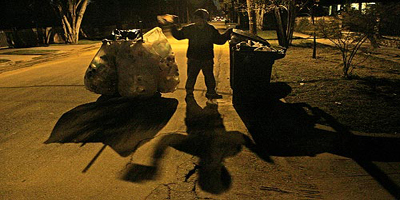
It's not yet 3 a.m. Juana Rivas grabs her shopping cart and steps off the curb into the dark.

She shields herself from the cold with a sweat shirt and jacket, along with a pink hat and gloves she bought at the 99-cent store. Only a barking dog interrupts the silence.

Rivas arrives at the first house, lifts the trash can lid and shines her flashlight inside. Nothing.

"No hay. No hay," she says in Spanish.

She peers into another trash can. Nothing. She zigzags back and forth across the street, stopping at each house to search for aluminum cans, glass bottles, plastic containers, anything she can exchange for money at the local recycling center. She reaches inside and shakes the contents, listening for the telltale clink of a beer bottle or the hollow tap of a milk carton. Nothing.

She starts to feel anxious. Her husband and four children are depending on her. The $2,300 rent check on their Pasadena home is due in one week. She already asked for an extension on the gas. The cable and the phone have been disconnected.

She speeds up the pace. The plastic bags attached to the cart swoosh against one another. The wheels rattle as they roll over pebbles in the street.

A few minutes later, she finds an empty Sierra Mist can, a few plastic water bottles and several Foster's beer bottles. She dumps them into her empty cart.

"There are bad days and good days," says Rivas, 48.

As she walks toward the next house, she says, "It's going to be a bad day."

Rivas knows what people think, that she digs through her neighbors' trash to make money for drugs or alcohol. She knows what people call her -- scavenger, digger, thief.

"There are people who look at me like, 'You aren't worth anything. You aren't anybody,' " she said.

For 13 years, she says, she has collected cans and bottles "to pay my rent, my bills. I do it out of necessity."

She has looked for more stable jobs, including cleaning offices at night. But nowadays, more companies are asking for immigration papers, papers she doesn't have.

Besides, scavenging pays OK, she says. The more hours she puts in, the more she earns. Her proof is in her recycling center receipts: Oct. 22: $70.12. Dec. 12: $143.08. Jan. 4: $134.91. Overall, in a year she might earn between $20,000 and $25,000. Combined with what her husband earns and what her children contribute, they can meet the rent and put food on the table.

Rivas is part of the expanding underground economy -- the hundreds of thousands of immigrants in Southern California who clean houses, mow lawns and wash dishes, making money at the margins and paying few if any taxes. Her story mirrors the contradictions that make illegal immigration such a flash point. She broke the law getting here and drains a municipal resource staying here. Yet she works hard, very hard, so her children won't have to do the same.

Every weekday, she wakes at 2:30 a.m., knowing that even an hour more of sleep means less money. She walks miles and miles, even when it rains, even when she is battling the flu.

"If I miss one day, I'm short," she says.

Her only company is the Spanish-language DJ El Piolin, Eddie Sotelo on KSCA-FM (101.9), who entertains her through a hand-held radio one of her sons gave her two years ago.

Her shoulders and legs ache from pushing the heavy cart up and down hills. Her hands throb from arthritis. This morning, two of her fingers are bandaged with white tape. Two years ago, she had to go to the emergency room to get stitches when a broken bottle gouged open her forearm. She left with several stitches and a tetanus shot. Emergency Medi-Cal covered the treatment.

Criando una familia con la basura de Pasadena

* Para comprar comida y pagar la renta, una inmigrante ilegal recolecta y vende reciclables.

Por Anna Gorman, Redactora del Times

March 12, 2008

Aún no han dado las 3 a.m., Juana Rivas echa mano a su carrito de súpermercado y pasa de la acera a la oscuridad.

Se resguarda del frío con una sudadera y una chamarra, así como un sombrero rosado y unos guantes que compró en una tienda de 99 centavos. Sólo los ladridos de un perro interrumpen el silencio.

Rivas llega a la primera casa, levanta la tapa del basurero y alumbra hacia adentro con su linterna. Nada.

"No hay. No hay," dice ella.

Mira al interior de otro basurero. Nada. Camina en zigzags hacia delante y hacia atrás por la calle, parando en cada casa en pos de latas de aluminio, botellas de cristal, recipientes plásticos, cualquier cosa que ella pueda cambiar por dinero en el centro de reciclaje local. Mete las manos dentro, sacude el contenido por si oye el sonido clave de una botella de cerveza o el sonido hueco de un cartón de leche. Nada.

Le entra ansiedad. Su esposo y cuatro hijos dependen de ella. Al cheque por $2,300 por el alquiler de su casa en Pasadena le falta una semana. Ya tuvo que pedir una extensión para el pago del gasóleo. El cable y el teléfono ya fueron desconectados.

Ella acelera el paso. Las bolsas plásticas atadas al carrito suenan al pasar unas contra otras. Las ruedas chirrían al pasar sobre los guijarros de la calle.

Unos minutos después, halla una lata vacía de Sierra Mist, unas cuantas botellas plásticas de agua y varias botellas de cerveza Foster. Lo echa todo en su carrito vacío.

"Hay días malos y días buenos," dice Rivas, de 48 años.

A medida que camina hacia la próxima casa, dice, "Va a ser un día malo."

Rivas sabe lo que la gente piensa, que ella registra los basureros de sus vecinos en busca de dinero para drogas o alcohol. Ella sabe lo que dicen de ella – rastrojera, buscona, ladrona.

"Hay gente que me mira con cara de, 'No vales nada. No eres nadie,' " dijo ella.

Durante 13 años, dice ella, has recolectado latas y botellas "para pagar la renta, mis cuentas. Lo hago por necesidad."

Ella ha buscado trabajos más estables, incluso limpiar oficinas de noche. Pero hoy en día, hay más compañías pidiendo papeles de inmigración, papeles que ella no tiene.

Además, recolectar rastros paga bien, dice ella. Cuántas más horas le dedica, más gana. Su prueba está en los recibos del centro de reciclaje: 22 de octubre: $70.12, 12 de diciembre: $143.08, 4 de enero: $134.91. En general, en un año ella puede ganar entre $20,000 y $25,000. Combinado con lo que gana su esposo y lo que contribuyen los hijos, pueden pagar la renta y poner comida en la mesa.

Rivas es parte de la incipiente economía clandestina – los cientos de miles de inmigrantes del sur de California que limpian casas, podan céspedes y friegan platos, que ganan un dinero marginal y pagan muy poco, o nada, en impuestos. Su historia refleja las contradicciones que hacen de la inmigración ilegal un punto álgido. Ella infringió la ley para llegar aquí y drena recursos municipales al quedarse aquí. Sin embargo, trabaja duro, muy duro, para que sus hijos no tengan que hacer lo mismo.

Todos los días se levanta a las 2:30 a.m., a sabiendas de que tan sólo una hora más de sueño significa menos dinero. Camina millas y millas, incluso cuando llueve, incluso cuando está batallando contra la gripe.

"Si falto un día, no me alcanza," dice ella.

Su única compañía es el locutor hispanohablante El Piolín, Eddie Sotelo de la KSCA-FM (101.9), que la entretiene mediante un radio portátil que uno de sus hijos le regaló hace dos años.

Los hombros y las piernas le duelen de empujar el carrito cuesta arriba y cuesta abajo. La manos le tiemblan de la artritis. Esta mañana tiene dos dedos vendados con esparadrapo blanco. Hace dos años tuvo que ir a una sala de urgencia para que le suturaran una laceración que le hizo un pico de botella en un antebrazo. Salió con varios puntos y una vacuna antitetánica. El servicio de emergencia Medi-Cal cubrió el tratamiento.

Tags

Victory of Resistance!

09/24/2021 - 10:42 by Anonymous (not verified)
Original Author
root
Original Body

After years of hard work by the Coalition on Homelessness, groundbreaking shelter standards are passed by San Francisco's Board of Supervisors.

by Jennifer Friedenbach/Coalition on Homelessness

After two years of hard work by the Coalition on Homelessness, and its allies, the Board of Supervisors voted 9 to 2 to pass ground breaking minimum standards in San Francisco shelters. The legislation, sponsored by Supervisor Tom Ammiano and co-sponsored by Supervisors Mirkarimi, Peskin, and Sandovol requires shelters to maintain their facilities, ensure clean sheets, towels and blankets, provide training for staff, nutritious food and more.

In May of 2007, the Coalition on Homelessness released a report entitled "Shelter Shock" regarding abuse cruelty and neglect in San Francisco's shelters. The report captured the voices of shelter
residents and their experiences. Based on the report findings, the
Coalition's Right to Roof Work Group outlined recommendations to create a standard of care in San Francisco's shelters. The ideas came directly from residents, regarding the on-going struggle of living in the shelter and what changes would make substantive differences in their lives.

The legislation follows standards that are set in place for other
congregate living facilities. There were literally hundreds of people
working on the legislation, with a chunk of the work being done in the Shelter Monitoring Committee Standard of Care work group. Shelter Providers, Human Services Agency, Department of Public Health, Disease Control, Worker Occupational Safety, and TB Control all had a voice in the process. The overall legislation also includes health standards to contain the spread of illness and disease. After all, living in a congregate setting, this should be of utmost concern. When residents don't have basic access to
toilet paper, and then do not have soap to wash their hands, the spread of disease is an obvious outcome. When residents don't have nutritious meals, their health further falters.

The Shelter Monitoring Committee found that a full one third of San Francisco's shelters did not meet basic hygiene standards. The
Coalition on Homelessness based on the voices of shelter residents that found that 55% of shelter residents experienced some form of abuse in San Francisco's shelters. The Mayor's Office on Disability reported that a full one-quarter of their complaints came from shelter residents. A look at both our own findings and those of governmental sources indicated that we had a major problem in the shelters. Problems that the administration continues to deny or downplay to this day.

While the legislation has garnered broad support from providers and homeless community members alike, the Mayor's office sent a letter opposing it. They stated it was too expensive based on inflated costs that were provided by the Human Services Agency. We worked hard to debunk those inflated costs with the Budget Analyst and in the end, the Mayor was forced to support the legislation for no other reason then we had enough votes to override a veto.

The passage of this legislation is seen as a major victory for homeless people and their organization, the Coalition on Homelessness. It is the third major systemic change in the shelter system that the organization has realized. The first victory was the passage of the shelter advocate program, which ensures due process when individuals are put out of shelters, and the second was the passage of the Shelter Monitoring Committee, which monitors shelter conditions. This legislation will strengthen the Shelter Monitoring Committee, as it will now have standards by which to measure the conditions of the shelters, and the ability to recommend fines for Public Health to carry out if the non-compliant shelter does not take corrective action.

Originally the idea was for the Shelter Monitoring Committee to levy fines, but that was found to be illegal by the City Attorney at the last minute. In that version, organizations could appeal fines to the Human Services Agency. Now Public Health, which is much more
independent from political winds then the Human Services Agency and levies fines in other situations for health code violations, would be the ones fining agencies for non-compliance. It is our hope, there will be no fines, as the shelters have the opportunity to take corrective action before it gets to that point.

Since the passage of this legislation, homeless shelter residents now have a right to:

Being treated with Dignity and Respect

A Safe Environment Free from violence.

Toilet Paper, hand soap and dryers

Clean Sheets, Blankets,

Pillow and Towels

Fresh Drinking Water

First Aid Kits

Reasonable accommodation for meals

Nutritionist in system to plan meals

8 hours of sleep

Daytime access in 24 hour shelters

Electricity for charging cell phones

Access to free local calls

Materials in Spanish and English

Staff who wear badges

Disaster plan

Public notice of meetings

Access to free laundry

Minimum 7 night stays (except CAAP beds)

Staff who is trained

To learn more about the work of the Coalition on Homelessness, and to get the latest scoop on the
politics of poverty in SF, go to the Street Sheet blog:
www.cohsf.org/streetsheet

Tags

Whose Poverty? Whose Crime?

09/24/2021 - 10:42 by Anonymous (not verified)
Original Author
root
Original Body

Unlocking the Criminalization of Poverty Symposium at UC Berkeley's School of Law. Challenging Academia and bringing the voices of surviving and thriving poverty, race, youth and disability scholars.

by Sam Drew, Tiny and Joanna Letz/PNN

Note from the Editor:

As I lived through the personal experience of being raised as the child of a houseless, criminalized family in Amerikkka, arrested countless times for the sole act of being homeless and sleeping in our vehicle, evicted and displaced when landlords/poverty pimps no longer thought they needed to provide "affordable housing" witnessed my mama, a poor woman of color, harassed by CPS, welfare systems and the criminal (In) justice System, and finally, when I was incarcerated for these crimes of poverty, I began the journey to write my memoir; Criminal of Poverty; Growing up homeless in America , which chronicled my families story of three generations of poor women in Amerikkka and the subsequent launch and resistance of POOR Magazine, the organization. In 2005 I launched the welfareQUEENS, which was a play and media project focused on the ways that poor women and families are criminalized, and in 2006,when my book was finally published by City Lights Foundation, I began a year-long effort to raise awareness on the increasingly dangerous trend of the criminalization of poverty which crosses race, class, cultures and generations of folks. We held several panels, and town halls over the year. Last week much of our powerful work and scholarship culminated in a very powerful symposia sponsored by the Thelton Henderson Center for Social Justice held at UC Berkeley's Boalt Hall. The following are pieces of the symposia told to you by poverty
and race scholars Sam Drew, myself and one of the graduates of POOR's Race, Poverty and Media Justice Institute, Joanna Letz.

Day 1 at the Symposium

The welfareQUEENS breaking it down; a living, breathing, struggling group of mamaz

By Sam Drew

Day One began at 12:00 noon with a panel led by graduate students and fellows of the Institute for the Study of Social Change entitled: State Action, Community Perspectives, and the Moral Order focused on research these students had done on the criminalization of migrant workers. Sam Arrived at 1:30 for panel two.

As I sat stiff backed watching the welfareQUEENS entertain and inform the crowd at the "Whose Poverty? Whose Crime? Unlocking the Criminalization of Poverty" Symposium at the Thelton E. Henderson Center for Social Justice at the UC Berkeley's school of Law, I glanced at a middle aged African-American couple being entertained in an interactive call and response style that was 180 degrees in opposition to the detached and overly intellectual style of lecture- listen and recite, that usually occurs in the halls of academia.

Before the welfareQUEENS took control of the stage the audience had just finished intently listening to the panel, "Breaking it Down: The Root Causes of the Criminalization of Poverty." , which featured Paul Boden, Monique Morris Dr. James Garrett and was moderated by Steven Pitts

Paul Boden, is the co-founder and longtime director of the Coalition on Homelessness (COH), and works with the Western Regional Advocacy Project (WRAP). He explained how homelessness has its roots in early legal and political decisions. Boden said, "25 years of federal housing cuts have created more homelessness."

Monique Morris, Director of Research Center for Social Justice, talked about the differential treatment of certain communities. She said, "The root causes of criminalization are low wage jobs, educational factors like zero tolerance and a juvenile justice system that polices some communities differently."

Ms. Morris continued, "The Prison Industrial Complex is a function of slavery[and is] sustainable because it's financially profitable... the government is spending money not on building community resources, but on waging war on the poor [while] at the same time receiving financial gain from this war because institutions like the prison industrial complex are financially profitable."

Dr. James Garrett, Division Dean at the Peralta Colleges, spoke to societies attack on the black community and black youth. He said, "The drug war became the war on the black community which then became the war on black youth."

Near the end of the first day of the symposium, the welfareQUEENS added the warmth of a living, breathing, struggling group of mamaz dealing with poverty, welfare, racism, and disability. Their performance reached out and touched the crowd in a way a lecture or pie-chart never could. They were the folks who have lived their experiences and were re-defining research and living scholarship.

Day One ended with a lecture by Dorothy Roberts, a Professor of Law from Northwestern University School of Law who echoed much of the scholarship on the relationship to racism and criminalization presented by the welfareQUEENs with a historical overview beginning with the advent and use of paupers prisons in the early days of Amerikkka and Western Europe.

Day 2 at the Symposium

Trash, Dirt, Mess, Crazy, Stupid
Hygienic Metaphors and the complicit role of media and academia in Criminalizing/ targeting people in poverty

By Tiny

This Day began with the panel:Poor Crimes: How the United States Punishes People Living in Poverty and featured Carlos Mares, poverty and migrant scholar and founder of Founder, Lucha Unida del Jornalero breaking down the ways that migrant workers are consistently criminalized for the sole act of seeking work as well as Tirien Steinbach, Executive Director of East Bay Legal Community Law Center (EBLC) in Oakland who spoke on the ways in which people are criminalized for the sole act of sitting , standing, and walking while poor and the revolutionary ways that EBLC works to fight these citations for crimes of poverty as well as Elisa Della Piana from Lawyers Committe for Civil Rights who also fights for justice for class and raced-based crimes and broke down the ways in which she, a white housed female with a child isn't cited for sitting in public parks while folks who "look houseless" are cited and arrested around her.This powerful panel was moderated by UC berkeley Law professor Jeff Selbin.

The Trash, Mess, Dirt,Crazy, Stupid Media panel followed at 11:00am

As the power-point stalled on the screen for the waiting audience, listing all the labels my fellow poverty, race, disability, migrant and youth scholars and I have been called, I walked up the aisle of the Goldberg Room in Boalt Hall.

POOR Magazine scholars were lead organizers and co-sponsors of the symposia, an interesting process that included challenging academia's notions of scholarship head-on from the planning to the execution. Myself and Leroy Moore from POOR Magazine, Martin Reynolds of the Oakland Tribune and Susan Rasky of the Journalism School at UC Berkeley were panelists of the media panel. The power-point was the preview to my presentation which included a
condemnation of not only "the media" but of "academia". And I knew, without a doubt, that there was never a more important speech for me to deliver. This was it, my moment of glory, the final round in my Muhammad Ali Versus Joe Frazier bout.

POOR Magazine has been fighting for media justice, media access and about the very essence of this whole symposia since 1996 when POOR Magazine, the literary, visual arts, intentionally glossy magazine (and then later, the non-profit organization of the same name) was a dream in me and my poor mama's eyes, a chance for change in my formerly incarcerated, always poor, underground economy-involved family. A chance for people who have been and
continue to be oppressed, incarcerated and silenced for hundreds of years by systems, institutions and organizations that work to segregate, target and disempower our voices, to be finally heard.

I began...."There are many things this poverty scholar can teach you- but in reality, no more or less than any of the poverty scholars you see, or more than likely don't see, everyday. Homeless families, poor youth of color, migrant workers, panhandlers, sex workers; sitting, dwelling, camping, soliciting work, convening. I am them, they are me.

We are in a revolutionary struggle to not be lied about, incarcerated, mythologized, and misconstrued; to be truly heard and recognized for the deep scholarship we all hold; to survive while battling the looming jaws of poverty, the criminal injustice system, the police, the welfare system, and the gentrifying landlords.

But the one thing this poverty scholar must teach you is to re-think your notions of scholarship itself. Who is considered a great scholar? How is scholarship attained? How is greatness honored? And with what barometer do we measure this canon"

At POOR Magazine we have a radical concept of scholarship: who deserves it, how it is attained, and how it is used. This scholarship has a new canon, with new designations for greatness. Survival itself, through extreme poverty and crisis, houselessness, racism, disability, and welfare, to name a few, are what you need to qualify for poverty scholarship. Conversely, a person who is formally educated with a Master's Degree and no poverty scholarship would be considered inexperienced and therefore, should not be writing, lecturing, or legislating for and about communities in poverty. The formally understood "signs" of scholarship, such as writing, researching, critiquing, publishing, require inherent privilege. These signs afford people an ability to be heard and recognized."

I went on to explain the ways in which academia with its rigid notions of scholarship, research, data collection, and language domination acts to covertly and overtly, pathologize, separate, segregate, sort and label communities in poverty into categories and by so doing they are no longer at the table of power and decision-making.

From these roots I took people through a survey of corporate media's coverage of communities facing displacement, eviction, homelessness, profiling, border fascism, racism and Incarceration. Communities like the Bayview facing Lennar Corp and Its lies and poison and our fellow brother and sisters in the gulf's fight against massive racist displacement, the gang Injunction's Impact on youth of color, and on and on.

How POOR Magazine's Race, Poverty and Media Justice Institute teaches on "the Myth of objectivity" In media production, which just means that only certain people get spoken to, quoted and considered, I.e., the po-lice, the legislators, the so-called "experts".

Finally, the resistance of truth media, the true peoples' media like the SF Bayview, PoorNewsNetwork, El Tecolote, The Street Sheet, Street Spirit, The Block report, La Raza Chronicles and POOR Magazine on KPFA as well as how we as a people need to stop limiting our notions of what media is. Media is Hip Hop, graffiti, art, spoken word, flowetry, talk and story.

After my last word, the room was in a hush. After a couple of seconds people stood up and then an almost standing ovation filled the auditorium. For a moment, the power dynamic was challenged, the paradigm shifted, and the scholars were heard.

Day Three at the Symposium

Strategy Sessions and Solutions

"How do you invest people in interdependence?”

By Joanna Letz

As I sat and listened intently to Tiny's presentation I looked around the room hoping everyone was holding onto each word as much as I was. The woman sitting next to me began a call and response as Tiny spoke, transforming the space from the stately, uprightness of academia into a fluid space of resistance. Time seemed to stop for a moment as Tiny finished her speech. No one had any words left to say.

As a person who comes from privilege I feel blessed to be a student in POOR Magazine's Race , poverty and Media Justice Institute's professional programs for college students and professionals which reinvents what it means to be educated and to educate. We are taught by poverty scholars educated in lived experiences how to really write, organize and do change-making media, policy and organizing.

At 12:30 the whole symposia broke out into lunchtime strategy sessions, focused on many forms of criminalization including vets, youth, mamaz and children, status crimes, media representations and homeless courts. Scholars like Willie Ratcliff joined Tiny in the media session, civil rights attorney and revolutionary legal advocate Osha Neuman and community legal scholar and PNN writer Marlon Crump dealt with status crimes, elder race and poverty scholars Bobby Brogan and Bruce Allison dealt with elders and welfareQueen Vivian Hain co-facilitated the mamaz session while Jennifer Friedenbach and welfareQUEEN and poverty scholar Jewnbug dealt the Housing strategies session.

One of the most powerful sessions co-facilitated by youth scholars in collaboration with educator Antwi Akom focused on youth. Their strategies included, "Education should be relevant to our communities (racially and ethnically), Develop and promote a Youth Bill of Rights, State youth, State activism: avenues for youths to express themselves and Be true to yourself and your culture."

The last panel, "Crossing the Poverty Line: Unlocking Solutions," addressed some of these strategies for resistance. Olis Simmons, Executive Director of Youth UpRising, spoke. Youth UpRising is a non-profit in East Oakland providing programming for youth between the ages of 13 to 23.Youth UpRising provides young people with job training, art classes, and access to health and wellness opportunities, including different holistic services such as massage and acupuncture.

Simmons said, "Criminalizing people because of our fear of who they are, often disinvesting them of the notions of citizenship…they no longer feel like the system is them.” Simmons' voice reverberated through the room. Her words echoed those of many of the other speakers.

Gary Blasi, Professor of Law at UCLA also spoke on the last panel. He reiterated the complete absurdity of criminalizing the poor, as he stated “An attempt to make the poor invisible, for no other reason than that they are poor. It is a crime to sit or sleep on public sidewalks…the most human of activities- a crime- sitting, eating, and breathing…A huge percentage of people in jails are homeless, many have some sort of disability. The reality is the current system is deeply invested in the criminalization of poverty."

He continued on to say, "To keep someone in jail a day costs $103, in supportive housing it costs $30 a day.. .the government is willing to spend that much money to keep the poor in jail the government has waged war on the poor...jails are the housing strategy for the poor."

The scholarship continued, as Olis Simmons said, "East Oakland is an incredibly vibrant community.. [and it is]..the most disenfranchised and criminalized population." There was an urgency in Simmons voice as she filled every second of her speech with information and insight about the youth of East Oakland. She said, "we are not a teen center.. .we are about developing and harnessing the power of young people." In a community where as she said, "it is illegal to drive your car around the lake more than one time.. and you can't park your car around the lake between 1 and 7am." Youth UpRising is doing work to reinvest and empower youth in their own lives.

Youth UpRising has 100 new young people every month, and has grown by 3200 youth in the last two years. Youth UpRising is also committed to coalition work, as Simmons put it, "relationships with people we don't want to be in relationships with." For example, the Oakland Police Department. But with whom Simmons said, "hopefully [we will] go beyond conferences.. and change the way the police do their work." Youth UpRising is creating for their own community, solutions to poverty, choices for young people, from young people, and that speak to young people.

Mari Villaluna, POOR's Indigenous Media Project Coordinator, was the last speaker of the day. Before she began her speech she asked Tiny, and Jewnbug from POOR to come to the podium. Mari presented offerings to both of them as a way of honoring their presence and influence in her life. As Tiny said, "if you think that this is not an act of resistance to the criminalization to poverty you are wrong." In just one act of honoring her elders the room was transformed into a space of resistance, honoring interdependency not individuation and working together as opposed to separate.

Mari went on to talk about some of POOR's projects. She said, "everybody already has a home, what many people don't have is a house, a shelter…POOR's Homefullness Project is a REAL solution to poverty and houselessness created by poverty, race, disability, youth, and indigenous scholars to actually change the position of poor families."

The site proposal will include: permanent housing units for homeless and formerly homeless families following a model of co-housing, a site for The F.A.M.I.L.Y. project and Artistikal Revolutionary Teaching (i.e., a social justice and arts based multi-generational, multi-cultural and multi-lingual school for families and children), a site for POOR Magazine's Race, Poverty, Arts and Media Justice Institute, and a site for The Justice Cafe; a multi-generational community arts and social justice eating and performance space.

Other POOR projects include: The Urban Indigenous Institute as a new inclusive model of education, the Po Mamaz column, and Voces De inmigrantes en resistencia. POOR Magazine also practices Family Council, a non-punitive, non poverty-pimp way of dealing with conflict in a grassroots organization.

Youth UpRising and POOR Magazine are just two organizations working towards creating spaces to resist poverty and criminalization. Community Action Network (CAN) is doing work in LA's Central City East region of Downtown, commonly known as Skid Row, which is home to over 11,000 homeless and extremely low-income people.

Coalition on Homelessness (COH) is also doing work to make visible and resist the criminalization of poverty. Paul Boden from COH addressed the last panel, "Lawyers for poor people! Front line attorneys. Legal defense…We're talking about it up here, and not defending it down here [on the ground].."

The system pathologizes poor people and people of color instead of doing what needs to be done; recognizing its own disease of criminalization and violence. The government is denying people their most human rights of shelter, wellness, and education. Poor people and people of color are dehumanized and labeled criminals as a way for the government to justify this war on poor people. For poor folks and houseless folks everyday is a "symposium" on the criminalization of poverty, everyday is an act of resistance.

As a person of privilege who is versed in the dominant language I feel I must make academia accountable, accountable to the way they play into the existing power structures and criminalization. One of the media strategies to make into reality is get POOR Magazine/POOR News Network, Street Sheet, Street Spirit, The Bayview Newspaper, on the required reading list for UCB's
Journalism School. As well as getting accreditation for internships at POOR Magazine, SF Bayview, and Street Sheet.

For people who come from privilege and wish to be an ally to the struggle of living poor in Amerikkka, organizations like POOR Magazine and Youth UpRising are always looking for people to do the nitty-gritty, day to day things along with looking for ways to fund POOR's many revolutionary projects. These organizations and the Poverty, Youth, Race, and Disability Scholars are resisting because to resist is a matter of life and death.

As Olis Simmons said, "How do you invest people in interdependence..[ the] quality and value of their lives is dependent on young people. Youth UpRising needs more resources and money...and hard-working people, to do the grind of the work.."

Links and Contacts for More Information--
Youth UpRising: www.youthuprising.org, 510-777-9909.

Community Action Network, LA, go to: www.cangress.org, 213-228-0024

Coalition on Homelessness: www.cohsf.org, 415-346-3740

Western Regional Advocacy Project: www.wraphome.org

Radio Free Georgia: WRFG.org

Tags

IOU

09/24/2021 - 10:42 by Anonymous (not verified)
Original Author
root
Original Body

The working class scholar speaks.

by Tony Robles/Special to PNN

I recall the instruction and indoctrination I received from my father as a child. Early on he stressed to me the importance of work. He stressed that I be on time and that "nobody in this world gave you anything for free." You had to work. He'd talk about all the children starving in China and how I was lucky to be eating. 30 years later I realize that there are people starving all over, many of whom are within shouting distance from where I am typing this.

I worked at a life insurance brokerage. I gave them 5 years of my life. I worked as a process specialist, which meant that I did everything except sell policies. The work was monotonous and it took a toll on my body and spirit. I met some good people along the way, one of whom was an aspiring actor. He started at the brokerage before I did. He was a nice looking fellow with more talent in his pinky than most folks had in their entire bodies. His passion was acting and I always thought he was wasting his time at that desk. Breaking into acting is hard and perhaps he was tired of the rejection. Whatever the reason, he is still working there and he is one of my best friends. He's not that old and I hope that he never loses his passion for the stage.

I didn't develop close friendships with many of my coworkers. I would sometimes see them outside of work on public transit or elsewhere. The encounters were a nod or a half-hearted smile. I would think about the fact that I spent much of my life with these people and I knew absolutely nothing about them--besides the fact that they sat in front of a computer or ate microwavable popcorn at their desks. The relationship dynamic was tangential at best.

One of my coworkers was a general office clerk, I'll call her Emma. She did the standard filing and typing. I never exchanged words or even a glance with her. She looked troubled but I didn't stop to ask her why. One day I didn't see Eleanor. Another day went by followed by another. I didn't ask what happened to her. She soon disappeared from my memory.

A month or so afterwards I heard one of the supervisors whisper, "Did you see you know who across the street?" I was not curious about who who was. However, I kept hearing about a person who was across the street.

One day I went out to lunch. As I crossed the street I saw Emma. She was sitting among the business folks who were working on their brown bag lunches, salads, soups and other edibles. Emma had the same troubled look only this time, she was homeless. She looked as if she hadn't been on the streets that long but she looked worn.

I wondered why nobody from the insurance company had spoken to her. I overheard another co-worker say, "Well, she's a bag lady now�" It was true, she was a bag lady, but she was also a woman with hair that needed washing, a woman in need of food, shelter and the basic necessities of life. I stood and watched Emma sitting among the business folks and the pigeons and the bike messengers and the people coming and going between Bart, Muni and homes and jobs.

I later learned that Emma had come across difficult circumstances. A relative had fallen ill and it caused an emotional and financial strain on Emma. She ended up losing her studio apartment. The emotional effects had a devastating effect on Emma. She ended up in the street. I'd see her across the street from the Brokerage, a few years after I had quit.

My father told me you don't get anything for free in this world. This is true. The things you get free of cost are the coldness and unfeeling disregard that fuels capitalism. What does capitalism owe Emma? What did the insurance brokerage owe her--something? Nothing? What should those co workers have done? What could they have done? Did they owe Emma anything besides the words: She's a bag lady now?

Tags

When We Were Kings

09/24/2021 - 10:42 by Anonymous (not verified)
Original Author
root
Original Body

How A San Francisco Treasure is being harassed, gentrified, silenced and criminalized out of San Francisco for the sole act of playing his drums

by Tony Robles/PNN

"To me, the drum has been the communicator since the beginning of time. I'm sure it was the first message ever sent. When I think of the beat centuries ago, it was the only thing that kept us together."


--Lloyd Price

Legendary Rhythm and blues pioneer and performer Lloyd Price spoke these words in the academy award winning documentary, 'When We Were Kings.' The film was set in 1974 in Zaire, Africa and the stage was the heavyweight championship of the world between George Foreman and Muhammad Ali. The film brought back many memories. Resonating from Price's words was the larger context of the event's significance--the connection between black Americans and their African brothers and sisters. He does this beautifully by illustrating the importance of the drum.

I was blessed to meet a music and poverty scholar using the drum as a form of resistance 3 years ago. I was walking along Market and Powell Streets in San Francisco among the tourists when a rhythmic and festive beat pulsed through the air. The trees swayed and my body was swept into the infectious rhythm that tingled its way from my toes, to my hips, up my spine and into my shoulders. I looked beyond the people and beheld the warm and disarming smile of Larry Hunt AKA Larry the Bucket Guy.

I watched as he entertained the crowd with his rapid rhythms, interjecting lyrics to familiar songs Jingo, The Girl from Impanema, Thank you falettinme be mice elf again, and Low Rider. I looked at the setup, an array of plastic buckets, some topped with cooking pots. Larry's sticks hit the buckets with precision. No bucket or pot remained silent. I was so moved by Larry's playing that when my second children's book, Lakas and the Makibaka Hotel was published, the inspiration for one of the characters, Tick-A-Boom, was Larry Himself, who proclaimed:

My name is Tick-A-Boom

I play the buckets to pay for my room

The rain was leaking in my hotel room

And the rain hit my buckets

Tick-a-boom tick-a-boom!

Larry's musical career was born in Leavenworth, Kansas where, at the age of 3 he started playing the pots and pans in his kitchen. "I owned my first drum set at the age of 4" says Larry. "As I got older I played at school dances and parties." The community soon recognized his talent and in 1964 he made the front page of the local newspaper.

If you've walked along Market and Powell Streets or Union Square in the city, you have surely have heard Larry's music. If you haven't, you're missing a true San Francisco Treasure. When you ask him, who is Larry the Bucket Guy, his face lights up the whole of Market Street. "I am a person trying to survive the jungle of San Francisco, the Tenderloin, and trying to do the right thing."

Larry survived his share of peaks and valleys on his journey to San Francisco. He was a member of the army's 82nd airborne division in North Carolina. Upon his discharge he joined some of the biggest acts in the music business Little Royal, The Drifters, The Tams, Rufus Thomas and Sonny Til and the Orioles, John Lee Hooker, Greg Allman and Lady Margaret.

Larry's musical success, however, put a strain on his marriage. "My wife wanted me to quit music," Larry says, reflecting back. The marriage ended when his step son assaulted him. "He was disrespecting his mother and I told him I wasn't having it. My wife sided with her son and I figured it was time to move on."

He recalls a chance meeting with Lou Bellson, the drummer for Pearl Bailey at the Starlite Theater in Kansas City. He said, "Kid, you got it. Don't stop. You're gonna make it." Invigorated by those encouraging words, Larry made the trek to the Bay Area in 1991. "I used to play Fisherman�s Wharf," Larry recalls, "But there was a lot of turf harassment by other street musicians. I made 175.00 for 35-45 minutes work."

Disenchanted with his experiences in Fisherman's Wharf, he relocated to Berkeley where he stayed for 6 six years. He was homeless but maintained a positive attitude and never gave up playing. "When I arrived in the Bay Area, I had 350.00 in my pocket. I slept in the Bart Station." It was in a homeless shelter minus his drums that Larry's resourceful mind was prompted by the encouraging words of a fellow shelter resident.

"You played the pots and buckets before you played the drums. Go back to your roots." Larry soon obtained an arsenal of buckets and pots and his musical scholarship manifested itself in a unique way. He incorporated fire eating as part of his act shortly after.

Larry sees his act as unique, a full entertainment experience. "I am a stone cold, pure entertainer, a die hard, a full-fledged entertainer/drummer." In 1996 he hooked up with Brian Compton and formed the New Funk Generation Band, performing on Powell and Market Streets.

Larry's gift for entertaining was featured in the movie, In The Pursuit of Happyness starring Will Smith. Larry laughs when recalling that time. "Will Smith approached me in front of Market and Powell streets. He was a nice guy. He said he liked my playing. The director of the film told me they'd been watching me play for 3 weeks."

One would think that things would get better for Larry after being featured in the movie but it hasn't. He has become a victim of gentrification. The San Francisco Police Department has issued him tickets totaling 1000 dollars for the sole act of playing his music. A downtown art gallery owner complained about Larry's presence and an officer informed him he was blocking the sidewalk. "They told me they didn't want me here�," Larry says. The holiday season, normally a fruitful season for Larry, was lacking in spirit courtesy of the SFPD. "They're trying to keep me from showing my talent but I'm not going to stop playing," says Larry.

During the holidays Larry normally earned $70 a day for one hour of playing. As a result of being told to 'move on' by SFPD, Larry earned $50 during the entire holiday season.

The little money he makes as a street musician supplements his meager income of 40 dollars per month after his rent is paid by General Assistance. "I have a bad knee and cannot work," Larry say. "I'm not going back on the streets." Larry has donated his time in the schools, inspiring children with his music. He was asked to perform at the Shoreline Amphitheater before 22,000 at the Wild 94.9 Comedy Jam. 33,000 people have seen Larry perform on youtube (http://www.youtube.com/watch?v=j0Nz1MOKzw0).

Larry finds himself in a situation where his very livelihood is threatened. Larry has worked to inform the public of his situation and has gathered a petition that is growing by the day. Most people he speaks to are supportive of him.

"I took a picture with Mayor Newsom but it was a photo op. I was told by an officer that they're leaning on me as part of the Mayor's agenda to earmark the streets for the rich by getting rid of the street performers." A fan in Australia sent the Mayor a letter in support of Larry as well as a member of the issues committee of the San Francisco Human Rights Commission. The Mayor has not responded.

Larry's struggle is a struggle for all street performers to have the right to earn a living performing in our public spaces. Larry takes his fight to court in late March. Larry recalls the words of his late grandmother, who passed away at the age of 99 words that have deeper meaning now for Larry: Don't stop playing the drums�.

Support Larry in his fight to retain his livelihood by contacting Mayor Gavin Newsom's office by phone at 415-554-6141 or by email: Gavin.newsom@sfgov.org. Larry's court hearing is scheduled Tuesday March 25th at 1:30 at 850 Bryant Street, Dept. A. You can sign an online petition in support of Larry: http://www.ipetitions.com/petition/larrythebucketman/. Hear Larry�s Music: http://www.myspace.com/thebucketman. For information about Lakas and the Makibaka Hotel, see www.tony-robles.com

Tags

Is it true that a healthy body is a wealthy body?

09/24/2021 - 10:42 by Anonymous (not verified)
Original Author
root
Original Body

Do you have to be rich to eat well and live smart? POOR Magazine scholars share ways to survive, thrive and be healthy while resisting cheap, corporate food.

by Tiny Gray-Garcia and Tony Robles

As the very poor daughter of a poor woman of color, I watched my mama struggle, juggle and go through all kinda trouble to feed me a nutritious meal that was low in sodium, low in fat and high in natural sources of vitamins, minerals, protein and good carbohydrates.

To eat well in this 21st century overpriced corporate food reality, the first thing we all need to realize is that eating healthy is a resistance to a racist and classist society where big corporations make money off feeding you cheap foods filled with no nutritional value. Big corporate pharmaceutical (drug companies) make huge profits by selling you all kinds of drugs for food, fat and weight related illnesses like high blood pressure, heart medicines, insulin and cholesterol blockers to name a few, not to mention thousands of diet pills and potions. HMO’s (Doctor groups and hospitals) make money when you get sick with related illnesses and countless other companies make money off your early death.

So the first thing to do is stop thinking that cheap food means piles of processed cheese, meats, chips and cakes just 'cause they can be bought in bulk at your local target, Wal-Mart or Food For Less--or better yet for .99 at your nearby liquor store.

It's All about strategic Shopping

Feeding you and/or your families a healthy diet without a lot of money and time is all about strategic shopping.

Whether you are on WIC, Food stamps, SSI, or are one of the many working very poor, find out where and when the farmers markets are held and when. That said, don't go to the Farmers Markets in the bourgeois (rich people) neighborhoods ‘cause they are catering to the rich folks and mostly stock overpriced "gourmet" veggies and fruits.

So how do you shop strategically? Create a shopping map. Shop for your veggies at the Farmers Markets or if you live in an area that has ethnic markets nearby like the Mission, East Oakland, Chinatown or Koreatown, you can pick up reasonably priced veggies in those markets as well as chicken ,fish and even meat for a lot less than a trip to Slaveway (Safeway).

In the Bay Area we have several options (see below) and in San Francisco alone we have a Farmers Market in the heart of the Tenderloin that meets on Wednesday and Sunday and at the Alemany Flea Market. In Oakland there is one that is held in Downtown Oakland on Fridays 11-3:00, and in Downtown Berkeley on Tuesdays and Saturdays

The place that healthy shopping truly starts to be based on wealth is when you buy your staples like milk, butter, cheese, bread and eggs. Most corporate dairy is filled with harmful hormones and antibiotics from the way the corporate farms deal with the cows and process the dairy products so the best thing to do is cut back on these things as much as possible. But for those of you with kids who should have as much calcium as possible, the best and cheapest milk and eggs are from Clover dairy. A gallon of Clover milk is only $3.99 instead of the usual "organic" milk prices of $8.00 and over.

Finally, limit your big box shopping sprees to paper goods and staples like dry pasta, beans, bulk canned, unsalted tomatoes and yogurt.

Each issue of PNN will feature a healthy and cheap menu, with a shopping map of prices. For any readers who also have recipes that are healthy, low-fat, low- sodium, cheap to create and tasty, please send em in, as well as information on any healthy food programs or markets and we’ll publish them... Cause a healthy body doesn't have to mean a wealthy body!

********You Can Eat Healthy and Cheap: Recipes that taste good and Cost Little!!!

Tiny & Tony's healthy (and cheap!) recipes

For all of these recipes you should get a couple of staples for your kitchen. A bottle of vinegar- preferably rice vinegar $2.99, chili pepper, curry pepper and garlic powder. But if you can’t buy all of them you can substitute limes or lemons and black pepper.

Green pepper chicken-Dinner for two for under six dollars!

Shopping List

one package of Rosie's drumsticks (best cause these chickens are range free- in other word they don't have all kinds of anti-biotics and steroids added to their chicken feed and they aren't cooped up in a cage for their entire life) from Safeway or cala - $3.36

one green pepper .65

Roasted root vegetables (all farmers market) one sweet potato $.65, one carrot loose .35 – one baked potatoes $.65, one turnip $.35

Cilantro $.79

Onion $.30

Instructions:

To prepare root veggies; wash the veggies, cut each vegetable up in quarters and put on a baking pan. Put a quarter cup of vinegar or lime juice on top of the veggies and a teaspoon of black pepper. These have a taste of their own. To add more spice add chili pepper. Cook at 350 in an oven for 45 minutes to one hour minutes or until a fork goes through them. If you don't have an oven, you can cook in a toaster oven.

To make chicken: heat up a frying pan. Put in one tablespoon of vinegar or half of a lime. No oil or butter, Cut up your chicken into pieces, dice up half of your cilantro bunch and toss it in the pan with the chicken. Dice up your green pepper, and add one more teaspoon of vinegar and a teaspoon of red pepper. Cover and simmer for 20 minutes. Serve with fresh cilantro and root veggies

Tony's Low-sodium HOOOOOT Chili

This can feed up to 10 people

Total: $13.57 (with meat) $9.08 (without meat) for a really big pot of low sodium, low-fat chili that will last several days. This is the cost of two Carl’s Jr. Meals that are laden with fat and sodium.

Shopping List

1 small bag of pinto beans $1.07

1 small bag of kidney beans $1.52

1 can crushed tomatoes—preferably with 100 Milligrams of sodium. Read label for this info. $1.95

1 green bell pepper $1.64 (The peppers were purchased at Safeway. Cheaper at Farmer's market)

1 red bell pepper $1.41

1 Onion $.75 cents

1 Clove of Garlic $.39 cents

10 serrano peppers $.35 cents

Optional: 1 package of ground turkey $4.49

Instructions:

Boil beans in a medium to large pot until tender. Chop onions and garlic and sauté in pan. Add turkey meat to pan and cook until brown. When beans are tender, add the ground turkey, onions and garlic. Slice the chili peppers and green and red bell peppers and add to the pot. Add chili powder and stir. Let simmer for an hour or until desired taste is achieved.

Tony's Low-sodium pasta surprise


Total: $6.38-the cost of a burger meal at Carl’s Jr. This pasta can last a couple days.

Shopping List

1 can crushed tomatoes (preferably with 100 milligrams of sodium or less) $1.95

1 package spaghetti or vermicelli $.79 cents

1 package of ground turkey $4.49

1 onion $.75 cents

1 garlic $.39 cents

Instructions: Saute the garlic and onion in a pan. Add turkey meat until brown. Add Crushed tomatoes. Let simmer. Boil pasta until tender. Serve.

Also be sure to check out these programs...

2008 Summer Lunch Program

From June 23rd to August 15th San Francisco will be serving FREE healthy lunches to anyone 18 and younger regardless of income. Call 311 or 211 after June 1st for a list of sites and serving times.

People's Grocery

Located at 3236 Market Street in West Oakland, this organization offers community programming on nutrition and cooking, as well as bulk food ordering. For more information call 510-652-7607

Tags

Hot Zone Tiny ...?

09/24/2021 - 10:42 by Anonymous (not verified)
Original Author
root
Original Body

First I accidently erased
all my columns.

Darwin Award Winner #4

Now,4 letters to me(Tell Joe).

That and another topic on another day.

by Joseph Bolden

SAmple Test Column of Tell Joe.

I said its only a sample.

ON WEDNESDAY,
I'LL GET INTO What is

H O T ! to me and the new Gayell
word - by now.

(I'll do a W.T.M.I.) column on this day.

Write to jsph_bldn@yahoo.com

Because I still cannot find my columns yet on Poor Magazine.org to respond.

Finally I get to respond to what little fan base I have:)

Tags

Imaginese Si Ese Era Usted

09/24/2021 - 10:42 by Anonymous (not verified)
Original Author
root
Original Body

Imagine if that was you. One migrant mama's analysis of the forced separation of migration/immigration/boarder facism

Imagine if that was you. One migrant mama's analysis of the forced separation of migration/immigration/boarder facism


by Patricia Morales/PNN Voces de inmigrantes en resistencia

For English scroll down

La perspectiva de una Mama Migratoria hacia la separación de familias migratorias debido a el criminalizacion de inmigrantes/migrantes en E.E.U.U.

Por Patricia

¿“Imagine si ésos eran Uds., uno de los niños separados de sus padres? Qué harían Uds. sin mí?” Les pregunto a mis niños cuando vemos y oímos en las noticias sobre muchas de las deportaciones. Toman a los padres de sus hogares y los separan de sus niños y de los niños estan sin familia. Mi hijo de 12 años me contesta y dice, “No pueden hacernos eso a nosotros.” Como una madre, inmigrante, combatiente, y ser humana, me siento rota cada vez que oigo hablar de la separacion de más familias. Tengo cinco niños que nacieron en este país. No sé como viviría si seria separada de ellos. Mis niños creen que esto nunca podría sucedernos, peor la realidad es que si pudiera. Si fuera deportada, mis niños no tendrían donde ir, y a nadie para cuidar de ellos.

Este país trata a inmigrantes indocumentados y a sus familias como criminales. En Taylor, Tejas, el Centro de Residencial de Don T. Ponga Hutto, un centro de detencion tiene aproximadamente trecientos y ochenta gente indocumentada. Entre los presos están dos cientos niños. El centro no se le llama una prisión, pero las condiciones en el interior son como si fuera uno. Julie Johnson de la Nueva Media de América (New AMerica Media, en ingles) escribió sobre el centro de la detención, “Todos, incluyendo los niños, deben usar los uniformes publicados por la prisión. Si no contenido en la misma celda, un padre no puede confortar a su niño gritando por la noche a menos que una guardia le de permiso.” Johnson cito a Michele Brané, director del Programa de Detención y Asilo para la Comisión de las Mujeres para las Mujeres y los Niños Refugiados (Detention and Asylum Program for the Women's Commission for Refugee Women and Children, en ingles) que dijo, “Esta gente que no ha cometido ningún crimen estan siendo tratados peor que como tratamos a criminales.” En Hutto los niños y sus padres viven como criminales. Algunas familias han tenido que permanecer en el centro de la detención por más de dos años.

Entrevisté a un Sacerdote de una iglesia local que dijo, “Nos preocupamos de las incursiones que están haciendo porque están separando a familias y eso no es justo.” Los que permanecen también sufren porque no tienen su familia y la ayuda que ellos necesitan. El Sacerdote dijo que él sabía que algunas Iglesias van a abrir sus puertas como santuarios para los inmigrantes indocumentados.

El hecho del no tener papeles, de ser indocumentado en los Estados Unidos no significa que no tenemos derechos. El departamento de la inmigración es cruel e inhumano. Como una madre, combatiente, inmigrante, y ser humano que no deseo ver a inmigrantes indocumentados separados de sus familias o encarcelados en prisiones. Tenemos que parar de vivir en miedo y continuar a luchar para los derechos de todos los inmigrantes. ....................................

“Imagine if that was you, if you were one of the children separated from their parents? What would you do without me?” I ask my children when we see and hear about the many deportations in the news. Parents are taken from their homes and separated from their children and children are left without family. My 12 year-old son answers me and says, “They can’t do this to us.” As a mother, immigrant, fighter, and human being, I feel torn apart every time I hear of more families being separated.

I have five children who were born in this country. I don’t know how I would live if I were to be separated from them. My children believe this could never happen to us, the reality is it could. If I were deported, my children would have nowhere to go, and no one to care for them.

This country treats undocumented immigrants and their families as criminals. In Taylor, Texas, The T. Don Hutto Residential Center, a private detention center holds approximately three hundred and eighty undocumented people. Among the prisoners are two hundred children. The center is not called a prison, but the conditions inside are as if it were one.

Julie Johnson from the New America Media wrote about the detention center, “Everybody, including children, must wear prison-issued uniforms. If not housed in the same cell, a parent can't comfort their crying child at night unless a guard gives permission.” Johnson went on to cite Michele Brané, director of the Detention and Asylum Program for the Women's Commission for Refugee Women and Children who said, "These people who have committed no crime are being treated worse than we treat criminals." In Hutto, children and their parents live like criminals. Some families have had to stay in the detention center for over two years.

I read an interview with a Priest of a local church who said, “We are worried about the raids they are doing because they are separating families and that is not just.” Those who remain also suffer greatly because they do not have their family and the support they need. The Priest said he knew some churches that are going to open their doors as sanctuaries for undocumented immigrants.

The fact of not having papers, of being undocumented in the United States does not mean that we do not have rights. The department of immigration is cruel and inhumane and they do not have any right to steal the dreams of families who wish to live together and share their lives. As a mother, fighter, immigrant, and human being I do not want to see undocumented immigrants separated from their families or locked in prisons. We have to stop living in fear and continue to fight for rights for all immigrants.

Tags

Rob DA Noize and the SugarHill Gang

09/24/2021 - 10:42 by Anonymous (not verified)
Original Author
root
Original Body

Leroy Moore interviews Rob DA Noize about his upcoming tour in Europe with the SugarHill Gang

by Leroy Moore/PNN

Tell us what is your relationship to Sugar Hill
Gang and others on the tour.

Well my brother Diamond has been a member of the Sugarhill Gang for 15 years, and Wonder Mike is my cousin. This is my first time working with Kurtis Blow and Melle Mel. I am working on their new CD.

Where are you going in Europe?

We will going to Italy, Bulgaria, Austria, Germany, Switzerland, Hungary, Poland, France, The Netherlands and The UK. The U.S. tour starts in May and goes through June [we will visit] 21 cities.

As a disabled artist what do you bring to the
tour?

Well I composed the theme song for Visit Florida.com one of the major sponsors. I also have a couple of
on their new CD The Big 3. I'll be assisting my brother Diamond who is the DJ, perhaps a bit of live keyboards
and because of my background in the martial arts a little security as well.

Your brother has a disability. Explain.

No, Diamond is not disabled.

What do you think about the Krip-Hop Project?

It is one of the most innovative moves made in the music industry. We are the unheard voices in the industry.[There is] so much vanity in the music industry. I thank God for Leroy Moore's vision, and I am behind him 123% [Its time] to get our message out there. It's out time to shine, it is Divine law.

You will be hanging out with the fathers of Hip-Hop but you have been around too. Give us your background in the music world.

I've been producing records since 1980. I was the first artist signed to Jive Records as a member of the group Conway & Temple. I have been playing in live bands since 1968. I have had a few number 1 dance hits and spent 9 weeks on the Billboard charts. I produce in multiple genres from Gospel to Hip Hop and own my own record label Solid Noize Records. I have been an ASCAP publisher for over 20 years with a publishing catalog of 7,000 songs.

What is your advice to disabled hip-hop artists?

First believe in yourself, study your craft and the biz. Create your own buzz, the music industry has changed you can put out your own music on the internet. Although it would be nice to have a major record deal, you don’t have to wait for a deal or hear record execs tell you to come back when you're better, or we can't market you, do your thing.

What do you want to see coming out of this tour?

The opportunity for a disabled artist to be involved in a major tour. The chance to work with living legends who were not afraid to give me that chance. To go on the road and produce and write tracks for them they respect me as an artist. To be able to continue spread the news about Krip Hop

What do you see in your future?

Krip Hop Volume 3. Making more records. The Temple Dynasty Tour for our new releases, we are currently # 1 on the Dance charts with Keep Rising on Deep Haven Music, He'll Give You Shelter on Rapture Trax and Lose Control or Fuzion Records. This year has been very productive with UK remixes of Beyonce, Chaka Khan, Mary J Blige, Keisha Cole, P Diddy and R Kelly, all out there in Europe at the same time. People will be surprised that all this was done by a disabled artist, [it will be] a Mystery.

Tell Krip-hop readers more about this tour.

This tour is to create a bridge for the youth today to identify and acknowledge the gifts and contributions of the originators of Hip Hop It will feature The Big 3 The Sugarhill Gang, Grandmaster Melle Mel and Kurtis Blow. The tour's major sponsor is Visit Florida.com. This tour will have European and U.S. concert dates. It is both an education in Hip Hop and a historical event as well. With a live band to also be incorporated and I'll be on the keyboards, a first in Hip Hop.

http://www.hiphopanniversary.com/index.html

Tags

Mentors in Heaven and Political Office

09/24/2021 - 10:42 by Anonymous (not verified)
Original Author
root
Original Body

Casper Banjo & Governor David Patterson

by Leroy Moore/PNN

On February 23rd 2006 the following statement from then State Senator David Patterson who was running to be Lt. Governor in New York appeared in a local New York City newspaper

He (Patterson) has introduced a bill in the State Senate of New York that would require Police Officers to shoot suspects in the arm or leg to disable instead of shooting for center of mass.

The author of the piece called Senator Patterson now Governor Patterson a Moron. As I go to bed tonight on March 25, 2008, after attending a candle light vigil for a friend, Casper Banjo, who was also Black and disabled, (Patterson is Black and blind) an artist and an elder I read the New York article and think that Casper Banjo would still be alive if Governor Patterson’s bill was signed into law and replicated here in Oakland, CA. Although I know that Casper was not a suspect but a person looking for help on the night of March 14th, 2008, if we just replace the word “suspect” with “person in need,” Governor Patterson’s proposed state legislation still applies.

The candle lights were still flickering as we, Wanda Sabir of the San Francisco Bayview Newspaper, I and a friend drove away from the vigil on 73rd Ave and Garfield Ave in East Oakland. I felt renewed knowing I have another elder guiding my way in heaven and another mentor in political office across the country, Governor David Patterson who continues to fight with and for people like Casper Banjo in NY and else where.

Tags