Story Archives

The Usage of the R Word by Our Own

09/24/2021 - 10:54 by Anonymous (not verified)
Original Author
root
Original Body

Rampant use of the word retarded by Black leaders and entertainers proves the desperate need for a Black disabled movement in this country.

by Leroy Moore

The usage of the R word, retarded, by Black leaders and entertainers is another example why this country desperately needs a Black disabled movement! As the Black community stood up to the latest verbal racial attack by a radio DJ, I and many others like me are standing up to our non-disabled Black leaders and entertainers to say you can’t be silent on the recent verbal bullets fired by some Black entertainers and so-called Black spokespersons. Check out the below quotes.

* April, 2007 — Halle Berry gets her Hollywood star on the walk of
fame and states 'I’m an emotional retard.'

* March, 2007 — Chris Rock calls President Bush a 'retard.'

* January, 2007 — Jesse Jackson says 'that’s retarded' in an interview
on CNN.

Earlier this year, one of my favorite Black comedians, Paul Moony, made a promise to never use the N word in his act after Seinfeld, Michael Richards, used it when he went off at an African American audience member in a L.A. club. The same promise or contract should be made between the disabled community and Black entertainers from Hip-Hop to the big screen without us having to picket against them until they promise to never use the R word.

Many people don’t see the problem using the R word until it used against them. Recently the NAACP of Washington, PA wanted Mayor Kenneth Westcott (D) to resign because he wrote “retarded” next to a name of an African American individual who was speaking at a hearing at City Hall. It took over a hundred people with developmental disabilities and their allies to convince legislators during a rally at the steps of the Statehouse in Montgomery to pass bills removing the word "retarded" from state language.

It is 2007 so why are we still going through basic 101-disability awareness? It is very hard to only blame Black leaders and entertainers when the word, Retarded, is all over the newspaper and other media. Many organizations have the R word in their title and it exists in laws and in the music we listen to. It has been ingrained into the fabric of our society so much that we can’t even compare the R word to the N word.

Who is to blame for this? In the early days of the disability rights movement our lives and language were in the hands of others like doctors, scientists, professionals. Have we, people with disabilities, really reclaimed our language? By the recent trend of using the R word and a lack of penalty towards people using this term, it makes me wonder as a Black disabled man, how far the disability rights movement has really come!

As you notice I didn’t touch on the recent popularizing of the R word in Hip-Hop in this article but if the Hip-Hop industry and the rest of society including my Black community and mainstream media wants to learn how to improve their language toward my community, I urge them to purchase Krip-Hop Mixtape Hip-Hop by disabled artists or better yet follow the quote from KRS One, “you must learn!” And the only way you will learn is by listening to us or better yet by us, the people with developmental disabilities, becoming the reporter, the politician, the hip-hop artist or the comedian!

By Leroy Moore Jr

www.leroymoore.com

Tags

welfareQUEENS- Las Reinas Del welfare

09/24/2021 - 10:54 by Anonymous (not verified)
Original Author
root
Original Body

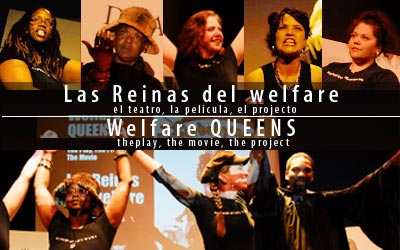
The welfareQUEENS is a revolutionary group of mamaz, daughters and sons struggling with poverty, welfare, racism and disability, poor women creating art with the goal of resisting and reclaiming the racist and classist mythologies about poverty and the criminilization of poor people in Amerikkka.

Through their art, storytelling and poetry, the QUEEN'S project will re-contextualize the word, welfareQUEEN, and who it refers to in a society that makes it illegal to be poor and refuses to recognize, support or legitimize the work involved in raising children With their cultural work, media activism, feature length play, and radio channel these mothers, daughters, and grandmothers, who have all struggled, survived and dealt with this ongoing oppression for years tell their stories, enact their struggles and realize their dreams of survival, thrival and resistance..

The welfareQUEENS is a revolutionary group of mamaz, daughters and sons struggling with poverty, welfare, racism and disability, poor women creating art with the goal of resisting and reclaiming the racist and classist mythologies about poverty and the criminilization of poor people in Amerikkka.

Through their art, storytelling and poetry, the QUEEN'S project will re-contextualize the word, welfareQUEEN, and who it refers to in a society that makes it illegal to be poor and refuses to recognize, support or legitimize the work involved in raising children With their cultural work, media activism, feature length play, and radio channel these mothers, daughters, and grandmothers, who have all struggled, survived and dealt with this ongoing oppression for years tell their stories, enact their struggles and realize their dreams of survival, thrival and resistance..


by Staff Writer

"A new mythology provided the ideological cannon fodder for the attack on the poor and people of color. That mythology equates growth in poverty to growth in an underclass which is primarily Black, Latino and female. This was the basis for the myth of the 'welfare queen'. Maurice Glele-Ahanhanzo in a report to the United Nations about poverty in the United States.

When does survival become criminal? When do poor women, poor mothers, become "the other"? And who determines who is "deserving" versus "undeserving" of aid?

According to 2007 census figures nearly 37 million Americans are living in deep or severe poverty. That’s almost half of all American’s subsisting below the federal poverty line. As poverty rises to record levels in the United States, the criminalization of poor people, poor families and poor mothers increased exponentially. For example, in 2005 in San Francisco, citations given to people for the sole act of being homeless increased by 400% .

Through intentional use of the highly problematic objectifying label/stereotype of 'welfare queen', originally coined by Ronald Reagan as an extremely derogatory reference to poor mothers who were receiving cash aid from Aid to Families with Dependent Children (AFDC), the welfare QUEENS project will re-contextualize the word and who it refers to in the framework of a post welfare reform, U.S. society. This society makes it illegal to be poor; this society does not recognize, support or legitimize the "work" involved in raising children; and this society is quick to accuse poor mothers of the crime of being poor rather than recognize the heroism of their survival.

Through the creation of a play, movie, publication, education and media project of the same name, a group of mothers, daughters, sons and fathers who have survived, struggled and dealt with this ongoing oppression will tell their stories, enact their struggles and realize their dreams of survival, thrival and resistance.

The team of poets, writers, and storytellers in poverty who are or have been on welfare, struggled as working poor, migrant or houseless parents, sons or daughters, have written, co-directed and acted in this play in an ensemble cast. The team is led by poverty justice organizer, poet, poverty scholar, journalist, co-founder of POOR Magazine/PoorNewsNetwork, and author of the recently published memoir, Criminal of Poverty – Growing up Homeless in America, Lisa Gray-Garcia aka Tiny. The project is collaboration between POOR Magazine and the Betty Shabazz Family Resource Center at the City College of San Francisco.

The welfareQUEENS are available for speaking, performance or workshop presentations from the Race, Poverty, Media Justice Institute at POOR Magazine or by calling (415) 863-6306

Tags

If it doesn't stop here with the SF8, who's next?

09/24/2021 - 10:54 by Anonymous (not verified)
Original Author
root
Original Body

The SF 8 Struggles for justice - we as a community have got their back

by Lola Bean/POORNewsNetwork

"Put your purse on the table and step through." The armed guard pointed to the metal detector and I quietly did as I was told. I stood and waited as he rifled through my purse and directed the woman behind me to wait her turn. He turned over my cell phone, my wallet, my camera, my pen and my paper a number of times before handing me back my bag and allowing me to
pass.

On this day the San Francisco 8, former Black Panthers, elders in the Black community, and mentors to generations of resisters would stand in court on charges stemming from a 36 year old case.

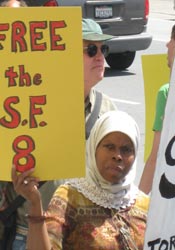
I was at the courthouse at 850 Bryant to re-port and sup-port the San Francisco 8 for POOR Magazine/PoorNewsNetwork. With numerous other supporters I chanted "Free the SF8!" in hopes that they could hear us from inside the building and know we are there for them.

Like many others born into violence and discrimination, my life has been characterized by struggle and resistance. My struggles led me to the tenderloin office of POOR Magazine and into a family of resistors dedicated to defending their communities and giving voice to those without. We are scholars in abuse, race, disability, and poverty that have come together to deconstruct the margins of oppression and much of our scholarship is rooted in the collective struggles of elder resisters like the SF8.

I followed a woman that I had recognized from outside past the elevators and around the corner to the hallway in front of Department 12. The area was filling up rapidly and soon I found myself leaning up against the wall outside of the courtroom surrounded by concerned members of the community.
The waves of concerned chatter rolled through the San Francisco courthouse and above crowded sounds my ears caught the words, "How can they do this? They are our heroes!"

It was here in the Bay Area in 1966, just over 40 years ago that the Black Panther Party for Self-Defense was formed. During the Civil Rights Movement, the Black Panthers sought to provide much needed social services to the Black community. In San Francisco, they began their Free Breakfast for Children Program which would eventually feed over 10,000 children across the United States every morning. They provided vocational training, educational resources, and community enrichment programs. They distributed clothing, food, and provided medical services. They were models of community self-empowerment and mentors to generations of resisters.

Their historic struggles laid the foundation for organizations like POOR Magazine, who provides the community with programs that are focused on teaching non-colonizing, community-based and community-led media, multi-media and art with the goals of creating access for unheard voices, preserving and de-gentrifying rooted communities of color and re-framing the debate on poverty, homelessness, disability and race in the US as well as creating short and long-term social change and racial justice.

For their contributions to the Black community, in 1968 President Hoover described the Black Panthers as "The greatest threat to the internal security of the country." By 1969, the Black Panthers had become the prime target of the federal counter-intelligence program, COINTELPRO. COINTELPRO carried out arrests, torture, and assassination of political dissidents and resisters. The Black Panther Party for Self-Defense organized to protect community members from violent state attacks and their lives were put in danger because of it.

"Everyone get in a single file line!" 3 uniformed guards appeared at the front of the courtroom. 2 had metal detecting wands. It was 1:30pm and finally time for us to enter Department 12. When I reached the front, one of the guards asked me to spread my arms apart so I could once again be searched. He waved the wand over my arms and legs and stomach and pointed me
in the direction of the third guard. This uniformed man took my purse and searched through my belongings.

In 1971, Sgt. John Young of the SFPD was murdered in Ingleside. At the height of the investigation, 13 Black activists were arrested in connection with the murder in Louisiana. The late John Bowman, Harold Taylor, and Ruben Scott were among those detained and interrogated in New Orleans in 1973. Two San Francisco detectives, McCoy and Erdelatz, supervised what
would turn into days of the interrogation and torture of these men. They were handcuffed to chairs and beaten. Plastic bags and hot blankets were wrapped around their heads and bodies until the suffocation found them unconscious. Cattle prods were used to shock their genitals and anuses.

After days of enduring this horrifying torture, law enforcement agencies succeeded in extracting "confessions" for the 1971 murder. In 1975, a San Francisco court recognized the torture used and dismissed the case citing that statements made under torture are neither credible nor legal. The men were free to continue their lives.

I took my purse and walked through the doors and into the courtroom. There were rows of old wooden chairs that folded down. A few were broken. I found one in the center row on the left hand side of the room. I was fortunate to have found a seat. There were more supporters in the courthouse than there was room to hold us.

The SF8 have spent the last 30 plus years as leaders in their communities. Richard Brown has worked in the Fillmore community for decades. Richard O'Neal works for the city of Dan Francisco and at a community center in the Bay View. Ray Bordeaux has worked for LA county for the past 25 years and has been involved in the community in his area. Harold Taylor continues his activism in Panama City, Fl. Hank Jones is a community elder in Altadena and Frank Torres works with trouble youth. Herman Bell and Jalil Muntaquim have been political prisoners for over 30 years, but continue their struggle from prison.

The SF8 have been productive members of society, elders in their community, and mentors to those of us struggling in society. The impact of their work was clearly exhibited by the outpouring of support from the seats in Department 12. In San Francisco and throughout the United States, organizations like POOR Magazine continue community based, grass-roots service and resistance for communities of struggle. Individuals such as myself personally engage daily in resisting state oppression and supporting communities of struggle. In this witch hunt against political activists, my fate, the fate of POOR Magazine, and the fate of all those engaged in the struggle against oppression may all be determined at 850 Bryant St.

In 2005, over 30 years after the charges had been dropped, post 9-11 legislation, especially regarding the use of torture, and restructuring of law enforcement and intelligence agencies has enabled detectives McCoy and Erdelatz, the same detectives that supervised the torture of Bowman, Taylor, and Scott, to combine forces with the FBI to once again reopen the case against SF8. On January 23, 2007 these community leaders were targeted for arrest stemming from the 36 year old case in which false confessions were extracted through the use of torture.

Members of the SF8, the eldest 71 years old, entered the courtroom shackled and in orange jumpsuits. These men, fathers, grandfathers, and great-grand fathers, looked with warm eyes out at the packed courtroom. They are chained at the waist, wrists, and feet and are kept on 24 hour lock down. Their bail is set at $3 million. No one has ever been charged for the torture that was carried out in New Orleans. Two of the men began speaking to each other. "SHHHHHHH." Warned a young, black woman in uniform. They weren't allowed to speak to each other.

The hearing lasted only a handful of minutes. Some technicalities were argued and the courtroom was cleared. We are still early in the process and the SF8 will see many more days behind bars before they will be brought to trial. The crowd disperses with promises to return to show support at the next hearing.

The government is sending a clear message to us. Resist and we will never forget. Resist and we will never stop going after you. Resist and we will find a way to destroy you no matter how long it takes. The government is spending millions of dollars to go after resisters past and present. If it doesn't stop here with the SF8, who's next? Will I find myself and the other members of POOR Magazine in shackles and orange jumpsuits or plastic bags and hot blankets. Will they come after us now, or 30 years from now.

Please show your support to the SF8. Come to 850 Bryant on May 4 at 1:30pm.

Tags

The Salt of the Earth

09/24/2021 - 10:54 by Anonymous (not verified)
Original Author
root
Original Body

The People march through San Francisco in opposition to the proposed poverty courts.

by Sam Fuller/PoorNewsNetwork

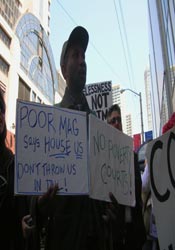
"We may look like a rag tag army but we are the salt of the earth." Chris Daly's voice boomed over the large crowd gathering in front of the Metreon Theatre last Tuesday in the warm breeze of the San Francisco sun. Signs waved in the bright blue sky reading, Homelessness is not a Crime, Give me a Home and I shall not Roam and Ser Pobre No Es Un Crimen.

This rag-tag, yet powerful army, of which I was a part as student reporter and poverty scholar with PoorNewsNetwork, was marching against the war declared on the poor and homeless by Mayor Gavin Newsom's proposed "Community" Courts or what we poverty scholars call, poverty courts.

These poverty courts are the latest effort of Newsom to "clean up the City" by eradicating people struggling with poverty and homelessness all over San Francisco. The courts, which are based on Rudy Giuliani's disastrous clean up; The Manhattan project, would immediately send people to jail and/or give other punishments for committing status crimes, crimes that are unavoidable to people living on the streets. (i.e. sitting on a sidewalk, vending, camping, sleeping outside or in a car) This plan, disguised as a "compassionate approach to quality of life issues," is yet another that disproportionately targets and criminalizes poor people in the Bay Area.

Not only is this plan poor policy and a misuse of funding, but it also poses a huge threat to the rights of houseless individuals and families and doesn't address the root causes of poverty and homelessness in any way.

"We don't need poor people courts to punish poor people for being poor," exclaimed Daly. I nodded my head vigorously in agreement as crowd members shouted their approval out.

A hush fell over the crowd when San Francisco poet Jack Hirshman took the stage and read a powerful poem about living on the streets. His hands shook with intensity as he bemoaned the sweeps of the poor and homeless "Streets swept clean of every bit of spontaneous life," his voice cut through the silence.

As I listened to Hirschman 's powerful words, I examined the sidewalk beneath my feet. Indeed the streets below us looked freshly cleaned and manicured without a spot of humanity left behind. I compared the spotlessness of the streets to our army of poverty, race, disability, immigrant and youth scholars with our torn jackets and backpacks; each of us bursting with emotions and feelings about justice and equality.

As the crowd marched to the brand new federal building I glanced up at the buildings lining the sky of the financial district. I couldn't help notice how much TLC these million dollar buildings received every day. Every need is catered to and every problem fixed at once. When I glanced down I noticed the people, citizens of the richest nation in the world whose festering wounds and illnesses are ignored or criminalized. In San Francisco, a new shining building gets more care and attention than a living, breathing human being.

"It is illegal to be poor in the US�, Renee Saucedo who acted as emcee for the day's march spoke with Teresa Molina, one of POOR's reporters from the Voces de Immigrantes en Resistencia Project, she continued," under these kind of legislations and similar ones that incarcerate poor immigrants, poor workers and poor youth we are all at-risk of incarceration, deportation and harassment.

"We can spend 484 billion blowin'up people we can sure as hell spend some money to take care of each other," Paul Boden, Executive Director of Western Regional Advocacy Project (WRAP) told the crowd. "Homeless people are not the problem the problem is cuts in housing," he said powerfully.

With the marchers filing by, Jennifer Friedenbach from the Coalition on Homelessness, which works to create permanent solutions to homelessness, spoke with me about the problems of poverty courts.

"Gavin Newsome's idea of poverty courts is an idiotic idea. They use a ton of money to prosecute people who don't have a home�police are used to clean the streets of the poor and homeless," she stated. She explained the benefits for politicians to support this criminalizing legislation. "They receive large donations from the tourism industry�it works to their advantage."

As our conversation ended, a large chant boomed out from the crowd. "We demand housing and health care. We don't want your poverty courts they are anti-human."

As I shouted in approval, I turned around and noticed that we had attracted some new soldiers for our march. Three SFPD squad cars and Homeland Security were following closely behind us and I realized the full extent of this criminalization.

After the march ended with major voices speaking in opposition to this plan the Chronicle published a glowing profile of the Manhattan poverty court's judge above the fold on the Sunday paper. In response, my editor, Tiny, a formerly homeless poverty scholar who just released the new book; Criminal of Poverty: Growing Up Homeless in America spoke with Juan Prada, Executive Director of The Coalition on Homelessness His response was simple, "The Newsom administration is working on a public relations campaign because this is an election year, these kinds of legislations are not planned to be funded or supported in the City"

Later while thinking about the day�s march and reflecting on the police presence there, I wondered is this any way to treat the salt of the earth?

Sam Fuller is a student and poverty scholar in POOR's Race, Poverty and Media Justice Institute at POOR Magazine. Join tiny and other poverty, race and disability scholars from POOR at a Dialogue on the Criminalization of Poverty with Jeff Adachi, Renee Saucedo, James Garrett, Ross Mirikarimi, Leroy Moore and the welfareQUEENS on Monday May 21st, at 7:00 pm at the Roxie Theatre at 16th and Valencia

Tags

Deep North

09/24/2021 - 10:54 by Anonymous (not verified)
Original Author
root
Original Body

A poem.

by Dee Allen


Headed to the "promised land" in droves

Attracted to bright urban lights

Like a swarm of sepia-toned moths

They arrive

In search of work

Safer homes

Altars to pray to

In search of the peace that

Living in the so-called

"Bible Belt"did not give them.

What kind of god

Would allow its own children to

Endure the jail cell

The slurs

Out of the mouths of babes & rednekkks

The noose that broke the neck

From a tree

Strung-up

For the crime of

Being born Black

The white hoods that made their Heaven

By making innocent lives Hell?

What kind of god

Would abandon its own children

To the mercy of hate?

To doors being shut to them

Because they are descendants of the enslaved?

They arrive

With a different kind of home in their hearts

Amongst the dark mass, a

Tslagi teenage girl, her Black carpenter husband and their

Two daughters [one a half-breed] leave Virginia in the dust

Headed to the "promised land"

In the shadow of the Great Depression.

The Deep North welcomes them all.

Tags

Theater Bystander

09/24/2021 - 10:54 by Anonymous (not verified)
Original Author
root
Original Body

Its,Rare,late,

Don't-Review Plays often.

Yes,its late.

Just a words anyway.

by Joseph Bolden

Bystander By
Joseph Bolden

I'll explain.
This is an over due multi -bits of plays review by me.

How do I explain the sampling of dramatic readings or parts of a play?

Here is my bite sized example:A CD sample of various artstist's music, songs,or comedy bits.

Intersection Theater

I’m don’t critique or praise any artistic endeavor precisely because artist’s work are their own creation and only they, their family, or loved ones shouh dhave say or sway over them.

(and not even then,we know how critical family or friends can be).

Hence its always a problem for me with my own odd artistic leanings.

Intersection Theater For The Arts "Have Been Creating Alternatives Since 1965" That’s the blurb on triple pea green colors and contrasting black – white flyer announced simply this literary series.

Last month, on Wednesday March 28, 2007 Intersection celebrated their 42nd year.

I may have been there once before my memory is flawed about when, date, or event.

First: Mr. TheArthur Write, an elder artist that has taken hidden artwork revealed using bleach while also writing of hidden Black History as well.

Second: Mr. Colm O’ Rain and Ms. Sundaralinghma, Pireeni of Shi Lanka who's country suffers through fractional war.

Poet,writer and Mr. Rain’s creative Irish musically, beatifically shows oppression blended in Irish-African cultures both artists spoke in perfect English,Shi Lankin, and Gaelic.

Third: 40 To The Head is a powerful snippet or tasted of a the struggles, drama,violence, and humor of life for youths in gangs of Mexican American’s.

This dramatic reading shows how drifting vicariously in their daily lives, the gentle to brutality of individuals.

1 woman and three males embody the play give it 3D texture,vivid in its harrowing depiction of life lived now.

A savage beating of a stranger by the three young men, accidental shooting death of one the players so true to life and how instantly can taken away was a heart searing, painful process to see.

If most of the work of "40 To The Head is dramatic, shows as much realism as that compact read I seen This Play and it Author(s) may be headed toward greatness in years to come.

This is why I don't do reviews I don't express the medium of theater clearly.

My apologies to both artist's,Intersection Theater,audiance,current,and past reader's for this bumbling attempt of theater reviewing.

Tags

Black Disabled Man with Big Mouth and High I.Q.

09/24/2021 - 10:54 by Anonymous (not verified)
Original Author
root
Original Body

Writer, poet, journalist and advocate, Leroy Moore presents his latest powerful publication, Black Disabled Man with Big Mouth and High I.Q.

by Leroy Moore

Hello Illin-n-Chillin readers,

How are you? Many of you might already know me but
those who don't my name is Leroy F. Moore Jr. Besides
writing for Poor Magazine I'm also a journalist, poet,
activist, and radio producer here in Berkeley, CA.

I'm posting this because my new book, Black Disabled
Man with Big Month & High I.Q,
will be coming out in
November of this year and I'll be touring in the
winter '07\spring '08 .

I would like to come to your town\city in the winter
or spring of 2008 to meet you all and do some readings
and workshop. I have a workshop entitled Black Blind
Blues to Krip-Hip-Hop
about Black disabled musicians
from Blues to Hip-Hop and have lectured about disabled
people of color and the struggles we face, such as abuse,
poverty, crime, and our rich history of activism and
art etc.. In January of 2007 I produced the first of
its kind, Krip-Hop Mixtape of disabled Hip-Hop artists
from around the world. You can check out my writings,
services and items on my website at www.leroymoore.com

I'm looking forward to my book tour this winter and I
hope you're interested in having me. Please get back
to me. Check back for book tour dates, reviews and
more

Leroy F. Moore, Jr. writes with all the fierceness and
urgency of a poet who consistently puts his body on
the line. Although he reports "From the Outskirts,"
Leroy is unwilling to accept the label of outsider.
As a "Black Disabled Man with a Big Mouth and a High
I.Q." his words and his community work push his voice
insistently into the center and the spotlight, which
is exactly where he belongs. His work is not about
charity, tolerance, liberalism, or tokenism, his work
is about liberation. From his krip hop performances
to his poetry to his race and disability consulting,
Leroy reminds us all to love our bodies, to trust our
brilliance, to find the humor, to build community, and
to keep up the fight for justice against all
oppressions.

-Aya de Leon, writer/performer of "Thieves in the
Temple: The Reclaiming of Hip Hop"

In the tradition of History's word warriors, Leroy
Moore pens full-frontal confrontations that blast away
the last nasty vestiges of Faith-based America's
biases against the poor, the disarranged, and the
different.

- Wanda Coleman/Los Angeles, known as "the L.A.
Blueswoman," author of many powerful books of poetry
and pros

"Niggahhhhhhh wid Disabilities, here, there, EVERYWHERE.....!" - Words of
revolution shout at you from every inch of the new book; Black Disabled Man
with a big Mouth and a High IQ. Leroy Moore, race and disability scholar at
POOR Magazine's Race, Poverty and Media Justice Institute and columnist with
PoorNewsNetwork, leaps off the page at you with truth, real-ness, humour and
poetic scholarship about our communities; our people and our resistance. ALL
communities that have EVER been marginalized, unheard and oppressed will
gain brute strength, thick inspiration and urgently needed scholarship from
his revolutionary words and images

-Tiny aka Lisa Gray-Garcia, author of
Criminal of Poverty; Growing Up Homeless in America

My website is www.leroymoore.com

E-Mail address is sfdamo@yahoo.com

Phone: (510) 649-8438

Keep reading and supporting Poor Magazine!!

Leroy Moore
Author of an upcoming book, Black Disabled Man with
Big Month & High I.Q
published by Gibbs go to
www.gibbsmagazine.com

Tags

We Are All the Same

09/24/2021 - 10:54 by Anonymous (not verified)
Original Author
root
Original Body

The May Day March

by Staff Writer

by Angel Garcia/Reportero para POBRE Prensa

Para espanol mire hacia bajo

On May 1st, 2007, I awoke at five o'clock in the morning to catch the first bus to San Francisco. I arrived at Dolores Park just as the march for immigrant rights was beginning. I was there to report and support with Prensa POBRE (POOR Magazine/PoorNewsNetwork).

May first is historically the "workers day". Last year the immigrant rights movement appropriated that day and we made it our own; we called that day “un dia sin immigrantes", which means, "A day without immigrants".

At the march, many signs read, “Amnesty for all. We are America. We made America!” The names of our cities and barrios tell us parts of our history. La Mission, San Francisco, and Los
Angeles are just a few names that signify California’s history as a part of Mexico.

The park was filled with various people of different nationalities and age groups. I saw families that brought their babies with them. I saw people carrying signs, which read, “We are all illegal.” If anyone should be labeled illegal than we, as
Americans, must all be illegal. We are all immigrants, even our own governor. On my back, I wore a sign reading, “We are here and we ain’t leaving. Reportero para POBRE prensa is against all false borders!”

I am an immigrant myself. I believe the march united us. I realized the power we have when we all come together and unite regardless of our different nationalities. As immigrants in this country, we have the privilege to demand our rights, our equality, and our stability. A lot of people think that we as immigrants are animals and criminals. Immigrants and people of color are being pitted against each other. But we are all the same. We deal with and live in the same system.

As we made our way down Guerrero, towards Civic Center, the sun shifted back and
forth between the clouds. People were carrying flags from different countries that swung back and forth in the gusty wind. We were a group of
non-violent marchers representing what we hope for in the world. We hope for a
world without false borders and a place where we can all walk peacefully.

The police were present on every corner. The marchers chanted, “la migra la policia la misma porqueria!", which means, "The police and the border patrol; they are all the same!”

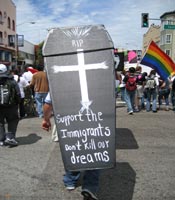
I saw some people carrying coffins. People are dying in vain in Iraq, and people are also just dying crossing the border. False borders create separation that in turn creates more violence. False borders not only separate but also strip us of our culture.

This was the first march I ever participated in. I was excited to be part of the change. I believe that, as immigrants, we represent America. As immigrant workers, we still have to work and pay taxes, like everyone else, and we are often denied services and rights. I saw many families marching side by side. It is hard to imagine that the police and the immigration laws are breaking families like these apart everyday. My body grew tense as I imagined parents being taken away from their kids.

So many of us were marching; we were marching to keep our families whole. We were marching to stop the unjust detentions, to stop the criminalization of immigrants and to unite.

My hope is that the unity that was created on this May Day is carried along for the rest of our lives and passed on to our children.

Todos Somos Iquales

El primero de mayo, del 2007 yo me levante a las 5 de la mañana para poder alcanzar el primer bus hacia San Francisco. Yo llegue al Parque Dolores cuando la marcha empezaba. Yo estaba allí para reportar y apoyar a Prensa POBRE (POOR Magazine/PoorNewsNetwork). El primero de mayo es un día histórico, por que es el “día de las trabajadores/as.” El ultimo año el movimiento de los derechos de los inmigrantes tomo ese día y lo hizo el suyo; nosotras llamamos ese día “un día sin inmigrantes.” En la marcha, muchas pancartas decían, “Amnistía para todas. Somos América. Construimos América!” Los nombres de nuestras ciudades y barrios nos cuentan parte de nuestra historia. La Misión, San Francisco, y Los Angeles son solo algunos nombres que enseñan la historia de California como parte de México.

El parque estaba lleno de varias personas de diferentes nacionalidades y grupos de edades. Yo vi familias que trajeron a sus bebes con ellas. Yo vi a personas cargando pancartas que leían, “Todos somos ilegales.” Y si alguna persona es clasificada como ilegales, entonces nosotras como Americanos, también somos ilegales. Todas somos inmigrantes incluyendo nuestro gobernador “El Terminador.”

Yo soy inmigrante también. Y pienso que la marcha nos ha unido. Ahora entiendo el poder que tenemos cuando todos nos unimos y no nos preocupamos de nuestras diferentes nacionalidades. Y como inmigrantes en este país, tenemos el priveliego de estar demandando por nuestros derechos, nuestra igualdad, y nuestra estabilidad.

Muchas personas piensan que nosotras como inmigrantes somos animales y criminales. Inmigrantes y gente de color están siendo puestos uno contra e otra. Todos somos iguales. Todos pasamos y vivimos en el mismo sistema.

Cuando pasábamos por la Guerrero, hacia el Civic Center, el sol se metía y salía de las nubes. Y la gente cargaba banderas de diferentes países. Y cuando el viento se levantaba, las banderas piloteaban en el viento. Nosotras éramos un grupo pacifico de marchantes representando nuestra esperanza para el mundo. Nuestra esperanza es de tener un mundo sin fronteras falsas y un lugar donde todas puedamos caminar en paz.

La presencia de la policía estaba en cada esquina. Y las marchantes gritaban, “la migra! la policía! la misma porquería!” Yo también vi algunas personas cargando ataúdes. La gente esta muriendo en vano en Irak y la gente también esta muriendo cruzando la frontera. Estas falsas fronteras crean separaciones que después se convierten en mas violencia. Estas fronteras falsas no solo separan sino también nos quitan nuestra cultura.

Esta fue la primera marcha en la que participe. Y estaba emocionado que tome parte de este cambio. Yo creo que como inmigrantes, nosotras representamos América. Y como trabajadores/as inmigrantes, nosotras también tenemos que trabajar y pagar impuestos, como cualquier otra persona.

Yo vi muchas familias marchando de hombro en hombro. Es muy difícil imaginar que la policía y las leyes de inmigración están separando familias. Mi cuerpo se tensa cuando pienso de los niños siendo separados de sus padres. Muchos de nosotras estamos marchando; estamos marchando para mantener a nuestras familias.

Nosotras marchamos para poner un alto a las injustas detenciones, para parar la criminalizacion de las inmigrantes. En mi espalda yo cargaba una pancarta que leía, “aquí estamos y no nos vamos!”

Este Reportero para Prensa POBRE esta en contra todas las fronteras falsas!” Y la unidad que se creo el primero de mayo tiene que ser cargada por el resto de nuestras vidas y seguirla para nuestros hijas.

Tags

Selectively grieving, never universally mourning.

09/24/2021 - 10:54 by Anonymous (not verified)
Original Author
root
Original Body

Reflections from one Virginia Tech Graduate

by Anna Kirsch/PNN

I can almost picture myself there; cutting across the well-manicured drill field surrounded by the hazy purple-blue southwest Virginia Mountains. Walking to class and cursing the sharp, icy knife-like wind as it cut into my well-worn brown scarf and tan jacket.

A walk I begrudgingly made time and time again to attend my classes at Virginia Tech over three years ago. I spent my university life on the tree-lined streets of the town of Blacksburg. It was the place where I had the privilege, the time and the space to think, to read and to write. The place where I found solace, support and friends. And now the place that will forever by synonymous with April 16th, 2007 and the deadliest shooting rampage in modern history.

Today these memories of Virginia I carry with me are haunting, not comforting as they continue to painfully seethe from the corners of my mind to the surface. The gray, almost cobble-stoned buildings, the massive lecture halls, the bright yellow walls of my first apartment off-campus. And now, the breaking news headlines, pictures of candlelight vigils, old photographs of the victims’ faces and video footage of an isolated, desperate, young man.

There is no separation between then and now for me and I am acutely aware of my connectedness and familiarity with this place and this tragedy. My memories feel desecrated, bloodstained and tender to touch. I knew those hallways, sidewalks and classrooms in a way most didn’t.

I tortured myself by watching the news over and over again. As painful as it was, I couldn’t stop blankly staring as pictures of my old town, school and home were splattered all over the papers, T.V. and radio. I watched because I felt I had to. I watched because I was desperately trying to understand. I watched because I wanted an answer.

Watching the tragic events unfold from over 3,000 miles away through the corporate media lens, I began to feel isolated and truly alone. I looked on as different “experts” casually debated the “issues,” gun control, immigration, and campus security less than 24 hours after the killings. Seeing the place and community I had considered home for so long invaded by news cameras and hounding journalists felt like a knife in a fresh wound. The media was once again determined to ignite a debate and bombarded us with forced rhetoric and framed questions. But for me this time it was different, it felt personal.

“The media did what they always do,” said Mari, a YouthinMedia journalist for POOR Magazine who is now an organizer in Washington D.C. “They didn’t look at the roots of the real issues and they didn’t listen to the people.”

Mari saw this first hand as she watched the Korean community of D.C. become the target for attempted hate crimes, racist remarks and threats. Many Korean people remain scared that they will all be typecast as violent. One Korean woman, a colleague of Mari’s, said soon after the killings “I hope that people won’t think that every Korean person is a killer.”

As I flipped the channels and heard over and over again “A Korean man…” I began to wonder why the media was focusing so intensely on the fact that the parents were immigrants, not born in America, as if that made them not part of this country. Was this the media’s way of convincing us that this unspeakable act of violence came from the outside?

I watched as fingers were pointed at the campus police and university administrators, and gun sellers and lawmakers, but never once did I hear a serious critique of the mental health crisis in this country or a deep analysis of the race and class struggles that plague so many.

I, myself, see these struggles everyday on the streets of San Francisco, watching as so many struggle with racism, classism and disability. This pain, this struggle exists everywhere- even in the hazy mountains surrounding Blacksburg, Virginia.

As Rev. Sang Jin Choi, of the Action for Peace through Prayer and Aid (APPA), recently stated, “It is a person’s immoral crime in an immoral society…there are no offenders in an immoral society only victims.”

Our pain, our crisis is universal but we are led to believe that it is not, that we are different, a race and class war rages on, false borders separate and we are taught to sympathize, not empathize, disconnect, not to relate to. Selectively grieving, never universally mourning.

Anna Kirsch is a graduate of the Race, Poverty and Media Justice Institute at POOR Magazine and is currently working as an assistant teacher and community journalist for POOR/PNN

Tags

Resistin' (Arrest)

09/24/2021 - 10:54 by Anonymous (not verified)
Original Author
root
Original Body

POOR Magazine poverty scholars harassed by the po’lice on May Day

by Staff Writer

by tiny

Para espanol, mire hacia bajo

Blue chards of San Francisco sky blinded our eyes as we emerged from POOR
Magazine’s tenderloin office and headed underground to the BART station.
Our cru consisted of my son tiburcio, a seasoned marcher at the ripe age
of almost four, driving the infamous Si Se Puede Chariot ( read: hooptie
stroller), myself covered from head to toe in pobre gente resistance
signage- and Angel Garcia, one of POOR’s newest inmigrante reporteros and
soon to be published POOR Press author. Our powerful grupo was small but
we were on our way to meet up with more folk from POOR, POWER, La
Collectiva de Mujer, and thousands of others in honor of inmigrante
workers at Delores Park on May day

“I think the “J” train would work better than BART”, said Angel gazing
into the rivers of tunnel in front of us. After several minutes of
confused wrangling with schedules and underground possibilities Angel and
I decided that taking the J train on MUNI would be better than the BART
and cause Angel is living with a physical disability, he needs to take the
elevator – so down we went.

Upon reaching the muni platform, Angel, tiburcio and I continued on with
moments of spacial confusion. Although I travel almost every day on the
multiple trains that run through the arteries of this City, we
collectively lost site of our direction. Which must be the reason that I
forgot my own rule that you NEVER ask the po-lice for ANYTHING!

“Is this the right way to Delores Park” I casually said to a BART/MUNI
po’lice officer stationed oddly right at the mouth of the escalator

“Do you have proof of payment?” she said, her triangle- shot gun legs
stiffening in tandem with a bullit proofed vested chest.

“Excuse me,” I stumbled, “I just asked you for directions”
“Do you have proof of payment”, she continued without blinking
“WHAT!?, activist tiny yelped, “I asked you for help, why are you
harassing me?”

“Are you resisting my inquiry, Do we need to have you arrested?” She began
talking lovingly to her shoulder radio, “Officer 3256 requesting
back-up….”

“Here,” Formerly incarcerated, system trained, tiny began desperately
searching through my stuff for a ticket.

“Cancel Back-up,” the words were terse, and loaded with disdain. She
pulled out her citation book and began to write.
“Are you giving me a citation?”
She didn’t answer.

Several more minutes of targeted harassment followed until she finally
“allowed” us to leave. No-longer-remotely-activist-tiny felt as though a
giant knife had been twisted and turned through my insides. The grueling
moments of –losing-my-son-going-to-jail-terror clung to me like dried
vomit.

“Mama, where would I go if they took you away,” As we all numbly rolled
over to the J train, my son completed the sorrow of the moment with his
plaintive request. Feelings of empowerment and resistance, consciousness
and pride that should belong to this important day fell away from my mind
and soul like petals off of a sunflower.

The day was filled with multiple voices of inmigrante scholarship, which I
was blessed to see and hear, but later that day when I heard about the
brutal attacks on all the gente pobre, and poor families at LA’s May Day
Marcha, my still adrenalin wrecked mind shuddered for all the brutal ICE
raids on immigrants, po’lice harassment of all poor people of color
locally and globally and border fascism which remains stronger and more
frightening than ever.

Resistiendo (Arresto!)

Las miembras académicos de POOR Magazine fueron abusadas por la policía el primero de mayo.

Cardos azules de San Francisco nublaron nuestros ojos al salir de nuestra oficina de POOR Magazine ubicada en el barrio del Tenderloin y nos dirigimos hacia la estación subterránea de BART. Nuestro equipo consistía de mi hijo Tiburcio, un marchante ya con mucha experiencia a sus cuatro años de edad, manejando la infame Carriola de Si Se Puede (lean: hooptie stroller) yo cubierta de pies a cabeza con resistencia de gente pobre- y Angel Garcia, uno de los nuevos reporteros y muy pronto publicador y autor de Prensa POBRE. Nuestro grupo poderoso era pequeño pero estábamos apunto de reunirnos con mas gente de POOR, POWER, La Colectiva de Mujeres, y miles de otras personas en honor a las trabajadores/as inmigrantes en el Parque Dolores este primero de mayo.

“Yo pienso que el tren “J” será mejor que el BART” dijo Angel mirando a los ríos de túneles enfrente de nosotros. Después de varios minutos de confundirnos con horarios y posibilidades subterráneas Angel y yo decidimos tomar el tren J en MUNI por que seria mejor que BART y por que Angel esta viviendo con una deshabilitad física, y el necesita tomar el elevador – entonces empezamos a bajar.

Llegando a la plataforma de MUNI, Angel, Tiburcio y yo continuamos con nuestros momentos de confusión. Y aunque yo viajo casi todos los días en múltiples trenes que corren por las arterias de la ciudad, nosotras perdimos nuestra dirección. Y es por esa la razón que se me olvido mi regla de NUNCA pedirles NADA a la policía!

“¿Es esta la manera correcta de llegar al Parque Dolores?” le pregunte casualmente al policía de BART/MUNI estacionada extrañamente en la boca de la escalera. “tienes alguna prueba de que pagaron?” dijo ella, sus piernas triangulares se atiesaron fuertemente con su chaleco anti balas en su pecho. “discúlpeme” empecé a decir “yo solo le pregunte por direcciones.”

“Tiene alguna prueba de que pagaron,” ella continuo sin moverse “¿QUE!?” dijo con vos alta la activista Tiny “Yo te pregunte por ayuda, ¿por que me estas abusando?”

“Estas resistiendo mi pregunta, ¿necesitamos arrestarte?” ella empezó a platicar muy despacio con su radio en su hombro, “oficial 3256 requiriendo ayuda…” “Aquí tiene” anteriormente encarcelada y entrenada por el sistema, dijo Tiny desesperadamente buscando en sus cosas por un boleto. “cancelen la ayuda,” las palabras fueron mencionadas, y pronunciadas con desden. Ella saco su libro de citaciones y empezó a escribir. “¿me estas dando una citación?” ella no contesto.

Varios minutos abuso escogido continuaron después hasta que finalmente nos dio “permiso” de irnos. No-mas-remotamente-activista-Tiny sintió como si una navaja gigante avía sido metida y volteada en mis adentros. Los momentos horrorosos de perder a mi hijo por ir a la cárcel se quedaron dentro de mi como vomito seco.

“Mama, ¿que hubiera pasado conmigo si te hubieran llevado?” mi hijo completo el dolor de este momento con su pregunta, cuando empezamos a caminar hacia el tren J. Sentimientos de poder y resistencia, conciencia y orgullo que deberían de haber permanecido en ese día tan importante se fueron de mi mente y alma como pétalos de un girasol.

Ese día estuvo lleno de muchas voces inmigrantes, que yo me sentí bendecía en escuchar y ver, pero después ese mismo día escuche de los ataques brutales hacia la gente pobre y familias en la marcha del primero de mayo en Los Angeles, mi mente todavía llena de adrelina se estremeció por todas estas redadas brutales en contra las inmigrantes, el abuso policial en contra toda la gente pobre de color localmente y globalmente y por el fascismo de la frontera que continua mas fuertemente y espantoso que nunca.

Tags