Story Archives

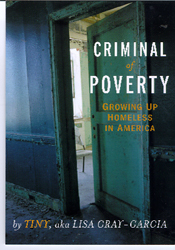
Criminal of Poverty: Growing up Homeless in America

09/24/2021 - 10:54 by Anonymous (not verified)
Original Author
root
Original Body

Tinys recently published memoir Criminal of Poverty: Growing Up Homeless in America paints a vivid, intense portrait of her and her mothers struggle with poverty, homelessness and the growing criminalization of poverty and poor folks in America as well as the fascinating story of the development of the highly innovative grassroots, organization, POOR Magazine and publication of the same name.

by Staff Writer

"Most books on poverty or the poor are written by people who have never been really poor, or are individualistic tales of a bootstrap pull that separates the (once) poor person from society as a whole. Tiny, a.k.a Lisa Gray-Garcia, has written an eloquent, graceful and refreshingly humor-filled book that tells a story which places poverty in a larger social, spiritual and political context. It challenges the reader to let go of clichés and catch phrases about the poor and homeless and see a population of struggling, hard working survivors who can work miracles when given proper support. It also is a compelling love story of a mother and daughter who surmount hurdles and climb out of pits that would defeat many, while building ladders and twining rope so that others can join them in their ongoing efforts to bring more and more people out of the quagmire of relentless poverty, hunger and hopelessness." – devorah major, author of Where River Meets Ocean and Brown Glass Windows

"In America we prefer not to see our poor. Only if we turn determinedly away can we maintain the illusion that we are not all responsible, not all culpable. Lisa Gray-Garcia won't let us avert our eyes. With style and verve she hauls our unwilling attention to what matters. If your heart is unmoved when you finish this memoir, then it's made of stone." – Ayelet Waldman author of Love and Other Impossible Pursuits

"Tiny’s indomitable spirit comes to life in her amazing story of poverty and homelessness, reaching into and teaching our hearts and minds. With her flawless descriptions of the pain of living in the margins of the richest country in the world, she opens up an important window onto a reality looked upon by many but truly seen by few, augmenting our capacity for empathy and action in an area so in need of social change. Bravo Tiny, for your gift to us all! Punto!!!" – Piri Thomas, author of Down These Mean Streets

"Criminal of Poverty lays bare the devastating effects of inheriting a life of poverty, as well the real redemption and power in finding your voice." – Michelle Tea, author of Rose of No Man's Land and Valencia

Tags

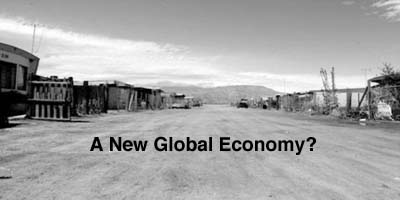
A New Globalized Economy or A New Globalized Poverty

09/24/2021 - 10:54 by Anonymous (not verified)
Original Author
root
Original Body

In the Coachella Valley, hundreds of trailer parks house desperately poor Raza workers amid burning trash, mud, contaminated water.

by David Kelly/LA TIMES

Reprinted for educational purposes from the LA Times

THERMAL, CALIF. � Like most of their neighbors in the sprawling, ramshackle Oasis Mobile Home Park, the Aguilars have no heat, no hot water. On cold nights, the family of eight stays warm by bundling up in layers of sweaters and sleeps packed together in two tiny rooms.

Bathing is a luxury that requires using valuable propane to boil gallons of water. So the farmworker clan spends a lot of time dirty.

Jose Aguilar, a wiry 9-year-old, has found a way around the bath problem. He just waits until dinner. "My mom makes frijoles," he said, "then I take a bath in that water."

Jose and his family live in a world few ever see, a vast poverty born in hundreds of trailer parks strung like a shabby necklace across the eastern Coachella Valley.

Out here � just a few miles from world-class golf resorts, private hunting clubs and polo fields � half-naked children toddle barefoot through mud and filth while packs of feral dogs prowl piles of garbage nearby.

Thick smoke from mountains of burning trash drifts through broken windows. People � sometimes 30 or more � are crammed into trailers with no heat, no air-conditioning, undrinkable water, flickering power and plumbing that breaks down for weeks or months at a time.

"I was speechless," said Haider Quintero, a Colombian training for the priesthood who recently visited the parks as part of his studies. "I never expected to see this in America."

Riverside County officials say there are between 100 and 200 illegal trailer parks in the valley, but the Coachella Valley Housing Coalition says the number could be as high as 500.

California Rural Legal Assistance says as few as 20 parks are legal, and they are often as dilapidated as the illegal ones. When county inspectors locate a park without permits, they prefer to let owners bring the place into compliance through loan and grant programs rather than evict the tenants.

Some of the largest and poorest parks are on the Torres Martinez Indian Reservation where they are not subject to local zoning laws and the county can't monitor safety, hygiene and building standards. The reservation is also home to the worst illegal dumps of any tribe in California, Arizona or Nevada, according to the Environmental Protection Agency. The federal agency has closed 10 of the 20 most toxic dumps and cited four of the largest trailer parks for health violations.

Despite the conditions, park owners say they are providing a vital service in an area where housing prices have soared.

"Before the parks, they were living in their cars, in the desert and bathing in the canals. Five guys would pay 50 bucks a month to share a camper shell," said Scott Lawson, a tribal member and co-owner of the Oasis park on the reservation. "Nobody cared when they lived like that, only when they moved into trailers. You can't expect the poorest to live like the wealthiest. They feel comfortable here; it's like being back in Mexico. They tell me that."

Lawson's 300-trailer park has been cited by the EPA for clean-water violations and was recently ordered to stop pumping raw sewage into the nearby Salton Sea.

"We had some citations about water but it's because we didn't know how to test it," he said. "I'm not ashamed of my place. There are a lot worse places than mine."

Exactly how many people live in the trailer parks is unknown, but social workers estimate tens of thousands. The biggest park, Desert Mobile Home Park, or "Duroville," has more than 4,000 residents and can be seen off California 195 near Thermal. Others are on private property and virtually invisible to passing motorists.

The tenants are almost entirely Latino farm or construction workers. Many are in the United States legally, but plenty are not. Their average income, according to county officials, is about $10,000 a year. Many parents rent out their children's rooms for extra money, leaving kids to sleep on floors or in sheds. Many families keep warm by burning grape stakes, which fill their trailers with toxic fumes.

In one nameless park on the reservation off Avenue 70 in Thermal, trailers with broken windows and unhinged doors sit against piles of trash. Box springs, tires, car parts are stacked 10 feet high. Sewage runs behind the trailers, and wild dogs yap and howl.

"This place has some of the worst conditions I have seen," said Sister Gabriella Williams, who does community outreach in the parks and is raising money to build a learning center for residents. "And it's actually gotten worse since I last saw it."

She picked her way through a yard that doubled as a trash heap.

"The park owners have to look into their own conscience as to why they run these kinds of places with these kind of conditions," she said. "They wouldn't want this in their backyard. They wouldn't tolerate it. We all need to recognize the dignity in each other."

Former resident Conrrada Valenzuela said she went three months without electricity, living by candlelight.

Maria Renosa, 35, from Guatemala, lives in the park now. She makes $7.25 an hour picking broccoli and shares a battered, sparsely furnished trailer with six other adults and her children, Edith, 2, and Frank, 3.

Renosa's husband was recently deported for being undocumented. "It would cost him $5,000 to return," she said. "I am not going back. What am I going to do there? I'd love to live somewhere else, but here it only costs $360 a month."

The EPA has cited park owner Robin Lawson for clean-water violations; Lawson could not be reached for comment. He is Scott Lawson's brother. Another brother, Kim, operated a vast, illegal dump for more than a decade that was shut down last year by a federal judge.

The presence of the parks on the reservation has frustrated Torres Martinez Tribal Chairman Raymond Torres.

"The owners started off with good intentions, then I think it overwhelmed them," he said. "I have a real problem with it. Someone is going to get hurt. I'd like to see the parks gone and the owners start over again."

But in the complex world of tribal sovereignty, Torres cannot close the parks; only the Bureau of Indian Affairs can. The bureau said last week that parks on the reservation are illegal because they do not issue bureau-approved leases to tenants. They are now threatening legal action against Duroville and said other parks could be next.

Trailer parks began springing up on Indian land largely because of a county crackdown. In 1998, after several fatal accidents caused by faulty wiring, Riverside County began closing parks that did not have permits and threatening to sue others not up to code. Faced with outrage from farmworker advocates and the Roman Catholic Church, who feared thousands could be rendered homeless, officials backed off, but not before many panicked park dwellers had moved onto the reservation.

"We wish we could wave a magic wand and make them go away," said County Supervisor Roy Wilson. "But we can't."

Adding to the misery is Kim Lawson's dump. Since 1992, it has burned paint cans, car batteries, plastic pipe and treated wood and other waste, throwing so many toxins into the air and soil that EPA said the dump represented an "endangerment [that] can be considered imminent and increasing over time."

And the dump, its smoke blowing for miles up and down the valley, sits right beside Duroville. A 2003 EPA memo reported some areas of the dump contained levels of dioxin 20 times the national average. Dioxin, a carcinogen, is one of the deadliest manufactured substances.

According to agency documents, soil samples revealed dioxin, PCBs and asbestos in Duroville itself. Citing the risks of cancer and other illnesses, the EPA urged the dump's immediate closure. The park remained open because the danger to it was not deemed "imminent," said agency attorney Letitia Moore.

Four years after the EPA recommendation, a federal judge in Riverside closed the dump in August. On Thursday, the judge ordered Lawson to pay $46.9 million to help clean up the mess. Since the facility was padlocked, there have been 20 fires � most the result of spontaneous combustion, said Ray Paiz, battalion chief with the Riverside County Fire Department. One fire in November nearly forced the evacuation of Duroville and nearby schools.

Smoke in the parks is as common as wild dogs and swirling dust. Health workers report that children suffer high levels of pulmonary illnesses, coughs, infections and skin rashes.

"These are almost Third World conditions," said Rosa Lucas, a nurse who runs the Oasis Clinic, across the road from a trailer park. "It's unbearable out there when there is burning. You literally can't go outside."

Although poverty is endemic in the parks, nothing rivals Duroville for sheer blight.

The 40-acre park is a grim, colorless warren of dirt roads with more than 300 trailers tightly packed inside. It's often hard to tell an abandoned scrap heap from a home. There are start-up businesses � car dealerships, a small taco stand and a restaurant specializing in Michoacan food � squeezed in amid the clutter. Trash blows here and there. Toddlers, some naked from the waist down, wander around in fetid muck. A wall surrounds part of the place, a thin barrier separating it from the dump.

What began as occupants of a few trailers seeking refuge from the county has turned into a vast slum bearing streets named after members of park owner Harvey Duro's family. Duro declined to comment for this article.

Efforts by the Bureau of Indian Affairs to close Duroville fizzled in 2003 when the owner agreed to make basic electrical and sewage improvements. Still, officials said, he has failed to provide tenants bureau-approved leases defining minimum living standards.

"He will have to come up with an approved lease or we will shut him down," said James Fletcher, the bureau's superintendent for Southern California.

Fletcher said all the parks on Indian land could be closed if they don't provide leases. "If that happens, where do the people go?" he asked. "I don't know."

Duroville is a bastion of poverty divided between the poor and the desperately poor. Among the most destitute are the Purepecha, an indigenous people from the Mexican state of Michoacan who speak neither Spanish nor English but their own language, Purepechan. They are often mocked by other Latinos who consider them backward.

In their culture, girls often marry young and drop out of school to have children.

Anjelica Serrano, a Purepechan, watched her children play in the dirt. "I got married at 15," she said through an interpreter, "and have five children."

She is 24.

At night, the dark streets come alive with thumping rap and mariachi music pouring from cars. Ice cream vendors work the narrow streets. Because there are no sidewalks, pedestrians keep a wary eye on traffic. Men gather in front of trailers, some drinking themselves into oblivion. Others have hard stares and watchful eyes. Residents say drug dealing is rife.

Theresa Argueta, 42, would leave if she could afford to. She lives in a two-bedroom trailer with her husband and eight children. The four boys sleep in the living room, the four girls in a tiny bedroom. Inside, the trailer is festooned with rosaries and statues of Our Lady of Guadalupe.

"The smoke has affected my children's health," she said. "When the smoke comes, they get bloody noses and have difficulty breathing."

On the other side of the park, Cesar Rafael, 17, a Purepechan, lives in his parents' trailer. He and several other students at Desert Mirage High School in Thermal made a short video about their world, "The Contaminated Valley," which was shown at school.

"I wanted people to see another side of life," he said. "Everything is poisonous here, even the water is poisonous. And nobody really cares about it. We are invisible."

david.kelly@latimes.com


Tags

Race, Disability and Justice in the Media

09/24/2021 - 10:54 by Anonymous (not verified)
Original Author
root
Original Body

POOR Magazine is making changes in the way the mainstream media covers issues of race, disability, poverty and justice.

by Leroy F. Moore

Back in 1999, I started writing for POOR Magazine/PoorNewsNetwork. I had been desperately trying to find a media outlet that would listen to and publish my stories on the struggles, talents, and rights of disabled people of color. At that time there was very little in any form of media about disabled people of color, and although there have been some positive changes recently, the mass media still in 2007 has a laissez-fair approach when it comes to issues in the disabled community and they are still individualizing not connecting our issues and news to the larger social justice picture.

Although mainstream and, yes even some of our progressive media outlets still have a laissez-faire approach when it comes to disability, it doesn’t mean that people with disabilities are not creating newsworthy headlines. From the political arena to music studios and even in Hollywood people with disabilities are starting to play a major role in politics, music, art and much more; however the mainstream and a lot of progressive media have chosen to not cover our groundbreaking stories. And, if they do cover a story about the disabled community, they almost always use out-of-date terminology or worst talk to experts in the field about disability not to the people living with the disability. How many media outlets reported on the record amount of disabled candidates who ran for political office in last year°¶s election or the recent police shooting of a disabled elderly woman in Atlanta?

The June US Social Forum in Atlanta will provide the groundbreaking opportunity to change how the media is portraying the issues affecting the disabled community by producing stories in the Peoples Media Center and The People Press Room controlled by grassroots journalist\activists. Atlanta is not only the home of CNN but is also the birth place of a new media network
EF.TV, which is not only for people with disabilities but also completely run by people with disabilities. POOR Magazine has worked with grassroots and disabled media outlets like EF.TV throughout the entire U.S. for many years.

In the Peoples Media Center and The Peoples Press Room at the US Social forum (USSF) slated to happen in Atlanta in June, a radical form of media production will take place. Launched by poverty, race, disability and youth scholars at POOR Magazine/PoorNewsNetwork, a non-profit media, arts and education organization, The Peoples Media Center will educate, facilitate and set up collaborations between established corporate, independent, ethnic and alternative media producers and global and local poverty and race scholars. These radical collaborations will result in the production of several forms of media (radio, TV, on-line and print) about a multitude of issues, events, and actions, but these stories will be told through the voices of the real experts, those experiencing the issues being written about.

As well as, we will work to build long-term collaborations between established corporate, independent, ethnic and alternative media and the race, poverty and disability scholars to create ongoing channels of media access, syndication, and new reporting models. These will provide sustainability to new media voices and society at large with long-term real and actionable solutions to poverty, homelessness, police abuse, gentrification, displacement, incarceration, violence, immigration and much more.

I remember in 1992 when POOR Magazine and the Disability Advocates of Minorities Organization held a press conference and a veteran disabled Latino organizer looked at the small crowd and noticed once again that the mainstream media was not there. He shouted, "If they don't come to us, we will go to them. Mainstream media, you're going to get your ass picketed!" Almost fourteen years later we, POOR Magazine stand alongside people with disabilities at the US Social Forum and demand an end to the mainstream media's Laissez faire approach to disabled issues and lives!

Tags

Youth in Media

09/24/2021 - 10:54 by Anonymous (not verified)
Original Author
root
Original Body

Youth voices are hardly ever heard in the mainstream media today.

by Mari Villaluna

While I was in middle school I fell in love with writing, and at the same time I fell in love with teenage girl magazines. I would read Seventeen, Sweet Sixteen, and Teen. I kept a magazine collection and for hours would gaze at all the clothes, makeup, shoes, and models. I never once saw anyone who looked like me or any articles written by girls like me. The same girls, who bought these magazines were not even shown in the pictures and many of the models were well over seventeen. Looking back many years later, I realized that most magazines that portray teens hardly ever publish teens. I dreamed that one day my writing would be published in one of these magazines.

I spoke with Emmanuel Anguiano, a Cal State Eastbay student, about the role of youth in the media industry and he stated, "Even magazines that are catered to youth, like Seventeen are run by adults. Why doesn’t the corporate media let youth write the articles?" Anguiano went on about the role of student media, "Many youth participate in their student newspapers, and anytime they speak from their truth they get censored."

The media industry not only censors youth, but takes it a step further by portraying youth of color as criminals. In fact, out of 13.3 million youth, 59.3%, volunteer an average of 3.5 hours per week, versus 49% of the adult population volunteering an average of 4.2 hours. (Independent Sector/Gallup, 1996)

Youth place a priority in being there for their communities, even though many adults see them as non-contributing members of society. In 1997, Public Agenda Survey for the Ad Council and Ronald McDonald House Charities ran a survey that showed 61% of American adults are convinced that today's youth face a crisis in their values and morals, look at teenagers with misgiving, and view them as undisciplined, disrespectful, and unfriendly. Youth see this truth and feel this perception of them. Only 20% of young people perceive that adults in the community value youth. (Search Institute Survey of Youth 6th to 12th Graders, 1997)

When it comes to changing society, youth have stepped up to the plate and died for what they believed in. Youth are the ones who see truth and speak up about systemic injustices. Youth have always brought hope and vision to society and have founded and led many major social justice movements. Until we as an organizing community value youth of color as media journalists, we will continue to lose vision and truth in our movements.

Tags

Another world (of media production) is possible

09/24/2021 - 10:54 by Anonymous (not verified)
Original Author
root
Original Body

Another world of media production is possible at The People's Media Center and People's Press Room at the World Social Forum in Atlanta.

by Tiny

Perhaps another world that REALLY hears unheard communities...

Another world with another kind of media production...

Another world where the media is led, used and driven by people who are usually only talked about rather than talked with...

Another world that views the voices of poor folks, poor workers, disabled folks, folks of color, youth and elders as scholars, leaders, and media producers...


This is the kind of world which would stop perpetuating lies about my family and my neighborhood, lies about displacement, lies about homelessness, lies about police brutality, lies about workers, lies about women and children , lies about me.


This is the kind of world that would hear real solutions to poverty, racism, homelessness, the criminal Un-justice system.


This is the kind of world that would embrace, engage and realize another world vision, rather than silencing, criminalizing and marginalizing all the worlds peoples

As a working poor, formerly homeless, previously incarcerated, mixed race single mama dealing with the struggle to care for myself, my children and my disabled mama, I have been thought of as lazy, stupid, ghetto, or at best, loud, but a writer, a media producer, a scholar, never.

When a story is written or reported about poor mamas and welfare de-form, I and other mamas like me are lucky to be quoted, scanned in a �stock� shot from the welfare lines, once or twice, and then lost in a sea of census figures, social workers and formally educated �scholars� on poverty.

In the Ida B. Wells Media Justice Center at the US Social forum (USSF) slated to happen in Atlanta in June, a radical form of media production will take place. Launched by poverty, race, disability and youth scholars at POOR Magazine/PoorNewsNetwork, a non-profit media, arts and education organization, The Media Justice Center will educate, facilitate and set up collaborations between established corporate, independent, ethnic and alternative media producers and global and local poverty and race scholars. These radical access collaborations will result in several forms of media (radio, TV, on-line and print) about the multitude of events, actions, arts and education that will happen at the very exciting USSF.

As well, we will work to build long-term collaborations between established corporate, independent, ethnic and alternative media and the poverty scholars to create ongoing channels of media access, syndication, and new reporting models, which will provide sustainability to these new media voices and society at large with long-term real and actionable solutions to poverty, homelessness, police abuse, gentrification, displacement, incarceration, violence, immigration and much more.

Tags

Manatua Pea Oe! (We will always remember you Bree Gutu: Poverty Hero)

09/24/2021 - 10:54 by Anonymous (not verified)
Original Author
root
Original Body

by Staff Writer

On Wednesday, April 4, our beloved Bree Gutu passed away due to heart complications. As some of you may have known, Bree struggled for a long time battling this condition, but never lost her determination to fight it.

She was the matriarch of the Student Union and embodied everything that we at SCube are about - cultural pride, education for all poor and oppressed people, and community. She will greatly be missed, but never forgotten.

She was a Peer Mentor at SCube for the last six years, the founding President of the Polynesian club, graduate of the School of Unity and Liberation's (SOUL) 2005 Summer School, and was recently accepted into the Extended Opportunity Programs and Services (EOPS) program. As a long time student at City College, she participated in a multitude of student-led campaigns to demand education for low-income students of color, culturally relevant classes, and increased services for underrepresented students at
City College.

Bree had a vision for making City College a home for students historically neglected by the educational system. One of her most proudest accomplishments was the creation of IDST 45 - the first and only course focusing on the Pacific Islander experience in the U.S. at City College. Bree was an important advocate for the Asian Pacific American Student Success (APASS) program. And most recently wanted to create a program designed specifically for addressing the needs of Polynesian students at City.

Most of us that knew Bree, cannot imagine City College without her bold, warrior spirit. She had a natural ability to command the respect and attention of many in a gentle, yet powerful way. She is the heart and soul of the Student Union and gave so much of her life in order to create a community for others. Despite her many accomplishments, there was still so much more that she wanted to achieve. Her vision is carried out in every single one of us and we know that she has left us with a responsibility to continue the work that she started.

We, at SCube are still in great shock over this monumental loss and would like to open up our office for any of her friends, family, and loved ones who would like to share memories of her. We will be building an altar in her honor in the Student Union, and welcome all of you to join us.

Our deepest condolences go out to the entire Gutu family, and to Alesana -her soul-mate, partner, and "love of her life".

We will post information regarding upcoming events to commemorate and celebrate our beloved Bree as soon as it becomes available.

Mabuhay Bree! Long live Galoma Bree Gutu!


Manatua Pea Oe! We will always remember you!


Your struggle continues through everyone whose life has been transformed by you. We will never forget.


In love and solidarity,


The SCube Staff –

Jeanne, Claudia, Nelly, Gene, and Mariana

Tags

Criminal of Poverty: Book, Discussion and Workshop Tour

09/24/2021 - 10:54 by Anonymous (not verified)
Original Author
root
Original Body

See below for Tiny's tour dates.

by Staff Writer

October

Saturday, October 6th 2 p.m.
San Francisco LitQuake
Gritty City: From the
Pavement to the Page

Koret Auditorium of the San Francisco Main Public Library

www. litquake.org

October 23 @ 12 p.m.

welfareQUEENS performance

Diego Rivera Theater at City College

open to public

October 24-28
The Oral History Association's Annual Meeting: THE REVOLUTIONARY IDEAL: Transforming Community through Oral History.

http://alpha.dickinson.
edu/oha/org_am_oakland.html

Registration required.

Tags

Where the Table is Open to All

09/24/2021 - 10:54 by Anonymous (not verified)
Original Author
root
Original Body

Brad and Libby Birky wanted to feed the hungry without setting them apart. At their cafe, customers pay what they can, or not at all.

by Stephanie Simon/LA Times Staff Writer

Denver — IT has been six months since Brad and Libby Birky opened a small cafe on a grungy strip of Colfax Avenue. They have no idea how much money they've made. Or how much any of their customers has paid for a bowl of the chicken chili or a slice of the organic pesto pizza.

Prices, profits — those don't mean much in the SAME Cafe. The acronym stands for So All May Eat, and that philosophy is all that matters.

After years of volunteering in soup kitchens, Libby and Brad wanted to create a place that would nourish the hungry without setting them apart. No assembly-line service, no meals mass-produced from whatever happened to be donated that week. Just fresh, sophisticated food, made from scratch, served up in a real restaurant — but a restaurant without a cash register.

Pay what you think is fair, the Birkys tell their customers. Pay what you can afford. Those who have a bit more are encouraged to drop a little extra in the donations box upfront. Those who can't pay at all are asked to work in the kitchen, dicing onions, scrubbing pots, giving back any way they can.

The Birkys could probably feed more hungry people, with far less effort, by donating the cash they spend on groceries to a homeless shelter.

That's not the point.

"It's not just the food," Libby says. "Often, homeless people, people in need, don't receive the same attention and care. Here, someone recognizes them, looks them in the eye, talks to them like they're just as valuable as the next person in line. That's why we do this."

Brad has turned away several panhandlers. He's not rolling pizza dough for four hours a day to give handouts. He and Libby aim to build a community in the SAME Cafe, one that draws in bankers and students and women living on the streets in double layers of clothes. They want their small space to fill with conversation — and with fellowship.

On this warm spring afternoon, James Duncan, 44, pedals up to the cafe and locks his bike to a banged-up rack. His T-shirt is ringed with sweat; his hair is matted.

But Libby lights up when she sees him, abandoning her post at the sudsy kitchen sink to perch on a chair beside him. She's been meaning to ask his opinion on the Dixie Chicks documentary.

They haven't chatted long before another regular comes in, an older woman with brassy black hair who has introduced herself to the Birkys simply as Dee. "What about that hat?" Dee squeals, laughing at Libby's boxy chef's cap.

"I have these silly bangs and they're getting in my face," Libby explains. Dee pulls up a chair next to James and they're off, marveling at how young people these days like the oddest music. "The other day, the band over there was 'Saliva,' " Dee says, nodding across the street at a seedy lounge.

Abruptly, Dee stops talking and peers into James' bowl. "What kind of soup is that?"

"Potato," he answers, and pushes the bowl toward her. "Try some! Try some!"

She dips in her spoon. "How did I miss that?"

"You want a cup?" Libby asks, jumping up.

Until she discovered the cafe, Dee lived on instant noodles and cold cereal, with a fast-food burger now and then for a treat. Now she lunches in the cafe at least four times a week (and Libby often packs her a meal to take home). When she can, Dee pays $3 or $4. When she can't, she mops the floor. Today, she has money, and lingers over Libby's sugar cookies.

James, a part-time math teacher, is out of cash today. He carries his empty bowl to the kitchen, pulls on rubber gloves, starts washing.

In the back of the restaurant, Will Murray, 52, is wondering how much to drop in the donations box after a meal of soup, salad and pizza. Ten dollars, he decides. On the wall behind him are framed quotations about giving: "A person's true wealth is the good he or she does in the world." And: "Be the change you want to see … "

"Maybe I'll toss in a few more," he says.

BRAD, 31, and Libby, 30, came up with the concept for the cafe as a way to help the hungry while letting Brad indulge his passion for cooking. Friends told them they were crazy. But the Birkys began scouring online auctions for secondhand restaurant gear.

They paid off their car — they figured if they went broke, they'd at least have something to their name. They drew up a financial plan. Several prospective landlords took one look and turned them away.

"It was a very alternative business model," Brad says, grinning. "It took some convincing."

To make their case, the Birkys pointed to the success of the One World Cafe in Salt Lake City, which has been serving up organic food on the pay-what-you-can philosophy since 2003. Its founder, Denise Cerreta, helped the Birkys map a start-up strategy, including applying for nonprofit status and setting up a board of directors.

In October, the couple opened the SAME Cafe, tucked under a green awning a few doors from the Kung-Fu Karate Studio and Purple Haze Smoke Shop. Other neighbors include a Salvation Army thrift shop, a liquor store and a tattoo parlor. But this area is slowly beginning to gentrify, attracting an art gallery, a clothing boutique, even a sushi restaurant.

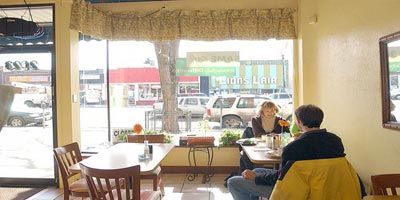
The cafe is tiny, just seven tables and a narrow kitchen. Behind a tangle of plants in the big bay window, the room's sunny yellow gives off a cozy feel. The Birkys hung a string of origami cranes in the kitchen and decorated every table with a bud vase of orange silk daisies.

Brad hopes eventually to pay himself to run the cafe. For now, the Birkys live off Libby's salary as a teacher of gifted elementary students and Brad's part-time work as a computer consultant.

Because they're the only employees, they keep the cafe open just five days a week: Tuesday through Thursday for lunch, Friday and Saturday from 11 a.m. to 7 p.m.

Brad changes the menu daily, using seasonal ingredients to create two soups, two salads and two varieties of gourmet pizza. Libby's in charge of the desserts: her grandma's sugar cookies (the recipe is pinned to the spice rack), fruit tarts, brownies, cheesecake or a rich banana-sour cream pie, served with a dollop of peanut butter.

To curtail waste, the Birkys don't set portions for their food. Customers take plates from a stack by the entrance and tell Brad how to fill them: a taste of the couscous with olives and feta cheese, a full bowl of the creamy squash soup, a thin wedge of the pear-and-gorgonzola pizza. They are always welcome back for seconds.

Brad's a largely self-taught chef — unless you count his high school job at Dairy Queen — and his food wins raves from customers. In a neighborhood dominated by fast-food chains and greasy diners, it's rare to find anything as inventive as his black-bean-quinoa salad, or the spicy tomato soup spiked with lime and finished with chunks of chicken and avocado.

BUT it's not the food alone that draws customers.

"You feel like you're helping them help others," says Bob Goodrich, 64, who walks to the cafe with his wife, Iris, several times a week. They give $15 or $20 when they can, $5 when that's all they have.

"It's like coming over to our friends' for lunch," Bob said.

While her husband gabs, Iris polishes off two slices of pizza and a green salad studded with dried cherries and pecans. "I cleaned my plate," she calls. "Can I get a cookie?"

Libby comes over with a tray of sweets. Bob turns to Brad. "Hand me your cloth," he says. "I'll wipe down the tables." The retired maintenance worker, wrapped in a cardigan sweater, lugs a bucket of soapy water to an empty table and gets to work.

By 1 p.m., the lunchtime crowd is gone. Libby dumps flour in a bowl for another batch of cookies. Brad leans against the fridge, trying to estimate the cafe's budget.

"Libby, you did those deposits recently. What do we take in?"

"Well, two weeks ago it was $850," Libby answers. "Last week, it was $200."

Brad shrugs, his interest waning. "Plus or minus a few hundred," he says.

In a few weeks, the cafe's board of directors — including a chef from a Denver culinary school and a nun who helps run the Catholic Worker shelter — will meet to review the books from the first quarter. All Brad knows, all that counts, is that the donations have been covering the rent and groceries.

Both Birkys grew up religious. Libby was raised Catholic; Brad, Mennonite. These days, they don't belong to any organized religion — except, maybe, the cafe.

"If we didn't have faith in the goodness of humankind, we wouldn't be doing this," Brad says. "This is our church." He pulls out a rolling pin and gets to work on another pizza crust.

stephanie.simon@latimes.com

Tags

9 Million Dollars and Still Locked Up!

09/24/2021 - 10:54 by Anonymous (not verified)
Original Author
root
Original Body

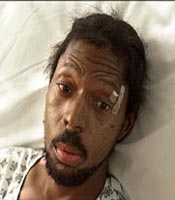
How does a man become a millionaire after a lawsuit settlement, yet still remain locked away in a nursing home with the state paying his bills and refusing to release him?

by Leroy Moore

I should be happy for Billy Ray Johnson, a Black disabled man of Linden, Texas, who received a little bite of justice recently for an attack he suffered in 2003 at the hands of a group of White men. Although I am happy, I’m not completely satisfied. The group of attackers were acquitted of serious felony charges and instead handed down lesser convictions with a recommended sentence of probation and on top of that many White residents went on record saying it wasn’t a hate crime and blamed Billy Ray Johnson for being in the wrong place at the wrong time.

After almost seven years, Johnson finally got some justice from a lawsuit that was brought against his attackers by the Southern Poverty Law Center. The jury, which had only one Black man on it, and the judge awarded Johnson nine million dollars for his medical bills and for past and future physical pain, mental aguish and physical impairment.

But I still don’t understand why Johnson still remains in a nursing home while the state pays for it using his money! A trust fund was created for his living and medical bills and the nine million will cover his needs for the rest of his live.

According to news reports, Johnson was living with his mother and family before the attack, so it seems completely senseless that he would stay locked up a home, costing more money and providing less support. Reports claim that because of his injuries, Johnson must remain in a nursing home.

Of course I don’t know Johnson’s family and their ability to care for him or to hire live-in care attendants but I do wonder if he was wealthy with support if he would be in a nursing home. I wonder if James Byrd, another poor Black disabled man beaten in Texas in 1998, would be in a nursing home today if he had survived his attack.

Bill Ray Johnson finally received long overdue justice in his case and I am extremely happy for him; however the question still remains about why he sits in a nursing home without his family. His winnings of nine million dollars can surely pay for a house and round the clock care. I only hope that after he recovers from his injuries physically that his lawyer and family will free him from the nursing home and he will have a solid supportive network around him!

I have yet to find a website dedicated solely to Billy Ray Johnson’s case; however if you google his name you can find more information. Also check out the website of the Southern Poverty Law Center at www.splcenter.org

www.leroymoore.com

Tags