Story Archives

A few folks have it in abundance, many have so little its pathetic. Its Called "COOL"

09/24/2021 - 11:22 by Anonymous (not verified)
Original Author
root
Original Body

It cannot be borrowed, split,
or loaned out.

Be and know yourself and
that invisibe it could find you.

Being Cool is hard work,
and I always loathed extra credit.

by Joe B.

I won’t be talk of the Kennedyesque guy gunning for mayor and last weeks protest of small business shaking hands.

Because some who is very good at investigation told me what I should’ve known had I been thinking about being in the public eye and perception good or bad can for a few pol’s can be just as calming as nicotine and chocolate for others.

So I’ll speak of other things for a while.

Cool, the word conjures up refreshing drinks, cold ice across warm heads hot summer days and as an adjective a way of feeling, being, or becoming.

There was a program on a few months on PBS’s Front Line called "The Merchants of Cool" about Madison Addison Avenue and other Ad agencies hiring Teens to capture the market on the latest trends, fads, who and what is in or out.

It got me thinking about cool’s meaning through the ages.

The meaning of cool is mercurial and since it is a recent phenomenon I wondered even the word at first didn’t convey what it does now how did folks in the past define the certain Panache, flair, charm, in the past?

Beside the few words above what set these few individuals apart. What is the secret "It" they have had, lost, gained, other men, women, children, and young adults didn’t posses? What I’ve learned is that cool in the past, present, or future cannot be quantified like the soul its essence is felt, known, quantified only by humans or sentient beings we have yet to make first contact with.

Take away fashion, looks, intelligence, and sense of humor, honor, and bravery even if it’s the accidental kind. You know when the high school, college, university bully girl, man, woman, or girl who’s been picked on all during the year; and there’s a personal crisis that the bully(s) didn’t know about. So they do their routine.

This time however something goes wrong as the victim doesn’t act as usual, in fact they just don’t care, the victim want to get the taunting and beating over with once and for all and never go through it ever again.
No longer embarrassed by a crowd say things they never would of said other wise never would and win or lose the bully may not change but the former victims can never set upon again and gains an inner "cool" from that time on.

Cool can be lost if one thinks about being it and yet when not being aware of if makes one cool! We never know when we’re cool and when where not is so arbitrary and subjective. Like the picture of a shirtless brawny guy gently holding an infant or playing with children being natural and completely not unaware of women and girls looking at them and mental swoon. Because he looks to be not only good lover but husband, father and nurturing material for the children and herself.

The same guy in a bar, on the street can be a jerk.
Children and animals can sense reality when people talk or smile at them.
Me I was raised with lizards, fish, cat, dogs, and turtles. There must be some kind of balance I’ve achieved because I keep hearing most people like dogs because they’re loyal than cats with their independent airs.

I don’t know which to chose it could be cats because they chose who they want to be with while dogs love being petted if they sense no fear.
However cats even if they like you may not want to nuzzled or pet and spit or scratch if they’re moody. A last thing is the future of cool.

It might be distilled or not from chemical or genetic means from folks who have so much charisma they become famous.

The next Frontier of "Cool" is many faceted whether it’s an Astronaut, researcher, scientist, or regular J. Q. public participating in life extending science and technologies, what type of personality is willing to be live a century or more?

A failure means illness or death but succeeding will mean a longer life than participants ever dreamed.

The question is how does a person(s) deal with an extended life span with the public looking on?

What will make him/her seem cool to the public after 30 to 50 years with a slowed or age stop so they are a strong in body, quick minded as they were decades past?

Like cats, dogs, and children might help and keeping up with the times also is a way of remaining cool.

Wanting everyone to have what they have, forming ways it could happen make enemies but ultimately is "Hero Cool."

Having a "God" complex is anti-cool, Hiding out, traveling, learning languages or otherwise being out of the public eye then returning on they’re own or because they are needed is or is not cool.

But staying in the public eye as a public immortal is tacky and will not be perceived as cool.

I think of cool as both cultural, sociological, mental construct.

Though it can be nudged cannot be directed or controlled by Ad agencies but up to individuals to define.

Long ago I myself learned that cool happens spontaneously and one cannot depend on friends to clue you in because our own minds have to decide our own way of what is comfortable for us.

To those who were and are always cool.

You know being yourself when everyone is against you is one of many secrets.

When I was growing up being cool meant dressing, having a dangerous, menacing aura about them was way cooler than a non-threatening one.

Later lots of the danger guys and gals died or in jails and it came to me that I’d rather live a quiet longer life, have lots of safe sex, and live longer less stressful life.

In the not to near future there will be a four way split in humanity:
1)

Will be having a traditional burial or being cryo-frozen.
2) learning and self-participation in life extension.
3) Going further to be an active immoralist.

4) Those on the sidelines trying to decide the best path for them to join.

They’re looking at the good and bad of all the three other groups.

For myself my own three pronged strategy of cool is learning about the Life

Extension and Immoralist, revolution while preparing for Cryonics Freezing immediately after death.

I figure, the longer I live a healthier life I might live through the small and medium extension breakthroughs and if not the cold cooling option is waiting.

I didn’t want to place all my eggs in one basket but spread them because if any of these blending and merging sciences begin feeding off each other…

I want to be around, sound, healthy, with regained youth and glad for taking the ultimate gamble.

You see, I don’t gamble a lot or bet but this last one is for a lifetime.

I cannot afford to make any errors in judgments as I’ve done in my still too short life. At least they weren’t fatal but now near infinity is on the line so slow, steady, for now as a turtle then fast and furious as a hare when the best of science and technology is able to save me.

It may not be cool to plan for death, yet hope for eternal life. But I see it this way; if I lose no big deal but if I live or get revived from a frozen coffin I’ll will be smiling with tears in my eyes shivering and shaking from cold and excitement.

I may be seen as an anachronism, barbarian, or one of the lucky few with enough vision to go for one last adventure.

If I’m revived, the cool mentality construct will be the last thing on my mind.

How about you readers out there, if it happens to you how would you then define
"COOL? Bye…

Tags

Police Brutality & Senseless Crimes: We Won’t Let You Rest

09/24/2021 - 11:22 by Anonymous (not verified)
Original Author
root
Original Body

DAMO looks at the recent case of police brutality against Donavon Jackson and other cases of senseless crimes against people of color with disabilites

by Leroy Moore/DAMO and PoorNewsNetwork

I can’t rest

My disabled brothers and sisters

Are shot, dragged and beaten to death……….

My poem, Can’t Rest, is more than words on paper, unfortunately it’s reality. In the last four years, Disability Advocates of Minorities Organization (DAMO) and I had many sleepless nights because of the continuous brutality and senseless crimes against our disabled bothers and sisters of color. What really keeps us up at night is the lack of awareness, media attention and no local community forums to educate and heal on this issue. Last July DAMO organized and implemented the first ever Senseless Crimes Open Forum dealing with people with disabilities of color in the community. However, since last July, DAMO and I still can’t rest

It’s been a year since our open forum and the physical attacks and police brutalities continue to happen to disabled people of color all over California. The following is a brief picture of this year's senseless crimes and police brutality against people of color with disabilities;
-

On Sunday evening, March 16th, Richard Tims, a frail, Black, mentally-ill young man, felt threatened when a teen stepped on his foot on a San Francisco Muni Bus and therefore tried to protect himself with a knife. He stabbed the teen, but when he got off the bus and hid in a bus shelter, the police arrived and talked to the wounded teen. After locating Mr. Tims the SFPD shot up the bus shelter killing Mr. Tims and seriously injuring an elderly woman coming out of a nearby fast food restaurant.
-

During Malcolm X’s birthday on May 19th, a disabled immigrant man of color was walking out of VALMAR SUPER LIQUOR & DELI on 16th & Valencia St. in the Mission District of San Francisco. A White male in his forties on a big skateboard was screaming about how this country was his country and how he hated fags and foreigners. He approached this elderly, disabled man and asked, "Are you an immigrant?" But the elderly man kept on walking. That’s when this White man picked up his big skateboard and hit the elderly man on the back of his head. On top of that, the three men of color inside the deli watched the whole thing and did nothing.
-

David Smith, a Black developmentally disabled youth of West Oakland was frisked and taken into police custody in the week of May 27th for no reason. After hours of questioning the officer realized they had the wrong person. David was let go with no apologies. David is still traumatized by the whole incident.

All of the above cases of police brutality and senseless crimes have been against poor people of color with disabilities who have very little resources to fight back. None of the cases had a witness video taping the incident so they were invisible to the public. Another example of this invisibility was the shooting and killing of Margaret L. Mitchell of L.A. You’d think the LAPD, and police in general, would stop, think and learn? However the recent L.A. police brutality against a Black, developmentally disabled and hard of hearing teen, Donovan Jackson of Inglewood, CA. is an on-going example that the LAPD doesn’t seem to have the intellectual capacity to learn from their history.

The LAPD & SFPD share a common reason why their victims end up wounded or dead: because "the victim had lunged towards the officer and the officer felt his life was in danger." From the above cases this reason doesn’t add up to me. Both Margaret L Mitchell and Richard Tims were frail and weighed only a hundred pounds. Both were accused of lunging toward the police officer with a very small weapon, but in both incidents the victims were outnumbered by police officers at the scene. Now why can’t police officers use reasonable thinking and come up with a less lethal tactic to deescalate the situation in which the police outnumber and outweigh its victim?

Donovan Jackson, a skinny teenager with developmental disabilities, only had a bag of chips. But once again an LA police officer, Jeremy Morse, said the Black disabled teen lunged at him and squeezed his testicles. So this forty-something year old grown man, who outweighed Jackson, punched him with all his weight. Although Jackson was punched, slammed on the roof of the police car, and dragged by his necklace, Jackson was booked for investigation of battery on a police office. As a Black, disabled advocate who worked with youth and young adults with developmental disabilities (for example, mental retardation) for almost twenty years, I have learned a lot about common traits they share. One common trait in most of the youth and young adults with mental retardation is the strong sense of loyalty and protectiveness some have towards family members and friends. So when Jackson returned to the car and saw the police still there, like any son he wanted to know what was going on and protect his father.

If you add that Jackson was hard of hearing, you get a very confused and hostile environment this teen had never been in before. If Morse took his time and realized that Jackson had developmental disabilities and was hard of hearing, he would have realized that Jackson needed accommodation. Morse could have let Jackson’s father do all the explaining on what was going on, or Morse could have turned face-to-face with Jackson to see if Jackson could read lips, or to see which ear had better hearing. Instead Morse escalated the situation, from which there was no turning back from that point on.

Another common factor found in some youth and young adults I’ve worked with who have developmental disabilities, is that if he or she has a good or bad experience with something or someone, it’s very difficult to change his or her mind of that person. Jackson is only a teenager, and from this horrible brutality it might be very hard to change his views about police. I don’t blame him! The most shocking but common finding in police brutality cases is that the officers, nine times out of ten, have a closet full of brutality cases against individuals (or a whole class of people) that haven’t been let out of their closet. Well Jeremy Morse’s closet is wide open and the media has been doing some Spring-cleaning. One of his brutality cases hit many news services, including the Saturday, July 13th LA Times. One case almost resembled what happen on Martin Luther Kings’ Birthday this year, in the Bayview Hunters Point District in San Francisco, where Black teens were physically and sexually assaulted and forced to lie on the ground at gunpoint. According to the July 13th LA Times, Morse had other legal and disciplinary problems including an off-duty incident in which he forced three teenagers at gunpoint to lie on the ground because he incorrectly believed they were stalking the sister of his then-girlfriend, court records showed. Morse was suspended for 13 days in connection with the incident, and the city settled a lawsuit with the teenagers for $37,000. Before Jackson’s tragic incident, Morse had continued to work for the Inglewood Police Department.

I’m glad that the Mayor of Inglewood, Roosevelt Dorn, took action and was vocal about the behavior of Morse. But I wonder, if there was no videotape, would he still react like he did? For example, the shooting of Idriss Stelley, a young Black man with mental illness in the San Francisco Sony Metreon Theater, didn’t have a video of the shooting that could have played nationwide. Although the grassroots campaign for Justice for Idriss is strong, still Mayor Willie Brown and the Chief of Police have been very slow to the demands of Idriss’ family and supporters. What are we saying? If it’s not on TV, then its not real and elected officials don’t need to react?

I agree with the Mayor that these cops should be fired and brought up on charges! As the Justice system does its job, we, the people, must do ours. I think it’s time for a grassroots movement on police brutality and senseless crimes against people with disabilities, especially people of color with disabilities including mental illness, locally and on a state level. Right here in San Francisco, Idriss’ mother, Mesha Irizarry, started a support group, Victory Over Violence, for families and loved ones who lost their disabled or non-disabled loved ones by the hands of the police. They meet the first Sunday of every month. There also has to be more community open forums on this issue with the financial and community support; more training of police officers on how to deescalate a tense situation involving people with mental illness and others with disabilities. Local groups and activists like:

Najee Ali of Project Islamic HOPE of LA,
Mesha Irizarry of Victory Over Violence of San Francisco and
Myself of Disability Advocates of Minorities Organization of San Francisco Bay Area
need more support, resources and media attention throughout the year for our work on this issue, not national leaders and not only during crisis!

My disabled brothers and sisters are put to rest

On the streets, in psychiatric wards & in prison

But I feel your sprit & anger in my chest


I won’t rest

Your sprit & anger won’t

We won’t let you rest

By Leroy F. Moore Jr.

Executive Director of DAMO

(510) 569-8438 sfdamo@Yahoo.com

Tags

Blood on the FBI’s Hands

09/24/2021 - 11:22 by Anonymous (not verified)
Original Author
root
Original Body

Leonard Pelteir’s lawyer speaks in the Bay Area about the Native American movement, terrorism and civil rights

by Christina Heatherton/PNN Media intern

My pencil tears across the page in a frenzied scrawl, desperately trying to follow Bruce Ellison’s lecture about Leonard Peltier and the American Indian Movement. I catch a few alarming phrases "…1/3 of Native American women unwittingly sterilized…64 people on the reservation killed…blood on the FBI’s hands…" but the context and stories are completely unfamiliar to me. Dates, events, and names merge into irrelevance. I have never heard of the American Indian Movement and am as vaguely familiar with the name Leonard Peltier as any UC Berkeley-part-time-student-activist might be. After a few minutes I squint at my notes in the dim auditorium and solemnly realize that my pencil has been outpaced by my swifter confusion.

I resign myself to observing the event from my seat, high at the back of the New College Auditorium in San Francisco. Ellison faces the audience of 35-40, sitting comfortably under warm lights with his arms casually folded on a table before him. His low-key manner and "aw-shucks" humility belie a well-educated confidence and sophistication. Bruce Ellison has served on Leonard Peltier’s defense team since Peltier’s original trial some 27 years ago. He flashes a self effacing smile and relates that at the time he was only a young lawyer who was often got to hold the other lawyers suitcases.

For most of the evening, Ellison does not speak of Peltier. With a lawyer’s persuasive simplicity, he sweeps through the history of US-Native American relations to demonstrate that persecution of the Native Americans has historically coincided with growing speculation into Native American territory. The history of indigenous people in our country and throughout the world, he says, is a history of people being deemed "in the way" of land and of resource exploitation. Ellison launches into a litany of injustices beginning in 1874 when Native Americans were forcibly removed from reservations after gold was discovered on their land. He picks up a century later in the 1960’s and 70s, when 27 multinational corporations quietly began to stake claims of reservation land for gold, coal, uranium, iron, and natural gas extraction.

It was during this time that the American Indian Movement (AIM) a leading proponent of indigenous rights emerged. In 1972, AIM lead a march on Washington called the "Trail of Broken Treaties" to protest the government’s defiance of past treaties as well as its responsibility for the impoverished conditions and suffering on Native American reservations. The march culminated in a raid on the Bureau of Indian Affairs. There AIM members uncovered classified documents which entailed the government’s plans to slowly eradicate the native people. Bruce Ellison’s tone becomes hardened as he relates that AIM discovered evidence that 1/3 of the female indigenous population between the ages of 18 and 25 had been involuntarily sterilized.

Leonard Peltier was a member of AIM. In 1973 he participated in AIM’s occupation of Wounded Knee, a dramatic protest against the human rights violations occurring on the Pine Ridge Reservation. A corrupt, US backed, tribal government had been in control of the Pine Ridge Reservation and had been enforcing its laws through the deployment of a violent militia known as the GOON squad (Guardians of the Oglala Nation). The US government responded to AIM’s occupation with military force. A 71-day standoff between AIM and heavily armed federal authorities ensued. The FBI armed and equipped the GOON squad to smother AIM’s dissent. After the standoff, violence on the reservation increased under the GOONs’ reign of terror. Residents of the reservation and AIM members lived under the constant threat of violence. Mothers, children, husbands, and relatives became victims of random beatings, tortures, gang rapes, and murders. 64 men, women, and children were murdered during this time. No one ever stood trial for the crimes despite the FBI’s presence.

It was in midst of this "climate of fear", as Ellison describes it, that two FBI agents were killed. On June 26, 1975, the two agents, driving an unmarked car, chased a small pick-up truck on to the ranch where AIM had its headquarters. A firefight broke out. AIM members heard the gunshots and believed they were under attack from the GOON squad. To protect the women, elders, and children inside, AIM members returned gunfire. In the skirmish, the two FBI agents and one Native American youth were killed.

Four AIM members were accused of the agents’ murders including Leonard Peltier. After hearing details of the "climate of fear", as well as significant proof of FBI misconduct, and a lack of evidence condemning the AIM members, a conservative Midwestern jury acquitted the first two suspects.

To suppress this embarrassing acquittal, according to Ellison, the FBI dropped the charges against the third suspect and targeted Leonard Peltier. Reading from an internal FBI document Ellison demonstrates that the government planned "to develop information to lock Peltier into the case" and place "the full prosecutive weight of the federal government" against him. Documents released from the Freedom of Information Act reveal that the government withheld and fabricated evidence, threatened and coerced witnesses, and flat out lied in order to get a conviction. In addition, Peltier’s lawyers were not allowed to introduce evidence of the "climate of fear" that had influenced the jury in the other trial. Peltier was convicted for the murder of the two FBI agents. He is currently in prison having served 26 years of his double life sentence.

So here’s the punch line…..

Terrorism, according to the government’s own federal guidelines, is defined as: "…the unlawful use of force and violence against persons or property to intimidate or coerce a government, the civilian population, or any segment thereof, in furtherance of political or social objectives." (28 Code of Federal Regulations Section 0.85)

Ellison demonstrates that the federal government is guilty by its own definition. Its support of GOON squad violence and its neglect of Pine Ridge residents constituted an unlawful use of force against American citizens. Additionally, the government’s fraudulent prosecution of Leonard Peltier revealed its subversive capacity to manipulate the criminal justice system for political purposes. Ellison asks the audience to consider who the real terrorists are.

Aside from its political agenda, Ellison suggests that persecution of Native Americans in the 70’s was additionally driven by economic objectives. He reveals that the FBI’s war on the American Indian Movement coincided with corporate plans to develop reservation land into the largest coal generating system in the country. Ellison points out that AIM attracted the most FBI attention when, in 1975, it adopted a decidedly more anti-corporate position with an emphasis on protecting land and water supplies from the corporate exploitation of mineral sources. With this shift, the FBI declared AIM one of most dangerous groups in the country.

Of the many "remarkable" and "frightening similarities" Ellison draws between the government’s suppression of AIM 27 years ago and its current War on Terrorism, his reference to the recent ruling in the Oakland EarthFirst! trial resonates strongly with the government’s persecution of AIM. Last June’s trial revealed that the Oakland Police Department had conspired with the FBI to suppress EarthFirst!’s environmental activism. While the group had been accused of terrorist activity, it became apparent that the only interests that EarthFirst! had threatened were those of the timber industry in Northern California. The EarthFirst! example illustrates the questionable ground upon which the national climate of fear is being founded.

Ellison’s voice gains a severe edge as he argues for the present relevance of Leonard Peltier’s case. He sees the same excessive governmental authority being granted to the FBI "not only without question but clearly without any consideration as to whether this new authority will actually in any way make us safer". The danger, he believes, is in the secrecy surrounding current government action. He sees secret military tribunals, for example, as being necessary to hide evidence of FBI misconduct and government abuse of the criminal justice system. Within the present climate of fear created by the government, Ellison suggests that dissension is being suppressed and civil liberties are being quietly decimated.

As Ellison discusses the intensifying counter-surveillance operations occurring nationally, he proposes that the very people we are sitting next to might be gathering information about us. For a long self-conscious moment, the auditorium is gripped with uncertainty. I look warily at the circulating petition requesting my name and address. I scan the room for infiltrators. I spot a head of blonde dreadlocks, some billows of white floating above creased collars, long manes of black strung with feathers and beads, a stray perm, some deliberately unkempt, clean chic, and/or spiky heads, and a cluster of disheveled masses strangled back into pony tails. I see no suspects in the audience, but then again, I have no idea what the back of a fed’s head might look like.


For more information, please go to:

The International Office of the Leonard Peltier Legal Defense Committee

http://www.freepeltier.org


First Nations: Issues of Consequence

http://www.dickshovel.com


Judi Bari’s Homepage (for information about EarthFirst!’s trial)

http://www.judibari.org

Tags

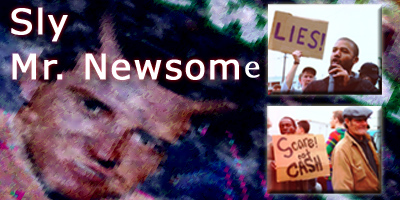
Sly Mr. Newsome

09/24/2021 - 11:22 by Anonymous (not verified)
Original Author
root
Original Body

The people of San Francisco confront Gavin Newsomes' many lies

Part 3 in the ongoing PNN series; Pretty Boy Newsome versus the Poor folk of San Francisco

by Liz Rodda/PoorNewsNetwork media intern

Four men fit into an olive metal box. I joined them with a smile for a new political adventure. Sitting quietly toward the back of Ed’s van, I observed their expertise. Here I was the uneducated: the POOR Magazine interns and staff whom I sat amongst understood social inequity in a way which I would never fully understand, each having dealt with poverty first hand. Nevertheless, they did not filter me from their bated breath, but immediately welcomed me into their endless madcap songs. We were high on life and ready to enlighten Gavin Newsome that his plan to cut General Assistance to fifty-nine dollars a month was absolutely unacceptable. Succeeding a chain of seven police on motorbikes, we spun up to our destination of 2311 Taraval Street, the Cal Insurance and Associates Building where we would meet Mr. Gavin Newsom for a bit of "conversation". Ed Willard, from PNN and POWER dropped us off along side the action, demanding us out of the van and into the heart of the protest.

"Newsom babozo! Tu eres un mentiroso!" I stepped into the street amongst these words: "Newsom baboza!" with fellow strangers throwing fists high, demanding, "Tu eres un mentiroso!" A red banner dangled from apartment windows opposite us reading, "Don’t Buy the Lies!" A picket march was already in full motion amongst hoarse voices screaming cantos just as a tremendous upheaval blew us away. Voices ran wild with the appearance of Gavin Newsom on the scene. "Mr. Newsom! Speak with us! We want to talk!" He quickly disappeared into the crowd with his team of guards and into the safety of the building. Mr. Newsom’s choice to ignore us only made our chants grow intensively louder, "Shame! Shame! Shame!" We continued to shout until it became apparent Mr. Newsom would not be making an appearance anytime soon. With a slowing shift in energy, several selected speakers began to tell their stories of how Mr. Newsom’s cut in GA would affect them individually.

"Without the money I have received from GA, I would be homeless". Thomas spoke with an appealing sweetness that only enhanced a powerful intensity he emitted. "It has allowed me to both find an apartment and hold onto it. If the money is cut, I will become homeless." His dark eyes looked up to thirty stoic police who were being paid incredible capital to stand in a straight line. Thomas took a deep breath and continued into the microphone, "I challenge you Mr. Newsom to come out here and speak with us, your voters. You will be surprised how willing we are to tell you what we need." He concluded his short speech with how GA has the ability to directly benefit families and children through increasing self-esteem, hope, and the possibility of permanent change. The crowd commended him for his words as retired to the sidewalk and Lucky Jones picked up the mike. Young and animated, Lucky immediately threw us into a terrific rhythm of "Gavin Newsom you think you’re sly. All you do is lie, lie, lie!" He entranced us with his extraordinary sense of verbal communication and I immediately knew he was the man for an interview.

When he finished his raucous chants and a new speaker commenced, I asked him for a few words. He nodded, having me follow him to a quieter area of the street where we could speak. He needed little prompting before laying the situation in full detail before me. "You see these streets?" His face was inches from mine, demanding every breath of my attention. His dark eyes and powerful presence immediately devoured me. I swallowed, trying to appear at ease "yeah". "How do they look?" "Clean", I retorted, glad I had paid attention to his earlier speech. "That’s right", he bellowed, "That is because people on GA keep it clean, working every day for less than minimum wage. And what happens when they get too old to clean the street? You have a grandma?" I nodded. "How would you like to see her working on the street to make less than minimum?" I closed my eyes, feeling overwhelmed by his presence and all that I didn’t know. He continued, "I need to be able to save 1/3 of my income to even think about coming out of my current situation. 1/3 of 59 dollars is 12 dollars. 12 dollars isn’t going to get me anywhere." His eyes remained fixated on mine becoming dry from ceasing to blink. "The money cut from GA will supposedly go to shelters which only means we will be paying high rent for a place to stay." He sighed, finally looking away from me to the dimming sky.

Gavin Newsom spends over seven hundred and fifty dollars for each advertisement he puts up, more than what several GA recipients receive in a month. He pays ten thousand dollars for every television advertisement he puts on air and recently received a three hundred thousand dollar wedding reception. The statistics are appalling. I remembered the words of Lucky, "Can I sleep on your door step tonight Mr. Gavin Newsom? No, I don’t think so." The evening air was growing cool as I bent down to pick up a lost photocopy of Gavin Newsom’s face floating down the street. Bold black letters were scratched across his smooth features, reading "SO HOT: And YOU can party with ME. Come and tell me how much you care about me. How much you love that I’m cashing in on making more people homeless. Call anytime. I need you NOW." Clever, I smiled. My head began to ache from a day of chanting and all of us looked ready for home. Unfortunately not all of us would have the luxury of returning to a warm apartment like I could. Ed, Charles, Richard and I ambled back to the van discussing the rally and Newsom’s super sly disappearing act. Ed shut the metal doors behind us and we returned to familiar territory. I revisited my corner of the van, quietly pondering the impact of an incredible experience.

Tags

Stop Unfair Incarceration of Youth

09/24/2021 - 11:22 by Anonymous (not verified)
Original Author
root
Original Body

by Youth Making a Change (YMAC)

San Francisco, CA Wednesday the 17th at 3:30pm in front of the Youth
Guidance Center seventy-five youth rallied to show support for Youth Making
A Change's campaign to support the JDAI process and relay the message that
the Risk Assessment Instrument needs to be implemented inorder to stop
unfair incarceration of youth.

The youth groups that represented were the United Playas, Homey, Conscious
Roots, MOVE, EID, OLIN, and CYWD. There was a speech made by Ray Balberon
and a spoken word piece by Javier Reyes of Colored Ink and Saron Angola of
SOUL. The rally was non-violent and there were no altercations with the
cops. Youth Making A Change's goal of letting city officials know that youth
care about this issue and promoting awareness to the youth was solidly
achieved. For info, contact YMAC @ 415-239-0161

Tags

Prisoners of a system

09/24/2021 - 11:22 by Anonymous (not verified)
Original Author
root
Original Body

Current and former welfare recipients speak on the impact of Welfare Reform (read: Deform)

by Alexandra Cuff/PNN media intern

As the sun climbed higher in the July morning, the strip of shade, offered by the charcoal block of awning at the check-cashing mart on 19th and Mission, receded into the crumbling brick of the wall. When I finally moved up in line far enough so that I was inside the building, I had already been waiting on food stamps for 30 minutes. I was definitely going to be late for work. Damn, I had already spent 3 full mornings sitting in the waiting room of DHS for my GA application to be reviewed and accepted. And now, late for work again, chances are I’ll lose the job. As a child growing up in a white middle-class family on long island, I did not know poverty. The word "welfare" did not ever conjure up an image at all. It was a word maybe mentioned in a social studies class. It was a word used to describe other people. The first time I saw a food stamp was while working in a small grocery store in a poor town in North Carolina where parents would come in with lots of kids and buy a month’s worth of meat to freeze and boxes of nutritional-free cereal. I didn’t necessarily blame them for being poor – hell I was a poor (and privileged) student – but I didn’t think that I would ever be on welfare.

After my experiences in applying for welfare in San Francisco, I know well the inefficient mode of getting people help. It causes us to spend more time running around for documents, filling out paperwork than it does being out in the fresh air, taking care of children or looking for a job. Looking back, I feel like I was waiting in line for a month. Each time I felt I was getting closer and closer to the abstract castle which Kafka’s "K" is seeking out in his bureaucracy-bashing novel the Castle. I know now that this system works in machine-like inhuman ways designed to beat back those in need.

I was excited when I was assigned to cover the July 19th media briefing on welfare reform at the World Affairs Council building in downtown San Francisco. Between Gavin Newsome’s insidious plan to slash GA benefits and welfare reform up for reauthorization this year, there is a lot of unchecked power at hand that can seriously affect the poor folk both here in the Bay Area and nationwide. Even as a welfare recipient, I was not aware of the history behind the last reform nor did I know the extreme provisions being proposed by the Bush Administration this time around. I don’t think that most of us, especially those not on welfare, know the injustice and idiocy around current and possible future policy.

In 1996, Bill Clinton’s welfare reform (or welfare deform) ended Aid to Families with Dependent Children (AFDC) and introduced a block grant program called Temporary Assistance to Needy Families (TANF). The 3 most consequential changes included a five-year limit on cash aid to adults with children, a rigorous work requirement, and the elimination of benefits to legal immigrants. This did nothing to reduce the poverty or homelessness in California. There are 1000 more families on welfare in California now than there were in October 2000, an increase of almost 40 families a month. The only thing it reduced was the caseloads. A new welfare law will be passed in the next couple months and we could be looking at increased work requirements, insufficient funding for childcare, transportation, higher education and vocational training, and a new "marriage promotion" program. What will this mean for the 700 families who will hit their 5-year time limit for welfare benefits in 2003?

On Friday morning, I met with other people who are concerned with finding out the truth about how welfare reform impacts the families and communities most directly affected by these issues. The media briefing was sponsored by the Coalition for Ethical Welfare Reform, Independent Press Association, Media Alliance, Pacific News Service, and National Campaign for Jobs and Income Support. We represented women, people of color, low-income families, and grassroots organizations that are, for some reason, not part of the policy making.

It’s interesting that a country so concerned with family values and with a president who apparently thinks that government-supported marriage promotion is the end all for poverty and violence, would put childcare at the bottom of the priority list with less than $6 billion in funding for the fiscal year 2002 to be divided by 50 states!! There is a correlation between single mothers not having affordable childcare (would free childcare be too much to ask from the richest country in the world?) and not being able to make a living wage. Contrary to the mainstream view of single mothers and other welfare recipients, this is not laziness. They don’t have people to take care of their children! This could be the difference between working and leaving your babies at home alone. Elected officials will never admit it but our society simply chooses not to invest in childcare.

Star Smith loves her job. She works 20 hours a week for the Coalition on Homelessness doing outreach to families living in SROs. In 1999 she was convicted of a drug felony. After being incarcerated and going through a drug treatment program, Star gave birth to her first son. When the father of the baby left she was responsible for both earning a living as well as providing uncompensated childcare. So she applied for welfare. Welfare, a supposed income-support program designed to help if you lose your job or are otherwise financially disadvantaged and have little money left to pay rent and feed yourself and family.

For Star there is no support. Due to her history of one felony, she is banned from all welfare for the rest of her life. She works 20-hours a week advocating for and supporting other poor families in San Francisco, sells jewelry to supplement that income and supports herself and her son. She is not eligible for subsidized childcare, training or education money, HUD or section 8 housing. She even moved in with her partner upon the suggestion of her caseworker after being told she can’t make it alone. Ask Star how she feels about the current welfare system: "Try to do anything in life when the government is putting up roadblocks. I paid for my crime through the criminal justice system, I shouldn’t have to pay for it through the welfare system." As far as I’m concerned, this is a big Fuck You to working families in general.

When the briefing was over, I spoke with 22-year old Rina Phou. Rina’s family has been on welfare since they moved to the United States from Cambodia. Rina’s father is disabled and her mother stays at home to care for him. Since Rina was 12 years old, she has been working to contribute to the family income. She has been working full time since she was 14 years old to support her parents and 3 brothers who all live in a one-bedroom apartment in the Tenderloin. Education is important to Rina and although having to work full time through high school, she has maintained a 3.5 GPA. She worries though for her 2 younger brothers who are growing up and equating life with work. Her 16-year old brother wants to stay in school and play sports but he has to find work. His grades are dropping because he is looking for job. Her 12-year old brother wants to work instead of going to school. Rina is paying for her brothers’ books and clothing.

I can’t imagine having that responsibility as a 22-year old let alone a 14-year old. Rina told me, "I don’t regret anything. All this drama made me a stronger person. I learned not to feel sorry for myself." She also admits though that it was difficult going to school with other youth who did not have to work. "I felt left out but I was lucky compared to people in Cambodia which is so poor." What will Rina’s family do when their 5-year limit is up? She fears that her parents will have to find dish washing jobs or another minimum wage job.

Rina’s parents would go from not working and being poor to working, possibly endangering her father’s health and still remaining poor! Within today’s booming economy, I have english speaking friends with industrial hygiene, psychology, and computer science degrees who are unable to find work. TANF’s stringent work requirements will force welfare recipients, no longer eligible, into low-paying, part-time positions with no hope of saving money, let alone making a living wage.

According to research done by Asians and Pacific Islanders for Reproductive Health, an organization out of Oakland, CA "welfare programs do little to assist poor, Southeast Asian communities and in fact continue to trap them in poverty. Within Alameda County County, Southeast Asians are the second largest group of welfare recipients. Many Alameda County welfare offices do not provide interpretation and translation services to large Southeast Asian populations, burdening youth to interpret for their parents at welfare office visits."

In June, the Senate Finance Committee passed its welfare bill, which differs from the House of Representatives and Bush Administration proposals. The Senate Finance Committee bill proposes to maintain the 30-hour per week work requirement and will restore TANF benefits to immigrants. In contrast, the House bill which passed in May will increase the work requirements to 40-hours a week and will provide little funding for childcare and transportation. Both of these bills are still promoting marriage and two-parent family solutions to poverty.

It’s infuriating to know that the difference between some of us living on the street or in an apartment, could be decided by folks who have never known what it’s like to plan a month around a $300 check. It’s disgusting that the poor in this country are really prisoners of a system which they’ve done nothing to offend but be poor and that the actual prison system, jails themselves, take a higher priority than childcare. We need welfare that is going to do what it says.

Tags

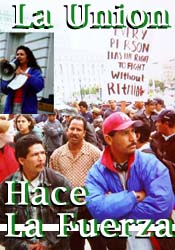
La Union Hace La Fuerza

09/24/2021 - 11:22 by Anonymous (not verified)
Original Author
root
Original Body

Willie Brown attempts to silence the voices and resistance of San Francisco’s poorest workers, The Workers answer back.

by Liz Rodda/PNN Media intern

A wire door stood vertical to the iron numerals: 3358. Never before had a line up of two threes, a five, and an eight looked so fantastic. This, my friends, was the aftermath of incredibly bad Muni directions from a foul roommate of mine. I lapsed around the door feeling relieved and suddenly attacked by twenty pairs of eyes in my direction. I had stepped in on the weekly meeting of San Francisco Day Labor Program conducted by the enchanting Renee Saucedo. I attempted to melt into the white walls, taking a vacant seat between two men of latino descent . Renee smiled at me, continuing to exchange a rapid flow of Spanish with workers who were addressing personal crises. As the final bit of green lettering on the posted agenda was addressed, the workers stood to return to the streets.

With the recent appointment of Police Captain Gregory Corrales to the Mission Police station, the Mission District has become a very different place for these workers as well as several other very low-income residents of the Mission. Three blocks of the Mission District have been painted yellow, screaming off-limits to all "lingering" workers. They now suffer the piercing sting of Corrales policy to "clean" the Mission District. It was not long ago these workers, predominantly of Latino descent, immigrated to the Mission District, coloring the streets with incredible diversity. A Day Labor Program was founded in 1984, when the community saw the need to organize an agency that would allow workers to access city resources and find work. For the first time they were presented with the opportunity to seek literacy classes, Health Care, and agencies that provide food and clothing. The Mission streets became the place workers found either temporary or permanent jobs from visiting employers. The workers spirit began to flood the streets, expressing their new life and the adversity they had faced along the way. These Mission streets became the workers’ home and source of livelihood.

Renee’s black locks fell beside her mouth as she spilled perfect English before me. She explained how the day laborers had recently led a protest at City Hall regarding the incessant harassment they endured from police officers. "They brought him (Mayor Willie Brown) a beautiful Fathers Day card, explaining this was why they would not be having a good fathers day." Mayor Brown responded to the non-violent protest with an incredibly disturbing message for La Raza Centro Legal, the Day Labor Program’s parent organization. The program was informed that the funding for the Day Labor Program is to be put up for public bid where they will no longer receive the same city funding they have depended on for operation. Program leaders of La Raza Centro Legal were dismayed to find they would now be up against two other groups to receive any city money. With this new measure, the city appears to have completely ignored the incredible success the program has had over the past years. La Raza Centro Legal has been recognized as a model for day laborers in major cities across the nation, far exceeding the expectations of job development the city had set earlier this year. Over forty letters have been sent to the Mayor’s office in support of La Raza Centro Legal’s administration from program workers, Mission residents, and relative agencies.

I eyed a quiet man who lingered in the room, wondering how this would affect him personally. Renee agreed to translate: "Putting the program up for public funding will affect me directly. I have been a volunteer with La Raza Centro Legal for over a year and a half and work with the men on Cesar Chavez every day. We are supported by La Raza Centro Legal as it works endlessly with the Latino Community." The carefree smile Daniel Rosas had worn when I first addressed him turned dry and his eyes lost their former glow. He continued to tell me that because he has been organizing with fellow workers for many years, he has often been present in the face of serious police harassment. Even though he is supported by La Raza Centro Legal, "there is still a bald police officer that comes in a van often. He says, ‘Don’t you understand you bunch of wetbacks you can’t be on these streets?’ and continues with his obscene harsh words. I was there." His deep brown eyes probed into mine hoping I could understand. It is a strange and beautiful situation watching translation occur. I watched the words from his lips travel to Renee and miraculously become something meaningful to me. His skin was sun scorched but still had softness. "I don’t have immigration papers. I realize I have to deal with reality when it comes to the authorities. Even the bald police told us that he is on our side, but must follow orders of Police Captain Corrales and neighbors who live on the District."

Renee motioned that she was growing pressed for time as our conversation came to a rapid conclusion. "Gracias" I said to my new friend. He smiled and returned a few words in Spanish. He gestured to ask if he could walk me to the bus stop. I turned to wave a grateful goodbye to Renee, as she parted with a friend in the opposite direction. Although Daniel and I could not communicate in words there was a speechless communication that occurred between us. He handed me a leaflet written in Spanish with his picture on the front amongst other day laborers. "Me", he said, pointing to his image and the text he had written in the body of the paper. The bus lurched up with an impatient sigh as I shook his hand, reluctant to say goodbye so suddenly. He waved me off until we might meet again. I sat back in my bus seat wondering where he would be returning to and how he would face the tremendous political battles ahead of him.

Tags

Foster Care, A Mother's Nightmare

09/24/2021 - 11:22 by Anonymous (not verified)
Original Author
root
Original Body

Courtwatch interviews a mother whose family was torn apart by Foster Care System

by Connie Lu/for Courtwatch and PNN

I meet Michelle Howard in the common room at POOR
Magazine. There are several simultaneous sounds of
loud and distracting conversations busily whirling
about the entire room. Our voices are muffled despite
the attempt to speak above the ambient noise, so we
decide to move to a more quiet room. The couch we are
sitting on is old, but comfortable. But most
importantly, I am now able to focus my attention on
Michelle. Her hair consists of intricate braids that
are beautifully gathered together on the top of her
head. Her deep brown eyes remain looking down at the
papers in her hands most of the time because she is
nervous about the interview. But the few times she
looks up into my eyes, I could see the glassy
reflection from the tears in her eyes as she begins
describing the photos of her daughter. At this point,
my arm is already becoming sore from holding the
microphone up to her mouth. However, as she continues
to tell her painful and frustrating experience of CPS
(Child Protective Services) taking her daughter away,
I begin to forget the pain in my arm and focus upon
the pain in her heart.

C: "Can you tell me your name and begin describing
your situation with CPS?"

MH: "My name is Michelle Howard. I'm coming in
concern of my daughter Alexis, who is in the custody
of the state CPS (Child Protective Services) workers.
I'm coming because nobody seems to want to listen to
the voice of my child, Alexis. She's been in custody
for 17 months now. During that period Alexis was kept
out of school when she was taken from me from the
hospital for three months. I went to the hospital
because my mother had just died and I was upset. I
was crying and plus I was physically hurting from
stress. My back was also hurting. Then when I came
out from talking with the doctor; my daughter had been
removed by the CPS workers. From there, she went to
three different foster homes. She was really abused
in one of them by the CPS. She was mentally abused.
They were asking her questions about "Has your mother
ever hit you? Has your mother ever abused you?"

C: "Why did they take her?"

MH: "They did not say at that point in time. They
never asked if I had a relative that she could stay
with. They just took her and put her in a foster
home."

C: "And this was a couple of months ago?"

MH: "No, this was on November 11th of 2000. Ok, then
they went all into my background, my history and said
that my background was the reason why they took
Alexis, even though me and Alexis were doing good
together. My daughter has never been abused of any
kind. She always had food and everything, but when I
see my daughter when they let me visit her. Alexis
had been mentally and physically abused.
She would tell me things on the phone like, "Mommy, my
body is hurting. Somebody is messin' with my body at
night." So I reported this to the CPS worker. They
said that they would look into it. They never got
back to me. Then they would put it to where my
daughter and I could not talk to each other on the
phone."

C: "You have every right to talk to your daughter."

MH: "But then I started getting like verbally abusive
with them of course, because I was finding out that
they were not checking on my daughter in the foster
homes as much as they could. My daughter would tell me
some little children that were in there were
physically touching on her privacy. I have pictures
of scars and scratches on her. I have a picture of
her with a ringworm in her head.

C: "Can you tell me more about the pictures?"

MH: "She was in one of the foster homes. A picture
tells a thousand words. She had a ring-worm and
that's her hair growing back (photo) from the
ring-worms she had. You can't see but she had
scratches and when I told the lawyer that they
appointed to me he said, "Well how do I know that it
didn't come from you?" You know, insulting me like
that."

C: "This is the back?"

MH: "And this is her back, she had scratches on her
back."

C: "I can see the scars."

MH: "Scars, a picture tells a thousand words.

C: "That's sad."

MH: "Even though I told her to smile when I was
taking pictures of her, she remained sad, real sad.
That's a picture of me and her. She smiled a little
bit, but she's still upset. I also had pictures when
Alexis hollered and screamed at the social service
building where I had to be supervised to see my child
which I could never understand, why I had to be
supervised."

C: "You couldn't be alone with your child?"
MH: "Yes."

C: "Someone had to be there?"

MH: "Someone had to be there, but then they stick her
in a stranger's home and let strangers keep my baby.
When I asked them if she could she come live with a
relative that I knew for years, they told me, "No, she
had to be with a licensed foster person." I kept
telling them, "You know, y'all doing something to my
daughter here. Y'all mentally abusing her. Why don't
y'all let my baby come home and supervise my child at
my house? They refused to do that."

C: "How can you tell she was being mentally abused?"

MH: "Because Alexis was very sad. She would breakdown
every time she saw me. She would say, "Mommy, Mommy, I
want to come home. Mommy please let me come home.
Mommy, please let me come home." She was specifically
telling them. When she told them, they would tell her
things about me and say, "It's your mother's fault
that you couldn't go home."

C: "Why did they tell her that?"

MH: "They just righteously lied to my baby. When my
baby tried to tell them my mama didn't hit me, they
said my baby said that I hit her with my fist. I
would never do that to my child." But they still kept
my child. I'm a type of person that when it gets to
the last point I get angry because you're mentally
abusing my child. I'm wondering every day and night
what's going to happen to my child? I'm asking them,
"Why did you take my child in the first place?" My
child wasn't abused when you picked her up in the
hospital."

C: "Was she was going to school?"

MH: "She was going to school, but they kept her out
for three months. She knew how to write her name.
She knew her ABC's at four. At three and a half she
was in preschool. But as she stayed in the foster
home, Alexis forgot how to write her name. Alexis
forgot her ABC's. She's seven years old and she's
going to the second grade. They're passing her along,
but Alexis is behind. She's very behind in school. It
breaks my heart because they told my daughter that if
I came to school to pick her up or if I came anywhere
near her without them knowing, then I would be
arrested and go to jail for three years. But when my
daughter stayed with the foster parents, she was
getting abused by a lady, who was screaming and
hollering at my baby while I was talking to her on the
phone. I reported it. They said they were going to
check into it, but they never did. So my daughter
became scared of the foster parents to the point that
when they abused her, she wouldn't say anything
because the CPS workers had told my daughter that if I
came anywhere near her, I would go to prison for three
years. So that's why she stopped telling me anything
about abuse or mental abuse. That's mental abuse when
you tell a child that if your mother comes anywhere
near you, she's going to jail. You know, it's just
getting to me. They're still holding my daughter."

C: "Did you talk to the foster parents? Are they
denying it?"

MH: "Of course they're gonna deny it. Not only do
they deny it, but they also think that I'm mentally
disturbed. Anybody would be mentally disturbed if they
go for help and come back to find their daughter gone.
They tell me that I need to be on medication because
I get angry a lot. Of course I'm angry. The CPS
workers walked into the hospital and took my child. I
was just seeking help because my mother had died. I'm
here to let you know about my daughter. All her
rights have been taken. She has told them, "I want to
be with my mommy." They won't let her be around me
without supervision. I don't understand this system.
I don't understand CPS. I'll do anything to help
anybody who has been through my situation. These
people are very evil."

C: "So, right now you still don't have your daughter
with you?"

MH: "No, she's still in Foster Care. She's with a
person that I call a relative because we know each
other. I get to see her more though."

C: "Do you have any sort of future plan of action
now?"

MH: "No, they have appointed lawyers for me, but the
lawyers seem more against my child and me. It's not
about me. It's about Alexis being mentally disturbed.
All the things they said in the past about me to my
daughter are not true and my baby knows it's not true.
It's making her all messed up in her head."

C: "She's just all confused right now."

MH: "She's very confused. I'm really trying to be a
voice for her because nobody else in the system seems
to want to listen to the child."

C: "And how old is she?"

MH: "She's seven now. The foster parents are
strangers to my daughter. She doesn't get the love she
needs.

C: "I'm sure your daughter knows that you love her."
MH: "Yeah, I love her very much. She knows I've never
abused her.

C: "Thank you so much for sharing your story."

MH: "Thank you. I hope this interview can help others
as well."

After listening to what Michelle and her daughter
suffered through, I am reminded that there is a
certain unexplainable, yet truly unbreakable bond that
a mother shares with her children. A powerful bond of
love that is able to withstand and endure the
destructive separating tactics of CPS. Their love for
each other is what gives them the hope for
reunification.

*************************************************

Open Letter to Rebecca from Michelle

Dear Rebecca,

I thank God for someone like you. I've been praying
for this time to come. Sorry for what has happened to
you and your children I know nothing can change the
damage that has been done, but God. Healing,
forgiving, and trust are violated when you and your
loved ones (your children) have been hurt so badly by
a system we were raised to trust and believe in.

My little girl was taken from me and she was kept out
of school for over three months. She was mentally and
physically abused by the CPS workers, people they
placed her with, and other children. Because my
daughter wanted to come home, she would get
abused by the other children that the foster person
would leave her with.

When I reported this to the CPS, they would punish me
and my daughter by keeping us apart. Sometimes I
would not get to see my daughter. Our visits were
always supervised, as if they had a real reason to say
I was a harm to my daughter. My child lived with
strangers (Foster Care) for over a year. Most of the
time she was not check on, as I would have liked and
as often as she should have been by the CPS worker.
When I was seeing my daughter she would have scars on
her back, face, and legs. She would tell me how they
got there and I would report it. Once again my
daughter and I would be punished for telling too much.
Sometimes they would not let her speak to me on the
phone. I would call, but they wouldn't let her return
my calls. Sometimes I wouldn't get my visits because
I was told I'm calling my daughter too much.

I'm going to stop here because it gets very painful to
continue. I have always believed that CPS was meant be
a good industry, but it turned bad. I hope and pray
that you and your children be compensated for what
happened.

Thank you and God bless Rebecca.

Tags

SPIRIT OF THE CORN

09/24/2021 - 11:22 by Anonymous (not verified)
Original Author
root
Original Body

by Aldo Arturo Della Maggiora

Melida Andrade (Ma ma) was born in Born 1902 in Cojutepeque, El Salvador, a country of volcanoes. Ma ma Melida came from a poor family. During this era the country was not very populated and their economy was fair. My Great Grand Mother did not know how to read or write, nor did she attend school. At that time going to school was a privilege for those who could afford it.

Ma ma was the oldest daughter of Catalina Delgado and Salvador (a military general). She had two brothers and a sister. The oldest brother was Estevan,11, the youngest brother was Atilio, 10, and Lidia, at 4 years old, was the youngest in the family.

In 1914, Ma ma Melida’s mother, Catalina passed away at age 38. Prior to my Great Great, Great, Grand Mother Catalina’s death, she had already separated from her husband. Ma ma Melida was only 12 years old; left to care for Estevan, Atilio and Lidia. Ma ma Melida went to live with her Grand Mother Benita Carrillo v. (view da) de Delgado. Estevan ran away from the family. My Great Grand Ma said that she tried to track him down but could not find him. Suffering from the frustration of losing a brother and not being able to afford medication for her mother, dying of a fever, she promised to herself that she would come out of poverty with her family. That was her turning point.

Finding herself at the age of 12 years old left with the responsibility to raise her brother and sister, Ma ma Melida wasted no time in vain conversation. Her conversations, were all about business and no more than that. She focused on looking and speaking proper so that she would not be outcast from the cream of society. She had an attitude that she was the queen and only interested in business. She used this attitude in society and in her family so that nobody could put her down. She did not let anybody in, because she understood the nature of envy and how personal history was used to minimize others; to interfere with the business or goals one had in life.

She earned her respect and everyone she worked with saw that this women was a hard worker, had self-determination and dignity.

Her strong character came from the fact that she had to confront life at an early age. She had the knowledge of "No meter la pâté" (to be proper) among the wealthy, intellectual, business community. Through listening and observing she learned to behave and survive amongst the privileged society. She graduated from the University of life.

It is believed that after the death of my Great, Great, Great Grand Mother, Ma ma Melida got involved in prostitution to be able to send money back to her grandmother to feed her brothers and sister and build the capital necessary to start her liquor business. From time to time, Ma ma Melida also got paid to breast feed other children, which was customary in El Salvador.

In El Salvador police were known for tattooing prostitutes with a serial number. My uncle was aware that my Great Grand Mother had a numerical tattoo on her shoulder, hidden behind two tattooed hearts; which she never showed anyone. Other than this information no one talked much about this subject within the family circle, and people that knew, did not speak about it, for respect.

At about age 19 Ma ma Melida started her liquor business. She traveled with local merchants who knew her. The barrels of liquor Ma ma Melida bought were transported on mules to different town fairs throughout El Salvador.

Once she arrived into town she would set up a tent both to promote the liquor she sold. Since she was on the road all the time the tents were convenient to sleep under after a long day of work. Ma ma Melida carried a 38 caliber with her as a means of defense. She would not let anyone take advantage of her. These town fairs would last up to three days, where local officials, business owners and town’s people would show up throughout El Salvador. There was music, dancing, food, and vendors.

As Ma ma Melida’s business began to flourish, she helped set up a barbershop for Atilio. but due to his alcoholism his business failed. He became a shoe shiner as well as a shoe repairer on the street. He lived in run down Mesones. (hotels) Other times he found himself in the streets when he could not afford the Mesones. Ma ma Melida tried hard to help him but Atilio gave up, she had to learn how to let her brother go, because no matter how much money she would give him he would always spend it on alcohol. Lidia received money from Ma ma Melida and opened two cantinas. Although Lidia’s business did well the hardships of a bad relationship resulted in her becoming bankrupt. Her unhealthy relationship lead to the mismanagement of her business. Lidia lost her business and house. She had seven children who were grown up by that time.

By this time Ma ma Melida had two children Arturo and Soli. She bought a house in Sensuntepeque and eventually bought 16 houses where she rented to people and established cantinas selling liquor. Sensuntepeque was a rural area and property was inexpensive

Being the new, single women with her siblings, in town and establishing businesses and homes attracted the envy of one woman who was known well in town for her business success. She took Ma ma Melida to court complaining that the cantinas were not good for the town. Eventually Ma ma Melida got tired of going to court and decided to sell all her property and businesses. She collected all her money and moved to the capital, San Salvador. She never gave up on her dreams. She bought a house and established her first cantina, later establishing more cantinas. Her husband Manuel Andrade opened two grocery stores.

As her business grew stronger, sooner then later, she was able to present herself to the De Stileria la Central and another company Ilopania at the time who made Flor de Cana.and Espiritu de Cana. She became a wholesale buyer of the production and National Drink called Espiritu de Cana, which is the spirit coming from the sugar cane and Flor de Cana, meaning flower of sugar cane. She was the #1 distributor for the whole country.

Mama Melida bought almost 90% of the production of both companies in cash. Both companies gave her the lowest discount, about 30 percent. The remaining production these two companies had were sold at a 15% discount; where as my Great Grand Mother was able to move the industry of liquor by selling her production at 12% discount. She sold to small towns, big cities, cantinas, grocery stores, etc.

She was recognized by Banko Salvadoreno run by Don Luis Escalante. Don Luis Escalante later on decided to open his own bank named Banko Agricola Comercial, the strongest bank in El Salvador. He ask her to transfer all her capital into his bank and offered to give her the most interest on her capital.

After 7 to 10 years of working in business Ma ma Melida contracted a designer and architect to design a big house for her whole family to move in. Her son, Pa Pa Arturo became an economist for the United Nations, representing Central, South America and the Caribbean Islands. He married my GrandMother, Lotty Lara, an educator. My grand parents had 4 children. Being that my Grand Father had children with different women, a divorce was inevitable.

My Great Grand Ma loved her grand children but she was on her son’s side and her dream of having a family dynasty washed away when my grandfather had his wife and children leave the house, with no money.

In the 1980’s Ma ma Melida came to America asking for forgiveness to the family on my mothers behalf. She asked my mother to go to her funeral to represent the rest of the family. My Great Grand Ma passed away January 13, 1981.

Ma ma Melida always meant business and wanted to produce more money. She received capital gain, prestige, gifts, power, and recognition in society. Unfortunately her liquor business exploited her people, whose life hopes became a bottle of alcohol and each generation repeated that same cycle. This is the price my Great Grand Mother had to pay to live well off and make it amongst the economic, political, and business elites.

.

In the case of my Great Grand Mother it was her ambition that created her accomplishments as well as her downfalls, unfortunately she could not confront the aspect of her life that contributed to exploiting her people as well as her family. Bad decisions caved in her dreams of having a united family. Hopefully the next generation won’t repeat the same mistake.

Tags

Boona Cheema

09/24/2021 - 11:22 by Anonymous (not verified)
Original Author
root
Original Body


by Staff Writer

Glints of Fire

Leap onto the Pavement

"no Justice No Peace"

She turns Words -

into a river

washing the lost tears

of gentrified

communities

and forgotten people

into a knife of resistance

As long as she speaks,

Thinks

and dreams

we are safe

Boona cheema, human rights and economic justice activist for
the protection of civil and human rights of the homeless
and Executive Director of Building Opportunities for
Self-Sufficiency (BOSS)

Tags