Story Archives

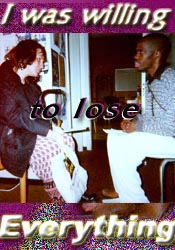
I was willing to lose everything!

09/24/2021 - 11:22 by Anonymous (not verified)
Original Author
root
Original Body

A low-income disabled woman of color fights Section 8 Housing Authority and WINS!

by Valerie Schwartz with Jewnbug and Audrey Eichorn/PNN Media Interns

On a sunny but windy afternoon there is a voice that resounds in my head louder than the fervor of the wind knocking against my window demanding my attention… It is the voice of Patricia Webb, a woman who I had the pleasure of speaking with today, who with the help of POOR Magazine/PNN and The San Francisco Bayview has won a crucial victory with the San Francisco Section 8 Housing Authority.

What some people may consider to be only the small problems of the poor and disabled are… more than small. For me this is not only a concept but an understood reality, as I am a low-income disabled person myself, who has had plenty of first-hand experience with discrimination and poverty. Usually in our apathetic world of seemingly monolithic problems these peoples’ "small problems" are rarely heard, understood, addressed or much less resolved. In one of these not so "small problems" Patricia Webb, a resident of the Fillmore Center has gone the distance and held her ground against overwhelming odds.

"My dilemma began with re-certification from Section 8 Housing." In April 2002, Ms. Webb contacted POOR to ask for help with what was an overwhelming problem with her housing re-certification. Ms. Webb is disabled with Cerebral Palsy in a progressive stage. She lived with her son who is her in-home caretaker and employed by I.H.S.S. (In Home Support Services). Upon receiving a letter for her re-certification Ms. Webb was informed by the Section 8 Housing Authority that there was too much income in her household, and raised her rent from $281 to $833 a month. They then informed her that her son must move out if she was to be re-certified for Section 8.

"Family support, as all of you are all too aware, is crucial. It needs to be a part of a network of services that promises inclusion rather than isolation"

Excerpt from Congresswoman Barbara Lee’s speech at the annual dinner of the Developmental Disabilities Council of Contra Costa County.

Ms. Webb then started the tedious task of following a paper trail of red tape, many grueling physical trips out of her home to attend to the matter… and a game of pass the buck via the telephone with the people at Section 8. As Ms. Webb told me, one of their supervisors, Cynthia Black said to her… "I’ll send you what need, not how to get it!" Ms. Black had also put Patricia’s son down as her attendant instead of her I.H.S.S. in-home caretaker, and created prolonged confusion with the paperwork. Ms. Webb told me later "It is my intention to write a letter of complaint to H.U.D. about Cynthia Black"

Ms. Webb did what was asked of her and provided the people at Section 8 with all the necessary documentation and paperwork she was required to present to them for having her housing re-certified. This also meant showing 3 pieces of verification that her son had moved out of her apartment, yet her rent stayed at $833 even though her son was no longer living with her. She continued to question why and how something that she felt was so unfair was happening to her. How was she going to deal with the absence of her son’s presence and support to help her, especially at night when she needs him there and how to deal with the break-up of her family?

It is unthinkable to me that any kind of social services/housing organization would want a stranger caring for a disabled person when there is a qualified and supportive family member to do so. I can fully understand how frightening it is for many to be cut off from their families and have to deal with having a stranger in their home taking care of them and how vulnerable that could feel. What is the purpose of dividing someone’s family?

"Most of the time the family is the only resource in the lives of disabled youth and adults, especially low income and people of color with disabilities. To cut this link inside the homes of people with disabilities is an invasion of privacy, family values and leads to separation i.e. institutionalization which leads to segregation" Excerpt by Leroy Moore of POOR Magazine/DAMO in an open letter to Gray Davis.

I asked Ms. Webb if her son’s employment and or housing status had been changed by all of this. She explained to me that her son is still her in-home caretaker but he does not live in her home and that he is now residing with his grandmother. I then asked her what would have happened if he had not had his grandmothers help, She answered quickly , "He’d have been up a creek."

As of the 1st of June 2002 Ms. Webb’s rent has been rescinded back to $282 a month a dollar higher than it had been, before the re-certification raise. I was immediately curious about what I consider to be an overpayment of rent for those three months and inquired whether she would have any of that overpayment refunded or put towards her upcoming rent payments. She told me she didn’t know and that she was trying to find out.

Ms. Webb acknowledged her heartfelt gratitude for the support of POOR Magazine, and Victoria Tedder of the Independent Living Resource Center for helping and advocating for her during this long process. She also requested that a mention be made for Mr. David Folis who works at the Fillmore Center for being "kind and helpful"

I finally asked one last question. How does if feel to have won what you thought was a no-win situation with the Section 8 Housing Authority? She replied in a voice that sounded like a melodic blend of humbleness and righteousness, thus creating a funny warm sustaining chord in my head… Her answer was: "Fantastic, totally elated that I fought for what I believed in and what I was doing and that I was willing to lose everything if that’s what it took."

Tags

A Crime disguised as Entertainment

09/24/2021 - 11:22 by Anonymous (not verified)
Original Author
root
Original Body

'Bumfights' Should Be Investigated As A Crime

by Michael Vizcarra/PNN Media Intern

Cool, hip music in the background.  Rapid-cut clips of men fighting and doing stunts flash on the screen.  A gratuitous T&A shot.  An MTV video?  A commercial on TV?  NO.  These are the previews you see when you go to www.bumfights.com, the website selling Bumfights:  A Cause For Concern, Volume 1, an hour-long video showcasing gruesome footage of homeless people fighting with each other and performing dangerous stunts.


Watching the video clips from the website made me sick and disgusted, sick and disgusted with the exploitation of homeless people.  In one scene, a homeless man breaks his ankle in a fight.  Another scene shows a homeless man smoking crack.  Another homeless man, named Rufus the Stunt Bum, performs stunts for the camera including ramming his head into walls or riding a shopping cart down stairs.  The filmmakers even do a parody on "The Crocodile Hunter" called, "The Bumhunter," where a man, dressed in safari clothing, hunts homeless men on the street, binding, gagging, and marking them.  The Las Vegas filmmakers, 23 year old Ray Laticia and 24 year old Ty Beeson, were "interested in the inherent humor of something that hasn't been touched upon in mainstream entertainment, which is homelessness."  


This is entertainment? 


I think these two filmmakers should be charged with crimes.  First and foremost, criminal solicitation.  The common-law crime of solicitation occurs when one requests or encourages another to perform a criminal act, regardless of whether the latter agrees.  There has been much debate on whether the producers of the video solicited homeless men to engage in fights with other homeless men.  But if that is the case, then they could be charged.  The crime of solicitation is never construed so as to require an overt act.  As soon as one makes the request or proposal, the crime is complete.

Another crime they could be charged with is conspiracy.  The common-law crime of conspiracy is defined as an agreement between two or more persons to do either an unlawful act or a lawful act by unlawful means.  Let's say, for example, the filmmakers requested or encouraged Rufus the Stunt Bum to fight another person (criminal solicitation), just the act of planning on doing this and preparing to film it would be considered conspiracy.  The Las Vegas police and the Clark County District Attorney would only need someone in the video to file a complaint with them and they would consider prosecuting the filmmakers or anyone who was involved with the making of the video.  The charges could move on to kidnapping (as in the case of the Bumhunter) and assault and battery.


But the filmmakers contend that all the homeless men appearing in the video did so by their own choice.  They also signed consent forms and agreed to the use of their images.  Also, they were compensated with food, clothing or money ($20 to $100) after the taping, say the filmmakers.  But even if they were paid and signed the consent forms they could still sue for assault, says Sgt. Eric Fricker, who oversees the Las Vegas Metropolitan Police Department's homeless-focused detail.


A main concern about the contents of these videos is the mental state of the homeless men.  "There has been a long history of the exploitation of people with mental illness," says Leroy Moore, our resident poet, writer, organizer, advocate and lecturer.  Leroy is not unfamiliar when talking of these issues.  A disabled person of color himself, Leroy formed a Bay Area organization for and by people of color with disabilities called Disability Advocates of Minorities Organization, DAMO.  DAMO's main goal is to empower, educate, advocate and bring together communities of color on issues concerning people with disabilities.  He says the problem stems from the de-institutionalizing of homeless people with mental illness.  With nowhere to go, no transitional plan, and no housing, they were left to fend for themselves on the streets.  The American Disabilities Act, ADA, "hasn't talked about people with mental illness," he says.  ""They are the last minority group that hasn't been touched by laws."


I also spoke with Jennifer Friedenbach of the Coalition on Homelessness about the Bumfights videos.  She says the video furthers the hatred to a particular group of people (the homeless).  The fact that they (the filmmakers) can get away with exploiting the homeless is appalling, she says.  If another video were made using other groups of people, for instance Hispanics or African Americans, there would be more of an uproar, she states.  "In order to get on the front page, you make fun of people.  That's how politicians use poor people to garner votes, that's how the media garners readership," she says.  I asked her what she thought of Ray Laticia's comments, in an interview with the Las Vegas Review-Journal, when he said, "To people who are going to take offense, I'd say, 'What have they done for the homeless?'"  Ms. Friedenbach replied, "How is he to know?  Doing nothing is better than doing something hurtful. "


The Bumfights producers are also full of contradictions.   In one interview with BBC News Online on May 25, 2002, Mr. Laticia explains, "It is not done to be shocking.  It was done to show an aspect of society that people would otherwise not see."   But in another interview with www.wired.com on June 5, 2002, Mr. Laticia says, "The video is designed to shock.  We're quite aware that some people find it hilarious and some people find it disgusting.  That's what sells videos."  In another interview with the Las Vegas Review-Journal, Laticia states, "This project is a means to an end.  We want to be feature filmmakers.  We're going to cash in and then cash out and go make some movies."  But, if that were the case, then why would this video be entitled Volume 1?  Hmm.  Documentary or exploitation?  Entertainers or criminals?  I would hope the answer is clear.

Tags

Letters to the Editor...on Eviction, Art and Resistance...

09/24/2021 - 11:22 by Anonymous (not verified)
Original Author
root
Original Body

PNN welcomes the expression of all views and is not responsible for the opinions or statements made in the Letters section

by Staff Writer

Letter to PNN from The Campaign For Renters Rights

Dear PNN editor; Please publish this letter and Protest notice;

The eviction for profit system runs rampant in
Oakland. Artists are being dumped on the street by
greedy landlords who want to double the rent.

Sue Doyle is one of many Oakland artists who have lost
their homes due to the lack of tenant protections. She
also lost her garden, her security deposit, and
several paintings-All at the hands of Michael Sturtz,
the Executive Director of "The Crucible." We find his
action highly ironic.

"The Crucible" represents itself as an organization
"Creating artist rental studio spaces in an area with
high artist eviction rates and the tightest real
estate market on the planet."

These actions are a direct contradiction to what "The
Crucible" is supposed to stand for, and we believe
that those who are associated with "The Crucible"
should be aware of what it's Executive Director has
really been up to!

Protest of Artist Eviction- Direct Action Event

Join us for a night to remember as artists and
activists converge on a Crucible event & rally against
the eviction. Sparks will fly for this event!

When: Saturday June 22nd

@7:30PM

Where: "The Crucible"

1035 Murray Street near Ashby & San Pablo)
Berkeley, CA

Letter to the editor From Michael Sturtz of The Crucible

Dear PNN editor

None of the protestors came back on Sunday to talk to me. I was
surprised; I respected the dedication I saw from them on Saturday and
felt that they were committed to uncovering the truth--especially
regarding an issue that is clearly near to their hearts.

As I know that you are writing an article for Poor regarding this
matter, I again offer you the opportunity to contact the previous
owners of the house in question.

I know that Poor Magazine holds high standards for journalistic
integrity, so I am sure that you will be careful to check facts on
anything you write regarding the situation.

Do feel free to call me. In the meantime, I confidently offer this
for print: The accusations that were made in the e-mail and in the
(frankly, rather cruel and certainly preposterous) booklet against me
are false. I handed you an info packet that included documents
disproving Sue's claims.

Thanks. And again, If you have any questions at all about the
accuracy of what you intend to put into print about me, I encourage
you to contact me first.

Sincerely,

Michael Sturtz

Michael Sturtz

Founder / Executive Director

The Crucible

an Educational Collaboration of

Arts * Industry * Community

Tags

HERE'S LOOKING AT YOUR HELLTHCARE, KID

09/24/2021 - 11:22 by Anonymous (not verified)
Original Author
root
Original Body

A romance....

by TJ Johnston

I look into Komiko’s almond-colored eyes, searching for the same smile they had when I first saw them in Vancouver. They’re now forlorn and searching for departure times at the SFO International Terminal.

"Don’t make this any more difficult than it already is," she says. I turn to the departure board and notice I don’t have much time. Komiko would soon be waiting to be screened for two hours and after that, sitting on the next JAL flight.

"If you get on that plane," I tell her, "you'll regret it. Maybe not today or tomorrow, but soon and for the rest of your life. Is there anything I can do to keep you from boarding that plane?" My eyes are tearing. I think it's emotions, but more because of the elderly lady who just passed me wore too much Chanel and Ben Gay.

"You know I love you," says Komiko, "but I need something you could never provide."

I know where this is going: we’ve had this conversation before.

"But I have Medi-Cal," I plead.

"It’s not enough. Japan’s Employee and National Health Insurance Systems can cover my hospital expenses when I become infirm and can no longer take care of myself."

My memory takes me back to our first meeting about five years ago. Before the pharmaceutical lobby squashed it, Hillary Clinton’s Health Care Bill of Rights still had a chance. Those were carefree days. Damn it, if I was a Canuck, I’d have single payer and we wouldn’t be playing this scene. "You don't have to leave this continent," I beg. "We could go to Mexico or Canada to get our cheaper meds."

I'm not sure what else to say. Many of our doctors, out of frustration and diminishing profit margins, don’t see Medi-Cal clients any more. And don’t get me started on HMO’s.

"Besides, we’re still young. If we can risk the hazards of the human heart, we could do the same with those of Highway 101 and super-sized fast food."

"That’s the difference between you and I," she rejoins. "You are reckless and live for the moment regardless of type-2 diabetes. I’m lactose-intolerant. You’re too much man for me."

"Baby, if you stay, I could always continue the fight for health care reform or else, get a real job." Komiko stands there for a moment. The highlights in her jet-black hair shine. That British Columbia glimmer appears once more. Then it vanishes.

"Neither one is possible," she says. I guess we'll always have Canada. Her flight number is called on the PA. She kisses me off, one last time and queues in that final line before the metal detector. I remember it’s lunchtime and I have just enough for a super-sized combo-meal.

Tags

MIDDLE CLASS WHITE BOY LEARNS A LITTLE SUMPN SUMPN ABOUT GAVIN NEWSOME (Pt 2 in the series)

09/24/2021 - 11:22 by Anonymous (not verified)
Original Author
root
Original Body

Newsom's Care Not Cash proposal is examined

The second part in the series; Pretty Boy Newsome vs. The poor folk of San Francisco

by Andrew DellaRocca/PoorNewsNetwork Media Intern

I registered as a San Francisco voter the other day. It wasn't an easy
thing for me to do. I had resisted declaring myself an official California
resident for quite some time. I'm from New York, and there is that whole
New York pride thing that goes along with it. East coast versus west coast.

Throughout my formative years, this rivalry was sensationalized through
the mediums of MTV and the NBA. I hate the Lakers, I love the Knicks. NWA
did their thing. That was cool. But you'd never have caught me putting
them in the same league as Tribe or the Digable Planets. "California is a
beautiful state", Iíd concede, "but it ainít nothing like New York."

But I'm not even from New York City. I'm from a suburb of Albany, about two
hours north of the City-- a very white, middle class suburb -- and let me
tell you, San Francisco blows it out of the water. And so I decided a
couple weeks back to make it official, and I registered. But with
registration comes a responsibility to find out exactly whatís going on
around here, and I began to watch the local news, and to read the Chronicle
(the Bay Area section).

One face that kept popping up all over the news was Gavin Newsom's. I
couldnít ignore him. Not only because he is constantly covered, but because
he kind of looks like me. Put me in a suit, and we could be brothers. And
I kept reading about this guy, about how he is proposing a new program for
the poor, called Care Not Cash. The local media would pound out the message
that this program would be a solution to the cityís homelessness. Care
sounds good, cash sounds good too but, maybe care is better. I donít know.
And so I decided to find out what it, and this guy, were all about.

And now, let me emphasize something: He aint my brother.

Newsome's Care Not Cash measure is designed, supposedly, to "assist" the
poor and homeless of San Francisco, by reforming the current County Adult
Assistance Program. Since the program is designed to assist the poor, I
thought it would be proper to ask the poor, and those who advocate for the
poor, exactly what this proposal would mean, since it is they who would know
best. They were eager to talk about it, and I soon learned a few things
that my perusals in the Chronicle, and my sittings through the KRON 4 news
report, failed to tell me.

Care Not Cash sounds more like an assault on the poor and homeless than a
program of assistance to the poor. It is a new system that its proponents
say will enable the city to spend more on creating affordable housing, as
well as bettering the services for the homeless. However, it offers no
plans on how to do so, nor does it guarantee that the funding will go into
such programs. What it does guarantee is that money will be taken directly
from the poorest people, who are already required to work for the assistance
they receive.

I spoke with Steve Williams from POWER, and he explained, "He [Gavin
Newsom] is going to require that people continue to work, for free or for
cheap, for the city, and then in the meantime he is going to wind up
slashing the money that the people are receiving. So now, basically, people
would be working in exchange for being able to stay in the shelters, working
to be able to get food at St. Anthonyís or Glide; all services that are
right now free. But now people would have to work in exchange for them.î

Care Not Cash will slash the amount of cash that recipients receive by 85%.
I am unsure of how this will cure homelessness. The plan is to convert this
cash into vouchers, and that these vouchers could be used at the cityís
shelters and food programs. However, these programs are already free, and
by requiring them to accept vouchers, the only thing that this proposal does
is take money away from those that receive it.

I found out from the Committee Against Increased Homelessness that the Care
Not Cash measure would actually increase homelessness. By slashing the
amount of cash that homeless people receive, the measure would prevent them
from having the ability to pay for affordable housing if some became
available. In addition, those persons who are housed ìcasuallyî, who cannot
get a receipt for their arrangement, would be unable to pay the rent,
forcing them onto the street. The shelters are full, and so without any
cash to rent a room, more people would be forced to sleep on the street.

When I learned about all of this, I began to think about what an idiotic
proposal it was. If the man is able to manage wineries and restaurants, why
is he proposing such an incoherent plan to the city of San Francisco, and
then disguising it as a measure that will help the homeless? Then I found
out that he plans to run for Mayor, and things began to make sense.
Although his proposal is idiotic, the man is no idiot, he has a plan. Care
Not Cash gives him media exposure. Homelessness is a problem that everyone
in San Francisco is concerned about, and by advocating this plan, Newsome is
able to get his face all over the News. Likewise, he is able to pay for
media time under the rubric of the Care campaign, preventing those
expenditures from being counted toward his mayoral campaign, bypassing
campaign finance restrictions.

Care Not Cash will also help his campaign in other ways. His website
states, ìThe initiative will bring San Francisco in line with almost every
other major California County, thereby eliminating the incentive for
homeless individuals who want cash rather than services to congregate here.î

The argument that slashing cash assistance will prevent homeless people
from coming to San Francisco, and maybe even compel those already here to
leave, entices the tourist industry, and other big business interests. By
promising them that homeless people in San Francisco will no longer be seen,
Newsom guarantees their endorsement for mayor. However, they fail to
recognize that even if some of the homeless decide to leave, there will be
those on the street that have become newly homeless, as a result of this
measure.

Care Not Cash,if passed, will be a failure to all. The measure, and the
man who endorses it, should be regarded with nothing short of mockery.
Those who support it do so only through ignorance, through pure
self-interest, or through both. I decided to write this piece because I am
disgusted with and concerned about Newsome's proposal. After all, I've got
to make sure us middle-class white boys represent.

Tags

The Roots of Displacement

09/24/2021 - 11:22 by Anonymous (not verified)
Original Author
root
Original Body

Just Cause gets on the ballot - Tenants have a chance in Oakland

by Lisa Gray-Garcia aka tiny/PoorNewsNetwork

"I’m Andrea Cousins with Just Cause Oakland, we are an all volunteer coalition of individuals and 20 community organizations that fought long and hard to put a Just Cause Eviction Measure on the Oakland November 2002 ballot. On June 10th we turned in over 35,000 signatures from Oakland voters saying " stop unfair evictions in Oakland," my eyes closed as I let the words of Just Cause’s triumph wash over me and the near capacity crowd at POOR’s Community Newsroom. Maybe now, I thought, I could forget, or perhaps transcend the fear hurt and loss from each of the unjust, No cause evictions my mother and I experienced in Oakland.

"In the last three years evictions have tripled in Oakland and predominantly lower income people, people on fixed incomes, people of color, and families have been evicted in Oakland", as Andrea continued my mind wandered once again to my not so distant heinous past.

"You need to go" I don’t remember my landlords name, nor even how he looked, he could have been a mirage, yet he wasn’t and with those three little words my life and the life of my family would change forever. I remember carefully locking the tears in my tired skull.

I remember trying to look sort of tough and confused at the same time as I replied calmly, "You have no legal basis for evicting us"

And then his response, each word becoming a long dark echo, like in a really bad horror movie, "WE DON’T neeeeeed a reason to EVICT YOU"

And then the memory goes dark, my life from four years ago, which for a scant eight months had become a little bit normal, a little bit stable, a little bit safe, cause my family and I had a home with neighbors and furniture and a bathroom, a home, that we could sort of afford. And then it was over. We ended up homeless.

And therein lies the root of displacement… gentrification… homelessness. You see, poor folk like me are already unstable. It is so easy to throw us off course, to mess us up – there is no trust fund or back-up – no family with money or savings to fall back on and yet, life happens, we lose our jobs, get sick and have no insurance or get evicted, and in just that blink we can be devastated, permanently scarred. Unable to climb back up. Gone like we were never there.

"What we found is that majority of the evictions that have happened in Oakland over the last three years are evictions for no reason, and when you look at who’s being evicted, its primarily so that people that can pay higher rents can move in so that the developer, the landlord, the rental company will attain greater profit. Not really looking to maintain a sense of community and have families feel a sense of stability in Oakland." Andrea concluded and I was brought back to the moment.

Me and my mom finally met up with a decent landlord who even let us pay rent over time whenever we got behind due to our poverty. We are still at-risk, we own nothing and I haven’t stopped looking over our collective shoulders, but for a moment we can breathe. Unfortunately thousands of other Oakland families continue to face eviction for no cause from their landlords, families like the Sloans who are working with POOR Magazine to fight the unjust eviction they recieved from their landlords; The City Of Oakland. We will fight for and with them and all the other poor folk who are facing injustices as long as there is breath in all of our lungs, but now because of the tireless work of all of the organizers and tenants involved in Just Cause we JUST might be able to Win!

Please get involved with Just Cause Oakland-now that its on the ballot they need your help more than ever - call them at (510) 464-1011

Tags

Police Containment

09/24/2021 - 11:22 by Anonymous (not verified)
Original Author
root
Original Body

Oakland Riders Trial Delayed for Months
in an Attempt to Chill Public Outcry.

by Wendy Snyder, Oaktown Uhuru News

All across the United States, a long list of police
have come to be known for their role in terrorizing
and brutalizing black people. Two years ago, Clarence
Mabanag, Jude Siapno, and Matthew Hornung and
Francisco Vasquez, the four the OPD gang accused of
planting drug evidence, kidnapping, and severely
beating people in the communities in West and North
Oakland, were added to this list. We can no longer
pretend that these are separate cases of bad apples in
a bunch, but must begin to challenge the popularly
supported public policy of police containment of the
black community.

Right here in the San Francisco Bay Area, police
terrorize African people in East and West Oakland,
South Berkeley, Richmond and the Bayview and Hunter's
Point on a daily basis. Not caught on video tape or
witnessed by rookie cops, these incidents are too
numerous and too heinous for words. We have to join
together and build a strong movement to challenge this
public policy of police containment of the African
community and struggle for reparations, justice, and
genuine economic development for African people.

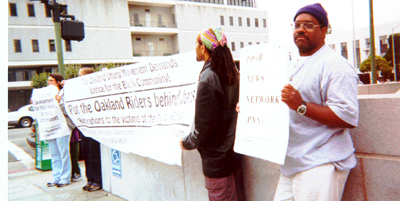
On Monday, July 15th, the International People's
Democratic Uhuru Movement, Poor News Network, SF
Independent Media and several of the victims of the
"Oakland Riders" stood outside the Alameda County
Courthouse holding signs and chanting at what was
supposed to be the opening of the trial for the
"Oakland Riders," the OPD gang accused of planting
drug evidence, kidnapping, and severely beating people
in communities in West and North Oakland. However,
instead of beginning on Monday, the "Oakland Riders"
trial is still continuing its "jury selection" and is
now expected not to begin until September.

InPDUM organizer Sealli Moyenda explained, "They are
most definitely dragging out this case in an attempt
to silence any kind of protest. We're not going to let
them off the hook though. We are calling for the
criminal prosecution of the four 'Oakland Rider' cops.
We also hold the city responsible for this type of
police brutality and are demanding a public apology
from OPD Chief Word and Mayor Jerry Brown as well as
reparations and justice for all the victims of OPD
brutality."

Continued Moyenda, " Last year, Jamil Muwwakkil was
beaten to death by six Oakland Police Officers, and
no one has even acknowledged that there was any kind
of wrongdoing. Those officers have remained on the
job. It's clear that the city-wide policy for the
African community is one of police containment."

One case in point is the story of Gregory Nash. Nash
came out to the courthouse to stand with the
demonstrators. Nash is part of a class action suit
being filed on behalf of the victims of the "Oakland
Riders." Nash was brutalized and framed by Francisco
Vasquez, the one officer who fled from the Bay Area
and still remains a fugitive.

One February night back in 2000, just months before
the whistle was blown, Gregory Nash crossed the
intersection at 40th and Telegraph and was nearly hit
by a van speeding along recklessly. He'd noticed a bag
that somebody had left on the bench at the bus stop
and had crossed the street thinking he could flag down
the bus to see if someone on the bus had left it
behind.

When Nash was almost hit by the van, he flipped them
the bird in response. The van pulled abruptly into the
parking lot in the strip mall near Payless Shoes. Five
to six undercover Oakland Police officers jumped out
of the van. "Oakland Rider" Francisco Vasquez grabbed
Nash by the neck and called him a "Fucking Nigger!"
Vasquez kept harassing and manhandling Nash, asking
him where the bag had come from. OPD then took Nash to
where he stayed and worked as the live-in security for
a health care facility. Nash said that Vasquez and his
partners proceeded to tear up his room. After that,
Vasquez took a bag out of his pocket containing crack
cocaine and a crack pipe and told Nash, "This is
yours."

Because of the OPD, Nash lost his residence and two
jobs. His personal life, he says, was seriously
disrupted. Nash vows that he and others he knows will
fight this injustice at every turn and calls on others
to do the same.

Attend the Wednesday night meetings of International
People's Democratic Uhuru Movement's Oakland branch to
organize for a massive mobilization at the opening of
the Oakland Riders trial and to continue to struggle
for justice for the African community.
Every Wednesday, 7pm, 7911 MacArthur Blvd, Oakland.
Call (510) 569-9620 for more info or email
oaktownuhuru@yahoo.com.

Tags

TENANT GENOCIDE

09/24/2021 - 11:22 by Anonymous (not verified)
Original Author
root
Original Body

The HOPE legislation is dangerous for San Francisco Tenants

by Andrew DellaRocca/PoorNewsNetwork Media Intern

I was first introduced to the HOPE legislation when I went to Dolores Park
last Sunday. The San Francisco Mime Troupe was there performing this year's
production Mister Smith Goes to Obscuristanî, a parody on US foreign policy
and the current administrationís version of ìnation-buildingî. I was sent
there by the POOR News Network, to meet with a representative from the San
Francisco tenantís union, and help SFTU to distribute information concerning
their ìHOPE is a Hoaxî campaign. The sun baked the park, and I stood on the
outskirts of the crowd, in an ill-planned outfit that consisted of a black
shirt and long khaki pants. One of SFTUís volunteers was there. She gave
me some flyers, a little background information, and offered me some
sunscreen. I soon learned what HOPE was all about.

HOPE is a current form of legislation, floated by Supervisor Tony Hall, and
backed by the real-estate industry, which seeks to increase the number of
apartment to condominium conversions in San Francisco from 200 per year to
3,500 per year. It is argued that this legislation will help tenants to
purchase their homes, increasing homeownership in San Francisco. But the
so-called benefits to normal San Franciscans, which are promoted deceptively
through the HOPE campaign, are as obscure as Obscuristan. Condominiums,
under California State law, are exempt from rent control. Thus, an increase
in apartment to condo conversions will mean an elimination of rent control
on many units, with subsequent rent increases and tenant displacement.

Signatures have been being collected by the cityís landlords for the past
months, and were submitted last week. Now, the HOPE measure will be an item
in Novemberís ballot box. People on the street were deceived by the
petitioners (perhaps, even, the petitioners were deceived by the
legislation), and told that the measure will result in more tenants becoming
owners of their homes. The truth is, very few condo conversions (less than
10%) are actually purchased by the tenants. The average price of a
condominium in San Francisco is $400,000, a figure that is out of a normal
tenantís reach. Signers of the petition were also told that those tenants
who did not want to purchase the converted apartments would be protected by
a series of tenant protections, such as a lifetime lease and a restriction
on rent increases. These ìtenant protectionsî are illusory, however,
because they are in direct contradiction with, and are therefore invalidated
by, established state laws. The Costa Hawkins State Law, for example,
prohibits rent limitations on condominiums. Likewise, court rulings on the
Ellis Act have consistently prevented any locality from trying to prohibit
certain types of evictions from condominiums. In spite of these blatant
contradictions, designers of the HOPE measure have included the protections
in order to deceive the voters, who are mostly tenants, into supporting the
very same legislation that would make them vulnerable.

In Santa Monica, during the 1990ís, a similar measure was passed. The
measure, however, was soon after repealed when it was discovered that only
8% of the converted apartments were purchased by the tenants. Over 3,000 of
Santa Monicaís apartments were converted, however, and 80% of the tenants in
those buildings were displaced. The San Francisco measure provides even
weaker tenant protections than the Santa Monica measure did, and if it is
passed, San Francisco will be facing a huge tenant displacement crisis.

One of the main concerns about the measure is the undemocratic process by
which a landlord gets approval to convert a building. Only 25% of the
lease-holders will need to sign an approval form with their landlord in
order to convert the entire building into condominiums.
ìThey say the justification is that in order for the wealthy people to be
able to buy homes, they should be able to kick out the less wealthy people,
and they see condo conversions as a great way to do thatî said Ted Gulucson
of the San Francisco Tenantís Union

I took a trip to the San Francisco Tenantís Union on Capp St. to speak with
Ted and find out more about their HOPE is a Hoax campaign. The SFTU has
been in existence since 1971, fighting for tenants rights and affordable
housing. We spoke in his office, the backroom in the bottom apartment of a
Mission Victorian. The apartment unpretentiously announces that it is the
SFTU headquarters, with black and white paper signs taped on the windows.
The walls in Tedís office are covered with placards from previous campaigns.
One of them announces ìHomes: Everybody gets one before anybody gets
two.î We sat down at a wooden table to talk.

Ted tells me that he is the office manager of the Tenantís Union, and that
he performs ìbasic administrative work, and organizing work, everything from
sweeping the floors to going to hearings.î He speaks with a drawl, and
doesnít pronounce his Rís. He refers to HOPEís assurances of lifetime
leases, and the prohibitions on rent increases, as ìbogus tenant protections
put in there as window dressing.î

The fact that condos are now exempt from rent control has created a whole
new demand, on the industry side, to do condo conversions. Because not only
do they get the ability to sell units as condos, and make a lot of money
that way, but they can just remove the units from rent control.î

The HOPE measure is created by the real estate industry, designed to
increase the wealth of the landlords. But in addition to its role in
creating profit, it is an extension of a United Statesí political backlash,
begun in the 1980s, and the overall shift towards neo-conservativism.

ìOne of the very interesting things about these movements is the groups
behind them. Groups like the Small Property Owners of San Francisco, and
similar groups across the country, are part of this emerging, growing
property-rights movement. They have as a sort of larger agenda, simply
getting rid of tenants. They donít want tenants in San Francisco, or
Boston, or Santa Monica. The reason is, they envision a San Francisco with
home owners as being a conservative city thatíll pay attention to issues
like police and low taxes, as opposed to the tenants who are more
progressive and see the city as a city of diversity. And in fact some of
the early HOPE literature has argued that point. If people of San Francisco
pass HOPE, then we will see less progressive legislation passed in SF, we
will not see bonds, we will not see tax increases. Besides the lead of the
Real Estate industry which has this thing moving, we also have this
right-wing property rights fundamentalism that is behind it. And what they
see is a very different San Francisco than what we have today, one much more
like the suburbs than a vibrant city with lots of different people.î

Ted and the San Francisco Tenantís Union have much work to do in the months
before the vote. The organizationís funds do not compete with the
million-dollar budget of the HOPE advocates. There is no money to counter
the ad campaigns on television and in the newspapers. The campaigning is
going to have to be on the grass-roots level, through tabling and outreach.
Volunteers are needed, and you can help by going to www.saverentcontrol.org
or www.sftu.org. You can also call 282-5525 to offer help. The
overwhelming majority of us in San Francisco are tenants. We will all be on
the defensive if the HOPE measure passes. HOPE is a hoax.

Tags

Protecting Who?

09/24/2021 - 11:22 by Anonymous (not verified)
Original Author
root
Original Body

The Role of Child Protective Services in the María Teresa Macias Case

by Tanya Brannan/Purple Berets for Courtwatch

On April 15, 1996 in the tiny Northern California town of Sonoma, María Teresa Macias, a 36-year old Mexican immigrant woman and mother of three small children, was shot to death by her husband Avelino.  Avelino then shot Teresa‚s mother, Sara Hernandez, before turning the gun on himself. 

In the two years prior to her death, Teresa had contacted the Sonoma County Sheriff‚s Department more than 25 times asking for protection from Avelino‚s stalking, threats to kill and physical and sexual abuse of >Teresa and her three young children.  Despite their own department policy and California law requiring arrest on domestic violelnce and on restraining order violations, Avelino was never arrested or cited.  Only two police reports were written.

On June 18th, two days into the trial, the federal civil rights lawsuit, María Teresa Macias v. Sonoma County Sheriff Mark Ihde, ended with a historic $1 million settlement.  This is the first time in history a police agency has paid for their failure to provide equal protection to a domestic violence homicide victim.

But the Sheriff‚s Department was not the only Sonoma County agency that bears responsibility for Teresa‚s death.  In fact, perhaps the ugliest piece of the Teresa Macias story is the family‚s interaction with Child Protective Services (CPS).

The Criminal Investigation of Child Abuse

In 1995, as Teresa was making her initial escape from Avelino, a contact with a Sonoma health center told her of services available to protect herself and her children.  On March 31, 1995, Georgina Warmouth with the YWCA battered women‚s shelter filed a child abuse report with Child Protective Services.  The report outlined Avelino‚s physical and sexual abuse of all three children, as well as Teresa‚s fear of what Avelino would do to her family if he learned she had reported the abuse.

As is standard policy, when the report of child abuse was filed, a copy was also forwarded to the Sheriff‚s Department for criminal investigation. In his final investigative report, Sheriff‚s Detective Lorenzo DueZas outlined significant evidence that the abuse had occurred, complete with three corroborating witnesses for every charge. Clearly there was enough there for the sheriff to arrest Avelino Macias and file multiple charges of felony child abuse against him. No such arrest ever occurred.

By the time the investigation was completed, Teresa had left the women‚s shelter and returned home after learning that Avelino had gone back to Mexico. Free at last of the violence and abuse, Teresa was preparing to flee with her children and start a new life. Instead she was to be literally held in place with the agonizing separation from her children and continual forced contact with Avelino until the day he tracked her down and shot her to death.

When Det. DueZas called Teresa to discuss the results of his investigation, there was no mention of arresting Avelino; only the threat that if Teresa allowed Avelino back into the home the children would be removed from her custody for her failure to protect them. Not long after that warning, Avelino returned >from Mexico and immediately broke into Teresa‚s house. Knowing of the CPS investigation, he threatened Teresa that if she reported his presence to the sheriff she would lose her kids. Thus extorted, Teresa remained silent.

Within weeks, a CPS worker called DueZas  to report Avelino was back and in June, 1995, the Macias children just didn‚t come home from school one day.  Only after a number of frantic phone calls did Teresa learn that her three children, ages 5, 11 and 12, had been picked up by the sheriff‚s department and taken to the Valley of the Moon Children‚s Center. They were later put into foster care.  The reason: because Teresa could not protect her kids from Avelino‚s violence.

The Insanity of Family Reunification

Thus began Teresa‚s torturous odyssey through the CPS system to which she had turned for help. Over the next nine months she would be driven to distraction by CPS‚s conflicting demands. On the one hand they had taken her kids because she hadn‚t protected them from Avelino. On the other, she was forced into joint counseling sessions with her batterer with the state-mandated goal of re-unifying the family. As she struggled to comply with CPS‚s ever-growing and contradictory demands, Teresa began to despair.

In addition to thwarting Teresa‚s escape from Avelino (as she surely wouldn‚t leave without her kids), the conduct of the plethora of social workers and counselors who then held ultimate power over her family may well have contributed to Teresa‚s murder.

For anyone who‚s ever had the illusion that a counselor‚s pledge of confidentiality is unbreakable, the Macias case provides a rude awakening.  Again and again information Teresa gave to CPS was passed on to Avelino, including the fact that she was filing for divorce. To Avelino, already enraged at losing his stranglehold of control over Teresa, this was like waving a red flag before a charging bull.

But it was Teresa‚s mother, Sara Hernandez, who tells of the deadliest of CPS‚s many interventions in the Macias family‚s lives. Sara and Teresa were driving together to a counseling session in Santa Rosa ˆ one of >those sessions Child Protective Services forced Teresa to attend with Avelino.

„Teresa noticed Avelino following us in his car,‰ Sara relates. Shaking in terror, Teresa drove straight to the Santa Rosa Police station. There she handed police the restraining order she had obtained some months before and asked that they arrest Avelino, who had boldly followed her into the station in direct violation of that order.  As police handcuffed Avelino, Teresa called her CPS worker, Suni Levi to tell her what happened and to ask her to help translate with the police. Levi told Teresa to put the officer on the phone.

According to the SRPD officer, Levi then told him to release Avelino because the couple‚s counseling session was more important than arresting Avelino. Police removed the handcuffs and Avelino left, a free man. Three weeks later, Teresa Macias was dead.

But there was still one more blow that certainly contributed to Avelino‚s complete disintegration not long before the murder. According to family friend Marty Cabello, Avelino received a bill from the County of Sonoma requiring him to pay the children‚s foster care expenses.  With no hope of ever paying the bill, amounting to „thousands of >dollars,‰ according to Cabello, Avelino went even deeper into the dark place he inhabited until that final bloody moment when he ended Teresa‚s life and his own.

(While Avelino‚s bill is not accessible, we do have a copy of a similar bill sent to Teresa two months after her death.  Citing past due and current charges for her share of the foster care expenses for just one of the three children, the bill totals $1,053.50.)

Using Children As Pawns

But even after the double-homicide, CPS maintained a powerful hold over the Macias family. Teresa‚s mother Sara and her sister, Ana Rosa Rubio, logically thought that with the violent death of both parents, Teresa‚s children would be immediately released into the consoling arms of their loving extended family.

Instead, CPS held on to the children for five full months after the murder, and in fact still had no plans to release them at the September 1996 hearing until they saw the family was accompanied by Purple Berets advocate, Tanya Brannan. [Purple Berets is a kick-ass, California-based women‚s rights group.] In a sudden shifting of gears, Judge Arnie Rosenfield signed the order releasing the children to the custody of their grandmother, Sara Hernandez.

Why would CPS not release the children, you might ask? While there is no written documentation of their reasoning, two effects of the embargo are clear. 

First, as long as the children were in CPS custody, Teresa‚s family was extremely hesitant to talk to the press about the daily revelations of the county‚s misconduct in the domestic violence case, fearing the county would retaliate by holding on to the children.

And secondly, whoever controlled the children controlled any possibility of a lawsuit, as technically the County of Sonoma was the children‚s legal guardian.  With a statutory limitation of six months on filing tort claims in California, had the kids not been liberated at that final CPS review, the next scheduled review date would have been at the end of the year ˆ well after the deadline for filing a claim.

The Bad News: It Happens All the Time

Unfortunately, Teresa Macias‚ experience both with the Sheriff‚s Department and Child Protective Services is not an uncommon experience for domestic violence victims.  The very existence of CPS gives law enforcement a place to shuffle off the many crimes against children that arise out of domestic violence in the home.  Since for the most part police everywhere detest doing domestic violence investigations, CPS gives them a convenient way to leave the case to be „social-worked‰ rather than prosecuted.  This has a devastating, sometimes deadly effect on the families involved.

Had CPS been really doing their job, they would have advocated for Teresa with the sheriff, pointing out that filing criminal charges against the abuser is a far more effective way of protecting the children than putting them in foster care.  And if they were too afraid of losing their jobs for doing the right thing, they knew well the few independent advocacy organizations that could have done it for them.  But as usual, CPS went along to get along; they did nothing and said nothing to those who could have helped Teresa Macias and her children, and the result was a dead woman, three motherless children and a wounded, heartbroken grandmother.

CPS also serves another convenient function for police.  I have interviewed scores of women who had called police for protection from their batterer, only to be threatened with being arrested themselves and losing their children to CPS if the women kept on calling police.  When you think about it, it‚s a great way for police to cut down on the number of domestic violence calls, as I can assure you, the women who talked with me about the threats from police will never call them for protection again.  Domestic violence rates go down ˆ no muss, no fuss.

Tags

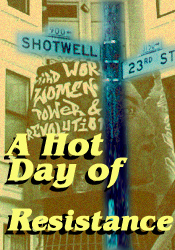
A Hot Day of Resistance

09/24/2021 - 11:22 by Anonymous (not verified)
Original Author
root
Original Body

The Shotwell Block Party celebrates culture, community and resistance to Eviction in El Mission’

by Alexandra Cuff/PoorNewsNetwork Media intern

Saturday afternoon I watched for the first time in my life, a spider capture and kill a fly. The power struggle was amazing. The fly was much larger than the spider but the spider’s attack was so natural, so organized. The web was beautiful. I was standing outside the neighborhood flower shop on 23rd and Shotwell, which was the first of my stops as I entered the free block-party on Shotwell Street on June 29. A rarity in San Francisco, a hot summer day – I had the afternoon off, folks were barbequing and playing live music in the street. Neighborhood youth were spray-painting murals, without harassment. My boyfriend and I, both recent victims of master-tenant schemes to rip off unassuming household members, rode our bikes down Shotwell street to celebrate this Mission neighborhoods' successful resistance to eviction.

Nuevo Ramize (a Flores mercado) is an example of one of the 1st successful cases of surviving unjust eviction during the peak of gentrification in the Mission district during 2001. When the flower shop moved to it’s current space on 23rd and Shotwell a neighbor wrote to city hall to advocate for an eviction based on an allegation that the zone was supposed to be residential. People in the community didn’t see the shop as being out of place. Through petition signing and legal and moral support of the community members, CBOs, and the landlord, Nuevo Ramize is still here. The owner, Carmen Ramirez is going through a legislative process through the Planning Commission to get a parking variance for the shop to gain two parking spots for clients.

Through the heat, the second annual Active Resistance celebration shouted, We Are Still Here. This wasn’t just a summer block party, it was a party to celebrate the victory that residents of the Mission have won in reclaiming our rights to stand up against the economic, racial and social inequities slithering into our neighborhood in the guise of the law and neighborhood rehabilitation. The founding block party was the first publicly recognized party for fighting the eviction of families living at 868 Shotwell Street in February 2001. Although threatened with eviction by their landlord, Khorges, for "nuisance, too much foot traffic in the building, and noise" – all of which were never proved - the Marenco, Recinos, and Barbarosa families were not leaving.

Rogelio Barbarosa brought the situation to the attention of Robert Morose who is a member of PODER (People Organized to Demand Environmental and Economic Rights) and a teacher at Cesar Chavez. Together Morose, Rogelio, PODER (which is a member of MAC, the Mission Anti-Displacement Coalition), St. Peters, and the community, organized weekly meetings, which sometimes saw up to seventy folks gathering together to come up with a strategy for dealing with the eviction. The tactics which were created came straight from the parents, children, teenagers and other community members. The meetings organized marches through the neighborhood which targeted the Khorges' other properties including the property of displaced residents who were already victims of his unfair evictions. Interestingly enough, the owner of these families’ homes also owns a liquor store, other apartments, and a check-cashing mart. The business’ were boycotted and Khorges' lawyer’s office was targeted as a protest site. Khorges finally gave in due to the lost business, calls from Tom Ammiano and other supervisors, and the proactive resistance from the community.

There was a lot representation going down on Saturday. A number of different community members contributed as vendors, educators, poets, cooks, artists, and community planners. Among friends representing were MEDA (Mission Economic Development Association), POOR Magazine, MAC (Mission Anti-Displacement Coalition, and as a vendor, community member Orlando Velez who teaches silk-screening at the Mission Cultural Center and has recently started his own clothing business.
MAC had a couple of tables set up which represented a virtual map of the North East Mission. People were invited to paint and build small models of buildings and neighborhood icons and place them wherever they wanted. This is part of the community planning process, "People’s Plan for Land" which through MAC, is handing the planning process back to the community. The Po' Poets from POOR; Mari, Jewnbug, A. Faye, Charles Pitts and Joseph Bolden performed, some of them doing "slam-bios" others reading pieces of poetry that spoke to the issue of gentrification and displacement. Joseph, (also a PNN columnist) whose poem "Death of a City" spoke of a city unfit to live in, warned us not to "make this cautionary tale come true".

Although the rents are slightly less in the Mission and there has been attention brought to the problem of gentrification, people are still being evicted. More than half of us are renters as opposed to owners here in San Francisco. Rents have dropped off about 10% in the past year but that is menial compared with the 100% rise in the past 2 years. Mom and pop stores are surviving on year-to-year leases. The victories already won are proof that through community solidarity and awareness, we can work to make decisions about our neighborhoods for ourselves. Although I’m aware that I’m still part of this modern feudal system as a tenant, I rode my bike to my rented home with a confirmed hope that not everyone is turning their head when an injustice goes down. I’m also looking forward to next year’s Shotwell Street block party and hope that it will stretch a couple more blocks and that even more of us will be able to say: We Are Still Here.

To get involved with or learn more about the Mission Anti-Displacement Coalition’s Community Planning Process, call PODER at 431-4210.

Tags