Story Archives

By Anna Kirsch

09/24/2021 - 10:54 by Anonymous (not verified)
Original Author
root
Original Body

PNN Journalist/Graduate of POOR's Race, Poverty and Media Justice Internship

by Staff Writer

To me, media justice is about people with privilege giving up some of their power and sharing skills and collaborating with people who don’t have that same access to get the untold stories told. I didn’t feel that most of the organizers of this media justice center, who had more privilege, access and media skills understood this at all. They really didn’t even want to surrender just a little of the control they had over the creation of the Media Justice Center, which lead to the marginalization of poor people once again. This was evident in not only the space that we were given to make our “little” media in, but also in the fact that almost none of the organizers of the MJC, those who claimed over and over again to understand the concept of collaborative news making, attended community newsroom. It seemed like they felt above the whole process. They worked separately the whole time and isolated themselves and never really shared their skills with people unlike them, further perpetuating the digital divide and individualism- rather than breaking down these barriers to media justice. When it actually came down to sharing power to make media justice happen, most of these organizers weren’t willing to give up enough control to make this possible. I believe this is reflective of what’s happening in the world of activism today. To make a new U.S. and a new world it is necessary that we learn how to truly collaborate and work together; that we, the people with privilege and access- share our skills and those with experiences with poverty, racism, disability, etc. share their scholarship .

Tags

By Joseph Bolden

09/24/2021 - 10:54 by Anonymous (not verified)
Original Author
root
Original Body

by Dee Allen, Joseph Bolden, Queennandi Xsheba, Jewnbug, Luis, Vivian Hain, Dharma, Ruyata

ATA Carpool Journal

What a wondrous, strange, annoying, oddly fascinating trip it was. So
much could've gone wrong didn't, others so predictable was laughable
if wasn't so intense at the time. Minor problems began with logistics
of travel I, Joseph of Ask /Tell Joe POOR Magazine columns, KPFA, and
Pirate radio, formally houseless, jobless, minor guess part in welfareQUEENS' play. (no where near famous) was to go alone by bus,
others by plane, and 10 person Van. Because of economic hardships I end up in a 10 seat van.

We were departing San Francisco at 10 am Saturday, June, 23rd I'm infamous at POOR for missing assignments, being late, or getting totally lost
on news assignments. To prevent this the night before my backpack, a
travel bag donated by my mother are filled with clothes, toiletries,
extra shoes, even a can opener plus a water bottle with ice. With
monies from my resent Clerk job by way of S.H.EC. [Supportive
Housing Employment Collaborative] by way of Housing Activist Mr.
James, Tracy donates hundred dollars which helped immensely.

On time,
ready, doors open for fellow and female passengers. A customer using
the van we were to use forgets placing the two seats and our two
driver's Mr. Anulfo, and Laura Yaya, went to Fresno/Colma for
reseating van.
It delays our departure by two hours making us leave at 11am or later.
We stop in Bay Veiw Hunter's Point to pick up Bay View newspapers to
distribute at the U.S. Social Forum in Atlanta, Georgia. They've
thrown down for us with our stories we're return the favor throw
down for them. It’s all good.

We rode out with tunes of Paris and Public Enemy"reality rap CD's
spitting angry, logical, conscious knowledge rap in Dolby surround
sound stereo from front to rear. This is going to be interesting
trip, I thought to myself.
Ms. Laura, Ya ya one of our two intrepid drivers had been driving for
four or 4 or 5 straight hours is tired and needs to rest. Mr. Anulfo
takes over as Ms. Ya ya before sleep had been documenting the early
start of our trip with video-voice, and quickie interviews of the trip
much will be edited out and some of the bloopers saved for posterity.
Micky D's, Carl Jr.'s eateries are the places Yaya, Anulfo, Louis,15,
Marcus,7, Theresa, Dee, Allen, Ruyate, myself(Joseph), Queennandi,
I'm not hungry. In fact from the week before I've been feelin' ill and
queasy on and off constant fighting dehydration by drinking and
pouring water all over me.
Drinking vitamin water don't cut if only cold or ice water works in
the days heat.

We're in Lost Hills? 4:32pm We drove through a town named Boron, a chemical compound on the periodic table.
10:28 pm we are in Arizona. In a motel our van's right side has
green/yellow paint streaks on it from another car's swipe. I didn't
see it until the next morning. I don't know the motel's name but it
has a pool and I before going for a swim I shower, do some swimming in
the pool with Kim, Ruyate, Louis, Marcus, and were others not known to
me. 10 am we're on the highway at 11am breakfasting in Denny's
Restaurant at 12:05 again riding through the Arizona Desert. 1:40 pm
or so Mr. Rayata and Ms. Kim have heated Afro/Euro,
multicultural/parallel socioeconomic argument by 2pm it cools.

We
arrive in New Mexico 4:40 pm. A sign painted red, green, chili
peppers says " Welcome to New Mexico, Land of Enchantment &quot. Across the
street and highway is Navajo Nation with stores, gas stations teepees,
and mountains, trading posts. 7pm stopped in Edgewood a city in New
Mexico for restroom breaks before hitting the road again. 11:31 pm
Texas, then Arkansas 9:45 am Drove through Clinton, stopped in Hillin?

A blue and White patrol car rode by us. 1:44 pm in Tennessee, 4pm
Alabama, " Alabama, The Beautiful " the sign reads as we enter the state
Ms. Laura, Ya ya, video-ing all that can be seen. We're ahead by a
day! Quick, weird weather patterns. Five minutes in heavy rain, heavy
fog in two minutes. Strange riding through Beautiful Alabama.

4:30 pm
rain on our side of highway dry on other side strange and weird
indeed! 6:05 am as usual missed an important recording but I cannot be
everywhere. The historic 7th street Baptist Church, a motorcycle cop
rode by. The Birmingham Museum where I and school children see, hear, through audio and print media Finally a knowledgeable
citizen on a bike schools me on historical aspects in Birmingham. 3

This story is in progress and will be continued…

Tags

By Queenandi Xsheba

09/24/2021 - 10:54 by Anonymous (not verified)
Original Author
root
Original Body

Don't Forget the Four Little Girls and the Struggle

by Dee Allen, Joseph Bolden, Queennandi Xsheba, Jewnbug, Luis, Vivian Hain, Dharma, Ruyata

6/25 Birmingham, Alabama

We stopped at the 16th Street Baptist Church where the four young girls lost their lives in the church bombing. I took pictures—Dynamite Bob was convicted eventually at the courthouse about four blocks away from where the bombing took place.
Juan, a homeless, self-appointed tour guide, gave us a spirited tour of the first “Nigger Park” that is across the street from the Church (still under construction). This park, currently known as The Kelly Ingram Park, is where the 3000 children came to march and were attacked by vicious dogs. About 1800 kids as young as nine, were arrested until there was no more room in the jails. Firefighters turned the hose on the brave children with 600 pound water pressure (that does a lot of damage, indeed). Monuments of the children ducking and covering themselves from the water hoses can be seen. Statues of the big vicious dogs, that were trained to recognize black skin by using black dummies can also be seen.

I took a picture standing in the place where Martin Luther King Junior did one of his first speeches. The radio station down the street was also bombed several times. And if you make a right past the park, you could find the building for the Black Masons (Prince Hall).
This is the first time I have seen this struggle with my own eyes. You can see the children; you can hear the dogs barking, ready to attack. You can hear the bomb detonate, killing the four little girls. The essence is painful, and I wept.

2007—it has only gotten worse. Coming into the South, I still got the stares from racist folks who didn’t know a damn thing about me, however hate me, or rather my skin color.
Mr./Ms. Superior say that I am inferior, but it is their ignorance that feeds the deep-rooted cancer that will eventually spread and kill their wicked ways of thought.
I am Queennandi Xsheba, descendant of slaves in these American Hells. I know who I am. What is Mr. KKK’s reason to hate? Did I Queennandi, rob Mr. KKK of his birthright? Did I rob Mr. KKK of his name? Religion? His language? Culture? His land?
Did one of, or all of the precious four little girls burn Mr. KKK’s little girls on the stake alive? These facts of atrocity still haven’t planted a seed of hate within me. I am better than that. The proof is in &quot his story&quot books of a regal lineage that flows through my veins—I will never forget.

Tags

By Luis

09/24/2021 - 10:54 by Anonymous (not verified)
Original Author
root
Original Body

by Dee Allen, Joseph Bolden, Queennandi Xsheba, Jewnbug, Luis, Vivian Hain, Dharma, Ruyata

My reflection on this trip was some what strange because I saw some things in the south that I didn't even know still existed.

On the way to Atlanta Yaya, one of the drivers, said she saw a very homophobic sign, it said, Wine like California but with out the fruits. " I was shocked because I've never really seen anything so harsh. When the trip first began I was like Atlanta here we come! But the closer we got to the south the more I started feeling a bit scared. They started telling me that people get killed here by white people. At first I didn't believe it but it seemed that every where we went people stared at us like we had a visible disease or something.

There was this white woman in front of us in line at the store and the cashier woman was a smiling and real nice but as soon as she saw me and my mom her voice changed so deep and when she told us have a good day she rolled her eyes. I have never felt so scared and so unwelcome in my life. Before this trip I didn't believe that white people were racist. I thought it was just people making up stories to scare other people.

The worst part was the when we were about 1 hour from Atlanta and we wear staying at the Comfort Inn; me and my brother and Kim decided to go swimming. When we got to the pool some people wear already there. A mom and a little boy about 3 or 4 and a 14 year old girl. When my brother got in the pool he went towards the kid to play with him and as soon as the mom saw him she told her soon to get away because she didn't want him to get splashed. It didn't make a whole lot of sense because my brother wasn't splashing, but I thought maybe my brother is just too big to be playing with him so it didn't bother me.

Then I started to talk to the girl and the first thing she said to me was &quot Hey boy,&quot which later I found out was a bad thing. She kept talking about herself saying she was smart and i said i was too. She said her IQ was 96 then she asked me what mine was but I've never taken the test. When i told her she made a sound and rolled her eyes like she knew i was gonna say that she sort of started to make me feel dumb for a moment. But then i thought to my self I'm not dumb and i snapped out of it.

She told me her name was Forest and I told her mine was Luis. And then she said that she had been to Mexico and that the houses there were rundown and that the people there were poor because they were ignorant. She said people in Mexico married their cousins.

I was thinking in my mind that is so not true, so I told her that people in Mexico are lawyers and hard working people and that just because they don't get everything given to them on a silver plate doesn't mean they are ignorant. Thats when i started to think she was a bit racist but then she told me she thought all the people in Africa are ignorant and she didn't even have a reason she just said because they don't have resources and go out on the street running around naked and having sex and babies with aids.

I was mad but I didn't want to loose my cool. I felt not anger but pity; I felt sad for her because she is gonna miss out on so much because of the way she thinks. I didn't blame her. She told me she was home schooled all her life so i guess that's all she learned. I know that when you have some one telling you something at a young age thats what you usually end up believing, even if it's wrong.

After that Joe came in the pool and the mother went crazy. You could see her face it looked like it was gonna explode because she was so uncomfortable around us. After that I went back into the hotel and started to feel so sad and horrible. That was the first time ever in my life that I met a racist person and I hope it's the last.

Tags

By Dee Allen

09/24/2021 - 10:54 by Anonymous (not verified)
Original Author
root
Original Body

The trip to Atlanta by Van

by Dee Allen, Joseph Bolden, Queennandi Xsheba, Jewnbug, Luis, Vivian Hain, Dharma, Ruyata

A Journal by Dee Allen

SATURDAY JUNE 23, 2007:

PAST 12 NOON: The white Chevrolet van, filled with 9 Poor Magazine
staff writers--including myself-- (Teresa Molina and her two children, Joseph Bolden, Ruyate, QueenNandi, Yaya,Arnulfo,) leave San Francisco by way of the
Bay Bridge. I felt nothing but excited to be going back home, even if
it's for a 5-day activst networking event. That & hearing oldschool 1980s
Hip-Hop by Grandmaster Flash, Run DMC, Paris kept me in good spirits.
Brought back memories of high school & the movies Fame, Krush Groove, Beat Street and Fast Forward.

4:30PM: Stopover at Carl's Jr. Brutally hot. While everyone else was
inside Carl's Jr., I stepped outside van to stretch my legs. Before we
left the restaurant, Joe gave me an idea: Take an icecube from the cooler
in the back of the van and swab it across my forehead, neck, upper back.
It worked. It may have melted, but it cooled me off better than those 2
Vitamin Waters from the cooler did.

5:20PM-9PM: Rode through acres of desert. Saw electrical towers with
white fan blades on them, lining both sides of the road. Wind
power-generated electricity.

9:30PM: We left California. We entered Arizona. The van stopped at the
state line. Ya-Ya busted out her camcorder just for the sign designed
like the Arizona state flag.

10:30PM: We stop at the Knight's Inn for the night, after stopping at a
Motel 6 at first. Motel 6 had one room available, with 2-3 beds; other
than that, no vacancies. The women & kids took a room, while the men had
the room next door. Ruyata & Arnolfo occupied the beds; Joe claimed the
chair with footrest; I claimed the chair with footrest; I claimed floor
space by the bathroom, under the air conditioner. Luckily, I brought my
sleeping bag & travel pillow. The motel was hella hot well into bedtime
[Kingston, Arizona]

SUNDAY JUNE 24

PAST 10 AM: Our group leaves the Knights Inn. With a noticeable scrape on
one side of the van caused by a nearby car that long since departed.

10:20AM: We hit up Denny's for breakfast. The dining room was packed with
old cowboys, bikers & rednekkks. Needless to say, I did not feel
comfortable there. While the Poor Magazine crew ate at the dining room
table, I took my breakfast order to go. I ate my soy Boca burder,
pancakes in the van. Washed it all down with apple juice.

11AM: Stopover at K-Mart for more H2O. We ran clean out.

2PM: Ruyata & Queennandi had a heated argument over whether or not
Amerikkkan Blacks are ignorant of their history. Ya-Ya chimed in with the
history of Capitalism, imperialism & economic globalisation & how those 3
things affected Africa, North & South Amerikkkas & their peoples. I put
in my measly 2 cents into the big conversation by talking about the
Eurocentrism that passes for "history lessons" in grade school [in
Amerikkka, that is]. I thank Ya-Ya for inspiring my part of the
conversation.

2:35 PM: We stopped at Chester's, a fast food restaurant that sold fried
chicken & doubled as a petrol station & convenience station.

3PM: We left Chester's and hit the road again, treated to a horrible
remake of " Love Will Keep Us Together " by Captain and Tenille. Yuck. I
hated this song when I was 7. My feelings about this particular song has
not changed with age.

4:30PM: Our group arrive at the New Mexico state line. Joe, Ya-Ya,
Ruyata, Arnolfo & Queen Nandi took the opportunity to take a picture in
front of a big orange sign: " Welcome To New Mexico, Land of Enchantment "
Corny poses & all.

5:30PM: We stopped at a Conoco petrol station. The cooler was quickly
re-stocked with ice & bottle H2O.

10:50pm: Stopover at Chevron petrol station in Tuquaceri*, New Mexico.
Picked up dinner at a Subway restaurant with Joe, Queen Nandi & Ya-Ya,
while Arnolfo & Ruyata pick up their dinner from the subject of " Fast
Food Nation " and " Super Size Me, " McDisease. Before hitting the road again,
Arnolfo gotten petrol for the van. Ruyate, little Marcos & myself cleaned
the van windows and windshield that had been caked with mud flecks. They looked hella
spotty. That changed immediately. Mutual aid put into practise.
*Translation: "The woman's breast". Language: Unknown, possibly some
Native Amerikkkan language.

MONDAY JUNE 25, 2007:

12:20AM: We reached the Texas state line. We keep ourselves entertained
with a comedy album by George Lopez. There's a lot of things in this life
that don't even make me laugh anymore, and when someone tries to make me
laugh, they only succeed in pissing me off. Not so in this case. I was
cracking up all the way through the Lone Star State, off of George
Lopez's hilarious take on La Raza life.

5:30AM: Stopover at Hinton Travel Centre-Sonic restaurant in Oklahoma.
Barely slept at all getting there.

8:45AM: We reach the Arkansas state line. Ruyate holds the camcorder for
the sign for "the natural state". [What the hell does that mean?]

9:10AM: Stopover at McDisease in Alma, Arkansas. Fucking rednekkk
central. I hate this state already.

1:16PM: Woke up to the sound of a politically-charged Rap song with a
dude slinging verses about Gulf War 2 Dolemite-style. Our group arrived
in Tennessee.

1:43PM: We finally spot a Tennessee state line sign. No pic was taken.

2:32PM: We roll into Mississippi----a lot quicker than I expected!

4PM: Our group reached Alabama----in a matter of 88 minutes! Ya-Ya broke
out the camcorder & Arnolfo, his digital camera. To take pics of the sign
at the state line. " Alabama The Beautiful. "

4:15PM: Upon crossing into Alabama, the van gets treated to sudden rain.
Then fog. The inclement weather ended as quick as it began 7 minutes
later. This reminds me of rainfall in Atlanta.

5PM: Our group made it into downtown Brimingham. Ya-Ya parked the van in
front of Sixteenth Street Baptist Church, across the street from the
Birmingham Civil Rights Institute. Sixteenth Street Baptist Church was
the building that had been bombed in 1963 by Klansmen. The resultant
blast killed 4 little Black girls and wounded others that weren't
fortunate enough to have evacuated.

When I stepped out of our white
rental van, I knew that I was staring Amerikkkan Black history in the
face.
Giving our group of 9 a guided tour of downtown Birmingham was a thin, intelligent sixty-something dude named Juan. Juan began his
tour by walking towards Kelly Ingram Park, the site where 3,000
non-violent Black youth were brutalized by racist White Brimingham cops.
Juan had shown us the sole Black-owned radio station sign, the pharmacy
next to it, the old N.A.A.C.P. office---all across from Kelly Ingram
Park.

Our party of 9 was guided down a path of the park called the
Freedom Walk. We stopped at a statue of Martin Luther King, followed by
another statue featuring a White racist cop in sunglasses siccing his
snarling, aggro dog on a lone Black boy. The third statue consisted of 2
walls; one wall had a couple of Black youth [boy & girl] standing around
it, with the engraved slogan " I ain't afraid of your jail " the other
wall had iron bars in the centre, with the engraved slogan--upside
down--" Segregation is a sin. "

At the edge of Kelly Ingram Park, we
stopped at a few white stone pillars, each one contained an engraved
picture & biography of local Black civil rights pioneers, including an
early mentor of houseless Black youth and the the very first Black
registered nurse. [I need to get better at remembering names.] Juan
directed us to the last statue in the park: A stone assembly of 3 Black
Protestant ministers in robes kneeling. All of these Black Protestant
ministers particpated in the Civil Rights movement of the 1950s and 1960s.

Juan made a thought-provoking observation: Birmingham was in the national
" Bible Belt " [the Southern United States], yet there were no statues of
Christ or stone crosses anywhere in its downtown area. To prove his
point, Juan had shown our group 2 statues of Greco-Roman gods, 1 on top
of each downtown Birmingham building. Vulcan, god of fire. Electra,
goddess of light.

The statues that gave me chills the most [second to the cop and
dog-on-boy statue] was the one that had two water cannons aimed at a wall
with Black kids near it. Imagine being hit with 600 ounces of water
pressure.
Once the tour was over, Juan asked our group for donations for his time.
Each of us gave Juan cash. I gave him a 5-dollar bill for his impromptu
tour.

I'd like to have see the Birmingham Civil Rights Institute, but it was already
closed.

7:30PM: Our group stopped at the Relax Inn, a motel nearest to the
interstate. Arnolfo & Ya-Ya went to the front office to check prices on
hotel rooms. A few minutes later, we all found out that the rooms are
$55.00 each, same as the Knights Inn in Kingston, Arizona. Arnolfo used
his cellphone to call around for other hotels. Among one of them was
Motel 6.

8PM: We roll up on the Comfort Inn, across the street from a barbeque
joint, a Hardees & other motels. The kids & Ruyate got a big kick out of
the swimming pool. Arnolfo & Ya-Ya went to the office to check prices on
each room. Again, like at the Relax Inn, our group waited outside the
van. A few minutes later, Arnolfo & Ya-Ya tell us that the rooms at
Comfort Inn are hella more expensive than the last place.
Our group met, heard the room prices & we had to bring this thing to a
final vote. Joe and me wanted to go to Motel 6. I expressed my concern over
Poor Magazine's budget & opined that Motel 6 was reasonably priced
enough to be within our means. Everyone else wanted to stay at Comfort
Inn for the swimming pool, free complimentary breakfast buffet & its
nicer aesthetics compared to the other place we've stayed at in Arizona.
Comfort Inn became our motel for the night.

8:40PM: After dropping my big green duffel bag off in room 125--a
non-smoking room--and busting out a change of clothes, I went to the
barbeque joint across the street. Checked out their menu upon sitting
down at the bar. The only truly meatless options were baked potatoes,
cinnamon apples & salads. Side dishes. Not too surprising in a restaurant
that had majority meat items. I had to beg the bartender to make their
wood-grilled quesadilla vegetarian, a dish this barbeque place normally
prepared with chicken, beef or pork. Fifteen minutes later, the bartender
approached the bench near the front, where I sat, and gave me my meal in
a brown paper bag.

9:25PM: Back at Comfort Inn. I dust off my spicy dinner, take a
much-deserved shower, shave, right before Ruyate returned to room 125
from the swimming pool. Once he came back, Ruyata managed to successfully
irritate me and Joe before I switched resting-spaces [from near the
bathroom/sink to near the front door] and pass the hell out.

TUESDAY JUNE 26, 2007:

8AM TO 11AM: Ate 2 raisin bagels & drank horrible orange juice, hit the
exercise room and sat through a couple of " I Love Lucy" reruns on TV Land
in preparation for our departure from Comfort Inn.

11:30PM: Our group returned to the 16th St. Baptist Church; this time, we
toured the inside. The 16th Street Baptist Church tour began in the
basement area. It was a museum of sorts, filled with an array of
photographs of past ministers, the Civil Rights Movement in action and of
course, the 4 Black female Sunday school students--Addie Mae Collins,
Carol Denice McNair, Carol Rosamond Robertson and Cynthia Dianne
Wesley--who were killed in the explosion of a bomb planted by Klansmen.
There were dioramas in memory of the slain 4 Sunday school students and
the Middle Passage, complete with a model slaveship, Black slave
figurines & a lone White ship captain figurine. Those alone gave me
chills.

For a moment, I broke away from our group and did some exploring
of my own. I continued my tour of the chapel on the upper levels by
taking the elevator. In the sanctuary, there were high school-aged
children sitting in the front pews, along with a female adult tour guide,
watching a VHS documentary about the 1963 16th Street Baptist Church
bombing on a steel cart-held television. I took the stairs to the balcony
and confronted the famous " Wales Window For Alabama. " The beautiful
stained glass window was created in 1964 by Welsh artist John Wetts and
donated/dedicated to the 16th Street Baptist Church on June 6, 1965. The
stained glass window depicted a crucified Black man with a rainbow halo;
below him are the large slogan: " You Do It To Me. "

Meanwhile, Joe was conducting a one-man tour of his own: At the Birmingham Civil Rights Institute across the street. Dude's lucky. I never went inside of that place, at least not after Ruyate said that the admission price was $10.00. I was hoping to get in for free. Oh, well.

After touring 16th Street Baptist Church, I walked towards Kelly Ingram Park. There, I met Arnolfo, Ya-Ya, Ruyate and Queennandi. Much to my own disgust, I saw hella White juniour high and high school-age children lounging around and clinging onto the statues as if they were jungle gym items. They totally disrespected the memory of those who lost and risked their lives confronting racist Southern White cops in the name of Black Civil Rights. This was total disrespect to me and my people.
Our group reconvened at the white van and drove away from Birmingham, for the second and final time.

3:30PM: We finally smash through Georgia. I never thought I'd come back to this state. Or return to the East Coast. When I started seeing licence-plates on cars with peaches on them, kudzu on trees and bushes and red clay instead of dark-brown topsoil, I knew I was home. Next destination: Hartsfield Airport.

4PM: Hartsfield Airport in Clayton County, one of thirteen counties that make up Atlanta.
We've made it. Ruyate, Joe, Queennandi and me stepped out of the van to meet someone who used to roll with Poor Magazine ages ago. All 4 of us was to look out for a half-Pacific Islander, half-Native American woman, her name was Mariposa. Until that point in time, the only Mariposa I knew was a street in Potrero Hill. We don't even know what gate she disembarked from the airplane at.

While waiting for Mariposa to show up, Ruyata, Queennandi and me ran into a celebrity. We met comedian Bruce-Bruce from B.E.T., by himself with no bodyguards or paparazzi. Sweet. My little brother is not going to believe this!

Queennandi and me occupied our time with talk about interracial sex, blood diamonds, hate crimes from the Jim Crow era, the police, our childhood friends and some black market documentary on Gulf War 2, where 2 Amerikkkan soldiers in the field equate shooting innocent, unarmed Iraqis to wild game hunting. We return to the airport, no sign of Mariposa. Queennandi and me wound up getting something to eat in the food court. I pick up a vegetarian bag lunch from the Atlanta Bread Company restaurant. A portobello mushroom club sandwich, apple juice and plain cheesecake.
Ruyata and Joe found Mariposa and the van left for Fulton County. Inner-city Atlanta.

Being on I-85 brings back memories. Westin Peachtree Plaza Hotel, with the revolving Sundial restaurant on top. Coca-Cola. Turner Field. Olympic Park. The Underground. C.N.N. North Avenue.

5:30PM: Atlanta International Hostel. The three-story house with the old heart-shaped Woodruff Inn sign in front. I've been here once before. This place will be home for 5 days, while me and the Poor Magazine crew are in town for the United States Social Forum. I really knew I was back home when that oppressive 100-degree heat hit me upon leaving the white rental van. Extreme humidity. No bodies of water nearby. Among two of several reasons why I left Atlanta in November 2002.

Our cross-country journey stopped here.

Tags

By Vivian Hain

09/24/2021 - 10:54 by Anonymous (not verified)
Original Author
root
Original Body

Trip to ATL by plane

by Dee Allen, Joseph Bolden, Queennandi Xsheba, Jewnbug, Luis, Vivian Hain, Dharma, Ruyata

Yesterday the POOR Magazine crew embarked on a our journey to the US Social Forum, traveling from San Francisco, California to Atlanta, Georgia. Though half of the POOR crew traveled via van and even on bus, a group of POOR Magazine folks, including myself, traveled by air. For me, this would be my first time traveling with POOR Magazine. The journey would be quite a harrowing and learning experience for me.

The night before my journey, I was up all night, packing and cleaning the house. I was feeling a lot of anxiety and anticipation, especially since it is the end of the month and for me, it is always a tough time financially. I am on welfare, so my food stamps and money usually runs out, so I was a little nervous about leaving my kids. I wanted to make sure that they had everything that they needed while I was away. By the middle of the night, I was still frantically packing my things and feeling very restless. I didn't get any sleep at all. I went into my children's bedroom and kissed each one of them on their little foreheads and quietly whispered goodbye, as their little bodies lay asleep in their peaceful bliss.

By 6:00 in the morning, I was feeling even more anxious and a little delirious, yet I continued to get myself ready for the travel. By 8:00 a.m., I was out of the door to meet Leroy Moore, POOR Magazine board member. Seeing Leroy made me feel better and more relaxed, as we made our way to the BART train station three blocks from where we both live. We took the BART train to S.F. from Berkeley, riding on a hot, packed and overcrowded train full of dull-faced 9-5 commuters. We arrived at the POOR office, met others and got on our way to SFO, where things went quite smooth. Even the security check was not so bad, but I didn't like the way they treated Leroy. The airport staff were pushy and rude toward him, rushing him through and not taking in consideration of his disability. This made me angry inside. I made sure that Leroy had whatever help he needed.

We got on to the plane and were packed in tightly in the mid rear seating area. The airline crew didn't seem too friendly. We managed ourselves well and got ourselves settled in on the plane. Though the plane ride started out smoothly, it got very rough during mid flight with turbulence. This put a lot of us on edge, feeling as if we would not make it! The plane bounced around in the big thick clouds. We were scared, yet I knew that we would get through it, just as we always manage to do in our lives of daily struggle. We had no food offered on the plane and were very thirsty. We had crappy snacks. We landed safely in Atlanta. The minute we got off of the plane, I felt the hot air hit me like a big punch, knocking the breath out of me. The air was hot and humid. I felt as if I was breathing inside of a hot metal drum that was left out in the middle of the desert.

Yet, for me, being here in Atlanta for what and why we are here is most important, as the issues that we deal with in CA are endemic throughout the US. As we drove through downtown Atlanta, I could see many lone silhouettes moving about the dark streets. I knew that no matter where I go in America, the same issues effect many like myself. Also on this trip, I am filming a lot of video footage. I want to catch the raw essence of our experience at the USSF and beyond it. I hope that we can bring forward and share the 'truth' to why this whole forum is what it is meant to be, not just a gathering for social justice groups. It is important to keep it real and get the message out of this reality.

I know that the same issues affect communities here in Atlanta just as they do in the S.F. Bay Area. As we drove in the hot van through the city center of Atlanta, I saw the same images despair that I see back home; the vacant streets of closed business as many roam the streets looking for a place to rest their bodies upon. I can only imagine how difficult this must be with this suffocatingly hot weather. I wonder where they go to get out of the heat, out from under the scorching sun, where can they go when all I can see is nothingness for them out there..

We drove in the hot van for another couple of hours, dropping people off, picking people up. I was sitting in the back of the van. Every time we stopped, it was very hot outside. It was still very hot after midnight. By the time we reached the hotel, my asthma had kicked up, making me feel very listless and exhausted. My chest felt like it was going to burst, my heart racing like a horse. I needed water. I felt very suffocated, but remained calm and quiet. When I got into the hotel, I immediately went to sleep. My body was beyond its capacity.

As I drifted off into a much needed deep sleep, I thought of all of those lone silhouettes I saw walking through downtown Atlanta in the night heat and how I was very privileged to be able to lay my head on this pillow in an air conditioned room. This is why I am here in Atlanta to give voice and send a message to the world that this type of social dynamic must change, for everyone should have a pillow to lay their head on in an air conditioned room here in Atlanta and everywhere throughout the US and the entire world. This is where eminent change must happen and we are here to be part of that.

Tags

By Jewnbug

09/24/2021 - 10:42 by Anonymous (not verified)
Original Author
root
Original Body

First Reflections of Trip and Atlanta

by Dee Allen, Joseph Bolden, Queennandi Xsheba, Jewnbug, Luis, Vivian Hain, Dharma, Ruyata

Hustling funds just to have access to a conversation where often times I am the subject and not the story teller required a lot of work.

Foundations and organizations provided limited money, and there are so many of us in economic limbo

Traveling to tell my story in hopes that I will make effective impact to stabilize equality.

The process at the airport felt like I had just entered Hitler's concentration camp

My shoes off and my bags wide open, the commotion over the lotion for hands and body almost taken away, but never will my mind and soul be taken away
riding in the third class economy on the plane I ate crackerjack snake boxes as if these crumbs would actually provide nourishment on a 5 hour flight.

In ATL, and the cost of living high, many people asking for fifty cents, I didn't feel I had left Frisco, still in the concrete jungle with bright lights, big buildings and still house-less.

We are staying 10 miles from the US Social Forum, where we are facilitating a process in which our message IS MEDIA.

We are working, and yet we are still marginalized.

Just to get here to the Social forum is a struggle and a story in its self, a story that speaks to PO' folks having accessibility to framing main stream media, to digital equipment, to policy making, to legislation and most importantly, making laws.

I feel like everyday we have to cross borders, and challenge criminalizing and dehumanizing mannerism.

We are running the Ida B. Wells Media Justice Center in a hallway. Everyone has to travel a hallway to get to a room, but when your room is the hallway, its sends a clear message , " There is no room for you "
However, I am blessed to be here to utilize this opportunity to move towards justice and freedom through various mediums. But the real question is, Are we all moving towards the same vision?�

Tags

A Devil to Big corporations

09/24/2021 - 10:42 by Anonymous (not verified)
Original Author
root
Original Body

PNN reports on a panel on Global Warming (why was he the only African Descendent man present?)

PNN reports on a panel on Global Warming (why was he the only African Descendent man present?)

by Marlon Crump

" I might be an angel to communities that fight against environmental issues, but I'm a devil to big corporations, developers, and governmental agencies."

These powerful words by Green Action for Health and Environmental Justice Director, Bradley Angel at a panel on global warming at Golden Gate University, immediately snapped me out of what felt like a hypnotic trance.

Angel was just one of the many prominent environmental directors present at the session, as well as one of the many speakers. There was also a scientist and manger from the Environmental Protection Agency (E.P.A.), as well as a few note-taking journalists and concerned residents from San Francisco and Richmond.

As I stepped off the elevator on the second floor, I walked into a corporate conference world, with only over twenty in a populated attendance, rectangular shaped tables, a wine-colored carpet, and projector slid show of each speaker's proposals. My reluctance at attending the conference subsided and I relaxed a little, as I took out my notebook preparing to take notes- until I did a 360degree quick turn of everyone and saw I was the only man of African Descent present. I suddenly felt like an alien but tried to shrug it off and began to listen to the speaker.

Peter M. Strauss, President of PM Strauss & Associations produced what appeared to be a timeline from the 19th century to present day. I battled through an approaching migraine to absorb the vital information Strauss produced, as he talked about radium nuclides that were buried in the Hunter's Point Shipyard, in the Bayview. Strauss also discussed the 1980s and El Nino and the severity of it's aftermath, nationwide.

According to his background on the item agenda sheet, Strauss was involved in numerous project sites in the Bay Area: The IBM Superfund Site in San Jose, Concord Weapons Naval Station, Alameda Naval Air Station and Hunter's Point Naval Shipyard..

Sitting alongside with Strauss was United States Environmental Protection Agency Region 9 Manager, Harold A. Ball. They began to take questions, and a couple of them immediately caught my ear. An activist gave both a question and a comment directed towards Ball, regarding the corporate interests of land developers and the EPA's neglect or refusal to stop the hazardous wastes exposed to the public.

Ball responded to the question by the activist, stating that he totally understood his concern and agreed, but he doesn't control what the agency does, entirely.

Sherry Padgett, a resident of Richmond, California gave an all too familiar concern of the levees in that city. "Over the past ten-fifteen years, our levees have been breached and no one from any governmental agency has took the time to investigate. What can we do as a community, as a people do to prevent any further damages?"

I practically knew the answer to this, myself, before Ball answered. " That would a something that the state or federal government would have to do, and get involved," he said. I immediately thought about the aftermaths of Hurricane Rita and Katrina and all the poor communities that were displaced.

The last two forum speakers were Jane Williams, executive director of California Communities Against Toxics, and Bradley Angel, executive director of Green Action for Health and Environmental Justice. Miss Williams gave an eloquent, often humorous, thorough presentation, as she discussed how developers try to worm their way around the chain of liability, by avoiding the costs of removing hazardous wastes, even abusing the Polanco Act.

" It's very common for public agencies to restrict, deny, or delay the process of releasing information surrounding environmental health hazard issues," she said. She also joked, &quotNowadays, it's like greek gods battling, so it's the same between developers, corporations, and the public into getting government into legislating laws around these issues."

Bradley Angel really caught my attention when he spoke about the lengths, struggles and hardships, many people face just to get state and federal government from protecting land developer's financial interests and hold them accountable for not complying with environmental regulations.

He mentioned a small town in Santa Barbara, and the horrendous lengths the community there had to go through simply to get rid of a company that produced deadly waste materials. They exposed hazards to such a degree, that after being falsely promised by the state government that it would remove the company, they literally had to take matters into their own hands and physically take over the entire plant.

According to Angel, " Even after taking that major risk, the company wasn't even shutdown for another two years." He talked about one instance of Midway Village, apartment complex in Daly City where tenants were duped into cruelly believing they had " died and gone to heaven" when they received housing there. However, what the poor residents didn't realize was they were leasing on toxic polluted soil.

I couldn't help but think back to all my really early years, at age 16, working in many industrial factory plants, in my native town of Cleveland, Ohio. In 2002, I worked at my most dangerous job to date, called Ferrous Processing Transfer (F.P.T Cleveland). At the time I was twenty-four, and didn't care about the dangers of an outside production scrap yard line, as long as I made decent earnings.

It required six ten-eleven hour days of standing inside a very filthy booth and wearing a hard hat, safety glasses, boots, and a mask. This equipment didn't stop anyone from being exposed to fiberglass, debris, foul odorous fumes, and God only knows what else was in those crushed car parts that raced on the conveyor belt, from an ancient old mill. Me and another partner of mine, sorted through scrap metals, rubbers, steel bars, and coppers day after day.

I was the fastest scrap conveyor belt picker they ever saw, especially when it came to copper, going over the average of one metal bin a night, to having three filled a night. I remember our quota, or in our case, over quotas, prompted the plant president to come out in the near-dead of the night, thanking me and my partner for doing a good job, every night. Then on an August summer evening, EPA got complaints of the huge blackened dust storms that hit the neighbors, and forced us to shutdown for one day. Looking back, had I not left after nearly a year later during the winter season, there is no telling how I might have turned out, today. I decided no job is worth my exposure to their environmental health hazards.

Giving the past situation, of my employment of nearly a lifetime in Ohio-based factory plants that were a carrion of hazardous material exposures, and the current situation, regarding the current crisis in the Bayview Hunter's Point area, I couldn't help but think of all the residents’ longevity in spite of the inhumane environmental condition caused by the Miami-based housing developing firm, Lennar Corp at the command of Mayor Newsom.

There is a very common and thin line for wanting to " change " or " renew " a large populated area of decent people, regardless of a status quo they may not have, and making false promises of " rebuilding their lives " with better homes. The way I see it, if and I do mean IF, there was a true solid genuine, good-natured effort of caring for the poor people's housing situation by the Newsom Administration, with no intentions of gentrification, then why no effort to rid the toxic wastes that's plagued the community for over half a century?

To say the least, people can't afford to be an angel in the face of seemingly domineering demons. In order to successfully prevail, you got to be the devil in defending all the threats to your homes and environments.

Tags

Another world or another mistake?

09/24/2021 - 10:42 by Anonymous (not verified)
Original Author
root
Original Body

Poverty, Race, Disability, Youth and Indigenous Scholars from POOR Magazine travel to the US Social Forum to realize a new world of media production..By Any Means Necessary

by tiny aka Lisa Gray-Garcia

P. O.O.R. .

.Scholaz til we die

The Revolution begins with I


QUEENNANDI 2007

The morning air in the Tenderloin was sharp. Small hidden daggers were embedded in the 9:00 am breeze. Micro-business people were trading products, elders and youth of color were convening and poverty survivors were consuming and acquiring different forms of substances to get through another day in Amerikkka.

The sounds of survival, thrival and subsistence brushed past the 21 determined faces of poverty, race, disability, inmigrante and youth scholars from POOR Magazine (and repping the SF Bayview Newspaper) about to embark on a revolutionary journey to the US Social Forum in Atlanta. Residue of past and present domestic violence, low wage jobs, gentrification and homelessness clung to our bodies as we piled into our rented van, greyhound buses and friends cars .. This was the first trip our organization had ever taken anywhere, and the first trip many of us personally had ever taken, which was not a result of a poverty crime, a crisis, an incarceration or deportation.

We were in pursuit of a dream. A realization of a vision of cooperative, non-competitive media justice and media production at the Ida B Wells Media Justice Center at the US Social Forum. A dream we had launched, worked on and struggled to attain for the last year.

The first conversation

" Have you heard about the US Social Forum? " almost a year ago when Gretchen Hildebran, filmmaker and alumni of POOR Magazine ´ s Race, Poverty and Media Justice Institute asked me about POOR possibly doing some media for the forum, I immediately reflected on other social forums that POOR Magazine never had the financial resources to attend much less make media on.

I had heard about how media centers were structured at these forums, how they are often completely inaccessible spaces for disabled media producers, poor folks who are stuck in the crevasses of the digital divide and folks who haven´t mastered the dominant (oppressors) language due to global, local poverty, institutional racism and classism, colonization and border fascism. In other words notwithstanding the radical goals and objectives of the Forums held all over the world, the media production is led by the same folks who always make media, who always have the channels of access and privelege

" Well, why don ´ t we propose a new vision for media production, you know, based on the model of POOR Magazine ´ s indigenous media production. "

Gretchen being one of Mama Dee ´ s best students and a truly creative and radical thinker responded quickly, " that would be great. "

After that conversation Gretchen put me in contact with Josue from The Praxis Project out of Washington DC, we had another conversation in which I laid out all of the aspects of POOR &acture s revolutionary media-making model which included on-site multi-media education in radio, print, on-line and broadcast journalism and finally, a commitment from all privileged media producers to participate in Community Newsroom, a truly indigenous media production center which all members of the community participate and collaborate on media production and where privileged folks with by-lines, broadcast channels, radio slots, share, co-author and co-create media with poverty scholars on issues such as displacement, homelessness, environmental racism, police brutality, workers rights, youth justice, border fascism and indigenous resistance.

After that conversation in which Josue also &quot got it " and was all about the vision, we went to work to actually begin the written proposal and massive networking with other poverty scholars and media producers locally and globally

The conference calls.

Leroy Moore, board member of POOR Magazine, Race and Disability scholar, my brother, best friend and columnist of illin n chillin on PoorNewsNEtwork and I began to take part in a series of frustrating and difficult conference calls in which statements like " real media " will happen in one room and the other media will happen elsewhere.." or we just need a quiet place for journalists to file their stories " showing us that many of the people we were talking to had no idea what we really meant by truly inclusionary, collaborative media, notwithstanding their hard work to make this center happen.

Leroy and I continued to educate and relate thinking that in the end they would all finally " get it " after all they were all our friends, our allies, fellow social justice workers, media workers and advocates.

The Dressing Room

As we got closer to the actual date of the event, space acquisition became the focus of the calls, an email went out that proposed a series of dressing rooms which had no elevator (except an ancient freight elevator) were way out in the back of the Civic Center which would have been completely inaccessible for disabled folks and most people in general. And perhaps most importantly there was no community newsroom or accessible classroom space and in the end only a space for the digitally privileged folks to file their stories in the aforementioned " quiet space. "

Some of the on-call allies in addition to Leroy and I began to get desperate, there must be some other space, I e-screamed.

After no sound a terse email appeared. There was another space. A homeless shelter, The Task Force for The Homeless, which had really big rooms for education, access and community newsroom. Leroy and I jumped on it. Leroy dispatched disabled organizers from Atlanta. A walk-through was arranged.

A " security " risk

After the walk-through in which it was wrongly purported that the space was ok with disabled folks who were present there was a concerted e-push to take the dressing rooms, with codified racist and clasisst terms like " security risk " and " lively " said about the Homeless Task Force, capped off by the culminating sentence, " Do you really think that Pacifica will broadcast from a homeless shelter? "( not said by Pacifica) with an additional claim that it would be " too hot there "

Leroy and I were summarily overruled, leaving dreams of revolutionary media making, extreme access, and open-ness floating into the Atlanta heat

Take the (Ida B Wells Media Justice Center) mission statement, (which I had authored with Gretchen) off of the USSF website, I don ´ t want to be part of a lie,my overwhelmed voice filled Gretchen ´ s voice mail.

In the 24 hours proceeding the decision to take the dressing rooms, Gretchen, Leroy and myself huddled over calls and emails to figure out what to do.

" Keep on girl, you need to bring this," Euenika Rogers a true poverty scholar, media producer, organizer and founder of Green Lady Media, began to take part in the whole process and with her soft urging talked us off the ledge, to proceed with this ridiculous space and try to make media justice happen by any means necessary.

Hours more of meetings, work, negotiation and confusion later- we took Eunika ´ s advise and proceeded with the now highly problematic Ida b Wells (not really)Media Justice Center.

Atlanta- Day 1

By Greyhound bus, by rented Van and by plane 21 of us arrived in Atlanta welfareQUEENS; Jewnbug, Laure McElroy, Vivien Hain, Tracey Faulkner, dharma, and me, POOR Press authors and PoorNewsNetwork staff writers; Leroy Moore, QueenNandi, Ruyate, Joseph Bolden, Dee Allen, Lola Bean, Joanna Letz, Anna Kirsch, Voces de Inmigrantes reporteras; Cheli Centano, Teresa Molina and her two children; Luis and Marcos, Videographers and drivers Arnulfo Cesaraz and Yaya, and PNN Youthin Media Washington DC correspondent; Mari Villaluna . We met up with POOR Magazine media organizers Gretchen Hildebran and Jasmine Sydullah who had arrived several days earlier.

Within hours of our arrival we were on the job, trying to make media justice at the Media Injustice Center. Trying to conduct trainings for privileged media workers on what it means to share power; i.e., by-lines, broadcasts, technology, etc. Tryin to put up signage to direct people to the labyrinthian maze that was the path to the Media Injustice Center. Trying to teach poverty scholas to use the technology, to utilize the extremely un-user-friendly space, to facilitate stories, to outreach, to have some semblance of a Community Newsroom.

The (Fire-lane) Hallway as Community Newsroom.

On our second day in Atlanta we took part in a huge march organized by the USSF. Armed with our Media Justice Center flyers we did massive, street-based, direct outreach. We had the first Community Newsroom planned for that day after the march and the main point was to really get the community to come in, learn, share and make media.

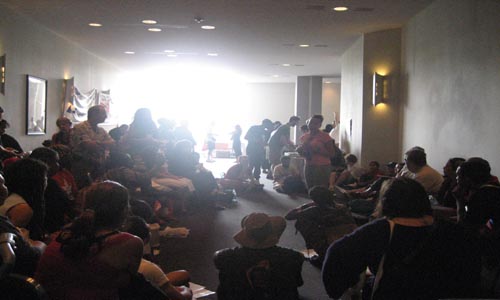
When we finished the extremely long march in the 105 degree weather, we attempted to hold a community Newsroom in the fire-lane/hallway that was designated for the Newsroom. Out of the literally hundreds of flyers and conversations that our folks had with the community of Atlanta as well as other attendees at the USSF, the horror stories of inaccessibility started to float into the chemical laced air of the jail-like bathrooms/dressing rooms of what we were now openly calling the Media InJustice Center.

" People from the housing protest who came (to the civic center) were told they couldn ´ t come in without a pass. "

" No-one could find this place "

" Indigenous elders were blocked at the door cause they didn ´ t have a pass "

" Over 20 disabled folks just gave up when they found out where this was. "

" Three houseless folks were escorted off the property of the Civic Center."

" This place feels like jail. "

As the bodies of the attendees of that day ´ s Newsroom pressed up against the one of the walls careful not to step into the taped off fire-lane, all of the POOR Magazine staff became increasingly upset.

" This is the same kind of oppression we experience at home, in our gentrified neighborhoods, our criminalized schools, our welfare offices, our everyday lives, " I screamed. After the depressing Newsroom was concluded and two of our staff writers who have struggled with environmental racism in the Bayview and East Oakland for years began wheezing from the chemical smells in the Media injustice Center I started to lose it, culminating in a scream to a media pool volunteer.

" Where else can we go? " Leroy and I looked at each other completely discouraged. And then we saw it.

PRESS BRIEFIING IN THE PEIDMONT ROOM- 8:30 am TOMORROW

The final straw for the already fed-up POOR Magazine staff was the finding that the organizers had managed to " find " another space for a press briefing that was designed for corporate media ( aka real media- as it had been referred to so many conference calls ago) Upon discovering this I made a plea to the lead organizer of the Media injustice Center to find another space. There was no response.

7:00 pm The Piedmont Room

Large chandeliers tinkled softly in the warm evening air. Multi-colored carpet lined the massive floor. A couple of hours later most of the POOR Magazine staff found the luxury that was the Piedmont Room- we had collectively decided that our only option was to do what we always do as poor folks tryin to be heard, seize this usable " real " media space for our grassroots media production.

8:00 pm-Homeless Task Force

Undress the Media Justice Center. Get us out of the Dressing Room.

We made an elaborate plan including signs, chants and the move of technology in collusion with our allies at Third World Majority. Later that night we ended up at the Homeless Task Force to paint our signs. Word went out via text messages and cel phone to show up for an action at 8:30 the next morning. We would seize the press briefing space as the new Media Justice Center. We knew Ida would be proud.

9:30pm- Media InJustice Center Staff Meeting

In one last attempt to negotiate a sanctioned move – the POOR staff attended a tense meeting called for by the Media Injustice Center volunteers. Nothing was accomplished except a lot of hurt feelings and widespread defensiveness.

10:30pm Media Injustice Center Parking Lot

An unplanned follow-up meeting in the parking lot of the MJC actually began an interesting dialogue between Josue, myself and all the POOR Magazine staff members. People were actually listening to our collective concerns. A promise of a 7:30 am cel phone call with another space acquisition was made. We would still have time for the action if the promises didn ´ t pan out.

7:30 am Next day

The over-worked, and extremely tired POOR staff were unable to reach our morning deadline, but we had another option. POOR staff were holding our Criminalization of Poverty and Poor Folks of color dialogue followed by the welfareQUEENS workshop; Cultural Work and the Revolution in a very accessible space called Mezzanine Right on this day. We decided the logical thing to do was seize that location for that day ´ s Newsroom. It was our only option

12:00 pm Community Newsroom

At 11:45am over 120 people were sitting in the indigenous circle that is necessary for Community Newsroom to happen, a circle possible in the Mezzanine Right location. Poverty, Race, Indigenous, Inmigrante, Youth and Disability scholars from Memphis, Atlanta, New Orleans, Puerto Rico, Cuba, Mexico, Guatemala, Ireland and New York. Independent media like Paper Tiger Television, Alternet, Race, Poverty and The Environment, Pacifica and AMARC showed up to actually try this new form of media collaboration. Radical Reference Librarians showed up to provide reference advocacy, Making Contact and the National Radio Project, Community News Production Institute Prometheus Radio Project signed on to do on-site trainings and broadcasts, Housless folks from Atlanta that we invited in and facilitated their entrance, joined us, Third World Majority, and Global Action Project, showed up to offer media organizing support as well as countless other organizers and folks, not to mention the PNN staff themselves leading the revolutionary, collaborative media-making It was perhaps one of the most powerful Newsrooms POOR has ever had. Media relationships were forged - multi-media stories were launched. Voices were heard, documented, integrated and respected.

Revolutionary media was made on nation-wide hospital closures and resulting hellthcare, the criminalization of poor folks locally and globally, shelter abuse of gay and transgender folks from Frisco to New York, displacement of poor folks locally and nationally, from New Orleans to Miami to the Bay Area and finally, the resistance of indigenous folks like Gary Spotted Wolf who would buy back Fort McPherson in Atlanta for a bottle of Jack Daniels was planned as the last act of Community Newsroom ´ s final day. Countless PNN poverty scholar correspondents were seeded for ongoing columns and broadcasts, all of the stories launched were led by their scholarship

By the next day it was clear to us that there was no other space for this powerful work to happen at. After some wrangling and hostile cel phone exchanges the National Planning Committee agreed that we could continue to proceed with Newsroom in its new accessible location.

Even after that the Disability and youth justice workshops planned and conducted in the Media InJustice Center by Mari Villaluna, Jewnbug and Leroy Moore were virtually unattended by anyone. People stuck in the very real digital divide remained there for the most part.

" Are you ready to move on miss, " Leroy Moore broke us out of the confines of the white and gray walls of the USSF to actually get real stories of poverty in Atlanta, including their own frightening anti-homeless laws that include not standing or sitting in public because it might give the perception of loitering which is why an officer told me not to stop and use my cel phone in a small Disney-like gentrified enclave that came with their own private po ´ lice force.

Final Day Questioning A Punitive Security Model for Another World Vision.

On the final day when POOR staff were extremely tired, ill from several personal illnesses, heat stroke, Media Injustice Center induced Asthma and very ready to go home, we were encouraged by several media justice workers who were also present at the USSF to create a declaration to present to the full delegation on what happened at the Media Injustice Center with a vision for next years program and a real media justice center that Ida B Wells would be proud of.

The POOR staff wanted to go up together in solidarity, but we were adamantly told that it could only be one representative on each issue and it could only be a two minute presentation. We felt this was rather strident and typical of the event ´ s overall rigid tone, and oddly not in keeping with the notion of a less rigid Peoples ´ Assembly that POOR had heard about in other countries, but we proceeded nonetheless.

Midway in the peoples assembly an indigenous elder was airing his demands for indigenous reparations and a future vision. Midway in his speech he was stopped and asked to leave the stage because he had run 30 seconds over his two minute time limit. When he was asked to leave the stage, several boos rang out in the audience, some of us, who truly understand and practice eldership felt truly wronged by this act of elder disrespect. There are just some things you don ´ t do especially when you are allegedly presenting a vision for another possible world.

And is there really a place for a punitive security model and rigid western notions of time and productivity in another world I wondered at this point if we are really talking about another world or just another world for progressives who all think the same way.

After the man was removed from the stage I walked over to him and was met by Cheli Centano, an indigenous revolutionary teacher from POOR ´ s Voces de Inmigrantes en Resistencia who was already thinking my same thought and suggested we offer POOR ´ s two minutes to the elder who was rudely interrupted.

When we approached the contingent who was with the elder, they agreed and we all proceeded to the rear of the stage to propose the idea to the organizers in back.

By the time we got back there, several other indigenous elders had followed us and we all proposed the idea to the backstage manager. At that point another indigenous leader joined our group and demanded stage time for the elder with the threat that if the organizers didn’t give it to us – they would seize it with a drum circle. A very reasonable offer, I thought, considering the circumstances.

Within minutes the organizers conceded to give us the time and allow this man to finish his demands.

POOR Magazine staff and welfareQUEENS stood in solidarity on stage as a many indigenous elders spoke and called out the hipocracy of the event. It was a revolutionary moment of resistance and solidarity

At the end of their presentation we all walked off together. The first speaker back on stage was welfare QUEEN and Digital Resistor, Vivien Hain backed by many of the POOR staff standing behind her in solidarity, " it was an act of resistance for us poverty scholars to even get here, why did we have to suffer in a jail-like environment that was completely inaccessible," she concluded.

The two minute rigid security model quickly resumed in lock step. The microphone was lurched from Vivian ´ s hands before she was even done. There was only one problem, the already very upset POOR staff ( including myself) was on another track,, free from the default hegemony that seemed to pervade this stage. We were in another world. A world where people are really heard, where Euro-centric notions of time and productivity are de-colonized Where peoples ´ voices are really listened to and not remanded to jail-like basements, where houseless folks are not seen as a security risks, but rather as people who need housing, where hip hop youth scholars are seen as journalists and media producers not " lively " or a threat, where elders are ALWAYS deferred to and never interrupted and where collaboration and cooperation by ALL people is seen as paramount and one of the most important goals.

welfareQUEEN jewnbug seized the mike, asking why we were being silenced. Emcee Cindy Weisner grabbed it back, I tried to step up to say one thing about access and security at which point she addressed me by name shouting to the audience for agreement, " tiny, don ´ t you want to move on? "

That ´ s odd I thought. The police officer in Atlanta had asked me a similar thing, threatening me with a citation if I didn ´ t comply. I wondered if in this parallel other world a similar threat would be forthcoming.

POOR Magazine staff will report back from Atlanta with spoken word, poetry journalism, Q&A and a debut of The Revolution begins with I the Movie - at POOR ´ s offices at 1095 Market street #307 in San Francisco (at 7th street) This will be also be a benefit for Tiny- gentrification by fire victim- so she can stay homeful- $10.00 at the door ( no-one turned away for lack of funds)

Tags

Mad Houser Huts; On the Other Side of Atlanta's air conditioned Civic Center Walls.

09/24/2021 - 10:42 by Anonymous (not verified)
Original Author
root
Original Body

by Joanna Letz

"This used to be an amusement park. We´ve nicknamed it Fun Town." Joe said with a smile and pointed over to the old pool. "Martin Luther King Jr. drove past with his daughter when it was still the park. His daughter asked if they could go. But that was when the park was segregated. Now sometimes I sit here and play speeches by MLK Jr."

On the last day of the U.S. Social Forum in Atlanta a crew of POOR Magazine's Poverty Scholars and Digital Resisters climbed into POOR's rented van and escaped from the walls of the Civic Center. Led by Keif one of Mad Housers architects we rode toward Fun Town. We passed parts of Atlanta we wouldn't have otherwise seen. I felt like we had entered a different world. We passed the gates into one of Atlanta's largest Universities and we went quickly off road down a dirt path to Joe Agana´s hut.

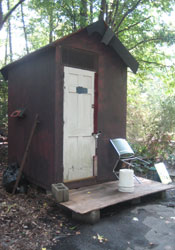
Joe Agana welcomed POOR Magazine into his hut and onto the land he has been living on for nine years. Nine other people live on the land, each with their own hut. Mad Housers build huts for houseless folks in Atlanta. Each hut costs Mad Housers four hundred dollars and with a team of people a hut can be constructed in a weekend.

The heat swelled as we all stepped out of the van. The cracked cement ground reflected the sun. Joe´s hut is only a stones throw away from the highway and from the university with its tennis courts and large buildings. Most people probably have no idea he is living there, hidden amidst the trees. Up above us, a billboard loomed, reminding us we were not far from luxury. The billboard read, "Georgia Tech Tickets on Sale." The cement ground, what was left of Fun Town, proved good land for the Mad Housers huts. Joe explained the land also at one point was a land-fill of some sort. The land is privately owned. Joe retold stories of police helicopters circling above their huts.

Mad Houser huts provide a better alternative for shelter and security than big state sponsored shelters. Keif said, "Give me a task force to write grants, instead of building a 1.3 million dollar shelter." The huts provide a level of autonomy that big shelters do not. Each hut has its own lock. Joe said, "This place beats the shelters. You can go and come as you please."

To even just walk in Downtown Atlanta you must have papers, state issued Identification. Keif explained Mad Housers are making their own ID's.

We stood around Joe's hut as he walked us through some of his life. I listened steadily to Joe as I held one kitten in my hand. The cats and kittens were everywhere, "to keep away the snakes and rats," Joe told us. Around the huts mosquitos swarmed. Joe seeing our attempts at swatting the bugs walked away for a moment and came back with a can of bug spray.

Joe pulled his stove out for us to see. "I just finished making lunch," he explained. Joe makes his own charcoal to heat his hut and cook his food. Mad Housers build the huts and provides each person with a stove. Keif described how the stoves are made. Lifting up the stove Keif said, "The stoves are made from paint buckets. The paint is taken off and the buckets screwed together. At the bottom the screws can be taken out to act like a thermostat… Mad Housers gets donations of wood that is used to heat the stoves."

Joe walked us through his garden. A tall tomato plant grew up from between the cement blocks. The soil Joe fertilizes with his own compost pile. Mustard greens, and swiss chard were ready to eat. Chickens and their little ones were scuttling about.

"There is no electricity or running water. Keif explained, "the city cracked the fire hydrant just down the road. We got a friend somewhere." Sanitation services, water, and power are difficult for Mad Housers to obtain. The billboard shines at night where Fun Town remains without power.

Joe Agana left Bolgotanga, Ghana for the U.S. in 1975. Joe said, "I didn´t live like this in Ghana. I had to learn all this… What I don't have I live without." Joe has two huts, one he sleeps in and the other one is his library. On Joe´s porch his battery powered radio sat waiting to be turned on.

Mad Housers is trying to forge relationships. Mad Housers has a relationship with the university where Joe just received his forklift certification. He is OSHA certified and he was the top of his class, but without papers Joe cannot find work. POOR magazine is looking to find Joe a lawyer to help him get legal status.

Before leaving Joe's we made contributions to his library, some POOR Press publications and POOR Magazine’s own poverty scholarship.

We piled back into the van and drove the short distance down the dirt road, past the fire hydrant, past the entrance to the college, and drove onto the highway. We drove back to the Civic Center and the US Social Forum walls. We drove past the McMansions, also known as the infils that have replaced bungalows, past condemned houses, past what POOR Magazine's Poverty scholar Vivian Hain nicknamed "Legoland Condos."

Poverty exists here in the U.S. as it does everywhere, only the U.S. likes to deny that poverty exists. The U.S. calls itself a "developed" country, a "first world" country, and relegates the use of "third world" and "developing" for those other countries south of here. But as Jewnbug, one of POOR's poverty scholars explained, "I come from a third-world economy right here."

The Mad Houser huts are not the end all of end alls. But as Joe said it beats living in a shelter. At community newsroom the issue of the huts is one of contestation. As Laure McElroy related, "We are fighting to keep the projects but no one really wants to live there…It is a thin line."

"As Tiny said, "What isnt talked about is the criminalization of poverty. If you are houseless in Atlanta you go to jail. I was standing outside, a few blocks from the Civic Center two patrol cars came and asked me what I was doing. The other element of the Mad Housers is the huts provide a safe place away from being put in jail."

"As Tiny also recalled, when poor folks get together to create communes and alternative lifestyles, they are criminalized. Such is the case with Madhousers and was the case in Mumia Abu Jamals house, MOVE, in Philadelphia. But when white folks create communes, they are not forced to go underground, the lifestyle is equated with going back to the land, the agrarian dream.

"Poverty Scholar Jewnbug related her experiences growing up in a camp in Castro Valley. "I lived for a few years with my family camping with other homeless families on private land. These places exist, but people don't talk about it. We moved back to San Francisco to a one room apartment, my mom, my brother and I. I heard the police broke up the campsite."

"Poverty is criminalized so as to send it underground, to make it go unseen. Tiny explained, "This country doesnt let us build shantytowns. In the U.S. you sleep on the streets and you get thrown in jail. In other countries they don't have the criminal industrial complex that we have."

"Joe Agana and the Madhouser huts have to remain unseen and hidden so as not to be criminalized and hounded by police. As an ally of Madhousers POOR Magazine is reporting and supporting Joes daily struggle and his continued fight to gain legal status.

Joe Agana is one of POOR Magazine’s Atlanta correspondents check back for his reports. To learn more about Madhousers go to www.madhousers.org. From May through September 2007, a Mad Housers hut is on display at the Cooper-Hewitt National Design Museum in Manhattan as a part of the "Design for the Other 90%" exhibition.

Tags