Story Archives

A Point of Resistance

09/24/2021 - 10:54 by Anonymous (not verified)
Original Author
root
Original Body

The Hunter's Point Uprising of 1966, a three part series

by Jasmine Sydullah/PNN Race and Poverty Reporter

"When a people is oppressed, stepped on, necked stepped on, butt kicked and they decide to rebel and fight the powers that be, that's not a riot..that is an Uprising!" Cati's voice boomed out of the phone into POOR Magazine's Community Newsroom and there was no room for doubt. Cati would have been about as old as I am now when she and her girlfriends watched from her porch as a conflict that raged for three days in late September 1966 unraveled before her -- an inevitable culmination of years of racial segregation and violence known as; "The Hunter's Point Uprising"

Born and bred in the southeast sector of San Francisco, better known as Bay View Hunter’s Point, Cati Hawkins Okorie is more than a product of her environment“ she is a masterpiece. With six decades of first hand wisdom and lots of love she holds the story of this dynamic neighborhood's ongoing struggles with violence, oppression, negligence and resistance with a grit and grace found only among those strong enough to have faced it all with hope. When I was asked to take part in the very important archival project of permanently documenting the events that occurred in the 66 Uprising led by the San Francisco Bay View Newspaper in collaboration with POOR Magazine's Race, Poverty and Media Justice Institute I was very excited to be returning for a second interview with this extra-ordinary woman to record her personal account of the 1966 so-called riot in Hunter's Point.

“For years the black people and people of color in this city were getting whooped, beaten, shot and killed by the SFPD and on that day on September the brothers decided they were not going to take it anymore.” Mathew Johnson, a 16 years old reminiscent of the Steve Urkel character from the sitcom Family Matters, was riding around on what Cati recalled as a nice hot sunny day with his cousin in a car his cousin had not told him was stolen. Police violence being no less pervasive then as it is now, when the police pulled up to the car, the young men inside had what could have been the good sense to take off running. Unfortunately, as Mathew climbed a fence that ironically separated the shipyard from the projects down at the end of Palou, a “warning” shot reportedly aimed above his head struck him in the back and proved fatal.

The irony of this portentous murder lies in location. In the years leading up to Mathew Johnson’s death at the hands of the police, Hunters Point had suffered a devastating economic blow with the closure of the shipyards. Employment for blacks was not easily come by so when the shipyard agreed to hire blacks, Bayview Hunter’s Point residents quickly became their core work force. People once dependent upon public housing, so-called “temporary” sorely decrepit old naval housing, began to dream of landownership, some even bought property. At its height 10,000 of the shipyard’s 17,000 employees were from the neighborhood. When it closed, all 10,000 jobs were dissolved.

Cati recalled that September 28th was one of those dog day afternoons and since the unemployment was so high a lot of people bore witness to the police chase. Shortly thereafter, from where Cati sat on her porch with her friends a few blocks away, she heard the voices of angry men coming close. They looked and saw a whole bunch of men walking up Palou, shouting, “We’re not going to take it any more! That’s it we’re going to take care of these jokers once and for all!” They explained the events that had just transpired and continued, marching and chanting until they arrived at 3rd Street. Even without the effortless convenience of cell phone technology, word quickly spread to neighboring housing projects in Double Rock, West point, Middle Point, Potrero Hill, and Alemany and more and more people began to pour onto Hunter’s Point’s main intersection, 3rd and Palou. Cati was quick to point out that these were the self same ‘hoods that currently battle for turf, reputation and trafficking which at one point stood together as a unified front.

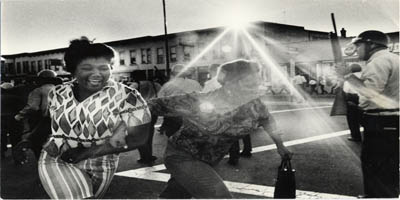
With a collective a call for retribution, jobs and an end to policy brutality, men began to “tear up” the store fronts that lined 3rd and Palou. They were “breaking the windows, setting the stores on fire, and raising all kinds of hell”. The police arrived around the same time as the network media so Cati was able to watch the hand-to-hand combat between the men of HP, their allies and the police from her TV on the evening news. “They were whoopin’ those police’s butts, ok? With their bare fists, ok? That’s anger. And I say they did it not to be thugs, not to be rough necks, but they did it out of the love for that child, Matthew Johnson. His killing was the catalyst for them going down to 3rd street and starting Uprising at that time.”

Cati was at home, pregnant and proudly cheering them on. She likened the mood of that warm September night to the small victories she experienced in her years of anti-apartied work – before liberation was in sight but where everyone felt galvanized by the miracle of progress and rallied around building on one another’s energy. “We were all gathered around the TVs watching on the news, and happy for what was happening because we had been mistreated for so long. It was good to see the guys finally striking back and getting noticed”.

Eventually others sought to join the the rebellion. Sympathizers from the Fillmore, the historically black central San Francisco neighborhood, and from Folsom Street, who were predominantly Latino and largely Mexican immigrants made their way towards 3rd Street where they encountered a Police barricade at Cesar Chavez, then Army Street and Market Street.

After a couple days of fighting after night all, the tanks, jeeps and troops of the National Guard came up over 3rd Street and imposed a curfew of sundown. But by then most of the damage had been done. For the next couple days “nothing on the scale of what they had done that first day”. However, every night, before sundown, formations like townhall meetings took place just outside the Opera House on the corner. Speakers stood up and from within the community began the process of crafting demands and visions for the future. Mayor Shelley caught wind of these meeting and seeing a way to influence the situation, appointed black cronies speak at the meetings but within no time they ran them both out.

The Newsroom was silent, our bodies perched on the little chairs. Tiny, co-teacher of the journalism class that sponsored the interview opened up the floor to the students in the room who asked Cati if the Black Panthers who were organizing across the Bay got involved “The Black Panthers who were organizing at the same time in Oakland came across the Bay and educated the HP community.

Another student inquired as to the changes that were made in the community after the uprising, “There were many innovative programs that the uprising inspired such as the re-opening and renovation of the Bayview Opera House to act as the site for community based service providers like the Equal Opportunity Commission (EOC) and the Bayview Hunter’s Point Foundation (BVHP).

Then Cati’s powerful voice rose and filled the room with collective anger, “But their has been a lot of harm too…A pool hall was opened which brought violence and drugs to the community, Crack came and tore up our mothers and fathers courtesy of the US government and police brutality increased…”

I concluded by asking her what her dream/reality for change is now, “The Black community, the Brown community, the Asian Pacific islander community, the Red community… we are all going to get married, we are all going to bring our own ethnic food, we are goin to come together and we are going to uplift our young. All things are possible if your faith is big enough!

This is the first in a series on the Hunter’s Point Uprising chronicled by POOR Magazine’s Race, Poverty, and Media Justice Institute in collaboration with The SF Bayview Newspaper. If you or someone you know witnessed that time please contact POOR at (415) 863-6306.

Tags

Good Dead Days Pt. 1

09/24/2021 - 10:54 by Anonymous (not verified)
Original Author
root
Original Body

Folks think back to so called
good old days.


When life began to quicken a bit.


Is our breakneck advancement worth it?

by Joseph Bolden

The Good Old Quickly Dead Days Pt.

September 11th another infamous day adds to our expanding lists of really bad days to live through.
That day will dwell burned into adults as its already affects children will affect generations taught these horrific lessons
as generations before learned about World Wars I and II,Korea War-Conflict,Viet Nam and our latest Middle East - Desert Storm/Shield battles..


It kind of makes me feel a longing for the good old quickly dead days. You know those days when we American’s thought of
ourselves as the greatest experiment of mixed blood minus a few African Americans, Pacific Asiatic, South Border, or

Brazilian folks.
Food eaten were = eggs, bacon, sausages, red meat butter, and gravy with no worries on our future health.

Remember when history was simple without her-story and other people’s stories messing up the pure story of Manifest Destiny of America?


But reality shakes her ass pointing glistening perfectly polished fingers at telling us truth will out, unjust laws must-will
change, and everyone’s living reality is equally valid without destroying the frayed original work which is now a
weave many discordant colors, threads, and patches.


Now our stories are many not only one dominant theme but of many in miniature ones buried under
the dominant culture for decades unseen, forced joined but not celebrated by said culture.
The dams have broken, tears shed from its holding back too long.

End Of Part 1.

Tags

Events like the Uprising inspired the Black Panther Party!

09/24/2021 - 10:54 by Anonymous (not verified)
Original Author
root
Original Body

The second in the PNN Hunter's Point Uprising series - an interview with Doctor James Garrett

by Rania Ahmed/Race, Poverty and Media Justice Intern -POOR Magazine

"The Panther Party was formed after the 1966 Uprising--the energy of the people formed the party!" Dr. James Garrett proudly exclaimed as he sat straight up in his seat in the Community Newsroom classroom at POOR Magazine. An aura of grandeur filled the room as Dr. Garrett spoke schooled the Newsroom about the Hunters Point uprising and how it in fact it was one of the events that led to the establishment of the Black Panther Party in the Bay Area.

Dr. James Garrett, or Jimmy as he says he used to be called by his buddies, was the second African American elder to be invited into POOR's Race, Poverty and Media Justice Institute to take part in the collaborative "Live Archive" of the Hunter's Point Uprising of 1966 sponsored by POOR Magazine and the San Francisco Bayview. Dr. Garrett's personal and political history was key to the archive as he bore witness and in several instances led the road to the empowerment of the Black community in the San Francisco Bay Area. Dr. Garrett grew up in Texas and moved to California in the 1950s. He immediately became involved in social services in Los Angeles however he was more interested in and greatly influenced by the Civil Rights movement.

"The Civil Rights organization drew me in." Dr. Garrett became an activist. In the 1960s Garrett was arrested seven times for his participation in protests and sit-ins. He was even involved in the Watts Riot. In 1966 Garrett moved to San Francisco and began attending San Francisco State University partially to avoid the Vietnam draft. Adamant about organizing a coalition of Black students to be pro-active politically and in the community, Garrett, with the help of other students, founded the Black Student Union. Garrett realized that student organizations were an essential tool in aiding the community. The Black Student Union formed alliances with other multi-ethnic organizations such as the Latino and Asian organizations.

The Black Student Union was inspired by Mao Zedong and China. They extracted ideas of studies and research methods and took to the streets of San Francisco to study the Black communities. Garrett and the rest of the students were engrossed by South of Market. There was a strong union movement going on in the area that interested the group. Hunters Point and Fillmore were both Black communities that were targeted and deemed "dangerous".

Garrett and the rest of the Black Student Union members were asked to give tutorials in the Hunters Point area. They were successful in building relationships between children and their parents. The renewed bonds between the youth of the neighborhood and the elders strengthened the community as a whole and created what seemed to be an acknowledged sense of unity that would become more fervent as time passed.

"People were very linked together." The people in the Hunters Point community were very tight. Everyone knew who everyone else was; the important folks and the leaders in the neighborhood were well-known. Hunters Point residents were drawn to the area because it offered job vacancies created by World War II in the part of the city where the Japanese had been rounded up from and put into concentration camps. The Hunters Point area was home to the Hunters Point Naval Shipyard where the vast majority of the employees were local residents. The war economy was booming and the people of Hunters Point were able to do something they were not able to do before--own property. Because of the maritime jobs, they were financially capable enough to actually begin purchasing property. These somewhat revering times would be followed by the closure of the shipyard which led thousands of people in the community to lose their jobs. Hunters Point became another marginalized neighborhood that was consistently persecuted by the police.

Listening to Dr. Garrett describe the injustice that the people of Hunters Point faced by the police I remember how my close friend told me about what he saw in Palestine when he was visiting family in Gaza. In the occupied Palestinian territories my Arab people, the Palestinians, are subject to maltreatment by the occupying forces. Villages are raided constantly, men are taken from their homes in the middle of the night for no legitimate reason, homes are uprooted and if one are caught without an ID he is hauled off to a jail cell.

"People were talking about the LA riots!" Dr. Garrett projected. The police in San Francisco were brutal. Residents of the community were fed-up with the way the police demonized the neighborhood, and took unwarranted action against its residents whom were people who lived in the neighborhood for generations as a result of housing discrimination. The police would stampede the Hunters Point (as well as Fillmore) community to instigate conflicts between the residents and the police.

"The police had been storming Hunters Point to stir-up trouble," Dr. Garrett vividly recollected. It was this sort of conduct that prompted Hunters Point residents to realize that they were being targeted on absolutely no relevant basis. It was not necessary to dissect the situation. It was as clear as day and it was as lethal as the toxins that linger in the air of the Bayview; these white cops were deliberately targeting this Black community.

It was on the 27th of September 1966 that things were going to take a turn. A turn not particularly for the worse but a turn in the direction of change. Things changed on that day that no one will forget--ever. The San Francisco police turned the streets of Hunters Point into a battle zone complete with National Guard tanks and artillery. The San Francisco neighborhood became a modern day occupied Palestine where the victims are armed with nothing more than a stone yet are aimed at with tank fire. Mayor Shelley was infamous in the Black community for his evident discriminatory policies against Blacks; hiring and housing policies of the city's government were inequitable. On the day of the uprising the mayor declared a state of emergency, called in 1200 National Guard troops, and set a curfew.

Was the murder of 16-year-old Matthew Johnson by that policeman the straw that broke the camel's back? Was the reaction of the Hunters Point community inevitable given the events that predeceased the murder? Either way, a boiling point was reached and residents of the ill-treated community were going to take action. The people took action for six days straight as policemen aimed their weapons at the unarmed community. The reaction spread beyond the Hunters Point community and poured out into other neighborhoods. People in the Fillmore District, Mission District and Haight were reacting. Yes, the people were reacting to the murder but they were also reacting to everything else that had been happening. The people were reacting to the racism, they were reacting to the inequality, they were reacting to the victimization, they were reacting to the isolation. There was nothing to lose since nothing was gained by not responding; this made the reaction loud--powerful, even. The police rounded-up random people and took them away. They shot at buildings with defenseless youth and considered anyone who was not a white police officer suspect.

Despite the immediate outcome of the Hunters Point uprising one thing was for sure, waiting around for change was not the road traveled anymore. There was a group of Black intellectuals in the Bay Area that were paving a new path. These individuals were not going to sacrifice their bodies anymore, they were going to retaliate against authority--stand up for themselves! They were no longer going to be that kid on the playground who got picked on and beat up everyday and quietly walked away with a swollen lip. This group of intellectuals formed the first chapter of the Black Panther Party (formally known as the Black Panther Party for Self-Defense).

The Black Panther Party became iconic to the Black communities. Black people were being taught how to take action and defend themselves in the racist society they were born into. The Black Panther Party provided Black youth with a sense of leadership that was void in their communities. This was a new generation that succeeded the Martin Luther King Jr. Civil Rights era and they were looking for something new; something new that echoed what they were living through and how they were feeling about this unabashed racism and inequality. The Black Panthers took action and demanded their right to equality. They called for equal housing opportunities and education about the history of African Americans in schools. They believed that education was the key to uplifting the Black community. The Black Panthers linked the low status of the Black communities to the poor degree of education that people in the community received. This made the Black Panther Party resolute about making education a principal objective in bettering the community.

Dr. Garrett was one of the first members of the newly formed Black Panthers Party in the Bay Area. There were two factions in Northern California: the Oakland section and the San Francisco section. Garrett recalls the Oakland section as being more militant. The new ideology that the Panthers initially banded on was the notion of no longer sacrificing oneself but to defend oneself. This was groundbreaking considering the abuses previous Civil Rights activists withstood to protest the racism and inequality they were living under.

Dr. Garrett concluded the session by answering questions posed to him by POOR Magazine's multi-cultural and multi-generational poverty and race scholars, many of whom are fighting several forms of police abuse today as low and no-income residents of the Bayview, Mission, East Oakland and beyond in 2006. The questions covered the uprising, the Black Panther Party, and the state of the community at the time, and the contributions Latino immigrants, Xicanos, Asians and other groups made at the time. Dr. Garrett said that during the uprising, Latinos played a big role in supporting the Black community. All walks of life in the area got involved to a certain degree during the uprising. Dr Garrett said with a hint of surprise that, "even the hippies" were out on the streets.

By the end of Dr. Garrett's presentation POOR's Community Newsroom was in rapt attention. Doctor Garrett's message was clear, powerful resistance organizations like The Black Panther Party in the Bay Area were formed because of events like the Hunters Point uprising. The uprising made a difference. The people made it clear that they were no longer going to lay down on the ground and be trampled; it was time to get up and stand their ground.

As Doctor Garrett spoke on the Uprising which is now facing its 40th year anniversary I was reminded of my people's struggle; the Palestinian Intifada (or uprising) that stemmed from the ongoing Israeli occupation. Palestinians were (and still are) enduring the most humiliating and dehumanizing circumstances by the occupying forces as well as watching their homes be bulldozed to make room for settlers. It was with the first Intifada that Palestinians broke a forty-year silence and put forth efforts to end this military occupation. It took forty years for the Palestinians to realize that not taking action was detrimental and was losing whatever land they had left. It was time for action. This first Intifada lasted six years. For six years Palestinians fought for their right to live on their land. This was not the last Intifada, the Palestinians continue to struggle to get back what was taken from them: their land, their dignity, their rights to live as human beings. In the end, it is a question of how much a human being can tolerate before reaching that boiling point. It is that moment that brings about reformation in the most profound way.

Doctor James Garrett's story is the second in the Live Archive series of The Hunter's Point Uprising of 1966 sponsored by POOR's Race, Poverty and Media Justice Institute at POOR Magazine and The San Francisco Bayview Newspaper. Raniaa Ahmed is a Race, Media and Poverty Studies intern at POOR Magazine. If you were in the Bayview at the time of the uprising please call POOR Magazine at ( 415) 863-6306. To hear the Live archive by Doctor Garrett and CAti-Okorie Hawkins on the Uprising listen to PoorNewsNetwork's radio show, Monday, October 2nd @7:30 am on Kpfa's Morning Show 94.1 fm or listen on-line at www.kpfa.org and click on the Morning Show

Tags

I can’t Go To School!

09/24/2021 - 10:54 by Anonymous (not verified)
Original Author
root
Original Body

Low income and working poor parents protest the closure of Infant and Toddler Child Care Centers in the Bay Are and beyond

by Amanda Smiles/PNN Race, Poverty and Media Justice Intern

I am standing at the entrance of Laney College in Oakland where the excitement, anxiety, and thrill of first day jitters permeate the air. Right and left students swarm to class, holding their schedules tightly, backpacks swinging. It is almost a typical first day of school, bustling, hectic, and noisy. The only irregularity is a group of 30 student parents and their children holding an emergency press conference to demand the reopening of Laney’s Infant and Toddler Center.

Being a student myself, I understand the pressures of school. Often, I feel overwhelmed by the combination of classes, homework, work, and everyday life. I find myself with very little time, and unlike many students in this country, I do not have children. Surrounded by children and student parents I imagine how much harder my student career would be if I had children and no child-care. I can barely cope as is, how would I cope then?

“Good luck, Mommy,” chimes the voice of one of Mahasin Moon’s three children before she moved in front of the microphones to address a crowd of television cameras, new reporters, and photographers. Mahasin, a parent, student of Laney College, and organizer with the advisory council of the Laney College Children's Center takes the mic and introduces her three children. The two oldest are graduates of Laney’s toddler and infant center, her youngest who just turned 2, will not be able to attend the center due to it’s closure.

Last May 16 days before the end of the spring semester, the staff at Laney’s Toddler and Infant Center was notified that at the end of the semester the center would be closed, indefinitely. Although the staff was notified, many students were not and found out about the closure only 2 weeks before the start of the semester, leaving many student with little options beside dropping out.

Laney’s solution to the closure is to have parents use Merritt College’s child-care center. This solution is unrealistic to most parents. There is only one bus that runs to Merritt College and the time it would take parents in transit would leave many stretched. Also, Merritt’s child care center runs out a single room, leaving little space for new children and unlike Laney’s Infant and Toddler Center, Merritt’s is not sliding scale

The closure and under funding of child care centers and family resource centers is a crisis happening all over the state. In San Francisco, the City College’s innovative PEP program recently lost its only licensed child-care provider. The PEP program, operating out of the Betty Shabazz Family Resource Center, is a license exempt child-care program that provides parents 9 hours of class time in exchange for 2 hours of volunteer time. It also provides a computer cluster space where parents can bring their children and food for parents and their children. Until recently PEP had a licensed childcare provider on staff, who eventually the left the position. Afterwards, City College refused to replace her due to lack of funding.

"The Funding that the state provides to Community Colleges is no way enough to fund the cost of providing care to infants and young children. Most Campus Child Care programs have had to generate funds from other sources. A common source for these funds has been the General Funds of the sponsoring institutions. However, as the colleges' General Funds have had to cover more and more costs over the years, many college administrations have become reluctant to use those funds for child care that is why the Peralta College system has been gradually reducing the programs to only include older children," says Judy Kriege, technical facilities assistant with Bananas, a Child Care and Referral Service in Oakland.

Tracy Faulkner, welfare QUEEN, single mother, and director of City College of San Francisco Betty Shabazz Family Resource Center says about funding, “We shouldn’t be fighting for scraps. We should be growing, not going backwards.”

The event at Laney was organized by POOR magazine a non-profit, arts, education, and media justice organization, in a cross bay effort in collaboration with LIFETIME, California Tomorrow, Parent Voice, and poor parents and students. We gather at Laney asking that certain steps be taken so thousands of poor parents do not lose their chance at an education and a better life for themselves and their families. The most urgent demand is that the Laney Infant and Toddler Center be re-opened by the start of the Fall 2006 semester.

We also demand the funding streams for all the Community College Child Care centers be prioritized, stream-lined and strengthened and that there be transparency and inclusion of the parent leaders and directors of the programs in the funding of the centers. Finally, we want a full-time licensed exempt child care position be reinstated at The Betty Shabazz Family Resource Center at City College and formalized at ALL Family Resource Centers as they are a crucial aspect of their successful operation and stabilization.

Having the privilege of being a financially stable student who has little need for family resource centers, I often forget how crucial their role is in aiding student parents who are struggling to get out of poverty. It is when I meet students who rely of family resource centers to complete their education do I remember why it isn’t just parents who need to support these center, but also people like me.

As the press conference comes to a close, cameras and reporters disperse and children run to a nearby grassy patch to play. Students who had stopped to listen now begin their migration back to class and supporters congratulate parents on their speeches. With the close of the press conference the jitters of the first day come back, but for some students at Laney these jitters won’t be felt again until the toddler and infant center is reopened.

As of September 4th Laney has still not reopened it’s Infant and Toddler Center. If you are interested in working on this urgent issue please call POOR @ 415-863-6306.

Tags

Own your own piece of paradise

09/24/2021 - 10:54 by Anonymous (not verified)
Original Author
root
Original Body

One American’s analysis of travel, colonization and gentrification locally and globally

by Anna Kirsch/Race, Poverty and Media Justice Intern at POOR

“Yeah we just bought something like twenty pieces of property here,” the young American gloated to me. His clear blue eyes were shinning and I could practically see the money signs popping up in them as he spoke. “Really,” I said trying not to sound too much like I didn’t give a damn. He had after all just bought me an overpriced shot of tequila in this overpriced, Americanized bar.

Here I was in Costa Rica, suppose to be immersed in a new culture and learning a new language, and I felt like I was at a frat party. Thoroughly disappointed with the lack of opportunity to practice my Spanish and wondering how the hell I had ended up here, my mind wandered back to the day I decided to leave San Francisco.

It was an usually, hot and sweaty afternoon in June when I looked around my cramped, messy apartment and thought “I gotta get out of here.” It was a sudden strange urge that I couldn’t ignore. A surge of claustrophobia erupted in my body and I knew I needed to escape—the fog, this place and my life for a while. “I’ll leave the country,” I thought almost immediately. Traveling had always cured my blues. Maybe because the distance between me and reality always seemed to grow as soon as I stepped on a plane or train. I could ignore the world in a way I never could when I was at home. I’ll just take a break from the maddening reality of life in the city. Yes that’s exactly what I need I thought to myself and smiled.

When I mentioned this to my teacher and editor, Tiny, at POOR magazine’s Race, Poverty and Media Justice Institute, she warned me not to be a poverty voyerist. She informed me about POOR’s disapproval of travel because it contributed to the colonization of other cultures. She told me that POOR believed tourists were, by default, adding to the suffering felt by increasingly displaced indigenous people all over the world by consuming and participating in the globalized real estate and tourism industries that caused them to live in poverty.

This was something I had never considered before. Traveling to me had always been an opportunity to experience and learn something new about the world and myself. I hadn’t so much thought about the effects of my trip on a global scale. I left my intern meeting that day feeling uneasy about my trip. I felt guilty when I realized I was going to be causing the destruction of a local culture. I vowed to myself and POOR that I would keep my eyes open and be conscious of the colonization I was contributing to. I also promised to be aware of the connections between the injustices occurring abroad and those happening in San Francisco.

A few short weeks later I found myself squeezed into an overcrowded plane on my way to Costa Rica. I was overjoyed. I had never heard a negative word uttered about the country known as the “Rich Coast.” Military less, with a low crime rate and one of the most progressive governments in the world, Costa Rica seemed like just the opposite of the poverty-stricken city of San Francisco. A city where more and more poor people and people of color were being pushed to the outskirts by corporations and investors. A city unconcerned with the well being of its citizens. A city where affordable housing was becoming non-existent. There had to be some place better. And I thought I had just landed in it. A few days later my mind drastically changed.

I wiped the sweat from the back of my neck and shifted uncomfortably on my barstool. He was still talking. “And you know everything is just dirt cheap here so I think we can really make a killing…His voice trailed off as I mentally focused on blocking his words from entering my ears.

It seemed to be the same story on every beautiful beach, in every corner market and in every local bar. Another rich foreign investor talking about his latest incredible property deal in one of the most desirable parts of the country. It was always “such a steal” and “unbelievably cheap.” These people seemed unconcerned with any thing other than a relaxing retirement or some business profiteering scheme. They seemed to have all the power in a country that wasn’t even theirs. The whole country felt hijacked.

Many “local” businesses were owned by foreigners and big corporations and companies had sprung up all over the country. “The stated aim is to entice primarily high-tech corporations to take advantage of Central America’s most educated and disciplined work force…the economy is being transformed from it’s longtime dependence on coffee, bananas and cattle to microprocessor production and high-end telecommunications,” an ad seeking foreign investors proudly stated. I couldn’t believe the country I had idealized in my head so much was turning out to be so different.

Early the next morning, I was walking down a dirt road in the boiling sun with mud splattered on the back of both my tanned legs when I glanced up into the mountains. That’s when I saw them for the first time. Dotting the horizon I saw mansions of epic proportions. I hadn’t even noticed before.

“Yeah, they’re all owned by rich white people, no Tico could ever afford that,” my friend Paige stated matter of fact. She had been traveling throughout the country for the past seven months. “Yeah dude, this place is full of gringos,” she said and sighed. “A gringo’s paradise.”

That’s when I realized the majority of people I had met weren’t indigenous or even local for that matter. They were white, English-speaking and many didn’t seem at all interested in assimilating into the local culture, a culture that was quickly disappearing. Although beautiful, no place I visited felt truly authentic and everything had been built to please the tourist population.

A few days later I was in Manuel Antonio on the Pacific Coast. Wandering up a long, winding paved road to try to get a good view, I became lost. As I tried to find my way back down, I stumbled on more unbelievablely huge, modern houses. These ones were still under construction and had private brick gates.

A young Tico was standing in the yard of one of the houses with modern architectural details and bright shinning metal that looked more like it belonged in L.A. than the grassy mountains of Costa Rica. He stood under the sweltering sun with a large brown dog. “Buenas,” I said. We talked for a few minutes and I asked him if the house belonged to his family. He smiled and shook his head, “No, es la casa de mi patron.” The house belonged to his boss. He told me he lived down the hillside.

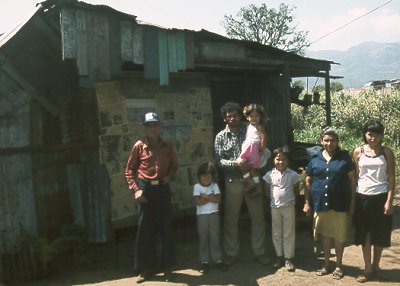
I remembered walking by the rundown houses with peeled paint lining the paved road that carried tour buses to and from the sparkling beaches. These were where most of the locals lived I guessed. I thought about the small brown shacks I had seen on the outskirts of the towns all over Costa Rica. These people had been pushed off of their own land because it was no longer affordable for them while foreigners were whisked by to the surfing spots and high end resorts. I thought I had left all this behind in San Francisco, but it just kept getting worse and worse.

Two days later a big, glossy real estate magazine lying open on a wooden table surrounded by dirty glasses and playing cards grabbed my attention. I was sitting in an open-air yellow patio in a small hostel on the Caribbean coast. “OWN YOUR OWN PIECE OF PARADISE,” “JUST ROLL YOUR 401K OVER,” “RETIRE IN STYLE,” “INVEST IN PROPERTY,” the ads screamed from the pages. Written in English, these ads were obviously not aimed at Costa Ricans and I wondered if the government was trying to control any of the rapidly expanding foreign investment. It didn’t seem like it. In fact, the government seemed to be enabling the robbery of land from indigenous people.

“The most strident problem facing Indian communities today is the rapid encroachment of non-Indigenous people onto their lands…the government recognizes this, but has done little to remedy the problem,” Gerard Schulting, a researcher in Costa Rica found. There is an Indigenous Act meant to preserve native culture, but the majority of the time the government does not enforce it’s land protection laws and readily allows foreigners to buy property.

I wandered around the following week and all I could see were the future construction sites, property for sale signs and SUVs hauling building materials. I left Costa Rica a rainy week later, feeling let down in a way. I hadn’t escaped reality at all. In fact, traveling had only made every problem clearer and more pronounced to me. I hadn’t been able to ignore anything.

After returning to the foggy streets of San Francisco, I was walking around the “New Fillmore District” when suddenly memories of my trip flooded my mind. Shading the sun from my eyes, I gazed up and noticed I was surrounded by towering residential buildings, chain coffee shops and live/work spaces for rent. Everything seemed fake, brand-new and shinny in a way that made my stomach turn.

This was the neighborhood that had been severely gutted by the city for “urban renewal” and redevelopment over thirty years ago. The indigenous people had been pushed out, the local culture had been destroyed and a unique cultural identity had become extinct. I thought about this place and about Costa Rica. One already destroyed and one severely threatened. They weren’t that different after all.

I returned to my internship that August with a new perspective. During our monthly newsroom meeting, Tiny discussed the gentrification occurring in West Oakland and about how when poor people are forced out of their homes they often don’t leave the community but become homeless. She spoke about people living in cardboard boxes or what’s called “the sidewalk hotel.”

As she was speaking, I remembered Costa Rica and felt a pang of pain run through my body. I thought about the new homes being built in West Oakland and I remembered the mansions dotting the horizon in Manual Antonio. I thought about the people living in boxes on the streets of their own communities in California and I remembered the shacks with peeling paint surrounding the resort towns of Costa Rica. As I shared this with everyone at POOR, I felt my experience come full circle and everything became clear. There was no escape from this. Locally, nationally and globally these problems were clear if you’re eyes were open and now mine were.

Tags

Hope VI Project Double Crosses Oakland Renters

09/24/2021 - 10:54 by Anonymous (not verified)
Original Author
root
Original Body

An in-depth study on the Hope VI Project in Oakland reveals that behind the hype and propaganda lies a huge gentrification project that has already displaced many families.

by Lynda Carson/Indy Media News Wire

Oakland CA - A developer's recent glossy sales brochure paints the
Coliseum Gardens housing development in East Oakland as being the next best thing, since chocolate milk. Being hailed as the most
comprehensive development to date for one of Oakland's largest
nonprofit housing developers, an in-depth look beyond the hype and propaganda being used to measure the success of the project reveals that only 4 out of the 178 low-income families displaced by the development, actually managed to return to the newly rebuilt housing complex that was recently christened as Lion Creek Crossings.

Documents reveal that as an effort to reduce violence and drug trafficking within and around the Coliseum and Lockwood communities of Oakland, the HOPE VI program enabled the Oakland Housing Authority (OHA) to use nearly $61 million in federal funding as a major Police Action designed to displace Oakland's low-income communities from the above mentioned locations.

These projects are only a small part of what is known as the Oakland Coliseum Redevelopment Area, which is approximately 11 square miles in size, extending from 22nd Ave., all the way to the San Leandro City limits, and is located between E. 14th St., and the Oakland Estuary/Airport.

The OHA's Board of Commissioners approved the selection of the East Bay Asian Local Development Corporation (EBALDC), the Related Companies of California (Related Companies), and Chambers General Construction as co-developers of the Coliseum Gardens public housing site during its board meeting on October 21, 2002. As partners in the development project, the OHA owns the land, and the developers own the buildings.

As a result of the OHA approval, local nonprofit housing developer EBALDC and Related Companies, LLC., out of New York City, created Creekside Housing Partners, L.P., to take control of Oakland's public housing property at the Coliseum Gardens site.

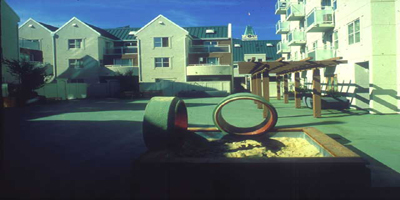
After the eviction of 178 families and the demolition of their 178public housing units during 2004, Creekside Housing Partners (CHP) moved as quickly as possible to rebuild and finish off "phase 1," of their massive gentrification project. Phase 1 of the development is managed by Related Companies, the tenants pay their rents to the New York based company, and during the past 6 months the developers have moved people into 115 newly rebuilt housing units at the development.

Twima Early works at the management office of Related Companies located at Lion Creek Crossings and was eager to help shed some light on what’s been going on at the newly privatized public housing site in East Oakland.

In an October 18 interview, Twima Early said, "During the past 6 months, we have completed phase 1 of our project and moved people into 115 housing units at our new development. Out of the 178 families who were originally displaced by our project, the OHA sent us a list of 13 families who were eligible to move back into this location, and only 4 of those families actually moved into our new development."

"It seemed odd that the Housing Authority would only allow 13 families to move back into this location, and I can't explain why so few were allowed to return," said Early.

When Randy Shaw of the Tenderloin Housing Clinic learned how few of the original public housing tenants that were actually allowed to move back into the Coliseum Gardens/Lion Creek housing development, he said, "The Hope VI program has once again proved to be the major cause of the displacement of low-income people. I've never heard of numbers so skewed before in regards to the displacement of families who were promised that the Hope VI project would be beneficial to them."

Since 1994, Oakland officials and the Federal Government have targeted Oakland's poor with nearly $84 million in federal funding through the Hope VI program, in an effort to displace the low-income communities from such housing projects known as Lockwood Gardens, Chestnut Court, Westwood Gardens, and the Coliseum Gardens. The above mentioned funds do not include all the other funding sources that have been used to dump the poor from their public housing units, in the name of the Hope VI program.

The privatization of Oakland's public housing units have been
occurring at a rapid pace. When wealthy billionaire Stephen M. Ross,
CEO of Related Companies, teamed up with local nonprofit housing
developer EBALDC to re-develop the Coliseum Gardens/Lion Creek housing complex, it became apparent that the developers made out much better than the displaced families did.

Carlos Castellanos of EBALDC is involved in the Coliseum Gardens/Lion Creek development, and when I asked how did this project benefit the families who used to reside there or how is the City of Oakland benefiting from the displacement of so many families, Castellanos said, "These are loaded questions and not something that I want to talk about. I think that a lot of those tenants did not really want to move back, and I think that you really need to talk to the Housing Authority to find out what happened to all of those families."

Vivian Hain resided in a public housing unit near the Coliseum
Gardens site, and said, "About a year ago, Kim Boyd the site manager where I resided at, told me that I'm lucky to be living here even if there is no money for repairs at this building, because they didn’t have enough funding to finish off the project at Coliseum Gardens, and most of the evicted tenants had no where to go. I believe that many ofthe families displaced from the Coliseum Gardens development couldn’t find any housing to move into and may have become homeless," Hain said.

Records show that on June 24, 2006, the OHA's Board of Commissioners approved the use of market rate rents in its Project-Based Section 8 program at the Coliseum Gardens/Lion Creek development, to cover a$600,000 funding shortfall after the EBALDC/Related Companies claimed that they needed more money to complete phase 3 of the project.

A Sept. 19, 2006, OHA memo mentions that EBALDC/Related Companies are co-developing the rental portion at Coliseum Gardens/Lion Creek Crossings, which will include 157 units of public housing. The total number of rental units, including public housing, now planned is approximately 440 units, plus another 28 units of for-sale housing which are planned to be developed by Chambers Construction Company.

With the demolition of 178 public housing units by the developers, and only 157 public housing units being rebuilt at the Coliseum Gardens/Lion Creek Crossings housing site, there’s been a net loss of 21 public housing units at this location.

Despite the fact that Stephen M. Ross, CEO of Related Companies, is so wealthy that during 2004 he gave away $100 million to the University of Michigan, the OHA and City of Oakland, continue to funnel millions of dollars to the EBALDC/Related Companies partnership, in an effort to privatize part of Oakland's public housing program in East Oakland.

Since it's inception, the Hope VI program has resulted in the
demolition of more than 120,000 public housing units across the
nation, and less than 12% of the displaced families managed to gain
entry back into the locations they were evicted from. In order to make way for the new housing projects being developed that resulted in the privatization of the nation's public housing properties, around 30% of the displaced families are given Section 8 vouchers, 49% are moved into other public housing units, and most of the rest often end up losing their housing assistance.

Lynda Carson may be contacted at; tenantsrule@yahoo.com

Tags

Vote, Complain, Pols Not Rest!!!

09/24/2021 - 10:54 by Anonymous (not verified)
Original Author
root
Original Body

Damn! Vote time again.

Folks,
I dislike this pol stuff.

by Joseph Bolden

You know my thoughts on the process: A stopgap, delaying tactic of cobbled, ever changing laws, bills, and mandates to keep our civilization from falling apart.

A working substitute as long as most of us obey said laws, bills, and mandates.

As we live our lives noticing most times its all cocked up most of us get totally screwed in the process.

If this is the best we've got lets improve it to the best of human capacity which can be awe inspiring when we set our mind and spirit to what needs to be done.
Way past time as Americans and Sentient beings we must end this reign of Mad George W. Jr.
Death, torture, lies, on a inconceivable scale.

Are there God's/Godesses, forces watching every blood drenched moment? Me,I won't waste my lifetime on this mockery of an administration.
Yes, to protest but most
importantly to live through this his/herstory making momentous era.

Few of us, if any can be called the mysterious unknown Wandering Jew,
Lazarous Long,
Lillith,
the family Mc Cloud-Connor, Duncan, or
Ben Richards, a racecar driver...

Whom’s life and that of his family changed because some chance miracle of blood and antibody
mixtures made them though ordinary looking outside are extraordinarily priceless in what they carry within their Genome!
When, not if any of us should find ourselves living their as of now fictional lives in reality only then will politics seem useless to us with centuries of miles before we sleep!

Then those of us might wake up, live out our lives beyond makeshift temporary political Alliances: THE ENEMY OF MY ENEMY IS MY FRIEND.

Look up those quotes and others under war, business, or political strategies.

I'd like to be one of many peopling the changes as part participant, part observer of his/herstory living many lives, surviving to tell it all the way it really happened.

I'd like to be one of many peopling the changes as part participant, part observer of his/herstory living many lives, surviving to tell it all the way it really happened.

Come to think on it access to time travel devices could be used so truth will be what can be observed, recorded, and brought back then real his and her-storians will have no doubts what really happened, or how and when.

All of what has happened has to be recorded, filed, and remembered so this never happens again.

But until Homo-longavus, homo-immortus, or Eternus arrives we mortals most hold the line so truth does not die as many loved ones in the armed forces have in the Middle East.

It is up us, free citizens to fight for them as they have fought for us.

Some citizens have already given their lives in this unholy, undeclared war on other nations. We must end this bankrupt regime before it slowly kills us inside.

We know what souless beings look like.

They are our so called elected leaders, let us reclaim, take back our countries soul it doesn't belong to those in power and cannot be bartered at any price!

So, show your souls worth, that ours are priceless, cannot be bought off with the blood of our country women and men, young boys and girls, or the lives of innocents dying in their own land by our so called leader's hands.
While we still have our so called rights let us use them to
VOTE, VOTE, VOTE!

WE CANNOT PROTEST, MOAN 'N GROAN IF WE DON'T VOTE WITH MINDS OF OUR OWN!

Pod cast words: Until we're eternal, this limited souless polie system is what we've got... USE IT!

Tags

94 and Still Homeless

09/24/2021 - 10:54 by Anonymous (not verified)
Original Author
root
Original Body

A family in poverty, Larry, Bessie and Charlie, vs. the System and Poli-tricks

by Marlon Crump/Poverty Scholar/POOR Magazine

The walls are covered by a collage of pictures of people who have fallen as a result of San Francisco Police Department (SFPD) violence; mostly black youth and youth of color whose lives were stolen and cut short. Set within the walls is a feeling of revolution and liberation and also a deep sadness.

The Idriss Stelley Foundation (ISF) is a safe haven as well as an
underground railroad for people who have been brutalized by the SFPD.

Idriss Stelley was shot and killed by SFPD at the Sony Metreon on June 13 2001, "48 shots, 9 officers, as he stood alone in an empty theater." A shrine to Idriss is set in one part of the room. Mesha Monge-Irizarry, mother of Idriss Stelley started the Foundation. Mesha is a phenomenal woman. She is truly a privilege to be around.

For the past month Mesha, myself, and many others have been meeting to plan the march on October 22nd against police brutality. It was at these meetings that I first met Bessie Berger and her two sons, Larry and Charlie Wilkerson. Bessie is 94 years old, Charlie is 59, and Larry is 57. They are living homeless in San Francisco. Bessie and her sons had come to the meetings to voice their concerns and tell their stories of harassment by the SFPD.

Like Bessie and her family, I have dealt directly with police brutality. This past Saturday marks the one-year anniversary of a traumatizing assault committed against me by the SFPD in my own home. On October 7th 2005 twelve armed police officers broke into my room at the All Star Hotel. The All Star Hotel failed to protect my rights as their tenant, which is a part of the long legal battle that I am currently caught up in. The SFPD wrongly accused me of a crime I did not commit and entered my room in the early hours of the morning. This is only one example of the kinds of police brutality that I, and many others, living in Single Room Occupancies (SRO's)
have had to endure. The stories Bessie and her sons tell are all too
familiar.

Mesha and Myself met with Bessie, Larry, and Charlie at the Idriss Stelley Foundation to hear their story.

Bessie is in a wheelchair and is in dire need of a new one. She has trouble seeing and hearing. Both of Bessie's legs are severely swollen. Bessie is a small, gentle woman of incredible spirit and she does not let her age slow her down. Bessie was well respected by the motorcycle gang, The Hell’s Angels, who referred to her as "mama." Bessie's family tree extends from a nineteenth century U.S. Navy Admiral named Allen Schley to Edgar Allen Poe.

Larry and Charlie are both silver haired men. Larry speaks from the heart and he has a stern voice. Charles has a more joking character and ads a comic sense here and there. Their voices contain anger and frustration. They are both tired.

Larry and Charlie are true examples of one of The Ten Commandments "Honor thy mother and thy father." Larry and Charlie's great concern is the well being of their mom. Bessie is bathed daily by her sons either from The City's resource facilities for the homeless or from a one night hotel room that they obtain from the little money they have. They continue to care for
her even while under the pressure of the harshest of times
economically, socially, and politically.

Larry and Charlie are both strong, capable men. They are able to care for their mom but they too are having health problems of their own. They are unable to care for themselves because most of their money goes towards the care of their mom. Bessie only receives a combined total of $800 a month, half of which goes towards her Medicare, she is left with only $400 a month.

Larry, Charlie, and Bessie have only been back in San Francisco four months. They briefly lived here in 2001 during the administration of Mayor Willie Brown.

Four months ago they lived in Palm Springs, California. Both Larry and Charlie worked industrial jobs to support their mom, each making $6.25 an hour. They worked opposite schedules so that while one was working the other one was taking care of their mom.

They lived in Palm Springs and faithfully paid their rent on time. They paid the standard cost of first and last months rent, and the security deposit that totaled over $1200. The building attendant took their move-in deposit and rent, never submitted a receipt, and never turned the money into the management. As a result of the building attendant's criminal conduct they were evicted by the property management. Bessie and her sons immediately brought a legal action upon the management, but they were unsuccessful and the case was mysteriously ruled out.

The All Star Hotel's handling of my situation on that fateful night last year was similar in its complete disregard for my wellbeing. Being evicted from your own home or having twelve unannounced police officers with guns burst into your room are experiences no one should ever have to endure.

Losing practically everything they had Bessie and her sons sought food and lodging from relatives. Bessie in the past had always welcomed family into her home and cared for them in their times of need. Now in need herself, Bessie asked her relatives for help. The same relatives she had always housed and fed would not take her and her sons in. Larry recalled their situation with anger.

"They did not care for one of their very own who had
cared for them when they all had nothing! It really breaks our hearts but we've managed to survive this long. Someone will help us, I hope," Larry concluded sadly.

The family also endured a heart shattering loss of a loved one. In 2001 while staying in Lake County, Bessie's great grandchild, eight year old Tyler James was killed by a drunk driver, named Mark Shifflet. Shifflet struck down Tyler while driving at 70 mph. A California Highway Patrol (CHP) officer arrived at the scene and astonishingly allowed Shifflet to leave the scene of the accident. The accident occurred on Highway 175 in Middletown. It was later discovered that Mark Shifflet had previous D.U.I arrests. But on this tragic night Shifflet was never given a sobriety test. The release of Shifflet was criminal negligence on the part of the CHP officer. The family lost the case in court and Mark Shifflet and the CHP
officer walked away unscathed and unpunished.

I am also waiting for the day in court where I will see legal action taken
on my behalf for the criminal conduct that was committed against me by the SFPD at the All Star Hotel.

Bessie, Larry, and Charlie have had to endure much harassment and abuse. In 2001, Bessie and her two sons approached Mayor Willie Brown, to seek his help in obtaining services. According to Larry and Charlie "We did nothing
wrong, we didn't provoke him, we weren't aggressive. We just wanted him to direct us to the right facility to care for our mom because we were all homeless. He says he didn't like the way we looked and he immediately called security to escort us out. That really hurt us a lot, because we felt he could really help us."

Shortly thereafter, the family caught sight of Mayor Brown at an event in front of City Hall. They again asked for his help and Mayor Brown showed the same discourtesy towards them as he had done before. They have not received any different treatment from the current administration.

They recently tried to seek refuge at the Salvation Army but the director refused them entry because of Bessie and her age. Larry and Charlie told the director, "Look, she's 94 years old, ma'am. We'll be damned if we have to separate and put her in some nursing home. We know all about the evils of neglect in those kinds of places. She is our mother and we are not leaving her to be mistreated!" The director looked at all of them, with a cold and
scornful glare, then replied, "I don't care, ok? She's not our damn problem or fault. She should be in a nursing home and not with her sons."

The response by the director of the Salvation Army towards Larry and Charlie is a prime example of the "Western" notion and belief in individuation. Dr. Wade Nobles, a tenured professor in the Black Studies Department at San Francisco State explains individuation in POOR's fourth issue, "MOTHERS" in the article "The Nature of Mama."

Dr. Wade Nobles says,

"I believe that capitalism and much of the construct in Western psychology emerge out of the same philosophical grounding, and that philosophical grounding is based on the idea of separateness, distinctness, domination, fear, and exploitation. So, capitalism is just the economic system that parallels individuation as a psychological system. It's not that it promotes it, it certainly does reinforce it and allows for it to exist, because individuation would never challenge some of the precepts of capitalism. Capitalism says I've maximized my profits, minimized my loss; in order to do that, I have to exploit others. I won't exploit others if I believe that others and I are the same. So if I believe in individuation, then I certainly have a free license to exploit others."

Larry and Charlie are committed to staying with their mom and caring for her themselves despite what the dominant response is,a committment which like my editor Tiny says, is supported and practiced in POOR Magazine's indigenous family organizing model for poor, and/or homeless families trying to survive and thrive in the US.

Bessie and her sons have been living out of their car. Their car has countless miles on it and they dread the day that it will no longer work. If their car breaks they would be forced to find storage for all of their personal belongings or lose everything.

Since our meeting an unfortunate event occurred. On Sunday October 15 their car was broken into, the registration, all their ID papers, and social security information is gone. This is an unusual theft and they are devastated.

They have continually been harassed in Golden Gate Park by the SFPD. The SFPD have intimidated, verbally assaulted, and insulted them. On one occasion an officer yelled, "No you are not suppose to know or do anything, but be like you people already are, poor and uneducated!"

Bessie, Charlie, and Larry have had to struggle to be triumphant against the criminalization of poverty. As Tiny Gray-Garcia at POOR magazine said, they are Poverty Heroes.

In closing the interview Mesha and I asked what they wanted San Francisco to do to aid them in their needs. Bessie replied, "I only want the city to please help me and my sons out. I also want the city and the mayor to order the police to leave us alone, because we are not hurting anyone. We just want to be helped and not disrespected."

Since the time of our meeting with Bessie, Larry, and Charlie on September 30th at the Idriss Stelley Foundation a short video was created of their situation, and can be viewed at

http://www.current. tv/studio/media/13670557?

You can view Mesha's article about Bessie and her sons at the Idriss Stelley Foundation's website:

http://mysite.verizon.net/vzeo9ewi/idrissstelleyfoundation/

The Idriss Stelley Foundation (ISF) will be hosting a benefit, after the November elections, for Bessie and her sons, which will help to purchase Bessie a new wheel chair.

You can make donations to Bessie and her sons by sending a check to:

ISF, 4921 3rd Street, SF,CA, 94124, attn:Justice4Bessie

ISF also donated a cell phone to the family. You can call Larry Wilkerson at (415) 368-2261 (415-DOT-CAMI). You can also log on to Justice 4 Bessie Berger, set up by ISF, to show your support, by emailing

Justice4Bessie-subscribe@yahoogroups.com,

http://groups.yahoo.com/group/Justice4Bessie.

Tags

Two Thousand Stolen Lives, We Refuse to Close Our Eyes

09/24/2021 - 10:54 by Anonymous (not verified)
Original Author
root
Original Body

March Against Police Brutality remembers loved ones lost, brings local community together in resistance

by Joanna Letz, POOR Magazine Media Justice Intern

The lowering sun hits the top of my head and the wind licks my shoulders. We could be the ones making the wind, I think, as I look back and feel the people behind me, in front of me, and to my side.

On the loud speaker the names of those whose lives have been stolen by the San Francisco Police Department (SFPD) reverberate across the streets.

"Justice for Big O

Justice for Idriss Stelley

Justice for Julio Ayala

Justice for Asa Sullivan

Justice for Gus Rugley

No More Stolen Lives, No Mas Vidas Robadas."

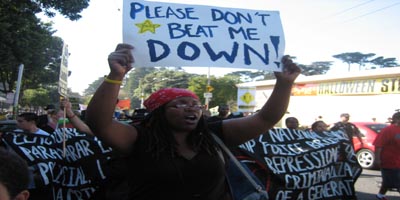
The march on Sunday, October 22nd in San Francisco was part of the 11th National Day of Protest to Stop Police Brutality, Repression, and the Criminalization of a Generation. Those who took to the streets included family members of those murdered by the police, people who have dealt with police brutality, and many individuals and organizations. Among the organizations represented were: The Answer Coalition, SF Coalition on Homelessness, Mothers with Murdered Children, Berkeley Cop Watch, Poor Magazine, The World Can't Wait, and The United Playaz. The march in San Francisco was organized by the October 22nd Coalition with the strong leadership of Mesha Monge-Irizarry founder of the Idriss Stelley Foundation, and Karen Martin.

It was not a huge march, but with it carried the signs, voices, and songs of people who have lost loved ones by the hands of the police. The march was filled with hope and a heaviness that comes from people who have dealt first hand with violence and police repression.

As I marched alongside people who had lost family members to bullets shot out of police guns I could not help but think of my family's experience in Europe during the Holocaust. My grandpa and grandma, Isaac and Adele Silber, survived the Hitler regime by hiding in a Christian family's basement. They both witnessed their family being murdered. My grandpa, who just passed away 4 months ago, was always reading the news and was always the first one to point to the many Holocaust's happening around the world. The speakers whose voices surged forth on Sunday also spoke of another Holocaust. This Holocaust is happening on our streets in San Francisco. The Holocaust, the executions, the murders of people of color in our houses, streets, empty movie theaters, and hotel rooms; this is happening in our city.

Chanting together on Sunday we took claim to the streets as we walked and made our way from Stanyan and Hate to Jefferson Square Park. Many protest chants echoed along the march.

From the loudspeakers to our responses in unison, our voices traveled,

"Whose streets?

Our streets!

Whose streets?

Our streets!"

From Golden Gate Park, at Stanyan and Hate, we walked, through the Hate, through the Fillmore, and onto Jefferson Square Park. Sunday afternoon shoppers stopped, starred, and took pictures. Mesha yelled on the loud speaker, "Come and join us in our fight against police brutality." I did not notice any of the bystanders join the march.

As I heard the wind approaching again I looked back and saw and felt a group of people taking back the streets.

The police walked along side the march all the way from Stanyan and Hate to the Park. I stood at the front and saw all along the spine of the march police officers in uniform carrying guns. Nowhere in the crowd were police represented as supporting the fight against police brutality. But the police were there in their uniforms and with their guns. There we were on the streets shouting, proclaiming and attesting to police brutality and walking alongside us were the police in uniform, silently, steadfastly moving, guns in holsters.

When we reached Jefferson Square Park the police officers mysteriously disappeared. Across the street loomed a big police station. Orange cones guarded the front and a police officer on a motorbike sat waiting. The police officers did not stay to hear the voices of those affected by police brutality.

At the park a memorial stood to those whose lives have been stolen by the police. The memorial, the wall includes names, and photographs of people whose lives have been stolen by police hands. The wall is a symbol of resistance, and of the harsh realities of police murder.

The wall was built by The Stolen Lives Project. The Stolen Lives Project also published a book in 1999, "Stolen Lives: Killed by Law Enforcement," which is available on Amazon.com and contains over 2000 cases of people killed nationwide in the decade of the 1990's. The Stolen Lives Project Update Booklet includes information collected since the 1999 book and can be viewed at their website, stolenlives.org.

As I write I think of my grandpa. He advocated for being aware of violence going on everywhere and not just listening to the stories of our own family, but knowing and listening to the harsh realities of violence and repression going on in many peoples lives.

Big Mike, the brother of Oliver Lefti "Big O" spoke on Sunday. "Big O" was killed on June 24th of this year. Big Mike said, "We pay…. And this is what we get. You pay for, I pay for the bullets that come out of that gun….In New Zealand police don't have guns…." As Big Mike so vividly pointed out, we are the ones paying for the bullets; the bullets that kill and steal the lives of loved ones.

With the heaviness of loss and struggle, comes a deep need to be heard, and a deep sense of where things are at in this country, and just how bad the institution known as the police department is.

Elvira Pollard, mother of Gus Rugley, who was killed by SFPD on June 29th 2004, said,

"June 29th 2004, loosing my son was a terrible way to get inducted into how bad the police really do people. Four different police units sat outside my house. They watched my son from 8:00 am to 6:30 pm. They don't come to ask questions. They come with heavy artillery. At the autopsy thirty-five bullets were pulled out of my son. There was no gunpowder on his hands. They said my son shot two clips…But there was no gunpowder found on his hands. Who told the story that day? The press and the police. They put me in handcuffs. All I said was he's my son. They have someone in jail, a 187 suspect for the crime. But now they don't talk about it…I wasn't wrapped so tight before, but they took something so valuable. I got to fight for my son now. An execution was perpetrated on my son. Get Gavin Newsom out of office…and Heather's too scared of her own troops. OCC (Office of Citizen Complaints) got broken into…We got to pull together and beat this shit at City Hall."

Mirna Ayala also spoke about losing her son, Julio Ayala who was killed by police on October 2nd 2005. She said, "He was in a hotel. There was a noise complaint. He was quiet. They came two by two. Thirty police. My son died. His neck broken. My son will never come back. The police stole his life."

The march and the rally was a call to listen… listen…

To listen to the stories of the mothers who have lost their sons, sons who have been murdered. To listen to community leaders calling for community boards, and community support. To listen to family members resisting and fighting for their lost loved ones. To listen to the stories of those affected by police brutality and to listen to the resistance and to the visions of change.

Minister Christopher Muhammad said, "The police are armed for military occupation. Youth of color are treated as if they are enemy combatants. Federal and local police become occupiers and relate to communities of color as if occupying." Minister Muhammad went on to say, "We must insist on enforcing a community model. They never want community control or community review boards. The Department protects themselves and serves their own interests."

In Berkeley on October 26th, Berkeley Copwatch held a march and rally to fight for the Berkeley Police Review Commission (PRC). The PRC was started as a civilian review organization to hold cops accountable. A recent California Supreme Court decision (Copley V. San Diego) cuts civilian oversight and closes police records to the public.

Khalil Sullivan, brother of Asa Sullivan who was killed by SFPD on June 26 2006, also asks for accountability. He said, "Why are police set free after they murder? Where's the accountability? God Forbid that they loose their families. We need to go to police commission meetings. And if someone can't go, send someone else. We need to create a network of people that speak... We are in control, they work for us." At the end, Khalil asked, "Are they peace officers?"

What are these uniforms that separate people? Why were there no police officers supporting the Stop Police Brutality March and Rally? But the police officers were there in their uniforms and with their guns.

In New Jersey police officer Delacy Davis has been fighting against police brutality for many years. In 1991 he founded the community-based organization called, Black Cops Against Police Brutality (B-CAP). He recently released a book titled "A Crisis Call to Action." B-CAP recommends the following courses of action:

-

civilian control and oversight of the police
-

Residency requirements
-

Community Based training for all police officers
-

Cash rewards for the exposure, arrest and conviction of corrupt cops
-

Congressional Public Hearings
-

Mandatory drug testing for all police officers
-

"Zero tolerance" for substance abuse by police officers
-

Integrity tests
-

Annual psychological evaluations

Delacy Davis says in his book, "Police brutality reminds me of the darkness in history when the master whipped the slaves just because he could. There can be no more blatant racism than that misuse of power by the police who have been entrusted to protect us."

Jewnbug, from POOR Magazine commented on the institution known as the Police Department. She said, "Why was the police system built? It was built on hate and racism…. I hear people talk about good cops and bad cops. There is a uniform and a human being. We need to change the structure. Police escalate abuse and violence. Violence doesn't stop. You displace it, put it in prison and make money off of it….To defeat an oppressive system you have to create a support system. It's more than fighting. In order to rebuild you must destroy."

As Jewnbug so articulately pointed out it is not about good and bad cops, but about a system of violence that puts people of color in danger, and leads to murder and stolen lives.

Jewnbug also related a story told to her by a friend from South Africa, "In 2002 a South African comrade said to me, in domestic violence cases, someone comes to talk with the people involved to talk and deal with the anger and where it comes from." Jewnbug and others say we need community support to deal with the root of the problems.

We are all implicated in this system of abuse and police violence, some people benefiting from the system and many people being abused and murdered.

As we chanted at the rally, we refuse to close our eyes to the system of violence and murder. To the many stolen lives, we say their names, and say, presente, in honor and remembrance.

Tags

Makin Sure All the people Own the Media

09/24/2021 - 10:54 by Anonymous (not verified)
Original Author
root
Original Body

Local community in Oakland questions two FCC Commissoners about big media, stereotyping and lack of diversity in the media

by Rania Ahmed/Race Poverty and Media Justice Intern at POOR Magazine

I rushed up the escalator in the Oakland Convention
Center to make my way up to the Calvin Simmons
Ballroom. The click-clack of my kitten heel shoes
seemed to echo throughout the lobby. I hopped off the escalator only to be blinded by studio lights. Network
news cameras were set up on tripods with reporters
standing by ready to pounce on anyone who walks out of
the ballroom where the Federal Communications
Commission (FCC) hearing was being held. As I started
walking towards the doors to the ballroom I caught a
glimpse of the peacock microphone and there was
Michael Copps doing an interview for NBC.

I tried to discretely walk in without being noticed. I
entered the room only to be astounded by the amount of
people who showed up to voice their concerns regarding
media consolidation. I did not do an actual head count
but there looked to be over three-hundred people in
the room and more kept walking in. Media consolidation
is a big concern to residents of the community. When
corporations buy media outlets in vast proportions
they have complete control over what will air. This
blocks media diversity, encourages stereotyping, and
limits information. I was there as one of four media justice interns to re-port and Sup-port for POOR Magazine/PoorNewsnetwork

Sponsored by the National Association for the
Advancement of Colored People (NAACP), Media Alliance,
Youth Media Council, and Free Press, the Oakland FCC hearing featured FCC commissioners Michael Copps and
Jonathan Adlestein as well as prominent members of the
community including Allen Hammond a law professor from
Santa Clara University School of Law and Karen Slade a
Vice President of a Black owned and operated radio
station (KJLH). This was an opportunity for members of
the community to address the commissioners with the
intent that Copps and Adlestein will go back to
Washington with these concerns and inform their
colleagues. Being the only Democrats on the five
person panel makes it more difficult for them to
attend to the community's interests successfully.
Commissioner Adlestein was quite frank in saying, "In
recent years, I am sad to say, the FCC has failed to
protect your interests."

The FCC has indeed failed to recognize and protect the
public's interest. In 2003, the FCC voted to make it
easier for companies to own multiple forms of media in
a single region. In 2004 a federal court ordered the
FCC to reconsider the policy. There will be several
hearings like the one in Oakland held across the
nation to review current FCC ownership policies. Big
Media is the result of the FCC's lax rules concerning
corporations that purchase media outlets in bulk.

"We forgot about the importance of music and news,"
said Adlestein. With the concentration of media
outlets, local artists do not get a decent amount of
airplay making it tougher on them to get their music
heard. With media consolidation, news stations do not
cover issues of importance to communities of color.

People of color own less than 3 percent of media
outlets. Michael Copps declared, "Now is the time to
assert our ownership rights." He also proposed,
"Airwaves of by and for the American people." Both
Copps and Adlestein, the only commissioners to vote
against the recent renovation of the FCC ownership
policies, made the crowd of concerned community
members feel like their opinions mattered. But how
much do they matter if only two out of the five
commissioners were present at this hearing?

"Tonight in and of itself is not going to change one
damn thing," said Jeff Perstein executive director of
Media Alliance. "It's crucial that we raise our
voices, it's crucial that we organize beyond this.and
figuring out what the next steps are is really the
crucial piece."

Many community members voiced their concern over
racist and stereotypical portrayals of people of color
in the media. Dr. Julianne Malveaux an economist and
President and CEO of Last Word Productions addressed
the issue of the negative portrayal of African
American women in the media. She brought up the
infamous Janet Jackson Super Bowl wardrobe malfunction
to prove that there are rampant double standards
present in FCC policies. "When Rush Limbaugh and Neal
Boortz have described African American women in most
graphic of terms.there were no fines incurred.When MTV
has black women with leashes there are no fines
incurred.I need to understand why it's okay for
Limbaugh, Boortz and these other hate mongers to put
their hate speech out but when someone's nipple.is
inadvertently shown you have all of this craziness,"
said Dr. Malveaux.

Jen Soriano, program director for Youth Media Council
moved to the Bay Area after the 1996
Telecommunications Act. The 1996 Telecommunications
act led most independent media to be bought up by
corporations. The act was intended to enable
competition but instead created major media
consolidation. Soriano was shocked by the Bay Area
media. "I found a mass media system that was more a
reflection of anywhere, any town USA, instead of the
Bay Area and the reality of the strong immigrant
communities, the strong African American communities
that have been here for generations and the majority
minority culture," said Soriano.

Peter B. Collins, a radio talk show host and officer
of the American Federation of Television and Radio
Artists, appealed to the commissioners to cut off
media consolidation. "It only serves the interests of
a few big corporations.their power to limit coverage
of descending voices to dumb down our culture in
political conversations to deliver the very highest
quality mindless dribble on every available channel.
This power is quite evident today far greater than it
was ten years ago," said Collins. Collins also
stressed that reduced competition on the airwaves has
truncated localism and diversity of voices. Local
media is not being preserved by the current FCC
policies.

Clifford Goler an actor/model and producer from
Oakland talked about the stereotyping of people of
color in the media. When he was modeling he would
always be booked for alcohol ads and when he inquired
why, he was usually told, "That's how it is." Goler is
concerned for the children and how they are effected
by the media. "As a kid I could watch Larry Bird or
Dr. J and go home and want to be like them...That got
me in college because I wanted to be like them. Now
these kids have nothing to dream about."

Leslie Ruiz, with the Youth Media Council told the
commissioners that everyone is despondent with the
violent attacks by the media on the community. "It's
obvious what the people want and if you guys aren't
meeting our interests than what are you doing? Isn't
that your job?" asked Ruiz.

Glancing over at the commissioners displayed on the
platform in front of the full room, I noticed they
looked a bit distressed. Were they overwhelmed by the
amount of discrepancies between their commission and
the local communities? It had only been a couple of
hours since the start of the hearing and there was no
end in sight.

Commissioner Copps said that concerned citizens can
make a difference. The turnout for the Oakland hearing
showed that there are plenty of concerned citizens. It
is up to the commissioners to relay the community's
voices back to Washington. One thing was certainly
accomplished at the hearing and that was that
community members attempted to make a change. Dr.
Malveaux said, "No one's speaking up.if we do not
speak up for ourselves, we're saying it's okay. And
you know what...it's not okay."

After a few hours, the room began to vacant and the
lines of people at the two microphones on either side
of the ballroom began to shorten. Exhausted from
sitting for four hours I decided it was time for me to
go. I walked out of the ballroom and found the
television cameras gone. A group of young adults were
huddled in the corner occupying the remaining chairs
in the lobby.

On my way down the escalator I spotted
one of the young men who spoke earlier about the
negative portrayal of people of color on the media.
"You know," he said to another young man standing
beside him, "that meeting had me riled up. To see
people coming together, uniting to show them that we
won't stand around and do nothing about it made me
feel like we took a stand today."

Tags