Story Archives

Color Printing By the POOR Press!!!!

09/24/2021 - 11:22 by Anonymous (not verified)
Original Author
root
Original Body

HIGH QUALITY NON-CORPORATE PRINTING

by PNN Staff

Beeee-uuuUUUUtiful HIGH QUality Color Printing available at Competitive Prices

POOR Press ( a non-profit project of POOR Magazine) can make all your color copies, brochures, flyers or Books.

We can work with your design, art work or text, or our POOR Press designers can do ALL your graphic design. Just give us your raw ideas, needs or material and we will turn it into a professional high quality artistic product.

We can also help you self-publish your books. We offer high volume binding (saddle stitching) and cutting.

Other Offers; CD burning, slide scans, graphic design consultation and much more!!!!!

$1.06 per page (on most sizes) - volume discount available- all paper sizes available up to 11x17

For More information please call (415) 863-6306
or email: tiny@poormagazine.org

Please bring your graphic needs to POOR press!!! and thereby help support POOR Magazine, a non-profit community based arts organization dedicated to providing media access, vocational and arts education to very low and no income and adults and youth locally and globally.

Tags

The Tainted Eye of The Media

09/24/2021 - 11:22 by Anonymous (not verified)
Original Author
root
Original Body

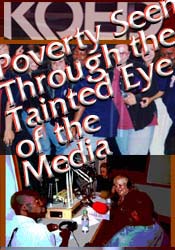
KQED sponsors a media salon focused on media images of poverty

by Connie Lu/PNN media intern

I enter KQED to attend a media salon focused on images of poverty in the media through large transparent glass doors. I
am amazed by the surrounding modern office furniture
and state of the art wide screen TV hanging on the
front wall of the room. I help myself to the
refreshments and to my surprise I notice a few bottles
of wine. Knowing that KQED is a "public" television
network; I expected a less extravagant atmosphere.
But aside from my misconceptions, I sit at a small
dark red table that is square-shaped with four
surrounding chairs, feeling unsure of what to expect
now, after my initial inclination was proved wrong.
But despite this feeling of uncertainty, I am
comforted by familiar faces from POOR Magazine.

Lisa Gray-Garcia aka Tiny, Co-Editor with Dee Gray of POOR
Magazine, is asked to speak first. She shares about
her struggle with poverty and how POOR Magazine was
established. She stresses the fact that low-income
people never get heard in mainstream media. The media
portrays the homeless as nuisances that are associated
with drugs and mental illness. However, POOR Magazine
does not see the homeless as outsiders, outcasts, or
the "other". This concept originated from Dee and is
the foundation that POOR is built upon.

Although I had heard POOR's mission statement before,
it did not feel redundant to me at all. Each time I
hear about the essence of POOR Magazine, I am reminded
of my purpose of being at POOR, which is to empathize
and find personal connections to the inspiring people
I write about. POOR Magazine writes in first person
because the article becomes more real and genuine.
Through empathy the writer is connected, which gives
the reader this same mutual experience. I do not see
those who are struggling with poverty as the "other",
but as my teachers.

Participating in the discussion at KQED also reminds
me of being in Community Newsroom each week at POOR,
which is where low-income people gather to be heard.
Both KQED and Community Newsroom consist of people
meeting together to express upon the issues of
poverty. However, I can not equate the two. At KQED,
there does not seem to be this feeling of being
connected, unlike the closeness I feel when I am at
POOR during Community Newsroom. The series of
comments made during the Media Salon seem unrelated at
times, which gave the impression that perhaps people
weren't really listening to each other. The comments
would often not link together in a natural flow of
discussion, but each point was made like kernels of
corn that randomly popped at the urge to speak.

However, at POOR each succeeding comment reflects the
genuine attention of the listener. Michael Isip,
Executive Director of KQED, has this same
characteristic of being a good listener. After
showing a documentary he is currently working on
called, "Hope on the Streets" he asks for constructive
criticism. As several opinions are being expressed,
he listens intently and writes them down. He felt
nervous showing his documentary after hearing several
comments about how the media's portrayal of the
homeless is tainted. However, Isip is eager to learn
and shows his gratitude for the suggestions.

The documentary focuses upon both homelessness and
mental illness. Through the documentary, Isip hopes
to convey a sense of hope for the homeless by showing
personal accounts of success from homelessness. The
purpose behind his documentary is to break stigmas and
stereotypes about the homeless because it prevents
them from asking for help. His goal is to educate
people about the homeless to increase awareness and
encourage out-reach to them. The documentary also
revolves around his strong belief that; "There is no
such thing as a throw away person".

The documentary shows the progress of a few homeless
and the success that is achieved in the end. A
homeless man named, John Joseph explains in the
documentary that he used to work on a ship, but was
then diagnosed with Acute Paranoia Disorder. He was
afraid of people and would seclude himself. He spent
four years sleeping in BART stations.

When Joseph mentions where he sleeps, my memory is
suddenly triggered to a homeless man I saw sleeping
against a pole at the BART station last month. I saw
him quietly sleeping. He was not disturbing anyone.
His black hat was low and covered his eyes. He wore a
backpack and a dark green jacket. But as I was
waiting for BART, I become alert to two policemen
walking towards him. The two policemen lifted the
homeless man up from the straps of his backpack. He
says something that I was not able to make out
clearly, but he sounded angry.

I felt as though I could have helped this homeless man
by waking him up and warning him that there were
policemen approaching. I worried about where he would
be taken and the pain he would suffer. I kept asking
myself why they wouldn't leave him alone because he
wasn't being disruptive or bothersome, but I continued
to watch in frustration as he was taken away.

The documentary then introduces another homeless man
named Jimmy, who asks a flower vendor named Byron
Yonandis, if he could help out at his flower stand.
Byron not only gives Jimmy the job, but he has given
Jimmy a sense of hope. He expresses his compassion
for Jimmy, who is now like a brother to Byron. There
is an incredible amount of trust between them. Jimmy
says when Byron leaves him in charge of the flower
stand, he "feels good".

I was amazed by the love in Byron's heart for Jimmy.
The empathy that Byron had was not only spoken through
his words, but also shown through his actions of
placing a genuine trust in Jimmy, despite the many
stereotypes against the homeless. As the discussion
came to an end, I recall images of Byron's face of
hope as I walk down the spacious hallway to meet the
cool night sky filled with glimmering stars.

Tags

Power in Prose

09/24/2021 - 11:22 by Anonymous (not verified)
Original Author
root
Original Body

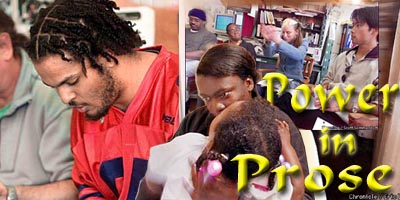
Poor magazine gives voice

by Venise Wagner

Power in prose
Poor magazine gives voice

L isa "Tiny" Gray-Garcia and her mother, Dee Gray, take exception with the phrase "those people," as in those homeless people, or those poor people, or if only those people got their act together.

In their minds, this seemingly innocuous phrase divides society and diminishes the humanity of a set of people, particularly men and women who find themselves among the have-nots.

As founders and editors of Poor magazine, they have decided to tackle this expression and the thinking behind it. Setting themselves apart from mainstream media approaches to covering the poor, the duo reports and writes about poverty, and trains its staff to find the universal "I" in them, as in "those poor people." Hence, we.

"I stress that people write in the first person so they don't feel separate from the people they're writing about," explains Dee. "They may not have the experience of sleeping in the doorway, but they may have had the experience of being afraid to speak out or feeling like they couldn't speak out." Both experiences, Dee says, are a form of alienation that most can relate to.

Tiny, Dee and the San Francisco magazine's four staffers and 10 volunteers see themselves not only as journalists, but as advocates, challenging misconceptions about poverty and a system they believe does more to keep people in their place than to help them rise.

A variety of nonprofit organization and private donations provide support. They also get support from the San Francisco Department of Human Services, which sends a handful of welfare-to-work clients to the magazine's Journalism and Media Studies Program for training. Their budget last year totaled $85,000. This year, they're not sure if they will make it through the end of 2002.

Tiny, 30, says she and the staff live in constant crisis. Many of the staff are homeless or living in dire situations and constantly struggling to survive. Tiny tries to advise and support them. She and Dee always worry about the operation making it to the next month. In the midst of these crises, they manage to produce an online publication ( www.poornewsnetwork.org ) weekly and a glossy magazine. Mothers was the theme in the last issue. Others include, "hellthcare," "homefulness" and work. They have published four times so far, one a year.

" 'Poor' usually means we're the subject of the news," Tiny says. "We don't get to shape the news. Until we are heard, there won't be any real change."

From the time Tiny was in sixth grade to about five years ago, she and Dee shuffled from evictions to squatting in abandoned buildings to living in their car.

As a single mom, Dee had always struggled to stay afloat, but when she was struck with severe asthma, she was no loner able to work as a social worker. They were evicted from their apartment in Los Angeles. Tiny dropped out of school. They started living out of their car.

"Mom was an orphan. She had no family," Tiny says. "When you have no family, it's one tier from having no money. In some ways it's worse."

They trekked up to the Bay Area and, for many years, eked out an existence selling T-shirts and soliciting change for their street performances, which usually involve acting out issues related to homelessness.

The year she turned 18, Tiny landed in jail. She and Dee had racked up a bunch of unpaid parking tickets, citations for sleeping in their car, driving without car registration and failure to appear at the hearings on those offenses. Tiny calls those crimes of poverty.

The judge ordered her to perform community service. She hooked up with a Berkeley nonprofit called Community Defense Inc. The man running the operation, civil rights attorney Osha Neumann, asked her what she could do. She told him she could write. He told her to write a piece about being poor. She came back after a few weeks with a piece on the experience of being evicted.

"It was sort of surprising," Neumann says. "Many people say they can write, and you never know what you'll get. She was an incredible writer."

She submitted the piece to East Bay Express, which published it. Tiny calls it an intervention, one of a series that would ultimately take her to Poor magazine. "Oh, my God, I was alive," Tiny says. "It was like someone threw me a life jacket."

She felt the power of being heard and craved more.

Writing had provided a lifeline for Tiny from an early age. She has kept journals, written short stories and chronicles of her life. Being published buoyed her hopes, but the misery in her life continued. She wanted to avoid welfare - in her mind, then, it carried too much shame. But she broke down and applied.

She never gave up on writing, though. While in a Berkeley bookstore in 1996, flipping through the magazine rack, it occurred to her no one spoke about the lives of poor people. She got to work, raising money from artist friends and poor friends who sacrificed what they could. She and Dee conducted writing workshops in shelters, community based organizations and advocacy agencies serving poor people. Within nine months, they had raised $2,000 and enough material to publish a 65-page glossy issue of Poor, with color art, poetry and prose - and no advertising.

It cost $10,000 to print 1,000 copies. They forked over what money they had, and paid the remainder with magazine sales. The latest edition, a run of 3,000 copies published in December, cost $15,000 to produce.

As always, half the run was distributed free to low-income readers; the rest sold for $3.95 each at Modern Times Bookstore and A Clean, Well-Lighted Place for Books in San Francisco and Cody's Books in Berkeley.

"We wanted to create a pretty product that yuppies would want to pick up," Tiny says. They also wanted a magazine that would raise the value of poverty issues to the status afforded mainstream magazines.

When the welfare-to-work program rolled out in 1998, case workers told Tiny she had to get a job, insisting that she apply for a receptionist position. She explained to the counselors her desire to become a reporter, but they kept telling her she didn't have the education. She told them she'd be willing to go back to school. She says she was told that would take too long.

Tiny developed her own welfare-to-work program. The Department of Human Services signed on. Now, Poor magazine staffers are training welfare recipients basic reporting, writing, graphic design, Web design, investigative reporting and advocacy at a South of Market union hall. It may be the only welfare-to-work training program that focuses on journalism. In the past four years, 15 people have completed the program.

Amanda Feinstein, a project manager for Human Services, says Poor and its media studies program gives clients skills that transfer to other jobs. Clients have gone to work as a desk manager, an administrative assistant and as a peer adviser for a juvenile-justice advocacy group.

"They've had some real successes," Feinstein said. "People get hands-on training in computer software and writing skills, which are helpful in a variety of ways, including self-expression."

From Osha Neumann's perspective, the magazine has a greater social impact.

"We tend to talk about the homeless as a collective noun, as a definite, generic homelessness or homeless condition," he says. "It's a political act to insist on individuality and humanity of a person. ...Tiny and Poor magazine (are) at the center stage of that battle. Giving voice to the poor is both a literary program and a political project."

The politics assert themselves at the start of each article. Every Thursday, Tiny and Dee lead a community newsroom meeting at the union hall. All are invited, especially anyone who has lived in poverty. About 105 people have taken part either in meetings or in producing the magazine.

"The establishment says it's wrong to be poor, and it's something to be ashamed of," Tiny says at the beginning of a recent meeting. The group listens intently. A Poor News Network promotion poster behind her head reads, "Driving While Poor, Part II." The folks at Poor want people to take pride in their ability to survive the toughest of circumstances. During the introduction, Tiny invites people to admit their poverty status.

Twenty people sit in a cramped circle. The group is a mix of races, ethnicities, ages and economic classes. Some participants are City College students or writers interested in social justice issues. Others are "poverty scholars" whose life experiences have made them experts on the subject. As introductions go around the circle, veteran staff members openly state their poverty roots or status.

They throw around story ideas, searching for the poverty angle in each one. The first is about coverage of a Free Tibet demonstration that overpowered an affordable housing protest on the same corner. The issue is finding the connection between the Tibetan cause and the affordable-housing movement. The consensus is that society seems to have more compassion for the oppressed in other countries than the oppressed in their own country.

They eventually map out an angle for the story, which ultimately includes the history of China's takeover of Tibet and draws ties between the Free Tibet movement and the struggles of poor people in the United States.

And so they jump from one poverty issue to the next: the disabled poor may lose their rights; medical marijuana clubs, which often serve the poor, are being shut down; San Francisco is set to renovate and expand a decrepit juvenile hall, in which many poor youth have been held. Every story gets assigned. In some cases, Tiny lets the subjects of the piece become co-authors of the article.

Isabel Estrada, 18, a media intern, has two stories in the works. One is a piece examining the "real" story behind the shooting death of Jerome Hooper in Chinatown in February by an off-duty cop. Though she may not be as poor as some of the other interns, she finds her universal "I" in this story. She tells how, as a child, she watched her mother get into a shouting match with a police officer over a parking ticket in the Mission District. He arrested her, and she went to jail.

"Since then, I'm scared of authority figures than most people, even though I don't do anything wrong," she says. Her distrust of the police pushes her to find answers in the Hooper case.

She also has been assigned a piece about an Oakland family that is being evicted.

A week after the meeting, Tiny and Estrada sit in the living room of Javlyn Woods. Woods and her father, Scott Sloan, recount the Byzantine story of how they got to the brink of eviction. Evidently, Sloan's mother owns the property, but the county took guardianship of her estate a few years ago. Now the county wants to evict the family since one of Woods' children got lead poisoning. Graying beige paint flakes off the walls. The stairs outside sag, and the wood floors are snarled and worn.

Tiny later explains that the interview is more like a conversation, a "crisis dialogue." Before Woods begins her story, Tiny sets the tone with a pronouncement:

"My mother and I were evicted on and off," she says.

Woods shows relief, as if she's found kin, someone who understands. After Woods and Sloan tell their tale, Tiny explains how she believes this is a pattern in Oakland: landlords evicting tenants for small reasons or none at all.

"We'll help you find and attorney and put it in the article that you need a lawyer," she tells Woods. "And we'll picket. We can take action."

Tiny says later: "That's what we mean when we say media advocacy. Connecting the dots for them and, in this case, for her getting an attorney. It means getting involved in her life as much as possible to solve the problem."

For more info

To read Poor Magazine online, subscribe or find out how to donate, visit www.poormagazine.org. Call for the time and location of the weekly community newsroom meetings. (415) 863-6306 or send e-mail to deeandtiny@poormagazine.org.

Tags

On Bolden's Trail

09/24/2021 - 11:22 by Anonymous (not verified)
Original Author
root
Original Body

While writing this
my site has gotten lighter.

Is someone improving, wiping
it out or is it some new improvement?

by Joe B.

Ever since Mr. Ken Burn’s Documentary film “JAZZ” I’ve wondered about “Buddy Bolden” an early cornet player and innovator of the then new form of music then know as “SASS” or Ragtime.

I may be wrong but it was some kind of product or drink that supposedly helped lifted spirits and made the libido act up.

Ragtime: was simple syncopation, rarely rhythmically complex.

Right hand danced across piano keys while the left hand supports and never sycopated.

Ragtime, essentially piano music was hard, bright, cheerfull and machine-like.

At first it was European in essence, though most practitioners were Black.

This new (1895) New Orleans born style of music is different in that it was not played exactly as a composer had written it, in the hands of talented player the music escaped narrow boxes imposed by its creator(s).

From[About Jazz.com & www. Pbs. Org/jazz/ biography/artist id_ bolden _buddy.htm]

I do the above so as not to be accused of or sued for plagiarism.

I don’t know if the late Buddy Bolden is an ancestor but to see his and other Boldens popping up gets me wondering the question all the same.

There’s a half sister maybe a brother or two in New York I’ve never met, a late?

Grandfather from West Africa who moved back in the late 1950’s or early 60’s I’m really hazy with those parts of my family tree.

I might visit Africa in a few years, being mono lingual could be seen as “A Lost Hibrid, relative from America” maybe I’ll luck out and American will be spoken but just in case I have to try my true mother tongue not this one my captured and long suffering sister and brothers learned on pain of death to speak.

He was born September, 6, 1877 Charles, Joseph, Bolden from Westmore and Alice Bolden. He lived, moved alot, had a turbulent life, covered keys on his horn with cloth so others could’nt copy how he played when he fingered his keys.

I tend to believe this sadly was true given the fact that everytime we as a people come up with inventions, innocations, creative and intellectual solutions they tend to ripped off by Europeans for economic gain and then not attributing.

In 1907 his health deteriorated and he was committed to a mental institution where he spent the remainder of his life.
In 1931, December, 23, Buddy Bolden died.

As you can see the man’s life was rough, tough, hard, and too short. (He was 54 when he died.) Do young bro’s and sista’s have it any better? I still being a moving target beats waiting for “The Blues” to make our neighborhoods into killing fields again.

We must spread out everywhere for years, create a possitive Diaspora across the planet everywhere.

April, 29, 2002 - A decade since the Rodney King Verdict setting four policemen free of a public beat-down of one man.

It wasn’t all about Rodney King, he was the endpoint of a long string of abuse by so called law enforcement making all young Black and Latino’s, families it didn’t matter if a brother, sister were in blue jeans or a three piece suit folks get jacked up for what being being Black, Brown, or Poor White.

It happened April, 29, 2002.

We don’t have much so lets not destroy our own neighborhoods - lets go to Beverly Hills.

(not the gorgeous, brainy, large busty star of flesh flicks and spot lighted stage.)

But rich strips of land, businesses not owned by us or lived on by us though worked in and on by us.

Yeah, we don’t forget this shit because [THE SHIT KEEPS HAPPENING!]

I don’t know about Buddy Bolden being related to Joseph O. Bolden but we’re still ‘livin this out of date nightmare, there is little difference between the Palestinian’s/Israeli conflict and Police, National Guards, units invading Black and Brown ghetto’s and Barrios.

Both feel like invading/occupying military brought in from outside to damp down situations coming to a boil after years of simmering.

Few people are armed with weapons of any kind and those with them know to lay low or they're targeted for wounding or killed.

On a psychic level, a few armed men, women fully outfitted feel they are on "alien soil" [Join The Club] Rainbow folks always feel this way.

Now we, living in our own neighborhoods become walking paper shadows made alive.
(practice tarkets)

A literal concrete jungle and no longer a neighborhood full of adults, children, and families.

Every Inner City Ghetto, Barrio, and non-white, to Poor White areas become Kill Zones for practicing para law/military forces.

People, we got to set up-self defence networks, natural food farms with hydoponics, economic and political alternate parties.

It’s as if the government is participating in a huge die-in and most of the particpant are unwilling pawns in KILL ZONE AMERICRUD, LAND OF BLUE DEATH.

I don’t know, these cops seem to be harking back or unchanged in seeking targets of color no matter their age.

Let them do some dying, their mother’s, brother’s, sister’s, and father’s go to their funerals.

Is that the only languge that is understood by law enforcement Americrude.

We have to change because law enforcement won’t, we’ve seen their anwer is a primitive stomp your ass into a mud puddle.

Umm, I think I’ve gotten off Buddy Bolden just a bit.

All I’m saying is - all you gangs, families, colors, whites, sexes, put our brains together because America’s gone mad dog, foaming for death, either at home or abroad.

We, the people, all the people must come together and never be divided or reconquered by wrong thinking Evangelical Religious Right Wing, Anti-Alternative Renewable Energy, - Oil Loving Backwards Flowing, Death Dealers in Doom-For-Boon Mad Rats.

I hope a young woman far away from Belly-Beast America is having a wonderous time.

I question, what’s happening in Africa and South Africa in general? I’d like to know because, well I’m just curious... Bye.

Tags

Brown, Nosing the Homeless

09/24/2021 - 11:22 by Anonymous (not verified)
Original Author
root
Original Body

by Josh Brandon/STREET SHEET

Irish Rose, bartender at the Dubya Hotel, a high-class watering hole
pandering to people with money, power, and celebrity, gave Jim Phinn, the
man with 12 million pig cells in his brain, his double scotch.

“Any side effects yet, Phinn, from that xenotransplant for your brain
hemorrhage a few years ago?” asked Irish.

“Nope, other than a craving for table scraps now and then. I still can’t
stand the smell of ham and eggs.”

“How’s your new job working out, Phinn?” Business was slow and Irish Rose
enjoyed talking to her regular customers. Her regular customers sometimes
didn’t enjoy the conversation as much as she did.

“Stupid question, Irish,” he said. “I work for San Francisco’s Homeless
Coordinator, so you know I deal with people who are a sandwich shy of a
picnic and this one is coordinating the picnic basket. With some difficulty,
I may add.”

“So, what is it that you do?” she asked, interested because, after all, he
had been on Oprah five years ago and only about 300 people in the world had
had a xenotransplant. She wanted to know how nine carrot-sized pig fetuses,
missing their heads, would affect someone’s work after being inserted in
their brain.

Phinn sighed, shook his head, then downed his drink in two gulps, placing
his empty glass softly on the bar. “I work for a formerly homeless man who
now makes over a 100 grand a year, thanks to an appointment from His
Williness. He has no power over any homeless program, so he has to do
something. For the past two years, he’s been counting homeless people. My
job is to help him do that by developing and implementing a $750,000
computerized central database called a Homeless Management Information
System.”

Irish Rose raised an eyebrow, thinking that perhaps she missed something.
“So you are being well paid to do what your even better-paid boss has been
doing for two years, counting homeless people when everyone already knows
that there are many more homeless people than houses for them, except you
are using computers?” as she reached for the glass to refill it.

“It’s worse than that, Irish Rose,” he continued. “I’ve got to sell this
project to the Board of Supervisors like a carnival barker shilling suckers
and marks who expect to see something they have never seen before out of
their money.”

“And they haven’t seen this before?” she asked.

Phinn took a sip of scotch before answering. “Three times before,” he said.
“San Francisco spent $12 million in federal monies for a centralized intake
system for substance abuse treatment and, after five years, it was called a
failure and its funding was cut deeper than the pension fund for ENRON
employees.

Then we spent $4 million on fingerprinting public assistance clients, and,
after the ink dried, ended up with finding only a dozen dunderheads who were
double-dipping. And, to top it off, we are now spending $500,000 a year on a
centralized intake system for homeless families.”

Irish Rose, looking up from washing some glasses, said, “Let me guess.
That’s not doing so well either, is it?”

“We don’t talk about that,” he said, “but, between you and me, that system
only places four families in the four shelters it manages... each week. The
other 150 families are put on a waiting list that grows faster than our
mayor’s nose any time he gives a speech.”

She pondered that for a minute.

“You’re doing the devil’s work, Phinn, the good Irish man with a good Irish
heart that you are, aside from that pig part of you. That money you are
spending on a new wheel that doesn’t roll should be going to those families
waiting outside so that they can get inside.”

Phinn sighed again. “I know, I know. But it’s even worse than that. It’s why
I’m drinking this scotch, and, yes, I’ll have another, because now
Supervisors Newsom and Hall, as well as my boss, are coming up with more
bugwit ideas for me to do that are so bad they make my good Irish heart
break and my pig brain squeal.”

“You’re getting maudlin, Phinn,” while handing him another double scotch.

Phinn squinted at Irish Rose, to make sure he was speaking to the real one
and not the ghost double. “You would too, if you were me, and getting drunk,
and wondering what is wrong with people,” he said. “Listen to this. Rumor
has it that Newsome and Hall, who are pushing for this system, are willing
to fingerprint any homeless person who goes to any shelter or drop-in center
as part of this data collection system, you know, so that we don’t count
them twice when we give this information to the feds, who are funding my
project.”

“You find that wrong, Phinn?” she asked.

“As wrong as the day is long,” he answered, or thought he did, because he
had actually said “as long as the day is wrong.”

“Look,” he continued, “what do you think a homeless person will do when he
believes that people are out after him and when he goes to a drop-in to use
the bathroom, the first thing that happens to him as he enters the door is
some stranger asks him a bunch of personal questions about his past, his
education, his work history, his health history, how much money he gets,
where he has stayed for the past year, and other personal stuff, and then
asks for his fingerprints, too, while we’re at it, thank you very much, now
you can pee.”

Irish Rose nodded, saying “That poor soul will be so shook up, he will know
that they are after him and he will never go back again. He won’t trust
them.”

“Yeah,” Phinn said, “and he will be joining a whole bunch of other people
with the same problem. If you think our streets are already clogged up with
too many homeless people, wait until that happens.”

“Or the other thing,” he added.

“What other thing?” she asked.

Phinn looked over his shoulder, turned back his head toward Irish Rose,
leaned closer, and whispered, “Metal detectors.”

“That’s your last drink, James Phinn,” she said.

“No, no,” he fumbled, “I mean yes, this is my last drink, but, no, this is a
real rumor. My boss wants to put in metal detectors in the shelters, and
drop-ins too. He thinks it will make the staff feel safer. Besides, His
Williness wants them.”

“Why does he want that?” asked Irish Rose.

“His Williness believes San Francisco is the American homeless Eden and
every homeless person in these United States will travel hundreds and
thousands of miles so they can collect a public assistance check of less
than $100 a week, live in doorways and alleys in the cold and rain and fog,
and lead the good life, in between dodging the cops and the Public Works
trucks that take and dump what little they have that they can call their
own.”

“You might have a point, Phinn. I’ve read that Mayor Brown doesn’t really
hate poor or homeless people because he and his friends need waiters and
waitresses to serve them.”

Phinn shook his head. “Nah,” he said, “that’s the public pablum he feeds the
masses. He wants the metal detectors or some X-ray machine to prove that
they are aliens because they don’t come from here, even though 95% of the
people who live here didn’t come from here. Did I say that right?”

Irish Rose shrugged her shoulders. “I don’t know,” she said. “A lot of what
you’ve said doesn’t make much sense, in a way.”

Phinn slowly stood up, his feet gingerly touching the floor as if to make
sure it wouldn’t move out from under him. After a few drinks, whether you
are rich or poor, he believed, the whole world became just a little bit
sneakier and would try to trick you.

“You just don’t know,” he said. “This Homeless Management Information System
has to be ready by September of 2004 in order for cities to receive any of
the millions of dollars of federal homeless money. San Francisco will have
at least 20 programs participating in it, all of them sharing all this
personal information from the same database I’m setting up, fingerprints and
all, with labels called “drug user” or “mentally ill” or “HIV-positive”
attached to each person who looked for medical help for a medical problem
when they went through a rough time in their life. Homeless families will be
afraid that social agencies will find a reason to take their children away
>from them. Immigrants will believe what is collected will be given to the
Feds and they will be deported.

“And you are right, Irish Rose. It doesn’t make much sense. This system
won’t result in an accurate count of homeless people because a lot of
>homeless people don’t use the system, many more newly homeless people will
be afraid of it and avoid it altogether, and those who used to use it will
stop.

Instead of complicating the system to make it harder for homeless people to
get housed and then get other help, they should be expanding the services
they need, like job training, homeless prevention, more mental health and
substance abuse treatment, all of which are, sadly, either being cut or
never got enough money to make them work the way they were designed in the
first place.”

“I’ve called a cab for you, Phinn,” she said. “It’ll be here in a minute or
two.”

Phinn handed her a ten-dollar tip, but Irish Rose looked at it, looked at
Phinn, then picked it up and gave it back to him, saying “Why don’t you give
that to that homeless panhandler that works the corner where the cabs come,
Phinn? From what you just told me, he is going to need it.”

“Oh,” said Phinn, “he might just use it for drugs or alcohol.”

She smiled and said, “What do you think you just did, and there’s no ‘might’
about it, either. It’s why I cut you off and why you are staggering to the
cab I called for you.”

Phinn thought about that, then nodded his head, and tiptoed toward the door
like an elephant balancing on egg shells he didn’t want to crush, just to
make sure the floor wouldn’t quickly move out from under him.

“And by the way, my friend,” she called out to him, “why don’t you tell your
boss and His Williness to just keep their noses out of people’s butts,
because not only would they see things more clearly, things would smell
better.”

“Oh, that’s wild, Irish Rose,” he said as he disappeared into the night.

--

Originally published in STREET SHEET
A Publication of the Coalition on Homelessness, San Francisco
468 Turk Street, San Francisco, CA 94102
415 / 346.3740-voice • 415 / 775.5639-fax
streetsheet@sf-homeless-coalition.org
http://www.sf-homeless-coalition.org

Tags

Giving Birth to Justice in the Desert

09/24/2021 - 11:22 by Anonymous (not verified)
Original Author
root
Original Body

Why are women being abused and dying in the "Skilled Nursing Facility" in Chowchilla Womens' Prison

by Leroy Moore/Illin and Chillin

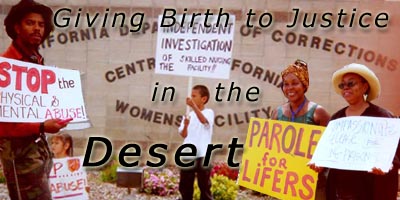
"The Warden is not here, no one is in charge today!", the security guard barked at the protesters who gathered at the gate of the Skilled Nursing Facility of Central California Women Facility in Chowchilla (CCWF) CA. armed with a list of demands as follows:

*Stop the lockdown of women in the Skilled Nursing Facility (SNF)

*Compassionate release for dying prisoners

*Independent investigation of the Skilled Nursing Facility at CCWF

On April 27th, 2002 over seventy-five former prisoners, family members and advocates from around the state gathered at the gates of Central California WomenÌs Facility in the town of Chowchilla to protest the health care crisis and deaths of women prisoners. The town of Chowchilla is part of Merdera County in central California, north of Fresno. Chowchilla current population is 5,930 according to the 1990 US Census and the land is 10.3 sq. mile. The origin of Chowchilla comes from the nearby Chowchilla River named for the Chauciles Indian tribe that once lived on its banks.

However the quiet rural desert with its calm river has became home for one of the biggest correctional nursing facility for women in the nation. One of the activists told the crowd that CCWF was built in 1990 and is known to be the place where that state routinely sends seriously ill women inmates because it operates a hospice and skilled nursing facility. If CCWF is known for its skilled nursing expertise, then why over fifty prison activists, family members, grassroots organizations and media carpooled to this facility? The reasons are well known to prison activists, inmateÌs families, California Prison Focus, California Women Prisoners and Families with a Future who with others organized the rally at the gates of CCFW.

Karen Shain of Legal Services for Prisoners with Children Organization in collaboration with prison activists and family members of inmates helped put the spotlight on the physical and sexual assaults against women at CCWF plus the denial of medical care that have lead to 17 deaths in the last year. Matter-of-fact two years ago the high death rate at Chowchilla reached the attention of Los Angeles Times.

According to A December 20th 2000 article in the LA Times, there have been 15 death in the year 2000, 9 in 1999 and 10 in 1998. Almost two years after the state corrections official investigation of repeated deaths at Chowchilla and a federal class-action lawsuit over shoddy health care, the death toll keeps on rising.

Ida McCray-Robinson, a formerly incarcerated poet, mother and organizer also Founder of Families with a Future shared with the crowd that17 women died in CCWF last year alone. Ida pumped up the rally as she told how she used to feel hearing protesters outside when she was incarcerated. ÏMake them hear you! We love you, we love you! we shout under IdaÌs commands. Speakers who represented a coalition of organizations, i.e. Critical Resistance, Out of Control, Legal Services for Prisoners with Children, California Coalition for Women Prisoners, California Prison Focus, Queers United to Fight Israeli Terrorism, Prison Moratorium Project, Death Penalty Focus Amnesty International and Disability Advocates of Minorities Organization and community activists
took the mike to talk about what was going on inside.

As I marched with 50 to 75 other protesters young and my elders, my blood was boiling from the stories that were spoken about the way my disabled and terminally ill sisters are treated inside CCWF. For example one organizer talked about the death of a quadriplegic inmate because nobody responded to her medical emergency but the guards rescued a burning microwave in record time. After an hour or so marching and listening to speakers, a handful of activists decided to take our list of demands to the Warden. As we approached the gate, three security guards, one of them was a women, communicated to us through their body language which read clearly as Total Confusion.

After we asked for the second in command because the Warden wasnÌt in, the guards looked at each other and replied that nobody was in charge today! At that moment a common thought breezed into our heads and flew out of our mouths in a chorus, Ïwell if nobody is in charged the women prisoners should come home with us. We realized that we were talking to a wall with human like features so we decided to continue our rally outside the gate. The beloved activist,Yuri Kochiyama rolled her walker up to the mike and gave herstory about the racist, sexist and classiest prison industrial complex that is becoming homes for our diverse society. As cars started to pull off, I received some more history of Chowchilla. Come to find out the town of Chowchilla is mainly comprised of low-income Latinos and the push for CCWF in this area was a political move to one separate families from their love ones and to provide jobs in Chowchilla.

As the car turned onto the highway to the Bay area, I saw three more prisons all for women. Our mothers, sisters, mothers and grandmothers are joining forces with spirits of our ancestors, goddess, Mother Earth and Mother Nature to give birth to JUSTICE in the desert. I wonder would our Native American ancestors would agree on how the land and women are being treated? I don't think so!

For more information call California Coalition for Women Prisoners at (415) 255-7036 x4 or visit their website; www.womenprissoners.org
The Coalition meets on the first Wednesday of every month at 7pm at 100 McAllister St., 3rd Floor in San Francisco.

You can also order their quarterly newsletter, The Fire Inside: Caring
Collectively for Women Prisoners. The Future issue of Fire Inside will look at the Americans with Disabilities Act & work regulation with a special focus on disabled prisoners.

Birth at Chowchilla

(For my sisters in the Skilled Nursing Facility at Central California Women Facility)


She gave birth

he is sleeping

while she struggles in his world

She gives him everything

he serves her a pink slip & an eviction

greed breaks up kinship

Men in Black & Blue

takes her away

a man in a Black rob

takes the verdict from the juror

who resembles her son, ex-boyfriend & father

the muscle-bound bailiff handcuffs her


I gave birth to all of you!

Without me thereÌs no you!

She finds sisterhood in prison

but his hands continues the abuse

from the GovernorÌs mansion

to skilled nursing facilities

men with no compassion

forgot who gave birth to them

He takes advantage of his authority

she used to breast feed him

now he force his seed in her

her blood is on his hands

can’t understand

why he canÌt make love to his wife or kiss his daughter

Umbilical cord tightens around the world

tossing & turning in his sleep

waking in a pool of sweet

screams echoing in his head

body covered with black buries, behind a black veil & black cell bars

Riding in a black Hurst to be buried in a black hole

Voices ring out

from Chowchilla

to Palestine

Grandmothers, mothers,

Sisters and daughters

join forces with

spirits of her Ancestors,

Goddess, Mother Earth & Mother Nature

to give birth to JUSTICE in the desert

By Leroy F. Moore Jr.

Tags

The Inquistion #2 or.... The Organization on Welfare

09/24/2021 - 11:22 by Anonymous (not verified)
Original Author
root
Original Body

*POOR staff continues to ask PIC/DHS the question, When will we get our reimbursements?

*The Youth Commission approves a resolution to support POOR Magazine's JOBS program

by Lisa Gray-Garcia and Connie Lu

"What will the very low-income participants do without their wages?"

"They'll be ok - they're still on welfare...?"

I didn't respond...I just looked up.. too tired to fight..to tired to resist this newest barage of accusations, assumptions, and requirements, "NO, I wanted to say "they " will not be ok, "they", like "us", are in fact trying to get off of welfare through POOR Magazine's innovative job creation program which pays folks a living wage to learn how to be journalists and multi-media artists, and due to the wages "they" have gotten so far "They" are no longer eligible for their cash grants and "we" are unable to pay "them" any more wages. But I said nothing. I just looked up and sighed, a new kind of weary entering my bones, a new kind of loss and confusion about our non-profit organizations' dilemma of recieving funding from the very system which continues to de-value everything we and our participants are attempting to do.

Today's meeting heretofore known as The Inquisition #2 began earlier that day with me and Scott, zen-admin volunteer at POOR, compiling and collating a massive set of documents which followed a memo from the Private Industry Council. Most of these documents were things we had already reviewed and submitted to PIC/DHS in The inquisition #1, a four hour meeting after which PIC/DHS reneged on their agreement to reimburse wages already paid by POOR for folks in the JOBS in the Media welfare to work internship and training program at POOR, we were aware that this whole process was probably futile and PIC would manage to find another excuse not to reimburse us or the interns, but nonethless we complied and collated.

At 2:20 a small crew of POOR staffers transported a one foot pile of paper to the offices of PIC and DHS, we were accompanied by Osha Neuman, civil rights attorney from Community Defense INC on behalf of POOR Magazine.

The meeting room was small, bursting at its stucco seams with the human overload of 7 people- San Francisco Deputy City Attorney, two representatives from The Private Industry Council (PIC) and one from the Department of Human Services (DHS) . We began right away after a cursory attempt at polite introductions. This Inquisition wasn't nearly as long as #1 and there were a few less redundant moments. We went over the "pile" and tried to re-explain a few of the same issues. We presented all of the proper documents, and then the perennial "outside of the box" question was brought up by PIC, "So what exactly do your interns do, we are questioning whether they were really working?"

I began to explain for the 20th time that the interns all did a creative variation of journalism, multi-media and creative writing production, but that wasn't enough, "if they don't come in to an office, sign in, and sit at a desk - how do we know if they are they really working?" They pressed on.

Dee Gray from POOR began to explain the different nature of the internships themselves, how POOR tried to tailor the internships and their work duties to the specific abilities and interests of the interns. Osha added that the duties are in fact "outside of the box" I continued that in the case of the journalism interns, the whole nature of journalism itself is not about sitting at a desk but in fact is done mostly out on the field, at the event, or at a computer finishing a story, ending with my statement, "let's define Staff Writer,(the job that is listed on PICS contract with POOR)

This kind of futile re-explaining continued for another hour until it was 5:00. After the blase' statement by PIC/DHS about how the very low-income participants were "all ok" cause they were on welfare, we asked them the same question we have been asking for the last three weeks, " This is an extreme hardship for our small organization and the participants in the program, " When will you reimburse us for the wages we already paid?"

"I can't say for sure.."

As of this publishing POOR
Magazine has still not received reimbursement from DHS and PIC for the
wages paid to the students in POOR's JOBS in the Media Welfare to Work
program, and yet, they will continue to speak, write and educate about
issues of poverty and racism as long as there is breath left in their
collective lungs...If you want to urge PIC/DHS to reimburse POOR's wages please call Pamela Calloway at PIC (415) 431-8700

Youth Commission Supports POOR

By Connie Lu/PoorNewsNetwork Media Intern

I am a few blocks from the San Francisco Youth
Commission at City Hall, but its colossal dome shaped
roof adorned with gold trim can already be seen from a
distance, as it sparkles against the fresh blue sky.
As I enter the commission hearing room I notice that
there are several lights hanging from the ceiling's outer edge that look
like delicately illuminated white tulips. The
ethnically diverse representatives of the Youth
Commission are seated in the front of the room in a
semi-circle, as they address the various issues of todays
agenda.

After several topics are discussed, the resolution
urging the Department of Human Services (DHS) and the
Private Industry Council (PIC) to maintain and
continue the funding of the JOBS in the Media Program
at POOR Magazine is introduced. The Youth Commission
is given information about the situation that POOR is
facing. The JOBS Program is a paid internship that
gives houseless and low-income people the opportunity
to gain writing and multi-media skills. DHS and PIC
are currently withholding desperately needed funding
from POOR due to trivial discrepancies in the
difference between class time and work hours completed
by the interns in the JOBS Program.

The Youth Commission then opens this topic to public
comment. The members of POOR Magazine approach the
microphone. As I rise out of my seat, I take a deep
breath in an attempt to somehow release the fluttering
anxiety in my beating heart. I had not planned on
speaking before the Youth Commission, but Isabel
Estrada, a Youth in the Media Intern at POOR, was
there to encourage me to represent POOR Magazine,
despite my fear of public speaking.

I move up to a seat in the front row and wait for my
turn at the podium. As I look over my notes, I am
unable to sit still. Suddenly, I realize that I am
next. Before I begin, I swallow the tight knot in my
throat. I feel like a nervous bottle of shaken
champagne with a cork that was inhibiting the use of
my vocal chords. As my mouth opens to speak, I could
hear and feel my voice wavering with the first few
sentences that were rushed through. However, I remind
myself to slow down. I force my eyes to look up from
my notes to the faces that were no longer intimidating
to me, as I finished speaking.

After the last public comment is made, several of the
representatives of the Youth Commission raise their
hands in favor of the resolution to urge DHS and PIC
to fund POOR Magazine, which will result in DHS and
PIC receiving a copy of the resolution. This matter
will also be brought to the attention of the Mayor of
San Francisco and the Board of Supervisors because the
Youth Commission are their advisors.

As I leave City Hall, I take another deep breath, only
this time it was a breath of relief. But at the same
time, I was also relieved that I was able to defeat
and break the tenacious grip of fear upon voicing my
support for POOR. I know that my brief comment to the
Youth Commission will not solve this entire difficult
matter, but I feel that through this experience I am
learning to strengthen voice.

Connie is a student in the New Journalism/Media Studies Program at POOR where she is learning how to speak her voice.

Tags

The Resistance Poems....

09/24/2021 - 11:22 by Anonymous (not verified)
Original Author
root
Original Body

The Po’ Poets Project of POOR Magazine created the Annual Resistance Awards Ceremony and Word Project to honor and give respect to 17 adults,elders, youths and ancestors for their struggle, resistance, and survival through poverty and racism.

by Staff Writer

Each Po' Poet, "Resistors" in their own right, began the process of "writing" the award tributes in OUR weekly workshops at POOR. Each Poet chose an adult, elder, youth or ancestor that WE believed deserved OUR honor through WORDS and visual art.

As poor folks who have barely managed to Make it through OUR lives, the Po' Poets believe that the "Word" is healing and that one of the ways for all of us to survive is to use words and images to honor our collective struggle through life itself.

To get a copy of the Book Resistance published by POOR Press - $10.00 you can call poor at (415) 863-6306 or email;tiny@poormagazine.org

Tags

Undrtker,Angle, & Hogan

09/24/2021 - 11:22 by Anonymous (not verified)
Original Author
root
Original Body

Where one compares
the WWF/WWO with politics and
Pol's singular.

This is why following Pol
stuff causes me pain on the membrane.

by Joe B.

Recently I read in
The Independent, a free newspaper about the Newsom "Care Not Cash" initiative soon be submitted to the Department of Elections.

He has the petition sighed by 20,000 citizen’s seeing houseless folks all over the Castro, Noe Valley, West of Twin Peaks, and West Portal.

All they see is homeless people on the streets. Funny with all the financial upheaval from Enron, World Com, or other business related turmoil they believe houseless folk are the problem.

I guess that stuff is too big but homeless people is something they can deal with.

These people use to live in those same neighborhoods but once evicted, rent hiked skyward.

Those voting for the charming, fair-haired, fresh faced, glittery, glint eyed Gavin will themselves be next as speculation and property value soar.

See how he frames houseless people, notice they are first people of color, its not a new face of homeless folk but a widening chasm of the poor.

Whether we're white, red, brown, black, or yellow its economic disregard for those not making enough bucks to be care for or about.

Like Newsom, the signee’s don’t see working poor with families struggling, elderly being removed from their living spaces, women with families with sub or minimum wage jobs falling behind.

Instead they are blinded by a quick negative photo conveying contempt masking the real problems like better choices in jobs, up graded training, higher education, and most importantly housing.

Its has always been housing and jobs not drugs, housing and careers not sleeping in public, housing not panhandling.

Taking people’s checks because you believe most of the homeless spend it on drugs is the arrogance of ignorance and blindly thinking all poor folks are the same.

If they were you wouldn’t see ‘em reading, carrying books from libraries or because they’re in school, or have work in other professions other than what can be seen.

We’re not monolithic people in thoughts, deeds, ideas, or ideologies.

You know what I use to spend my General Assistance checks on?

Sometimes it was books on fiction, history, biography, movies, and regular feminine companionship (monogamous) safe sex if you want to know.

Besides looking for jobs too and I’m not the only one but does Newsome and others care or know that – No, they want to control what houseless do with their own money.

When you control someone’s personal economics you can dictate whatever terms you want.
"First take their money then place them in SRO’s (Single Room Occupancy) now Newsom doesn’t think SRO’s are appropriate either.

Dangling someone else’s money to do your bidding is.

Is this guys smiling face is only a mask is he really that serious that he’s willing to cause more "accidental" deaths by turning homeless folk into pariah’s so even if they do find ways out of their mess they’ll still have to fight a negative stigma.

This guy is so Oily wet slick that he makes Willie Brown seem fair and honest by comparison.

I think of Dan White, another squeeky clean up standing though working class guy and when he didn’t get his way after quitting his supervisor job; we all know the tragic end to that
Mayor Moscone and Sup. Harvey Milk Assassinated in City Hall.

Just as Tom Ammiano San Francisco Supervisor is American as anyone else with tons more of experience in life and politics knows that the hidden agenda can help or hinder pol’s and its best to lay the cards on the table and be done with games.

Are all of Newsom’s cards on the table or is he hiding more slight of hand tricks with extra cards to play?

I get an ominous feeling that blood will flow again only it won’t be seen in City Hall but all over from working poor and houseless people.

I could be wrong but just in case Mr. G. and his handler’s or backers backgrounds should be check on thoroughly.

Lets find this candidates skeletons, and inform the public if he won’t … Bye.


HouseCare-Pro Price range:
$25 per day or 100 a week for
1 bdrm. Apt, small House.
4 to 3 bedrooms, $50 to $100 a week,
$5,000 a week for 20 to 40 rm. Homes.
$25,000 by the week or $100,000 for
50 to 100 rm Mansions
Prices are negotiable.
Non drinker, smoker, drugs (unless its aspirin & vitamins)
Not a party animal, Boredom, works me.

For Joe only my snail mail:
PO Box 1230 #645
Market St. San Francisco, CA 94102
Email: askjoe@poormagazine.org

Tags