Story Archives

Doe Fund. Real or Hype?

09/24/2021 - 11:22 by Anonymous (not verified)
Original Author
root
Original Body

If working at minimum wage
job(s), permanent housing
and Church is so great.

How come we didn't we hear
word about it until now?

Did lots of Corps. make big bucks
while paying formelly homeless
worker's (sub)minimum wages?

by Joe B.

As for Sup. Newcom and his 28 or less points "to help homeless folk" with the "Ready, Willing, And Able" Program adopted from Apple City.

Deciding to webcheck [light virtual research or investigation] the Doe Fund Side [www.doe.org]
readers should also see it also.

The Doe Fund Founder and President is Mr. George McDonald had his Ready, Willing, And Able more than 15 years ago as the homeless crisis loomed large.

He said his Catholic upbringing and education made hime not ignore the problem.

The nuns had taught him "that other people's miseries are your miseries," and that those with gifts and advantages have an obligation to help others who do not. So far it reads well.

Some of this was gleaned directly off Doe's Webside. George decided to run for Congress on a platform of ending homelessness.

A testament to growing public concern about homelessness and his keen political sense, he achieved 40 percent of the popular vote in the democratic primary and the endorsement of three major New York

City newspapers, all with a campaign fund of only $7,000. [off site.] I'm skipping lots of this wholesome tale.

Soon Mr. McDonald is underground in New York's Grand Central Station talking, listening to homeless people and comes up with his plan:

To Prove formally Homeless people even with minimum wage could live a "viable" existance his aim: disprove minimum wage work is not a dead end. [I've been here before]

It may not be a dead end but it sure helps to have other options instead of steady state-non upwardly mobile working skills. He fight SRO [single room occupancy/only] into luxury housing.

One such placed is turned over to non-profit for permanent housing. That's the problem being lock-in to such a system.

We continue.

In 1985 a homeless woman known only as "Mama" dies on Christmas making McDonald work harder on what would become the Doe Foundation, named after "Mama" and all the anonymous men and women who've died on the streets New York.

,Other people trying to help saw simular situations happen and are helpless to stop people from homicide, suicide, or other kinds of death.

Founded on January 2, 1990 the first 45 trainees began in the Doe Training Program.

The program mirrored what society would ultimately expect of those who graduated. Trainees relinquished welfare benefits in favor of$5.50 per hour in wages, paid $65 per week toward their room
and board, and put $30 per week in savings accounts. In return, they slept in comfortable beds insemi-private rooms, and ate healthy, hearty meals prepared by trainees who expressed interest in food
preparation as a possible career.
12-step meetings, life skills classes, and certified teachers to help those who needed them earn high school equivalency diplomas or, in some cases, to learn to read and write.

What George McDonald had known all along proved powerfully true: "Work works." By 1994, 90 formerly homeless and drug-addicted men had entered the legitimate workforce. They were staying clean, doing their jobs
diligently and well, paying rent, saving money, repairing relationships and forging new ones and looking to the future. [From off the Webside]

Most of the above give a positive spin to people struggling to survive and given a chance a few will however.
1. $5.50 per hour in wages.
2. $65 per week toward their room and board.

3. $30 per week in savings accounts.

Number 3 is the beginning of good things. And who can deny nutricious food and training for those in clined but George McDonald's "Work Work's" is a cruel irony because work without access to higher skills, education, while sweeping streets, doing low wage maintenance jobs all over the city create wage slaves. Yes its a start but don't let this so called successful program stay at the same level, suppose to improve, grow, and with people with every kind of skill available [most homeless are not drug addicted, alcoholics, or mentally ill that's what most of the population continue failing to see.

It looks like if Mr. George McDonald's not making money off the backs of the poor many of the city's or other corporations are getting near free labor yet again in guise of "help the homeless help themselves" And going to the Church of St. Agnes is a nice touch since anyone who does not is deemed as someone "who may not work out.

What I want to know is after a decade can other graduates that made it through this R.W.A.A. programs thoughts on this and anyone formelly on the streets can say about this this New York Program since its moving to San Francisco and other cities.

I'll probably hear glowing reports. [yeah, right]

So reader's in the
New York or from other cities tell me the low down and if you don't tell please spread what you know to everyone about R.W.A.A. Bye.

As a House-Care Watcher Professional or[H.C.W.P.]

I'm a non drug user, smoker, drinker, pill popper - drug test me anytime. Light vacuum, no windows or laundry.

Pets have their routine - make a list of walking times, foods, and
moods.
Prices: $25 a day apartments/flats

$50 a week for 2 to 4 bedroom cottage.

$2000, or $3,000 a month depending on home not area.


$50,000 to $100,000 monthly for homes with 7to10 rooms


INFORM FRIENDS, NEIGHBORS, POLICE; IN FACT
INVITE THEM PERSONALLY TO SEE ME, ASK QUESTIONS
THEN NO MISUNDERSTANDING, MISHAPS OR ACCIDENTS
OF IDENTITY CAN HAPPEN.

Tags

Newsome Tries Cloning NYC TO S.F.C.

09/24/2021 - 11:22 by Anonymous (not verified)
Original Author
root
Original Body

Just because New York "imagines"
its solved the homeless problem
don't mean it has.

Hidden, in jail or underground
invisible means that the unseen
homeless has not been solved,
it just looks like it.

by Joe B.

Sup. Gavin Newsom tries his hand at cloning but the original may be flawed.

I wonder if He's thought about rasing the minimum wage maching the "Cost Of Living" index or more advanced training for people who want more than to be in low wage dead-end jobs, or that former Mayor "G"s clean city has a few holes and is possibly that the NYC model can improved upon - because cloning a program from somewhere else may not work the same the exact same way.

I'd really, really like to know the difference between Newsome's stumping for votes from anonymous human's on the street, in homes, or in banquets from pandhandlers's selling wares, performing tricks for money in streets, in cafe-restaurants, or in private homes?

Could it be the clean, pressed suit, neat hair, slick delivery, or possibly family connections?

All I want [when my work at POOR's done] is to House Sit or House Care to earn extra dough.

What I do is usually a long list of prices and lots of blah, blah about what I won't do in that capacity.

I say for anyone reading this who'll be choosing the next Mayor in 2003 or 4 please be absolutely sure which face your voting for.

In fact background check all the candidates.

If Mr.Newsom wants finger printing, checking puptents - do the same for his campaign too.

We don't need another crusader who only looks to be doing right but is constantly making deals left, right, and center for more power.

I'd like to go begging and have bags full of money, free food (oh, I forgot a few sponsor's to help grease 'um, I mean ease the the way to higher power)

All I want is to Housesit to earn a few extra dollars on the side.

I guess Newsom too needs an extra job too.

When I go for free meals its mostly on long lines with other folks waiting on the same line.

Can anyone out there tell me which one of us is the begging panhandler? Now below the House Care Ad. Bye.

As a House-Care Watcher Professional or [H.C.W. P.]
I'm a non drug user, smoker, drinker, pill popper - drug test me anytime.

Light vacuum, no windows or laundry.

Pets have their routine - make a list of walking times, foods, and
moods.
Prices: $25 a day apartments/flats

$50 a week for 2 to 4 bedroom cottage.

$2000, or $3,000 a month depending on home not area.


$50,000 to $100,000 monthly for homes with 7to10 rooms


INFORM FRIENDS, NEIGHBORS, POLICE; IN FACT
INVITE THEM PERSONALLY TO SEE ME, ASK QUESTIONS
THEN NO MISUNDERSTANDING, MISHAPS OR ACCIDENTS
OF IDENTITY CAN HAPPEN.

Tags

24 hr. Warning...To be Continued.

09/24/2021 - 11:22 by Anonymous (not verified)
Original Author
root
Original Body

by TJ Johnston and PNN Staff

It didn’t exactly surprise fellow POOR Magazine supportive reporter, Laurie McElroy, or me when the Board of Supervisors once again put off deciding on important legislation: to have Department of Public Works give 24 hours notice before removing a person’s belongings. This legislation has a serious impact on the lives of San Francisco’s homeless citizens.

But before we could set foot on City Hall to view this legislative inertia, the building was evacuated because of a bomb scare, putting the regularly scheduled meeting on hold for about one half-hour.

In the interim, we strategized on street-level lobbying to get the DPW to place 24-hour tags on a person’s stuff. We even rehearsed a reworded Rolling Stones classic: “I Can’t Get No Notice Action” (we never got the chance to sing it). Then the bomb squad determined the infernal device to be a dud in this latest development of the five-year effort by several economic justice organizations, including the Coalition on Homelessness (COH).

The proposal cites, above all, the need to protect the homeless, a population historically at the short end of the stick. Kathleen Gray, a homeless woman and COH member, sees current practices as a catch-22. “When you have systems which gives people blankets and medicines, then turn around and take them away, (it) is not only wasteful of resources, it is also very debilitating.”

Gray emphasizes, “This legislation is about permitting people to own things, to accumulate things, to go beyond collecting bottles in a cart, to have some nice clothes to enable them to work a job.” Currently, this civil right (not to mention one’s possessions) is at risk.

“That right is self-empowering,” continues Gray, “and those who are self-empowered improve their lives. When their lives are improved, the neighborhood is improved.”

While the Supes listened to Falun Gong advocates, who were there in numbers, we visited the offices of five Board members including Sophie Maxwell and Leland Yee (initially, they supported the 24-hour advance warning, but have since backpedaled). We delivered a letter addressed to each supervisor thanking them “for their continued support” (fully realizing the irony of this phrasing).

Some of us even placed orange stickers of our cause on the doors. At the urging of the COH’s Mara Radar, we removed them immediately. Supervisor Tony Hall of the Rules Committee himself returned one of our stickers. He didn’t seem too pleased about it!

After tabling a resolution condemning Chinese persecution of the Falun Gong and deciding on other measures, the Board eventually kicked our locally based proposal back to the Rules Committee. This hearing is scheduled for Friday, Oct. 18.

In order for the measure to be adopted, six out of eleven Supervisors must vote yes; to override a likely mayoral veto, eight “yea” votes are required. Curiously, this body, one of the most progressive ones this city has seen, has just as much trouble arriving at a decision as previous Boards. After five years, where many have navigated mazes in often-futile efforts to retrieve their possessions, such a decision is long overdue.

(For more about this policy, see “Where’s My Stuff?” by Clive Whistle, on POOR News Network, 7/10/01.)

Tags

Sup. Newsom To Clone N.Y.C.'s (Doe) To S.F.C.

09/24/2021 - 11:22 by Anonymous (not verified)
Original Author
root
Original Body

Acting like Movie Hero/Mad
Scientist Sup. Newsom's has
seen the future.

And it looks like a New York Model
homeless free city.

Please look beyond its glittering surface.

by Joe B.

Sup. Gavin Newsom tries his hand at cloning but the original may be flawed.

I wonder if He's thought about rasing the minimum wage maching the "Cost Of Living" index or more advanced training for people who want more than to be in low wage dead-end jobs, or that former Mayor "Gs" clean city has a few holes and is possibly that the NYC model can improved upon - because cloning a program from somewhere else may not work the same exact same way.

I'd really, really like to know the difference between Newsome's stumping for votes from anonymous human's on the street, in homes, or in banquets from pandhandlers's selling wares, performing tricks for money in streets, in cafe-restaurants, or in private homes?

Could it be the clean, pressed suit, neat hair, slick delivery, or possibly family connections?

All I want [when my work at POOR's done] is to House Sit or House Care to earn extra dough.

What do I do? Its usually a long list of prices and lots of blah, blah about what I won't do in that capacity.

I say for anyone reading this who be choosing the next Mayor in 2003 please be absolutely sure which face your voting for.

In fact background check all the candidates.

If Mr. wants finger printing, and checking puptents do the same for his campaign too.

We don't another crusader who only looks to be doing right but are constantly making deals left, right, and center for more power.

I'd like to go begging and have bags full of money, free food (oh, I forgot a few sponsor's to help grease I mean ease the
the way to higher power) All I want is to Housesit to earn a few extra dollars on the side I guess Newsom too needs and extra job too.

When I go for free meals its mostly on long lines with other folks waiting on the same line.

Can anyone out there tell me which one of us is the begging panhandler? Now below the House Care Ad. Bye.

As a House-Care Watcher Professional or[H.C.W.P.]
I'm a non drug user, smoker, drinker, pill popper - drug test me anytime. Light vacuum, no windows or laundry.

Pets have their routine - make a list of walking times, foods, and
moods.

Prices: $25 a day apartments/flats

$50 a week for 2 to 4 bedroom cottage.

$2000, or $3,000 a month depending on home not area.

$50,000 to $100,000 monthly for homes with 7to10 rooms


INFORM FRIENDS, NEIGHBORS, POLICE; IN FACT
INVITE THEM PERSONALLY TO SEE ME, ASK QUESTIONS
THEN NO MISUNDERSTANDING, MISHAPS OR ACCIDENTS
OF IDENTITY CAN HAPPEN.

Tags

Heads Up For A Series.

09/24/2021 - 11:22 by Anonymous (not verified)
Original Author
root
Original Body

This is just a reminder
of what is to come.

The truism of Don'T Volunteer
makes more sense now.

by Joe B.

Friday, April, 12, 2002. OK, what happened to my writings? PC glitches, human error in saving, or what I don’t know.

Maybe because this might be a multi-part piece I should wait until POOR’s Sunday’s Resistance Awards Dinner is over before beginning this epic or for a certain someone to leave the country?

Either way with business cards, girlfriends, poem practice, money problems and all manner of flux going on

I won’t be able to have time, patience, or mental strength to do the job at hand.

[I’ll visit a friend or two, rest, “get off,” be satiated then deal with this stuff].

Every once in a while a brake is needed, when I'm completely wiped its time to Get.- A - Way before coming back fresh-that’s where I’m at now as I begin feeling time speed-up its up to me to vanish for awhile.

The Title: Restrain Day deals with Domestic Violence and my being a third party to deliver a Restraining Order to one of the two parties on behalf of injured party.

Confusing isn’t it? Being a man, serving another man with restraining orders is not on any list at all of what I wanted to do.

That and other musings is part of my column on this difficult, dangerous, and complex issue.

Tags

'Po Folks Revolution, To join 'Rev Help The 'Poor Get Filthy Rich.

09/24/2021 - 11:22 by Anonymous (not verified)
Original Author
root
Original Body

Imagine if poor
folks in America, and
globally had a few million
or billion bucks even?

More than enough not
to listen to their governments,
pay lawyers, own land, buy homes
and have economic clout.

It would shake up our so
called balance of economic power

possibly forever!

by Joe B.

Poor folks with millions or dollars or more?

Able to cast economic clout to what they deem important (you know minor things) such as housing, education, health technologies, alternatives to incarceration and the death penalty, mental health for those who need it not warehousing.

There's so many simple ways less expensive in the long run than how we do things now.

Problem is most people with more than enough cash
concentrate on more way to take it from already poor folks.

How can poor folks fight back when voting boxes get lost, destroyed, votes not counted or worse discounted
period?

My answer isn't as new as it sounds and isn't radical but it does take time, patience, and strong nerves to pull off what at first seems daunting but will later become easier when practiced over time.

N.A.S.D.A.Q..

(National Association of Securities Dealers Automated Quotations)

Here's a short history of the 'NAS:
( from the nasdaq.com website.)

As the world's largest electronic stock market, Nasdaq® is not
limited to one central trading location.

Rather, trading is executed through Nasdaq's sophisticated computer and telecommunications network, which transmits real-time quote and trade data to more than 1.3 million users in 83 countries.

Without size limitations orgeographical boundaries, Nasdaq's "open architecture" market structure allows a virtually unlimited number of participants to trade in a company's stock.
[

Reader's of my work already know where I'm 'goin with this, for those who don't, stop scratching your heads and keep reading.]

Today, Nasdaq lists the securities of nearly 4,100 of the world's leading companies and each year, continues to help hundreds of companies successfully make the transition to public ownership.

1961 Congress authorizes the Security and Exchange Commission (SEC) to conduct a study of fragmentation in the over-the-counter market.

The SEC proposes automation as a possible solution and charges the NASD with it implementation.

1971 On February 8, Nasdaq begins trading.

1984 Small Order Execution SystemSM (SOESSM) becomes ready for use to execute small orders automatically against the best quotations-making greater volume and efficiency in trading
possible.

1990 SelectNet®, an online screen negotiation and execution service debuts, enhancing opportunities for finding and executing transactions at the best prices at greater volume than allowed by SOES.

1994 Nasdaq surpasses the New York Stock Exchange inannual share volume.

1997 Final phase for implementation of Order Handling Rules.

1998 In conjunction with The Stock Exchange of Hong Kong, Nasdaq announced a partnership to provide investors worldwide with information about their respective markets on a new, joint Internet Web service.

1999 Nasdaq becomes the largest stock market in the U.S. by dollar volume and repeatedly breaks share and dollar volume records.

In June, Nasdaq signed an agreement in Tokyo with Softbank Corporation, jointly capitalizing a new company-Nasdaq JapanSM.

This proved to be the first leg in Nasdaq's global strategy to link Asian markets with European and American markets.

2000 NASD membership votes overwhelmingly to restructure the organization.

The restructuring spins off Nasdaq into a shareholder-owned, for-profit company.

Nasdaq completes the first phase of its restructuring.

Nasdaq formally opened the new MarketSite in the heart of New York's Times Square.


Nasdaq continued to be the engine for capital formation and job creation.

Between 1997 and 2000, it brought 1,649 companies public, and in the process raised $316.5 billion and added hundreds of thousands of jobs to the American economy.

Nasdaq continues to build capacity for the trading volumes of tomorrow, with a capacity to trade 6 billion shares a day, a ten-fold increase since 1997.

2001 SuperMontage SM proposal approved by SEC. Phase II of NASD's private placement is completed.

Whew, I have to again thank the NASDAQ webside webmasters for its information on this fairly new electronic era of Stock Market touted as "The Stock Market for The Next Hundred Years."

Now, what my concept or idea is wealth sharing directly to poor folks and affecting global change.

On the tv, radio, and especially the net for a few years there's been talk about financial freedom short cuts from no money down real estate deals, on-line businesses, selling on-line items on customized websites, or website designing itself and also e-trading.

The latter is my interest because of its potential to change lives instantly.

I know about the guy who after losing most of his wealth in on- line investing goes home, armed with an assortment of semi automatic weapons kills his family then returns to work killing fellow worker's.

This gave insider trading a purple swollen eye for a few months maybe years however I maintain that guy was slighly unhinged before the blood bath to go off on a killing spree.

Poor folks equipped with PC's electronically connected to NASDAQ before in vest could take a free two weeks or montly course, to make sure they know what they are getting into.

A modest goal is making $100 to $500 or more by a day or week.

Next a little more and what they make is there's

To graduate a student invests and makes anywhere from $20, $50, to $100,000 dollars.

This means the student can make money this way and can save too.

Losing money is what most poor folks fear, maybe put in jail for own and not able to pay.

It is possible for this to happen that's why most on-line investors must be emotionally detatched or have a investment limit or if their making lots of if another money making limit and hours when to stop.

With so many pc's being thrown out many can be donated free to the poor for this indepence making program.

The problem is one poor folks get the nack of making money this easy they tend to vanish from view that's why it should be taugh en mass and the ones who still want to help others and use their new found wealth to reopen hospitals, schools, have new foundations, grants, even after they stop giving or die can still be helping others long after they're gone.

Everyone reading this won't believe it possible but as with a virus some people will sucumb end up on drugs, drink, gambling, while others will do more and have families, find tax lawyers, support their parties, and set free PC's for jumpstart-to-riches programs everywhere.

Just because something has not been done does not mean it cannot be tried.

Poor people try hard to feed themselves and their family, we work harder and get less as taxes gobble up what little we make, and yet as the economy worsen's there is no cost-of-living ajustment or its to slow 'n low to matter.

I say lets jumpstart from poverty to at least being comfortable and able to breathe economically with a few 100 thousand to million dollars in new networhs.

The beautiful thing is when people learn a few economic rules and have the means to use high tech for an economic boost the possibilities though not endless is doable.

I think it will take a few self made millionaries or scions wealth to see this as possible. Why not really give poor a chance to jump into wealth?

Unless poor folks with real wealth make so called established wealthy feels threatened with these new million and billionairs.

As for myself I might try and jumpstart my own wealth then see if this can be done a few more times.

Sooner or later this idea has to be implimated, tried, and for the successful there will be struggle to see how well they can survive being in the leisure class where everyday is a struggle not to be bored. Any ideas how this can begin all over our fifty states? ...

As a House-Care Watcher Professional or [H.C.W.P.]

I'm a non drug user, smoker, drinker, pill popper - drug test me anytime. Light vacuum, no windows or laundry.

Pets have their routine - make a list of walking times, foods, and
moods.
Prices: $25 a day apartments/flats

$50 a week for 2 to 4 bedroom cottage.

$2000, or $3,000 a month depending on home not area.


$50,000 to $100,000 monthly for homes with 7to10 rooms


INFORM FRIENDS, NEIGHBORS, POLICE; IN FACT
INVITE THEM PERSONALLY TO SEE ME, ASK QUESTIONS
THEN NO MISUNDERSTANDING, MISHAPS OR ACCIDENTS
OF IDENTITY CAN HAPPEN.

Tags

Quick 'Splaination. This is a not a column.

09/24/2021 - 11:22 by Anonymous (not verified)
Original Author
root
Original Body

"Look, Listen, and Learn"

by Joe B.

In case I have not explained creating Rich Poor Folks, here's one way it can be done.

1)Any hall or large building with 100 or more computers.

2)These banks of machines
electronically connected to
the NASDAQ digital speed is even to New York, Hong Kong and other excahages globally.

3) Person's participation in program must leave their substance, gambling problems
outside concentrating on lessons to learn.

4) A short history of old and new stock exchange.

5) Type of trades. Good/Bad of those trade cycles.

6) Each person picks what they want to learn how to invest practice before using real money for two weeks or more. mayby less for advanced students.

7)After practice some of their and school's money is put to a small test seeing what students have learned.

8) Graduation is when a students earns from trading
on the market between $100,000 - $500,000 - to 1 million or more.

9) if student has housing they'll be able to have checks come to them or P.O. Box.

10) If no housing a student may now have the means to live in a regular apartment complex or place down payment on a house while "working the market.

11)To help students keep eanings, appointments are set for a bank of their choosing for interest bi, tri, or quaterly baring account that can be mailed to them at regular interval insuring no problems as they continue to earn money.

12) If some fall back into the same old habits other people or former students can help and if this fails too. Backsliding
does happens.

13) But for strong individuals who triumph over addictioins or non drink, drug, gamblers, their lives will be changed drastically.
Surving success will be their on going test of will.

That's it and if anyone who's has done this without any program as this has really economically chaged their dire circumstances - I'd like to hear from them on how and why they did it and what pit falls they fell into or avoided. That's It - That's All... Bye.

Tags

I Could Hear The Gritos

09/24/2021 - 11:22 by Anonymous (not verified)
Original Author
root
Original Body

PNN staff writer attends a protest for five Latino families facing housing discrimination in the Mission.

by Aldo Arturo Della Maggiora


I could hear the gritos, (screams)….

vecinos unidos; jamas sera’n vencidos.

Aqui estamos y no nos vamos!

?Que Queremos?

!Viviendas Dignas!

Cuando?.

Ahora!….

Hard sidewalks, leafs blowing cold, old cars parked in the Mission neighborhood. As I walked towards the building where five Latino families were being discriminated against, I reminisced on the time when my landlord violated my rights. He entered my unit while I was housing a friend who had been a victim of eviction for unjust rental policies. My request for maintenance put my tenancy in jeopardy. I ended up having to move out and live in different homes until I could "reestablish" my housing situation. What hit me the hardest during my experience was that I did not have a voice. The power of voice is a privilege, and the access to media to voice issues is necessary in the 21 century!

On Tuesday, January 15, 2002 .,I attended a rally and press conference ,sponsored by five primarily mono-lingual Latino families who were tenants of 2389 Folsom Street and their advocates, St. Peter’s Housing Committee who were protesting the conditions of their building and the mistreatment by their landlord .

Most of the tenants were present, many people walking by stayed to support the protest, and cars honked in support. The cold air hit my face, I began my interview in my second language, Spanish. " Hola me llamo Aldo Arturo y trabajo para la revista de los Pobres ayudando gente de todas las comunidades . ¿Puedes explicar que esta pasando aqui?" "Tenemos muchos problemas en el apartamento, de que el dueno , siempre que lo queremos hablar nunca nos escucha. El Sabado vino muy aggressivo, boracho y golpeando todas las purtas, y no sabiamos por que el motivio que vino asi aggressivo. Y queremos que nos escuche," said Francisca Sanchez.

Tenants made several complaints to the landlords, Maurine and John O’Neill. They sent a letter complaining about the new rental agreement that jeopardized the tenants’ occupancy, putting them at risk of eviction and misleading the tenants into believing that they only had one day to sign the new agreement in case of a "fire". The letter protests the signing of the new rental agreements. This letter also opposed the landlords eliminating the five-day grace period, insisting that the tenants pay their rent on the first of each month before 4:00 p.m. Eleven tenants signed this letter.

What happens to the tenants who have to pay the rent on the fifth of the month due to getting their salary late? According to the new landlords policy, a $50.00 late fee is charged for late rent.

Maintenance and repair concerns continue to be a problem. All units at 2389 Folsom St. lack repairs from sink leaks, bathroom leaks, humidity, poor ventilation, worn down carpets, linoleum, broken fire alarms, etc.

According to the California Civil Code Section 1941.1 (Warranty of Habitability) and the San Francisco Municipal Code, the O’Neill’s are responsible for taking care of the damages in the units at 2389 Folsom St. If the tenants’ claims are not met after thirty days, the tenants could call the Code Enforcement Outreach Program. In addition to this, California Civil Code Section 1942.5 prohibits the landlords from striking back against the tenants for exercising their legal right to request repairs.

On November 27, 2001 the O’Neill’s received a notice of violation from the Department of Building Inspection Housing Inspection Services (City and County of San Francisco complaint # 200122994). In the notice the O’Neill’s were ordered to abide with the request of the tenants and asked to call Andrew Kares, Housing Inspector, at 415 558-6465 to inspect the apartment complex.

"What are some of the issues that are going to be addressed today?" I asked. Lauren Porter, of the St. Peter’s Housing Committee, replied, "The landlords’ blatant disrespect for the rights of the tenants. We just want the tenants to have opportunity to be heard on these issues and to get some response because they have been working since last August to try and get these repairs taken care of, and up until now nothing has been done."

The rally began and several tenants voiced experiences they have faced. I approached a young man named David, "What is your point of view on what has happened here?" David said that his friend, Hector, has resided at 2389 Folsom St. his whole life. They complained to the landlord about the conditions of the apartment, but no action had been taken to maintain safe, livable conditions in the apartment. I asked a tenant, Juvenal Alcantar, what the problem was with his apartment. "Los problemas con el apartamento es que no quire arreglarlos . ¿Y con tu apartmento? Pues el plomeria."

Another person spoke loudly into the megaphone. "The bathrooms have leaks and the landlords has ignored our request for maintenance. This is why we have united and nobody will be alone, everyone will unite, so that we can triumph." Many residents have taken a day off from work and school to attend this public meeting. One tenant, Juan Garcia, complained that the landlord did not want to hear their complaints and wanted to charge the tenants $50.00 for not paying rent on the first of the month.

I approached Lupe Arreola from St.Peter’s Housing Committee and asked her who could be contacted to deal with the lead poisoning and asthma which pose serious health issues for the tenants. She told me that the Department of Health and Building Inspections would deal with the health issues.

Another issue that was important to me was the discrimination the tenants might face because the O’Neill’s refused to meet with the tenants because they could not speak English. I tracked this issue by talking to Lupe. She pointed out that this issue could be pursued by contacting those from the Human Rights Advocate.

As a POOR Magazine advocate (we don’t just "report – we support), I called and left a message for Housing Inspector Andrew Kares to see if the O’Neill’s had addressed the concerns of the tenants. Although I have not yet received a response from Andrew Kares, Clarie Flahive, a counselor and organizer for St. Peter’s Housing Committee, revealed to me that since the press conference the O’Neill’s have begun some of the repairs at 2389 Folsom St. As I mentioned before, I wish I had knowledge of a support group that could inform me about my rights, such as the Civil and Municipal Codes that protect tenants from landlords that harass and discriminate against them.

Tags

The Life and Times of a Beggarman Troll

09/24/2021 - 11:22 by Anonymous (not verified)
Original Author
root
Original Body

by by Josh Brandon

I live under a San Francisco bridge and panhandle to survive. It’s a hard
life -- one that I did not choose, nor want to continue.

As a longtime San Franciscan I have lived in housing ranging from a
Haight-Ashbury flat to a Tenderloin residential hotel. I have earned my
living here by working for a community newspaper, a non-profit agency,
and for San Francisco’s Department of Public Health.

My only immediate family are two Siamese cats, Dungee and TL, and a wide
circle of friends.

Contrary to the recent sensational headlines in our daily newspapers, I did
not wake up one morning and decide that my life would be better if I simply
camped beneath a bridge and asked people for change.

I did, however, wake up one morning, go to work for the Health Department
as a homeless death researcher (as I had for nearly three years), and was
told I was laid off. The last thing my supervisor told me as I cleaned out
my desk was that perhaps I could get on SSI -- a Federal income security
program for disabled people.

The bone in my right hip is dying from lack of circulation, which restricts
my mobility. Since I have lived on the streets, my hip condition has
worsened with severe arthritis. As a result, I now use a cane to go with my
pronounced limp.

My meager unemployment benefits barely covered my rent, and when they ran
out I tapped into my pension to keep my housing. Soon, faced with dwindling
resources and a tight job market, I had no other option but to move.

It was an inevitable situation. No income usually makes for grumpy
landlords, and mine was no different. My choices were now as slim as my
wallet.

Going to a shelter came with many problems. For one, shelter space was as
rare as warmth in Mayor Brown's heart. People are routinely turned away, or
compete with one another in a Dickensian lottery where the WINNER gets to
sleep in a chair or on the floor. By the time one lottery is over for one
shelter, the others are closed, or too far away. And there’s no guarantee of
space, either, once you do get to the next one.

To make matters worse, most shelters kick people out at 6 am and then ban
them from returning until they reopen for the following night.

But the biggest problem is that shelters are a dead end if you really want
to leave the streets. Too few people ever enter a shelter and later leave
with a key to their own room or apartment. As rare as the shelter spaces
are, affordable housing here is even more rare, with even longer waiting
lists and even more people competing in housing lotteries for housing
vouchers.

I couldn’t carry all my possessions on my back or in a cart all day long,
not while using a cane and with my two cats to care for as well. So I gimped
over and through San Francisco’s many bridges until I found one with a nook
and cranny away from public view -- a place where I could set up a permanent
camp where I could keep my clothes and food… and my cats.

Once I settled in, I had to earn money, which I have done since I held my
first job picking blueberries when I was five years old. Although I had
papered businesses and non-profits with job applications, I still needed to
eat, to buy my medications, to keep my clothes clean, and to feed my cats.

By that time two other homeless people had moved in nearby, and they had
money they earned everyday -- enough for them to eat well and take care
of their daily needs. They were panhandlers, and they laughed when I told
them I could never do that. I am a child of the fifties, when being a beggar
was as loathsome as being a politician or lawyer today.

But they became my mentors.

They explained that they panhandled differently than most people, and they
did it by using two cardinal rules: They never asked for change and they
were always polite to the people who passed by -- even if they swore at you,
or called you names, or vented all the fears and frustrations and anger from
their own lives at the one group of people who could do nothing in return.

The first day I panhandled was, and continues to be, a hardship. Panhandling
is one of the most difficult jobs I have ever had.

I have a morning shift across from Pac Bell on Third Street between Folsom
and Harrison Streets. I wake up at 5:30 am, feed my cats, gather my gear,
and get cleaned up at a nearby drop-in center or the bus station. By 7:30
am, I am at my spot.

In order to panhandle, I have to psychologically convince myself that I am
not begging. I know that I am not the village drunk or the village idiot,
but when I am working I do become the village greeter. I never ask the
people who pass by for anything, but simply say, "Good morning, Sir (or
Ma’am)," and smile. I never sit down, so I can look them directly in the eye
with as much pride and confidence as I can pull up from deep inside.

By 10 am the sidewalks are nearly empty, so I take a break and read the
newspaper over a cup of coffee. If I need to, I go to St. Anthony’s for a
meal, then head for my afternoon shift.

I go to a fire hydrant between the Museum of Modern Art and one of the
luxury hotels. Here I work, sometimes for several hours, never sitting down,
greeting people, and trying to make the best lemonade I can from the worst
tasting lemons.

By the end of the day, after four or five hours of standing stationary on
cold concrete, I can usually make anywhere from $25-35, roughly minimum
wage. But because I am always at those spots at the same time, I can earn
this amount almost every day. There are worse days, and there are better
days, but both are seldom. I now know several panhandlers; most are happy to
get $15-20 per day and they usually work longer than I do, so I consider
myself fortunate.

I have panhandled during the wettest February and December in San
Francisco’s history, as well as during the hottest July. I have shivered
from the cold so violently that my hands turned blue, my cup shook and
I could not count my money. I have sweated in the sun so much that my clothes were
as damp as if I’d been rained upon. My hip has hurt so much from standing
that I could barely walk back to my camp, and sometimes I had to crawl to
make it up under the bridge.

So when I read our daily newspapers and see the latest media Jihad against
homeless infidels who panhandle and don’t use shelters, I can only shake my
head in disbelief at their arrogant ignorance. Because I am a beggarman
troll, I do not steal, or rob, or become violent. I earn my money, and it
comes at great personal cost. And I earn my privacy away from the public eye
as I quietly, desperately apply for jobs.

But I am still standing on my own two feet… and my cane.

(EDITOR'S NOTE: Josh Brandon was an editor for the now-defunct Tenderloin
Times, and originated the "homeless deaths story" for that publication,
later publishing exclusive articles on that topic under his byline for the
Chronicle and Examiner. He was also my writing coach back when I was still
busy determining whether I wanted to write about homeless deaths, or become
one myself. -- chance martin)

Tags

No Renticide!!!!

09/24/2021 - 11:22 by Anonymous (not verified)
Original Author
root
Original Body

Hundreds of Oakland tenants, advocates and community organizers gathered outside Oakland City Hall

by Fiona Gow/PoorNewsNetwork

Crossing the Bay, from San Francisco to Oakland is always reassuring to me. Oakland has been described as where the real people live, meaning I suppose that it was not hit by the dotcom boom and the turf wars that hit San Francisco. But this is changing. Even though Oakland did not boom with the rest of the Bay Area, it is not immune from the housing crunch, and right now it appears that while Jerry Brown encourages economic development, many renters are finding themselves at the mercy of greedy landlords, many of whom have no qualms about evicting tenants if it means they can double or triple the rents. In Oakland, it is far easier than in other Bay Area cities to evict tenants, as there is no Just Cause protection. In a city where 65 percent of the residents are renters it is unbelievable that they have so few protections. According to community member Rebecca Kaplan, one of the protesters at the January 22 renters’ rights rally I attended, "Under the current law, it is legal for a landlord to tell a young woman that he will evict her if she doesn't sleep with him."

As renter John Barnett knows from his long and arduous battle with his landlord Madison REIT, it takes a great deal of confidence and resources to be able to fight these increases. He, along with 15 other tenants petitioned the Oakland Rent Arbitration Board after their rents were raised by 20-65 percent by a landlord who claimed exemption from Oakland rent control laws. The petitioning process took almost a year, during which time the tenants had to reserve enough money for back rent in case they lost their cases. Tenants pooled their money for an attorney, demonstrating their seriousness and knowledge of current law. Early on Madison REIT had suggested that the tenants negotiate. But, as Barnett said, "There was nothing to negotiate. Either you're exempt or you're not." Madison REIT apparently was not, and rescinded the rent increases.

Cases like Barnett's are becoming more common, though few tenants have the information and finances necessary to challenge their landlords. Renters' rights groups, now more than ever, are making a powerful push to educate renters and to organize them to fight for more protections. Hundreds of such renters' rights groups gathered outside Oakland City Hall on January 22 to stage a protest rally before the City Council Meeting at which a new rent ordinance was to be voted on.

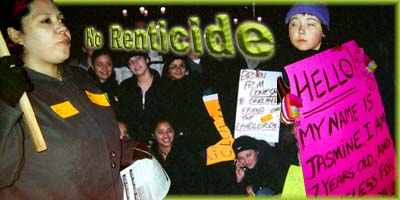
The evening of January 22 was a bone-chilling one, but the mood of the ralliers was generous and excited. A dozen or so high school students from the students' and youths' rights group OLIN brandished signs saying, "Help Jerry Out of Oakland" and "No Renticide", while chanting passionately with the rest of the demonstrators. Also marching was a seven-year-old girl named Jasmine who was there with her mother to demand better living conditions for her family, in particular a sister who was suffering from severe lead poisoning. Many renters told their stories of unfair evictions—Ramona was served with a 30-day notice for renovations that were never done. "He {the landlord} got so tied up in his own lies that the judge dismissed the case," she explained.

John Ryman of the Campaign for Renters' Rights suggested that we all look back at history, to the Oakland General Strike of 1946 that shut down the entire city, "We have to stop this bloodsucking system from functioning." Another speaker, Mr. Basset, sees the new ordinance as perpetuating racism, "You want to keep us as renters, on the plantation. Black people own nothing in this city except for some homes."

After the rally everyone moved inside for the Oakland City Council meeting. The chambers were packed. Over 60 speakers took center stage to give their opinions on the proposed ordinance. The overwhelming majority, of both renters and landlords, asked the council not to pass this ordinance. Many boos and applause rang out in the chambers, as did shouts of "Bloodsucker" and "Bull". Phil Rapier, of Just Cause Oakland, was so passionate in his plea for getting Just Cause protections in place that he eventually was escorted from the floor by guards.

The new ordinance gets rid of the 3 percent cap on rent increases. Instead, rent increases would be calculated from on a formula based on the Consumer Price Index for San Jose and San Francisco, which is the average of the percentage increase in the CPI (all items) and the CPI minus shelter for the twelve months starting on March 1 in each calendar year and ending the following February. Renters are worried that without any cap, the annual allowable rent increases could potentially skyrocket. For the time being though they are better off, since the increase presently would only be about 1.9 percent. Council member Nancy Nadel who opposed the ordinance said, "I would have liked to see a floor and cap of perhaps 1 and five percents, with an overall cap of 12 annually that would include banked rents and any capital improvement pass-throughs."

Section 8 renters, of which there are approximately 20,000 in Oakland have been specifically excluded from rent control protections in this ordinance. This means that after one year of tenancy, Section 8 landlords can raise the rents as high as they want. According to Andrew Wolff of Just Cause Oakland, this is a move to attract landlords to rent to accept Section 8 renters.

Another point of contention is that renters would be forced to pay any rent increase, even while they were petitioning the increase with the Rent Arbitration Board. In the past, such petitions have taken over a year to get heard. If a renter cannot or will not pay the increased rent, they can be evicted. With such a law it is easy to imagine people being evicted simply because they don't have the funds to wait for their case to be heard.

Under the new ordinance, landlords are not penalized for unjust rent increases, though they will be penalized for unjustly evicting someone. Unjust in this case means that the landlord is found to have evicted someone simply so the rent could be increased above the permissible amount. Under this ordinance, landlords are not allowed to evict a tenant and then raise the rent indiscriminately for the new tenant. The new tenant will instead "step into the shoes" of the previous tenant and can only incur the increases in their rent that the old tenant would have incurred. Under the new ordinance, such landlords will be forced to pay the tenant $1000 plus two months' rent. The city will supposedly keep track of a landlord's history of evictions and rent increases, though it is most likely that the onus will be on new tenants to find this out.

According to the new ordinance, landlords will not be required to inform renters about possible recourse for rent increases and evictions through the Rent Arbitration Board unless the renter is affected by an increase or eviction.

Though the criteria for determining which landlords are exempt seems clear, renters claim that there are far too many loopholes in the ordinance for landlords to use if they wish to jack up the rent. Capital improvements as well as banked increases are big ones. There is no place where tenants can go to find out which landlords are or are not exempt from rent control laws. Very few landlords qualify, and yet many renters are faced with situations like Barnett and his fellow tenants, where landlords claim exemption. (There are two ways that a landlord can be exempted from rent control. One way is to own a building that was built after 1983, a law meant to encourage development in Oakland, and the other way is for landlords to invest at least 50 percent of the cost of the building in improvements.)

Another point of contention is the fee used to fund the Rent Arbitration Board. It now costs $24 dollars a year, per rental unit and half of that is paid by the tenant. Organizer Linda Carson fears that the rate will climb, as it did in Berkeley, where the fee is now $150 dollars. However, the new ordinance states that this fee will remain the same through 2003, at which point it will sunset.

There are serious questions about the Rent Arbitration Board itself and how well it is able to fulfill its role. According to renters at the rally, their experience with the Renters Arbitration Board proved abysmal. The Board did not schedule a hearing within 30 days as they are supposed to, neither did they respond to phone calls and other inquiries. The new ordinance is supposed to address these complaints, yet it was not clear how. Their funding at the moment is 1.6 million, an amount which seems preposterously large for a body that is so irresponsible.

Even after all the public comment criticizing the ordinance, council voted to pass it anyway, without much discussion. Council member Nancy Nadel, who voted against the ordinance stated, "I think the ordinance proposed and later passed is a series of band-aids on an originally weak concept. What the city needs and what tenants need is Just Cause for eviction protections." This lack of discussion on such an important issue was reprehensible, considering the council spent an hour discussing a nightclub license before the rent ordinance item was heard.

Spirits among community members and tenants’ rights groups still seemed very strong after the vote though. There was no doubt in people's minds that they would gather the 30,000 signatures needed to get the Just Cause initiative on the November ballot. As Phil Rapier said, "It is clear that the challenge is on us and we have to organize the people in Oakland." Support for Just Cause and greater tenants’ rights can only grow as more and more people are affected by evictions and outrageous rent increases.

Tags