Story Archives

Hearts are Turning to Stone

09/24/2021 - 11:22 by Anonymous (not verified)
Original Author
root
Original Body

by The Coalition on Homelessness

Things are getting bad for homeless people in San Francisco. It is
pouring rain, and since Christmas is gone and past, the powerfuls’
hearts are turning into stone. Guilliani is now considered a saint
(forget how he recommended pulling children away from their mothers
if they could not do workfare because they had no childcare). Newsom
is running for Mayor on an "anti-homeless because I am a
compassionate man" platform. We got problems:

1) Newsom will be introducing anti-panhandling legislation that
would include medians, parking meters, and any place people wait in
line. This is following the other madness about creating a whole lot
of bureaucracy instead of solutions including homeless department etc.

2) Patrick Hoge did an article on the front page of the
Sunday paper on how San Francisco is looking towards New York to solve homelessness.

3) Check out January 2nd’s editorial page in the
Chronicle. It is a huge piece on why New York is so great in the way
it treats homeless people. We will be sending out our official
position on this soon. New York has over 20,000 shelter beds where
people are institutionalized. Still homeless. Sounds like they
solved this problem. They still have thousands outside.

All these pieces show a lack of investigative journalism. It is hard to
tell the difference between the editorials and the articles. They
push for a particular direction in homeless policy—zero tolerance
without the presence of solutions. No real analysis of the cause of
homelessness. No examination at the issues over time of how it has been handled
by SF over time. No questioning of where homeless people went in New
York. Just "there are no homeless people in Manhattan, Let's be
Manhattan"

Newsom is, as you know, also pushing centralized intake. The
Chronicle is loving this. It is the bureaucracy's dream. More red
tape, a lot of expenditures and homeless people don't benefit at all.

Newsom wants fingerprints. The Chronicle wants photos of each
homeless person. And of course the fuel for the bureaucracy, the
needed and ever cherished "data", data so good it doesn't matter how
much we spend on it. How we love to study poor people. Study them
further into poverty. We now spend $500,000 for centralized intake
for four family shelters. Ouch. That could fund a whole new
program. We spent $12,000,000 for substance abuse centralized intake
and it failed. Meanwhile we have thousands of people on waiting
lists, and lots of lost lives.

The piece also contains a hit on the Coalition on Homelessness. How
we fight for people's right to refuse shelter. This on a rainy day
and all the shelters full.

As you know we all have been working for substance abuse and mental
health treatment on demand, housing, childcare, living wage jobs,
and fair benefits. We also have demanded that until these exist, we
must protect the civil and human rights of those forced to remain on
the streets.

But, the "decision makers" are looking for someone to blame, so they
are blaming homeless people and their organization, the Coalition on
Homelessness.

Please respond to the editorial, and put pressure on the Chronicle.
We are a one-newspaper town, and we need some fair reporting.

e-mail them at letter@sfchronicle.com - you should also send any
letter to the writers as well - their first initial, last name and
sfchronicle.com (Rachel Gordan did the anti-panhandling and Patrick
Hoge the New York model).

Here is the Chronicle editorial:

WE LIKE to think that we're 'The City That Knows How.' And, for the
most part, we deserve our reputation as a community whose spirit is
as distinctive as our spectacular views of San Francisco Bay and the
Golden Gate Bridge.
Yet, as Chronicle staff writer Patrick Hoge recently revealed, San
Francisco trails New York City in helping the homeless.
This is hardly news to any Bay Area residents who have recently
walked the streets of Manhattan, then hopped a plane back home and
found themselves shocked by scenes of homeless men and women living
on the streets of San Francisco.

Anyone who visited Manhattan 10 years ago knows just how much its
streets have changed since New York City expanded its system of
shelters and treatment centers for its homeless population.
Here's what is different in New York City. The city refuses no
homeless person a bed. The centralization of its social services
means that every person who enters the system is registered and
photographed. When a homeless person appears at a different shelter,
outreach workers can quickly decide where the person needs to be
referred.

New York's shelter system, moreover, provides voluntary long-term
treatment for mental illness and substance abuse, two of the major
causes of homelessness. Nearly all of New York City's shelters are
integrated into mandatory, structured, rehabilitative programs. In
addition, the citywide program offers education, counseling and
employment services for those who are able to work.

In contrast, San Francisco's method of helping the homeless can best
be described as disorganized. According to the Chronicle's research,
the city spends approximately $200 million on programs associated
with the homeless -- mostly by subcontracting services to nonprofit
organizations. Without any centralized records, however, the city is
unable to track what services have been given, or what an individual
needs when he or she appears at another shelter.

The problem is not the nonprofits, but rather the lack of
coordination among services. Shelters rarely provide treatment for
mental illness or substance abuse. Nor do they provide the homeless
with counseling, training or work. As a result, San Francisco offers
the homeless revolving-door protection from the elements, but not the
integrated services provided by its East Coast counterpart.
Interestingly, New York and San Francisco have about the same number
living on the streets. New York officials estimate that some 3,000
individuals are living outdoors. A recent census study counted 3,136
homeless in the City by the Bay.

Yet, the amount of money spent on the homeless is dramatically
different. New York's state constitution declares that 'aid, care and
support of the needy are public concerns and shall be provided by the
state and by such of its subdivisions.' Advocates for the homeless
have used this language to force the city to provide shelter and
services for every homeless person. New York State spends $150
million for the city's shelter system alone.

California's Constitution, by contrast, guarantees no such services
to the poor or needy. The state, moreover, spends only $2 million on
San Francisco's homeless programs and gives merely $91 million for
similar services scattered across the state.

The political climate also is vastly different in this city. San
Francisco's Coalition on Homelessness, a nonprofit advocacy group,
has consistently resisted all efforts to track the homeless. Its
position is that such a database would invade the privacy of the
homeless. Nor have homeless advocates tried to force the city to
provide shelter for every homeless person.
Rather, the coalition's view is that the homeless have a right to
refuse shelter.

We disagree. As does San Francisco Supervisor Gavin Newsom, who has
recently taken up the city's homeless problem. In addition to
proposing an independent Department of Homeless Services, Newsom also
wants the city to establish a centralized system that offers
long-term treatment, as well as training and incentives to work.
Unlike other politicians, Newsom doesn't look for a quick fix,
otherwise known as 'cracking down on the homeless.' Crackdowns simply
scatter the homeless to other neighborhoods. They neither help the
homeless nor the urban dwellers who seek safer streets.
To be sure, New York City provides a model of the possible, but
certainly not a blueprint for what will work in San Francisco. Our
goal must be to provide coordinated, integrated services for the
homeless. What's lacking, however, is state funding, as well as the political
will to help the homeless reclaim their lives.
We've said it before: There is nothing moral or just about allowing
people to live on the streets of our city.

Tags

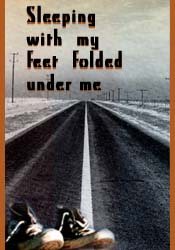
Sleeping with my feet folded under me

09/24/2021 - 11:22 by Anonymous (not verified)
Original Author
root
Original Body

One man’s journey through Homelessness in Tallahassee

by Marcus Green

When I was in school I once talked to a homeless man. He told me that he
had fallen asleep the night before and woke up the following morning with cold
feet. Someone had stolen his shoes. I hope no one steals my shoes if I get
to sleep tonight.

I feel like a Bruce Springsteen song come to life, or maybe Bob Dylan wrote
a tune about me years ago. People who aren’t from Florida imagine it to be
beautiful and sunny year round, but it does get cold here too.

No major mistake got me on the streets of Tallahassee. It was more a series
of small mistakes, which individually meant nothing, but together
spelled out a painful fate for a once-promising young man. I feel like I
was playing one of those pool games where you seem to miss every shot by no
more than a quarter of an inch. I’ve been close, very close, but at the end
of the night I am still the loser.

I think the hardest part of being where I am is, first of all, the way
people look at me, or rather don’t look at me. It is as if by not looking they can
avoid me asking for money, or pretend that they didn’t hear me beg because
I’m hungry. I wouldn’t ask them for money.

Harder still are the memories. Memories of jobs that I took for granted haunt me. The jobs I had while I was still in school could at least feed me, but I was too good for those
jobs. I had a future. "Sure I can go out and miss work tonight. It’s a
shit job anyway." I was going to be something someday.

Memories of the girls that I let go for no good reason at all haunt me now. Just one of
them to hold would make these nights so much more bearable. Some were so
sweet, they might have stuck with me, even all the way down here. When I
had them, I could let them go so easily. But, those were better days, back
when we had it all figured out, when I used to throw people the way people now throw me a dime.

The cold hurts. It’s so fucking cold. I think someone said it was in the
teens. It snowed today. It was cold but nice. It only snows here every ten
years. It was nice.

I can’t even tell right now if I miss people or the times that I used to
have with them. I did have great times, once upon a time. If I saw someone now that
I knew then, what would I do? I would love to speak to them,
remember old times, and hear of how great they are doing now. But how could
I possibly let them know that this is what’s become of me. As Jacob Marley
surely felt, I would fear telling my friends of my fate and their possible
fate. The cold hurts.

Of course there are programs for people like me around here, but once the
hope is gone it’s gone. No matter what programs The Shelter or The Mission
offer, they just don’t seem to offer what I need. The job programs at those
places do promise work, but what would that mean. Meals more often, yes,
but what else. There is no more hope for that "American Dream."

The
idea of a wife and 2.5 kids surrounded by a nice white picket fence just
isn’t going to happen to me. If I did have that option right now, how would
that feel? At least now my only worries are food to keep me alive, and
staying warm enough to breathe. After knowing that I am capable of surviving at depths
like these, how could I possibly accept the responsibility of caring for
others? What if my history of choices led me right back here? I couldn’t
possibly bring others into the abyss of me. I need hope and it’s just not
there.

What horrible thoughts. The cold hurts.

I smoke. People see me and are disgusted. How could a man hungry for food
possibly spend any money on cigarettes? Well, it’s simple. They bring me
comfort, sometimes more comfort than food. The warm feeling of smoke in my
lungs helps warm me. Standing by a fire, even if it is just the fire of a
smoke, makes me think of warmth. Besides all of that, a man in a white
Chevy pickup gave me this particular cigarette, so, piss off judgemongers.

I sit here on this convenience store sidewalk looking at the people walking in
to buy gas, buy smokes, or buy beer. I remember when I was on the other side,
when I was the one looking down into the eyes of the hopeless, seeing eyes
of despair glaring up. When I was on that side, everyone I looked down to
on the sidewalk would look back up. But now, from the sidewalk very few look
my way.

I just noticed a reflection in a window, such a bitter and hateful face. I
remember my own reflection. It was nice, kindhearted. I was shocked to
find out, when I went into a restroom, that the bitter face was probably my
own. Somewhere between the cold and poverty my face learned to display
bitterness rather than the compassion that I remember from my youth. I
never thought myself a bitter person, but in retrospect I can see the
gradual shift in my personality. Again, it was no major event, as the
movies would have you believe. It happened slowly.

At one time, I could
listen to anyone’s problems for hours for the simple reason that I believed
that it made their life easier to unload their problems on someone who would
listen. Now, that face I see in reflections tells a story of hatred, a
story of bitter despair, a story that has no time for other stories, a face
that is cold. A face that has no time for problems, not even its own.

Speaking of my problems, I’ve got one now. It’s late. A big problem
is finding a safe place to sleep. There are shelters here in Tallahassee, but they are crowded. I think I may have a
solution for the night. A simple place to lean. Sleeping with my feet
folded under me, my shoes just might be safe.

Tags

Dis-Ebonics

09/24/2021 - 11:22 by Anonymous (not verified)
Original Author
root
Original Body

The Disabled Ebonics Tour

by Staff Writer

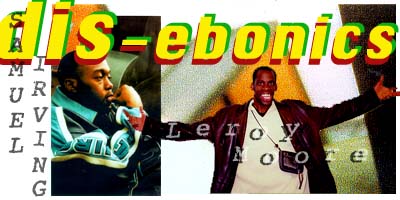
Disabled Ebonics Tour is the brain child of two, talented, extraordinary, Black, disabled poets\activists, Leroy Franklin Moore, Jr. and Samuel Irving. Disabled Ebonics Tour’s goal is to display a small part of the artistic and political voice of the Black, disabled community through a mixture of spoken word, story telling, and lectures, while adding a very important voice to this year’s Black History Month.

Leroy and Samuel believe their Black, disabled brothers and sisters have lived and are still living under harsh conditions and discrimination, but like a rose between the sidewalks, they are blossoming and spreading their beauty in all arenas including the arts. Disabled Ebonics Tour will be taking place around the Bay Area, where Leroy resides, and in Portland, Oregon, where Samuel resides. They are both authors and motivating speakers

Leroy and Samuel met on the Internet thanks to POOR Magazine’s on-line magazine; http://www.poormaagazine.org where Leroy pens a column entitled Illin-n-Chilln
.

Leroy is the Founder and Executive Director of Disability Advocates of Minorities Organization (DAMO) of San Francisco. He has traveled all over the country and the United Kingdom sharing his perspectives on identity, race and disability, through his lecture series On the Outskirts: Race & Disability. In 2000 Leroy self published his first chapbook Black Disabled Man with Big Mouth and a High I.Q.with editorial and design expertise from POOR Magazine. Leroy has a new chapbook For the Ladiesedited and designed by James Tracy of the San Francisco Coalition on Homelessness.

Samuel Irving is a man with many talents-and challenges. However, in his own mind he is simply a poet. Named Poet of the Year in 1998 and 1999 by Famous Poet Society, his first book of poetry Quiet in a Storm received initial acclaim from a variety of critical sources. His new book Open Meditationswill be released this spring.

He is known in local business circles and the faith community around Portland. Irving was instrumental in founding and operating Kimbro Kidds, a nonprofit organization, which teaches entrepreneurship to youth who are from 7 to 13 years of age. He volunteers numerous hours presenting poetry workshops in schools and hospitals, helping children understand the healing powers of poetry. His "poetic medicine" workshops offer participants limitless possibilities for creative expression.

Dis-Ebonics
The Other Brother: Disabled Ebonics Tour

DATES & PLACES

Places in the Bay Area- Leroy Moore


1)Feb. 6th KQED Reception for Local Hero Awards, San Francisco

2) Feb. 14th POOR Magazine The Po’ Poets Project Featured Speaker/ Workshop Facilitator at 10am. 255 9th Street (@Folsom), San Francisco

3) Feb. 11th (6:00 pm) at Erna P. Harris Community Room 1330 University Ave, Berkeley

4) Feb. 8th @7:00pm at Modern Times Bookstore, Valencia St, San Francisco

5) Feb. 15th on KPOO radio in San Francisco

6) Feb. 9th at Oakland Library, Oakland (2-4pm)

7) Feb 13th,(@8:00 pm) Java House,Oakland/ph (510) 836-5282

8) Feb 16th DAMO’s Breaking the Silence Event at the San Francisco Main Library

Dates and locations in Portland:

February 18 at Emotions

February 19 at One Night

February 20 at Springfield High School

February 21 at Love Jones

February 22 at Reflections Book Store

February 23 Multnomah Library

(yet to be confirmed)

Powell's Books

90.7 KBOO

For dates and places or to book Dis-Ebonics The Other Brother: Disabled Ebonics Tour call, mail or e-mail Leroy c/o

Disability Advocates of Minorities Organization, DAMO

820 Valencia St.

San Francisco, CA. 94110

Leroy@ (510) 649-8438 or Samuel @ (503) 233-7225

E-mail:sfdamo@Yahoo.com

DAMO’ s Web site: www.sfdamo.freeservers.com

Tags

Happy Birthday to the Revolution

09/24/2021 - 11:22 by Anonymous (not verified)
Original Author
root
Original Body

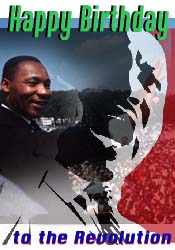
Disability Advocates of Minorities Organization (DAMO) celebrates Martin Luther King Jr.’s Birthday

by Leroy Moore

January is Martin Luther King, Jr.’s birthday and as a Black, disabled activist\writer, I’ve turned to MLK’s incredible book Why We Can’t Wait, on the birth of the Black Revolution in Birmingham, Alabama in which he explains why African Americans could not wait any longer.

Disability Advocates of Minorities Organization (DAMO) is standing on the message of this book to inspire the birth of the Disabled People of Color Revolution. DAMO will be introducing their Breaking the Silence & Organizing Campaign, funded by the Catholic Campaign for Human Development, during a press conference around Martin Luther King, Jr.’s birthday. The passion, determination, and leadership of MLK, Jr.’s work and his book Why We Can’t Wait should be our guiding light, our strength, and our faith, for our future, reminding us why, as disabled people of color, we can’t wait.

DAMO, like Martin Luther King, Jr., has also realized that the media is essential to bring awareness to the masses about the lives, struggles, and accomplishments of disabled people of color. In the words of Martin Luther King, Jr., "Without the help of the media, the voices of African Americans will always be muddled and change will be very, very slow, causing our people to release their pent up anger in violent ways." I like to say that today we, disabled people of color, have connected with local media and our beautiful light will enlighten our community.

Dr. Martin Luther King Jr. once wrote: "In order to be somebody, people must feel themselves part of something." This is one of the main reasons why DAMO is here.
DAMO was established in 1998 and is a grassroots organization for and by disabled and non-disabled people of color. We’ve been in existence for almost five years. DAMO’s mission is to represent and promote the welfare and the equalization of opportunities concerning people of color with disabilities through the encouragement and development of education, artistic expression, self-advocacy training, community organizing, networking and consulting. This is our revolution, our organization, and our time to tell people why we can’t wait any longer and to take action with our own hands.

Today, DAMO and I have some reasons why disabled people of color can’t wait and why disabled grassroots organizations of color are long overdue. Over the past thirty years, California’s population has undergone a tremendous shift in its racial and ethnic distribution. The 1990 US census clearly points out that the population of people of color in California has out numbered the White population. According to organizations for and by individuals with disabilities and the 1998 report from the National Council on Disability, the disabled population in California has an over representation of disabled people of color.

With these two facts you might think that California would have many organizations run by and for disabled people of color, but until very recently this was not the case!

Although California is the home of the Independent Living Movement and has a rich history with the disability rights movement, until recently there were no organizations for and by disabled people of color. Because of this, many disabled people of color have been left outside of the disabled rights movement, especially the Independent Living Movement to deal with the concept of race and disability. During the Black civil rights movement, leaders realized that institutional power was essential to the movement. To carry out their messages they created their own organizations like the NAACP and the Urban League.

The same is true for the disabled people of color movement here in California. The new disabled people of color movement has formed newly state-wide and community-based organizations , like the Harambee Educational Council, the Asian Pacific Islanders with Disabilities Organization, and Disability Advocates of Minorities Organization. But they are still struggling to stay alive while traditional disabled organizations suck up resources, money, and media attention.

Today Americans with disabilities have laws on the books to deter discrimination and bring disabled Americans into mainstream society—the Rehabilitation Act of 1973, the Individual Disability Education Act of 1975, and now the Americans with Disabilities Act of 1990. Like Martin Luther King, Jr. realized in 1963, DAMO has realized in 2002 that very little has changed for disabled people of color since the signing of these laws. This is why today, on Martin Luther King, Jr.’s birthday, we are calling on our disabled brothers and sisters of color and our allies to help us in this campaign, and then the revolution. We, disabled Californians of color, are playing catch up and need a platform from which we can educate and organize. DAMO is that platform.

This year Americans will be celebrating the 12th birthday of the Americans with Disabilities Act, what disabled Americans call Independence Day. But, as a Black, disabled man, Independence Day is still far away. On July 26, 1990 President Bush turned to the four White, disabled activists sitting beside him and proclaimed, "Let the shameful wall of exclusion come tumbling down." However, disabled people of color are far behind our White, disabled colleague in every arena—only one Black of working age in every forty is a college graduate. The rate among non-disabled Blacks is just 29 percent of the rate among disabled Whites. The unemployment rate among disabled people of color is in the high nineties.

According to a paper published in October of 1995 entitled Disability Among Racial & Ethnic Groups, from the Disability Statistics Rehabilitation Research & Training Center at University of California, at San Francisco
the overall rate of disability in the U.S. population is 19.4 percent. The total number of disabled people of color make up 67.1 percent of the population nationally.

From what I stated above, it makes sense that DAMO is here but we need more grassroots organizations run for and by disabled people of color especially in California. We also need financial and community support for organizations, like the ones I mentioned, that are performing incredible work on boot string budgets. Communities of color are in desperate need of education, empowerment, and advocacy on rights, services, history, talents, and other issues that touch disabled people of color by disabled people of color. DAMO’s Breaking the Silence and Organizing Campaign will do just that and more but we need you to get involve.

The only way we, disabled people of color, can educate our communities, show our talents and solve our problems is to come together and organize and speak our stories. Disabled people of color face racism, sexism, disablism, heterosexism, and classism, so yes, we have a lot to battle with but we must come out and organize because nobody will do it for us. Our youth deserve to feel part of something.

Dr. Martin Luther King, Jr. said "Oppressed people cannot stay oppressed forever." This is true as today we see Disabled people of color are organizing in London, England, Brazil and in South African to name a few. Disabled people of color in California, the Bay area and all over the US, it is our turn! Happy B-Day Dr. Martin Luther King, Jr. and thank you! For more information on DAMO’s upcoming press conference and their Breaking the Silence Campaign call Leroy Moore at (510) 649-8438 or visit Leroy’s column Illin-N-Chillin at www.poormagazine.org.

Tags

Tech Wrong

09/24/2021 - 11:22 by Anonymous (not verified)
Original Author
root
Original Body

While big things are happening
in San Francisco and Las Vagas.

A college kid has AOL acting
like a jerks with their pants down.

by Joe B.

It’s baaac, in Moscone Center in San Franciso and Las Vagas.

Innovative soft/hardware, or the short version "New Tech stuff" for the mass consumers.

Mechanisms gets smaller, faster, supposedly more efficient chip power squeezed in less space.

To bad humans still stagger around, beat their laptop keyboards when someone points out glitches in their software programs case in point.

A young, 19 year old, Utah College student who's learned the “DO THE RIGHT THING” lesson / mantra last Thursday calls AOL AOL, (America On Line) warns them of a security kink in their system.

He (Mr. Matt Conover, one of the w00w00 founders of the “World’s largest nonprofit security with more than 30 members in about nine countries.”[his/their words.] sent out a report of a flaw in AOL’s AIM (America Online Instant Messenger) Once contacted AOL fixed its problem but instead of thanking the members an AOL spokesmen (Mr. Andrew Weinstein) critizied the group for failing to give AOL more time before announcing their problem publicly.

There seems to be a disconnect in that Mr. Conover told AOL about a problem that all their brilliant programmer, software designers, engineers didn’t see or were too busy getting it up and running to notice.

I think they (AOL) is ticked off because they didn’t see the bug and instead of saying "Way Cool Dudes" they publicly bash w00w00 for the good deed.

w00w00 showed itself as a lawfull Web Secure Co. by warning AOL of an error it may pay for its short sightedness when w00w00 lets a worse glitch go by and hackers have their fun.

“A” will bung it up again with that attitude and no one may ring an alarm of another foul-up.

The w00w00 folks are our future and it looks bright even if “W0” disbands, splits, reforms or stays together it shows how weak Big old AOL and others like them really are.

These young men and woman are college students yet AOL out of hand didn’t take a moment to think it as a possiblity.

To me the future is in good hands, just don’t listen to so called experts because they don’t really know, setting arbitrary limits then say that’s it – limits are made to be broken.

Tech innovations in San Francisco and Las Vagas works only when new ideas, ways , thinking, seeing is tested and excepted; AOL should think of those facts instead of being pissed of that their fallible mortals it takes lest energy than angry bluster.

That’s how we human’s grow, advance, and evolve… Bye.

Please donate what can to
Poor Magazine or
C/0 Ask

Joe at 255 9th St.

Street, San Francisco, CA. 94103 USA

For Joe only my snail

mail: PO Box 1230 #645

Market St. San Francisco,

CA. 94102

E-mail: ask joe@poormagazine. Org

PS.
As a House-Care Watcher Professional or [H.C.W.P.]

I'm a non drug user, smoker, drinker, pill popper - drug test me anytime.

Light vacuum, no windows or laundry.

Pets have their routine - make a list of walking times, foods, and moods.
INFORM FRIENDS, NEIGHBORS, POLICE; IN FACT
INVITE THEM TO PERSONALLY SEE ME, ASK QUESTIONS
THEN NO MISUNDERSTANDING, MISHAPS OR ACCIDENTS OF IDENTITY CAN HAPPEN.


Prices: $25 a day apartments/flats

$50 a week for 2 to 4 bedroom cottage.
$2000, or $3,000 a month depending on home not area.


$50,000 to $100,000 monthly for certain homes with
7 to10 room TO BE TRUSTED EVEN A LITTLE BY THE COMMUNITY MAKES EVERYONE MORE SECURE AND LESS LIKELY TO JUMP TO CONCLUSIONS.

Tags

We Waited, and Waited, and Then We Won!!

09/24/2021 - 11:22 by Anonymous (not verified)
Original Author
root
Original Body

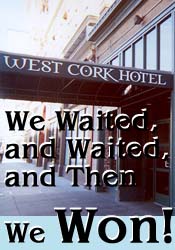
The West Cork Hotel Found to Be Illegally Housing Tourists by The SF Board of Appeals after countless continuances and delays!

by Gretchen Hildebran/PoorNewsNetwork

The SF Board of Appeals hearing room was packed and just like last time, we were asked to move to the overflow room down the hall. We were asked many times but nobody wanted to budge. Commissioner McInerney, the one who left us waiting for hours last time, asked the board to be recused from a case yet again. The tenant advocate sitting next to me muttered under his breath, "He better not leave." The SRO resident sitting behind me was more straightforward. He yelled out to the wayward commissioner, "You stick around now, we’re waiting for you!"

I had arrived at the Board of Appeals hearing room at five, to wait with the SRO tenants, housing advocates and homeless folks, for the law to be laid down on the West Cork Hotel case. We waited for over four hours in December and another two hours last Wednesday night for a vote that finally took about ten minutes to debate. After 6 months of illegal operation as a tourist hotel, West Cork was officially found to be in violation of the law that protects Single Room Occupancy (SRO) hotel rooms from being converted to other uses.

The stakes were high. The 88 rooms of the West Cork are a precious resource for folks that can only afford an SRO room. These rooms were vacated twenty years ago when the city shut down the hotel (formerly the Empress Hotel) for countless health and safety violations. In May of last year they opened again—to tourists.

For this community, reclaiming the West Cork is not a symbolic act, but one that will save lives. If the West Cork landlords can turn their SRO into a tourist hotel and charge double or more the nightly fees and get away with it, other landlords will certainly follow their lead. And with downtown businesses already eager to turn the TL into a shiny tourist trap, this case could set a dangerous precedent. I recall the Redevelopment Agency meetings I have attended, where the value of an SRO was measured against parking spaces and luxury lofts. It scared me that these decisions aren’t in the hands of folks who live in SRO’s, who don’t get to choose where they park or where they sleep.

The waiting got to me and I finally did leave my seat, and in the overflow room I met Shorty, an energetic SRO tenant and activist wearing a bright bandana. He reassured me that we were going to win. "This will serve as a warning to other landlords as well, that they will be sued by people who need this housing." And after all, the law created to protect low-income housing stock backed us up, right?

Laws, however, are always up to official interpretation. We rushed back to the hearing room for the very brief statements of the Board (McInerney decided to show up this time) on the matter. Board President Arnold Chin and Commissioner Allam El Qadah both sympathized more with the investments of the West Cork landlords than the housing rights of tenderloin residents. Luckily the importance of low-income housing was not lost on Commissioner Saunders who said her decision was influenced by SF’s current housing crisis. She also noted that the West Cork landlords "are not new to the process or naive to the city’s policies." Commissioner McInerney then surprised the crowd by siding with Commissioners Saunders and Cullum in voting to uphold the six-month old ruling against the West Cork.

While the case against the West Cork officially had been argued by the Tenderloin Housing Clinic, it was people power that finally convinced the Board to get on with it and do the right thing. This had been the fourth time we had packed the room to see justice done. This time, when the hearing room emptied out after the ruling, we celebrated in the knowledge that we didn’t have to come back again, at least not for this case.

Larry Edward sat energetically and patiently through the two hours of delay before the case was heard. As we were jubilantly leaving City Hall he was passing out snacks declaring, "It just goes to show, when oppressed folks come together they can win." Edward described himself as currently homeless but said he was here because "SRO rooms and homeless folks, we’re all on the same ticket." He was feeling positive about his option to move into a decent room after this decision. A fellow celebrant then chimed in that another SRO owned by the same landlords, the Alder Hotel, had been cited for over 100 code violations in the past six months, most of them fire safety violations.

On the steps of City Hall the air was cool and fresh and people were jumping with the energy of the recent victory. I asked Randy Shaw of the THC whether we would have to fight this again in court. As far as he knew, the landlords had recently changed their tune and instead of readying a legal challenge they were courting a non-profit to lease and manage the building. Hopefully the West Cork and all of its now-swanky 88 rooms are on their way to being desperately needed low-income homes for people. If not, Shaw stated, "We will let them know that they are violating the law." And we’ll keep coming back until they stop.

Tags

Deadly MYTH-Information

09/24/2021 - 11:22 by Anonymous (not verified)
Original Author
root
Original Body

Denial of information, tribal myths and lack of resources turns the Aids crisis in Africa into a deadly crisis...for girl children.

by Lani Kent/PoorNewsNetwork

June in LA. All 450 of us highschool students filtered into the crowded gym and took seats. It was wet with heat and my long
hair stuck to my wet neck. An unfamiliar man stood
center on the gym floor, emaciated and limp. The
microphone in front of him seemed more capable of
speech than he appeared to be, yet he motioned to our
school principle that he was ready. We settled, and
then the lights dimmed: "Hello class of 1993. Please
look at the person on your left, and then look at the
person at your right," he said with a voice too loud
for a body so weak, "In ten years, one of you three will
be HIV-positive."

It being graduation
rehearsal, and adhering to the standard simplicity of
sitting in alphabetical order, one of my two seatmates
appeared to be doomed. I did not know either of them
well, so I did not feel bad when I justified in my
head that they were both boys and I was the girl and
to make things statistically even, HIV would have to
take one of them. I released all my fear with this
convenient conclusion; with the logic of a
16-year-old, I was safe from AIDS and free of
responsibility and consequences. No longer in such a
hurry to avoid responsibility, I do think of those
boys often, for ten years is only 18 months away.
That nameless man who drove to my high school on that
hot June day lives in my memory.

Today, there is a nameless man in South Africa who
drives a lot. Much like the man who spoke at my
graduation practice, this man travels to schools and
community centers and orphanages, where he attempts to
spread life-saving information. Information the South
African government, and its leader, Thabo Mbeki,
willingly ignores—critical information that is
disposed of like spoiled food, leaving people swarming
around it, a now-rotting feast of health that could
have been theirs. This man who drives a lot attempts
to educate young children about AIDS and safe sex,
young children for whom statisticians have labeled
illiterate and poor, nameless faces with big bellies.
These children who, according to research on the AIDS
epidemic in South Africa, will become HIV-positive
adults. Daily, this man fights the statistics by
educating the numbers.

Of the 36 million people on this planet infected with
HIV, almost 70 percent are living in poverty in
Africa. The poor man who drives a lot has a lot more
driving to do, for South Africa’s government-funded
programs prove oblivious to the needs of the poor.
Currently, programs do not address the basic
precautionary measures to prevent HIV transmission,
they do not address the specific circumstances by
which poor people are exposed, and they do not
distribute to them the drugs needed to combat the
virus. In effect, HIV and AIDS spreads further and
deeper into the population least capable of dealing
with it. A fact such as using a condom to prevent the
spread of disease is a foreign concept to many South
Africans. Unless one happens to be on the driving
mans route of knowledge, this fact will remain
elusive.

Information that most of the world believes mythical
or calls urban legend, is real for many South African
people. For centuries traditional healers have paved
the road to health for their people, and for centuries
this road has absorbed various urban legends, gaining
strength and carrying more people. For example, a
popular legend has over-shadowed condom-use, as it
promotes unprotected sex by convincing women that
semen helps them stay young and fertile.

Consequently, fear of infertility has kept many women
away from condom use. Another myth attributes
magical healing powers to young women. Youth and
brilliance have been elevated to such outstanding
importance that young women become magical. This myth
has been taken to repulsive and bewildering heights in
South Africa.

Circulating throughout the continent, stealing
international headlines and questioning the validity
of Africa’s traditional healers, this urban legend has
lead to the regular raping of women, young girls, and
infants. Several, but not all traditional healers, or
witch doctors as they have become known in America,
have passed along the myth that having sex with a
virgin will cure HIV and AIDS. In a country where
urban legends thrive as a fact, and are readily
available to the people who need some type of
information to deal with their poverty and disease,
children are now being raped everyday. Scared men who
don’t know what’s wrong with them but have heard of
this absurd cure have self-diagnosed, they think youth
and brilliance will cure them of AIDS.

Add to this ancient road of misinformation another
popular myth: Having sex with a lunatic, or a mentally
ill female, will lead a man to riches. With 10
percent of the population suffering from some type of
mental illness, there is yet another justification for
the raping of women. Recent headlines in Nigeria
address the problem of pregnant lunatics roaming the
streets. Now consider that 90 percent of the
population seeks treatment from traditional healers,
the very doctors who frequently confirm the antiquated
tales plaguing South Africa. Pregnant lunatics and
violated adolescent girls are not the outcome of
misguided evildoers; they are the unfortunate products
of a society without the information to lead them to
healthy resolutions.

Two men were just sent to court for raping a five-month-old child. An eight-month-old was found raped
and left to die on the side of a road. Child rape in
Johannesburg is said to be up to 10 young girls a day.

Two rapes occur every minute in Africa, the highest
incident of rape in the world. Gang rape is common in
elementary school, and often goes un-reported. Eighteen hundred
new HIV infections are reported a day. Thirty-three percent of women,
children, and babies are HIV-positive due in part to
this rape, and the government has done nothing to
address this specific situation that lives and
breathes through legend and poverty. The urban
legends strengthen, the poor grow diseased and poorer,
and there is only one man driving around in his car
trying to dismantle this lethal system of beliefs.

The man who came to my school and addressed all 450 of
us American students did not have to dispel any
overwhelming urban myth; he had only to confirm
well-known facts—facts we read daily in our media,
study in our classrooms, and talk about with peers.
The process of breaking down old myths and introducing
new information has proved difficult on many different
levels for South Africans. As the driving man tries
to inform the people for whom Mbeki has kept
uninformed, he has encountered men whose only power
comes from their sexual organs. The self-respect and
dignity of many South African men has not been
restored after being brutalized under the apartheid
system; many of these men use rape to regain the power
lost to them.

These men, or rapists, are guilty of
savagery, that is certain; but they are committing
savagery in a society that does not base its actions
in science and logic. Their decisions are found in
the legends and tales, the spirits and stories that
confirm South African culture. They work within a
completely different set of rules than we do in
America, and they have a government intentionally
withholding valuable information from them. How can we
hold a rapist 100 percent responsible for his crime,
when the only doctor his country has ever known told
him to do it? When his own leader has denied him
every other possible solution? How can we judge his
desperation? We have the luxury of knowledge that
South African people do not have; knowledge they may
not even want. The challenge for South Africa will be
to dispel numerous lethal myths without dispelling an
entire way of existence.

One small victory for South African people concerns
Thabo Mbeki and his political stance on HIV and AIDS.
He just recently, although reluctantly, withdrew his
statement that HIV does not cause AIDS. He did not
replace his statement with a new one, nor did he
administer credibility to the West’s belief that HIV
leads to AIDS. Mbeki simply retracted an earlier
statement that bestowed upon him international scorn.

His original stance has successfully ensured that AZT
is not distributed to the population at large, even
though the drug could be readily available to him and
his entire country at 30 percent of what the rest of
the world pays for it. A financial bargain that could
prevent infected mothers from passing HIV onto their
children, and minimize the risk of rape victims from
becoming infected with AIDS. He denies this to his
people. Interestingly, though, is that Mbeki does
make AZT freely available to members of parliament.
They, and other wealthy South African people who can
afford international AZT prices, visit the few medical
doctors practicing in South Africa.

The small and
almost hidden victory here is that Thabo Mbeki took a
step back from ignorance by retracting his statement
that HIV does not lead to AIDS. We anxiously wait to
see where he goes next. Maybe the man who drives all
over South Africa will not have to do it alone for
much longer.

The nameless man who spoke at my graduation rehearsal almost nine
years ago drove a dilapidated Toyota Tercel out of my
school parking lot. His real job, or the one that
paid, was at the recycling center next to the car
wash. Up until two years ago, I would always see him
in front of the recycle bins, sorting glass or reading
soiled newspapers. I talked to him once, but didn’t
tell him how I remembered him slumped and standing
small with a big voice in the middle of my school
gymnasium. I didn’t tell him how I had manipulated
his facts into convenient untruths, simple myths that
comforted me. On that hot day nine years ago I was
not much different from most South African people,
except that I knew I was wrong. My myth was intentional.
Sometimes I wonder, if I had never heard about AIDS
beyond that day, if facts were not sprayed across our
daily media, might I still be rationalizing deathly
statistics into neat little male/female categories?
What if that man never drove his Tercel to my school?

The man who drives all over South Africa is a
non-practicing playwright; he hopes to one day make
money by selling his words. He is a speaker by trade,
HIV-positive and well informed about his disease. He
is finally seeing progress, or at least finding people in
support of the message he is trying to spread. He
spoke at a school recently where a young girl had
actually heard of condom-use. He also found a clinic
that somehow secures AZT and provides it to the
community at no cost. This nameless man smiles as he
drives by taxi stands in Johannesburg that now fly
banners reading: "It is illegal to have sex with a
child."

Tags

POLICE CRISIS….(Training)

09/24/2021 - 11:22 by Anonymous (not verified)
Original Author
root
Original Body

A resolution to get at least 25% of all SFPD patrol officers trained on how to treat folks with mental illness- passes – almost!

by MAri/Youth in the Media Intern

"People with mental illness have been shot by the San Francisco Police Department, and the SFPD haven't had any real training on approaching these folks in a non-threatening way.", Leroy Moore, head of Disability Advocates for Minority Organizations, (DAMO) and columnist of Illin' and Chillin' at POOR Magazine was angry. " These senseless crimes must STOP!" Moore's responses to my questions about the lack of police crisis training in San Francisco reminded me of a story told to me by one of my friends about a 15 year old girl named Molly X. She had sufferred from mental illness, and was emancipated from the foster care system. One day, she was at a shopping mall in Palo Alto. She started to break down and started screaming in the mall. Police came and told her to stop screaming twice, and she didn't stop screaming. Then the police shot, and killed her. There are many more stories like this, where the police's interaction with people in psychiatric crisis ends up in the death of the person they were supposed to be helping.

Idriss Stelly was another young man who was shot and killed by the police. He was having a psychiatric crisis at the Metreon Movie Theatre, so his fiancée called the police for help. But the police did not help him, they killed him. He was 23 years old, just two years older than I. He had a 4.0 GPA, and was enrolled in Heald College. He was a youth organizer. He loved and took really good care of animals; in fact he had three cats himself. He was also going to get married. I started thinking what can I do to make sure that this does not happen again? I am a Youth Commissioner; I represent youth at City Hall, so I decided to work on writing a resolution. A resolution is a piece of paper urging whomever to do what you want them to do. A resolution is one of the ways to get things done at City Hall.

After doing some research into the issue, I discovered there was a police crisis training program for police officers, which taught them how to interact with people who have mental illnesses. The police crisis training program reminded me of the Quaker's model called "moral treatment," which was based on a belief that people who have mental illnesses are human beings and should be treated as such. The odd thing is even with the urgent need for this training program, it only had trained about 20 "first responders" (patrol officers) since the program began .

So I started to work on the resolution pushing to get at least 25% of police officers trained on how to deal with people who are going through a psychiatric crisis within two years. Working on writing this resolution was very hard. I was working on something that a lot of people disagreed with, and/or had their own very specific ideas about.. The resolution went through so many revisions I can't even count the number of times it was changed. It took about a whole summer and a month to finish it.

On Monday, October 1, 2001 I introduced the resolution to the Youth Commission. The resolution was passed unanimously by the commission. Then on
Thursday, October 4, 2001 the Board of Supervisors' Rules Committee called a hearing on the Idriss Stelly's case. At that hearing, I read the resolution that the Youth Commission passed. Also some community advocates at the hearing stated that one of the Supervisors "pick" up the resolution. Before the end of the hearing Supervisor Tom Ammiano stated that he would "pick" up the resolution.

In December, the Board of Supervisors’ Rules Committee looked at the resolution to see if they wanted to recommend this to the Board of Supervisors, and to see if they wanted to make changes. They made some changes, but did not change the point of the resolution. The resolution states that "in two years, 25% of a First Responders of the San Francisco Police Officers per shift, per station complete this
training" and "that within one year at least 12-13% of First Responders per shift, per
station must have completed this training; including those who have supervising
authority when responding to an individual with psychiatric crisis" and "that this training is
maintained at current quality levels until such time all police officers are trained." The resolution also calls for semiannual reporting as stated "in June of 2002, and every six thereafter, the Police Department shall report to a Committee of the Board regarding the status and success of the Police Crisis Intervention Training for Police Officers."

In January of, 2002 the resolution passed before the Board of Supervisors. Every Supervisor who was present voted for the resolution. Supervisor Maxwell was not present. The resolution passed with ten votes.

The resolution is now being forwarded to the Mayor. He can do one of three things he can sign the resolution, not sign it, or veto it. If the resolution is vetoed by the Mayor, its back to the Board of Supervisors. for another vote. The mayor has until January 21 to make a decision.

As I looked at a beautiful picture of Idriss posted on Leroy’s column, his words reverberated through my mind "People with mental illness have been shot and killed by the SFPD and these senseless crimes against mentally disabled people must stop"

If this resolution passes, I believe it will.

Tags

Patriot Amnesia: Buried In Paper

09/24/2021 - 11:22 by Anonymous (not verified)
Original Author
root
Original Body

by Tommy Ates

Well, well, what a difference a huge financial collapse can
make! The Bush administration is now getting bushwhacked with inquiries
and rumors regarding the Enron meltdown. Who would have thought the
Houston-based oil broker, whose dealings in hidden partnerships and
'cooked' financial records to hide enormous losses (plus, being America's
seventh largest company), would have finally healed Washington from
patriot amnesia stemming from the September attacks? Well, I'll be! Money
does buy happiness!

In terms of 'good old boys,' we can add Treasury Secretary Paul O'Neill (a
Democrat) and Commerce Secretary Donald Evans (old Bushite) to the 'no see
evil, no hear evil, no speak evil' crew, even though the devil knocked on
the door and they answered. No wonder the nation's economic policy cannot
see the forest for the trees, it is on the political donor's beck and
call.

All the while, Presidential spokesperson Ari Fleischer says the Bush
administration has no prior knowledge of Enron's predicament or that they
intervened as the company's behalf to the disbelief of many in Congress.
How can executives be able to contact secretaries of the Cabinet and have
word not go to the President's hands? It's a shame that the Bush
administration may have not blown the whistle on Enron's dirty dealings
before thousands of innocent workers lost their jobs as well as retirement
benefits.

But seriously, can anyone really be surprised that Enron executives
(Chairman Kenneth Lay and co.) had access to heads of the Treasury and
Labor departments to give them the heads up and possible want help? After
all, Enron has been President Bush's biggest contributor and the company's
mammoth political contributions helped bolster many Republicans into
office. The Enron debacle is a prime example of money buying access and
how the corporation can circumvent laws enabling the legality of
white-collar robbery of the lower-classes, while blue-collar masses face
severe penalties for defying the corporation (even without a gun), just
for slipping a piece of paper to the bank teller.

To make things worse, the Republican administration never offered to
provide relief for the employees or suggest solutions (via resolutions) to
make corporate behavior like Enron's less likely to occur. An official not
telling how a stock price once valued at $83 could plummet to less than a
dollar undermines the public trust. With no agenda, yet quiet smiles in
the cabinets' public statements, more Americans are realizing that
Attorney General John Ashcroft and Interior Secretary Gale Norton are not
just conservative anomalies, rather they are part of a wider, greater
effort of conservative appointees to provide legislative cover for big
business to generate greater profits as the average, working-class
American suffers.

Meanwhile, all the flying paper (not from World Trade Center) nearly
blinds everyone to the little told plight of indigent, migrant workers who
have helped to the cleanup Ground Zero. Many of these working-class
laborers (who worked alongside firemen and police) were recruited by
contractor firms to clean at the site, as well as the streets in downtown
New York, but even in the extreme sadness of the tragedy, business
continued as normal, with many workers being stiffed in pay and forced to
work long hours. Now many of these unsung (and unappreciated) heroes are
developing throat and lung ailments due to their exposure.
Unfortunately, the Bush administration has not taken an active step in
protecting its most vulnerable workers; but luckily New York State is
attempting to accommodate their needs. Apparently the administration is
taking a cue from Enron - accept the credit they didn't create and leave
the voiceless others holding the bag.

However, the migrant workers are not alone in their plight, many
downtown residents, firemen, and police officers are also suffering from
ailments due to the smoke and ash that permeated the air as the towers
fell. Many of which are now on personal leave unable to work. The EPA
declared it safe for residents (and workers) that the area was safe to
return in less than a week. Could it be that another government agency
spoke to soon in the "Keep America Rolling" campaign (i.e. the Office of
Homeland Security with the shoe bomber)? I hope not; there does not need
to be more innocent victims post-Sept. 11 besides the Afghan people, and
the hundreds of detained Arabic men.

As for the Enron-gate distraction, will there be criminal charges ordered
in the wake of the multi-million dollar theft? Maybe. Will the executives
still keep most, if not, all of the booty? You 'betcha! The American
justice system in inaction for a price!

Yes, folks; it may be sad; but I, for one, am ironically comforted to see
that human nature is no different than the system under which we live: be
it a rich man doing insider trading or a poor man performing a bank
robbery, greed is universal.

Tommy Ates is 27 year-old black male from Austin, Texas, trying to get a
get a job, keep a job, and not go crazy. You can reach him at atesbodhi5@aol.com
Left Is RightTM (http://www.leftisright.net)

Tags