Story Archives

Living A Life.

09/24/2021 - 09:45 by Anonymous (not verified)
Original Author
root
Original Body

Turn of the wheel.

I can change titles.

From pits to cherries.

Think I'll live and learn

some more.

by Joseph Bolden

Living A Life

Recently my birthday had passed double five still alive.

It occurs to me that some missed opportunities, may have saved my life in various crossroads in time.

Nearly drowned in the Orchard Beach as five or six year old I think a woman saved me.

I didn’t see bright lights but didn’t feel pain just calm about it.

Volunteering for Viet Nam in 1972 or 3 at the age of 18 or 19 for the usual reasons of no jobs, didn’t, get away from home, to do something with my life.

Anyway volunteered at four branches of the military was turned down because of a lazy eye (told to drink plenty of carrot juice).

Being asked, “What if you are ordered to shoot a man?”

My first answer was a question “Why, what reason to do that?”

I guess that was the wrong way of answering a direct question because in the circumstances when given an order one’s duty is to obey without question any, most orders given by a superior or higher ranking officer.

From Army, Navy, Marines, Air Force to Air National Guard the latter is a given because of my eyesight.

I am gently turned down.
The exercise that involved jumping up and down.

I may have been too enthusiastic jumping too high and across the floor.

Oh well I know I volunteered so it’s one of those fate full choices that for anyone could change their lives.

Before that bad times in summer camp sponsored by Our Lady Of Mercy. Bright yellow shirt blue-green writing stenciled on.

My memory has pain connected because I was about to fight some kid.

My belly churns as I back up in fear and room then I’m stuck!

I had backed right into a rusty nail! Impaled, not knowing it while I fought.
Move from the place as girls screamed as red seeps out of me.

I though it was rain feeling wet and pain in my back.

A nurse at the infirmary said it wasn’t serious but gave me a preventive shot.

I still have small jagged scar on my back.
That wasn’t the only time

I was impaled.

Also speared in the throat after giving two quick,
hard rabbit punches to some guy who thought if funny to take my gym shorts down in public while outside on a grassy field as everyone was in gym class?

That’s why I rabbit punched him bloodied his nose.

The next day was his revenge as I’m speared in the throat.

Some blood looked worse than it was.

I always felt my voice had been changed because of that incident.

Girls, women, confounding mysteries always drawn to ‘em but not they to me so missed out on dances, social stuff, graduated but didn’t dance.

Traveled, bummed around Los Angeles just when a psychopath who road the rails and hunted houseless folk.

Safe in Joe’s working for room and board and later in the L.A.’s West End Skid row I would hear men mostly scream for help and wonder was it the
railway killer or some guy getting beaten up or worse because they got caught by a gang or someone just wanting beat a hobo or bum up for the fun of it knowing they get away clean.

Eventually while learning a skill I did find a woman or two taking a chance on me but as for the four letters word of love only three seemed to call on me.

As an old movie line says, “What’s sex without love?

“It's Just Sex, it's just sex.”

Better deal with the latter if the other isn’t meant for me.

So now I’m 55, there are still places to go, visit, people to know, and so what If I missed some things
I as a single healthy black male count myself as lucky in the extreme to still be alive at this stage of the game.

San Francisco is where I reside for now but that may change and its all right change is constant and I’ve tended to go-with-flow and not let too many things up set me.

I just pray to live a long vigorous, adventurous, live many good fem friends and guy buds as well avoiding old grim reaper, faking out Mother Nature for as long as science and technology will allow.

Any comments sent to

telljoe@poormagazine.org or email me at

jsph_bldn@yahoo.com

Tags

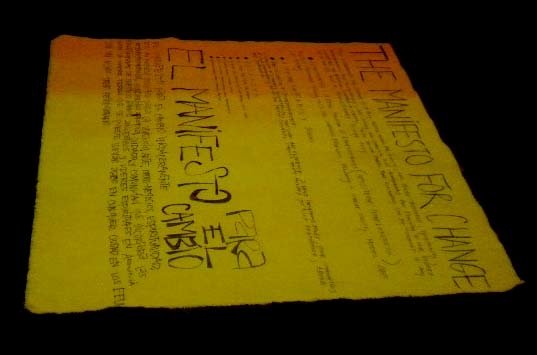
Manifesto for Change

09/24/2021 - 09:45 by Anonymous (not verified)
Original Author
root
Original Body

The Manifesto For Change is a truly "green" model for housing, art, micro-business, spirituality, interdependence, self-accountability, care-giving and community....

by Staff Writer

The Manifesto For Change is a truly "green" model for housing, art, micro-business, spirituality, interdependence, self-accountability, care-giving and community that incorporates the teaching of our elders, ancestors and spiritual leaders in harmony with Mother Earth that ultimately can be launched in any city in the U.S. with a Revolutionary Giving Ally.

The Manifesto for Change was created in a 16 year process by a multi-lingual, multi-racial, multi-generational, group of landless, indigenous elders, children, families and folks engaged in a life-long struggle with poverty, racism, incarceration, welfare systems,white supremacy, mis-education, landlessness, ableism, Non-Profit-Profiteering and violence

The Manifesto for Change was introduced at the Revolutionary Change Session on June 19, 2009 as a template for global and local revolutionary change.

1. The Declaration of Inter-dependence

To act on indigenous values of accountability and care-giving with the goal of moving indigenous folks, poor communities of color permanently out of the Prison Industrial Complex which includes po'lice dependence,abuse and destruction.

Excerpt from the Opening Statement of the Declaration of Inter-Dependence launched on July 4th, 2008

.....We, la gente, the people, the workers, the poor folks, poverty scholars, gente indigena, indigenous people, mamaz, daddys, abuelitos, abuelitas, elders, children y ninos, hereby declare the following articles to be true and original...

2. R.E.C.L.A.I.M.M.

Reclaiming Community & Land Access (through) Investment in Micro-Business (on) Mother (Earth) -A Community Thrival Strategy, Ad Campaign and Micro-business Strategy

Through the RECLAIMM project, POOR Magazine is promoting a new form of indigenous, sustainable "green" equity and resource re-distribution that will enable us to reclaim and build equity, support and promote micro-business, micro-economics and land ownership in our native urban communities.

3. The HOMEFULLNESS Project

Permanent housing units for landless* families and individuals, following a model of co-housing, which includes a home for all of the following components;

A site for the F.A.M.I.L.Y. (Family Access to Multi-cultural Intergenerational Learning with our Youth) school, a revolutionary on-site child care and school for children and families in poverty, which incorporates a social justice and arts multi-cultural and multi-lingual curriculum for families and children 2 to 102 yrs.

A site for POOR Magazine, The Race, Poverty, and Media Justice Institute, Community Newsroom and all of POOR's indigenous community arts programming.

A site for Uncle Al & Mama Dee's Cafe; a multi-generational community arts and social justice eating and performance space.

Tierra Madre/Mother Earth: Following indigenous values of localizing food growth to cut down on greenhouse gases and poisoning of our communities, this will be a site for a 'sustainable urban farm' to teach children and adults in poverty how to grow their own organic and healthy food to eat and to economically sustain their families, so that they can permanently get out of poverty. Also will provide indigenous model of project based learning for FAMILY School providing space for elders to teach indigenous forms of math and science through earth and agriculture.

II. The Building:

A Mixed Use/C3-zoned, multiple units or Loft space with adjoining land or small yard that has space for all of the listed above.

III. Funding:

Equity "Capital" Campaign budget: (2.5 million)

Fundraising will occur through an "equity campaign," launched by POOR Magazine, which is an act of resistance to the hierarchal and unjust distribution of wealth and resources locally and globally. POOR Magazine is formally calling the fundraising effort for HOMEFULLNESS, an 'equity campaign,' instead of a 'capital campaign,' conducted through equity sharing, not tied to financial resources. We will be creating permanent and lasting solutions to houselessness for families in poverty, who have been displaced, evicted, gentrified and destabilized out of their indigenous lands and communities.

*After years of struggling to be heard and housed and working to organize, de-silence and power the scholarship of poor folks of color and urban indigenous peoples,I, tiny, one of the co-author's of the Manifesto, daughter of a disabled single mother of color/indigenous Boricua, African descent, in a life-long struggle for land and equity, hereby refuse to use the codified, meaningless label of "the homeless people" and will instead from hereon, identify our peoples position as landless peoples.

Tags

A Review of Teaching Rebellion: Stories from the Grassroots Mobilization in Oaxaca

09/24/2021 - 09:45 by Anonymous (not verified)
Original Author
root
Original Body

by Hans Bennett/Alternet.org

“I am 77 years old. I have two children, eight grandchildren, and six great-grandchildren...My children are scared for me. It's just that they love me. Everyone loves the little old granny, the mother hen of all those eggs. They say 'They're going to send someone to kill you. They'll put a bullet through you.' But I tell them, 'I don't care if it's two bullets.' I've become fearless like that. God gave me life and He will take it away when it is His will. If I get killed, I'll be remembered as the old lady who fought the good fight, a heroine, even, who worked for peace...Hasta la victoria siempre. That's what I believe," says Marinita, a lifetime resident of Oaxaca, Mexico. Marinita was one of the many participants in the 2006 Oaxaca rebellion, whose first-hand account is featured in the new book released by PM Press, titled Teaching Rebellion: Stories from the Grassroots Mobilization in Oaxaca.

Teaching Rebellion does just that: it teaches us why the 2006 rebellion in Oaxaca, Mexico was so impressive, and is something we can all learn from. Edited by Diana Denham and the CASA Collective, Teaching Rebellion provides an overview of the Oaxaca rebellion. It also gives numerous first-hand interviews from participants, including longtime organizers, teachers, students, housewives, religious leaders, union members, schoolchildren, indigenous community activists, artists and journalists. The diverse interviews allow some of those who led themselves in rebellion to also speak for themselves. Political art is featured throughout the book alongside excellent photographs from the uprising.

The introduction, by Diana Denham, Patrick Lincoln, and Chris Thomas, provides an overview of the rebellion to contextualize the participants' accounts. The story of the 2006 rebellion begins with a teachers' strike and sit-in that occupied over fifty blocks in the center of Oaxaca City, initiated on May 22, 2006, by the historically active Section 22 of the National Education Workers Union. When the government failed to respond to the teachers' demands for more educational resources and better working conditions, thousands took to the streets demanding a trial for the hated State Governor Ulises Ruiz Ortiz, of the Institutional Revolutionary Party (PRI), believed to have gained office in 2004 through electoral fraud. Five days later, 120,000-200,000 marched and held a popular trial for Governor Ruiz. Yet, the major rebellion was still to come.

On June 14, the police used teargas, firearms, and helicopters to brutally attack both the teachers' sit-in at the city's center and the union's radio station—destroying their equipment and brutalizing the radio operators. This violent attack, meant to stifle the people's resistance, backfired when the city rose in defense of the teachers. Transmission was taken up by Radio Universidad (at Universidad Autónoma Benito Juarez de Oaxaca) and thousands of supporters helped the union retake the city center that day. Two days later, 500,000 people marched through the city demanding that the federal government remove Governor Ruiz from office.

The next day, the Popular Assembly of the Peoples of Oaxaca (APPO) was formed, eventually comprising over 300 unions, social organizations, indigenous communities, collectives, neighborhoods and student groups. The APPO's autonomous, non-hierarchical approach in Oaxaca was "a new and original approach to political organizing," Teaching Rebellion explains, but "it also drew from forms of indigenous self-governance, known as usos and costumbres. The APPO, an assembly by name, emphasizes the input of a diverse body of people who discuss issues and make decisions collectively; similarly, in many indigenous communities in Oaxaca, the assembly is the basis for communal governance. The customs of guelaguetza (which actually refers to reciprocity or 'the gift of giving') and tequio (collective, unpaid work for the benefit of the community) are the two traditions most deeply engrained in Oaxacan culture that literally fed the movement."

With the June 14 police attack, the 2006 Oaxaca rebellion had begun. Teaching Rebellion continues, "in addition to responding to a police attack on striking teachers or a particularly repressive governor, the movement that surfaced in Oaxaca took over and ran an entire city for six months starting in June 2006. Government officials fled, police weren't present to maintain even the semblance of responding to social harm, and many of the government institutions and services that we depend on daily were shut down. Without relying on centralized organization, neighborhoods managed everything from public safety (crime rates actually went down dramatically during the course of the six months) to food distribution and transportation. People across the state began to question the established line of western thinking that says communities can't survive, much less thrive, without the intervention of a separate hierarchy caring for its needs. Oaxaca sent a compelling message to the world in 2006: the power we need is in our hands."

The book's introduction elaborates that after the June uprising, "no uniformed police were seen for months in the city of Oaxaca, but paramilitary forces terrorized public spaces occupied by protesters. These death squads, including many plainclothes police officers, sped through the city in unmarked vehicles, shooting at neighbors gathered at the barricades," which were constructed around the city in defense against death squads and state repression. State repression began to escalate while negotiations were taking place between the APPO and the government, which only made the community more distrustful of the government. On October 28, 2006, over 4,500 federal police troops were sent to Oaxaca, attacking the barricades and retaking the historic city center where they set up a military base that was maintained until mid-December.

On November 2, the police attacked the university campus, home to Radio Universidad, but "in what turned into a seven-hour battle, neighbors, parents, students, and other civilians took to the streets to defend the campus with stones and firecrackers, eventually managing to surround the police and force their retreat." In another major conflict that month, on November 25, "thousands of protesters marched into the city center and formed a ring around the occupying federal police forces. After a well-planned police attack, several hours of chaos and violence ensued, leaving nearly forty buildings ablaze. Hundreds were beaten, tortured, and arrested that day, and many movement activists and sympathizers not arrested were forced underground."
This final repression essentially ended the community's occupation and control of Oaxaca City, but, Teaching Rebellion reports that the struggle is not over: "While a Supreme Court Commission has been named to investigate the human rights abuses, Oaxacans have little faith that a real difference will trickle down. Despite the dead-end government redress the air stirs with the force of a familiar slogan: 'We will never be the same again.' The city walls seem to share this sentiment, planted in the post-repression graffiti: 'Esta semilla germinará,' from this seed we will grow."

The First-Hand Accounts

The many featured interviews illustrate the spirits of spontaneity, anti-authoritarianism, and self-defense that were fundamental to the uprising. There is Jenny's account of accompanying the family of slain US independent journalist Brad Will. The family had traveled to Oaxaca to demand justice for Brad and for all victims of government repression. Cuautli recounts his experience working in the community topiles (basically a people's police force), formed during the occupation of Oaxaca City, as community defense groups protecting people from government repression as well as "common criminals" who preyed upon other poor people.

Tonia, recalls the women's "Pots and Pans March" of August 1, 2006, which sparked the spontaneous takeover of the Channel 9 television and radio station by thousands of women. "When we got to the Channel 9 offices, the security guard didn't want to let us in...The women in the front were asking permission for an hour or two to broadcast, but the employees of Channel 9 said it was impossible. Maybe if they would have given us that one hour and cooperated, then it wouldn't have gone any further. But with them seeing the number of women present, and still saying no, we decided, 'Okay then, we'll take over the whole station...' Everyone was taken by the spontaneity of it all. Since no one had foreseen what would happen and no one was trained in advance, everything was born in the spur of the moment...One thing I liked is that there were no individual leaders. For each task, there was a group of several women in charge."

In the middle of the night, August 21, 2006, paramilitary forces destroyed the antennas at the occupied Channel 9. The social movement took immediate action in support of the women, fighting off the police and paramilitary attackers at the antennas, and spontaneously deciding to occupy all eleven of the city's commercial radio stations. Francisco, an engineering student and radio technician who first got involved with the movement when Radio Universidad was vandalized by apparent police infiltrators, describes these actions from the frontlines. He was working the night of August 21 at Radio Universidad when word went out that occupied Channel 9's Radio Cacerola was down, and people were being attacked at the antennas at Fortin Hill. Francisco recounts, "we got up from our seats and left immediately...We grabbed whatever was available: Molotov cocktails, sticks, machetes, fireworks, stones, and other improvised weapons. But what could we do with our 'arms' against Ulises Ruiz's thugs, who carried AK-47s, high caliber pistols, and so much hatred? Still, we had a lot of courage, the group of us, and in that moment the only important thing was getting to the place where our companeros were under attack...We made it thanks to our skilled but funny-looking driver, Red Beard, who wore round-framed carpenter goggles covering half of his face, a yellow fireman's helmet, and red beard. In truth, we all looked pretty funny in our protective gear: leather gloves and layered t-shirts. But wasn't funny at all was the sound of bullets and screams that we heard on the other side of the hill as we continued onward."

The busload from Radio Universidad arrived on the tail end of the government attack, and when they met up with their companeros, they were told that police had shot and injured several people and destroyed the antennas. They searched for any injured companeros who remained, then left to go help elsewhere. After visiting Radio La Ley, which had just been occupied, they were inspired to take over another station themselves and went to Radio ORO: "When we got there, we knocked on the door of the station and announced with a megaphone: 'This is a peaceful takeover. Open Up. We are occupying this radio because they’ve taken away our last remaining means of free expression. This is a peaceful takeover. Open Up!' The security guard opened the door and we entered, without anyone being hit, without insults—we just walked in." Francisco concludes, "after the takeover, I read an article that said that intellectual and material authors of the takeovers of the radios weren't Oaxacan, that they came from somewhere else, and that they received very specialized support. The article claimed that it would have been impossible for anyone without previous training to operate the radios in such a short amount of time because the equipment is too sophisticated for just anyone to use. They were wrong."

Another account comes from former political prisoner David Venegas Reyes, who co-found VOCAL (Oaxacan Voices Constructing Autonomy and Liberty) in February, 2007, for the purposes of challenging the more mainstream and hierarchical elements within the APPO. David, who in October, 2006 was named representative of the barricades to the APPO council, recounts defending the barricades formed after the August 21 radio occupations: "we asked ourselves, 'how can we defend these takeovers and defend the people inside?'...that's when my participation, along with the participation of hundreds of thousands of others, began to make a more substantial difference. Because the movement stopped being defined by the announcements of events and calls for support made by the teachers' union and began to be about the physical, territorial control of communities by those communities, by way of the barricades."

David recounts that "We originally formed the barricade to protect the antennas of Radio Oro, but the barricade took on a life of its own. You could describe it like a party, a celebration of self-governance where we were starting to make emancipation through self-determination a reality. The barricades were about struggle, confrontation, and organization. We eventually started discussing agreements and decisions made by the APPO Council and the teachers' union. There were a number of occasions where the barricade chose actions that went against those agreements, which in my view, only strengthened our capacity for organized resistance."

David says VOCAL "stemmed from an APPO Statewide Assembly when it became evident that there were divergent perspectives with regard to the upcoming elections." One side felt that the APPO movement "in all its plurality and diversity," had purposefully excluded "political parties and any corrupt institution," so getting involved with elections would "attack the unity constructed from diversity of thought and visions that exist within the movement." The other side wanted to "act pragmatically and participate in the elections with our own candidates." Those not wanting to participate in elections "that serve to legitimate repressive governments," and who were distrustful of organizations that did, formed VOCAL. Consequently, VOCAL
"turned into a diverse organization where a lot of anti-authoritarian visions and ways of thinking coexist—some rooted in indigenous tradition, like magonismo, and some more connected to European ideologies. A lot of companeros who have no particular ideological doctrine are also active in the organization...What we all have in common is our idea of autonomy as a founding principle. We defend the diverse ways of organizing of pueblos and the rights of people to self-govern in all realms of life...Unlike other hegemonic ideologies, we don't believe that to promote our own line of thought it's necessary to exclude anyone else's."

In April 2007, David was arrested, "with no arrest warrant or explanation. They drove me to an unknown place, where they planted drugs on me, then tried to force me to hold the drugs so that they could take photos. When I refused, they beat me...Finally they presented me with the arrest warrant that accused me of being involved in the social movement and the acts of November 25th. The warrant accused me of sedition, organized crime, and arson. Even as the government fabricated the idea of accusing me of drug possession in an attempt to criminalize and discredit me, they already intended to present the arrest warrant of a political nature once I was in jail."

On March 5, 2008, after nearly a year in prison, David was released, after he was judged not-guilty by the court on all political charges. However, the CASA Collective’s website reports that since drug charges were still pending, "he was released on bail and forced to report to the court every week for over a year, severely limiting his ability to travel." On April 21, 2009, Oaxacan judge Amado Chinas Fuentes found him not guilty on "charges of possession with intent to distribute cocaine and heroin." Following this verdict, David said, "This innocent verdict, far from demonstrating the health or rectitude of the Mexican legal system, was pulled off thanks to the strength of the popular movement and with the solidarity of compañeros and companeras from Mexico and various parts of the world. The legal system in Mexico is corrupt to the core and is a despicable tool used by the authorities to subjugate and repress those who struggle for justice and freedom."

Oaxaca: Three Years Later

Three years since the Oaxaca uprising that was sparked by the June 14, 2006 police assault on the striking teachers, the issues behind the rebellion have not been resolved, Governor Ulises Ruiz Ortiz is still in office, and Oaxaca is still in the news. A 2007 article, The Lights of Xanica, reported on the continuing struggle of the Zapotec community of Santiago Xanica in the Sierra Sur of Oaxaca. In 2009, a controversial U.S. Military-funded mapping project in Oaxaca has met local resistance this year. In May, El Enemigo Común reported that State and Federal police forcibly evicted "community members who had been blocking the entrance to the mining project Cuzctalan in the municipality of San José del Progreso since March 16." Recently, Narco News reported on heated negotiations between the government and Section 22 of the National Education Workers Union (initiators of the 2006 strike), as well as a robbery and murder committed by State Agency of Investigation agents at a bus terminal in Oaxaca City.

On June 8, 2009 The Committee in Defense of the Rights of the People (CODEP-APPO) reported the assassination of Sergio Martínez Vásquez, member of the State Council of CODEP, arguing that the "way in which it was done and due to some information gathered, everything points to the fact that the material actors of this assassination were paramilitary groups that Ulises Ruiz has operating in the region."

On June 14, a march in Oaxaca City commemorated the three year anniversary of the 2006 uprising (read report in English or Spanish), and on June 17, a protest encampment in the Zocalo of Oaxaca City was attacked by paramilitaries (read report in English or Spanish).

The future in Oaxaca is unclear, but it is certain that the people will continue to resist, and international solidarity with help to strengthen the local resistance. Be sure and visit www.casacollective.org for the latest reports and opportunities for international solidarity.

--Hans Bennett is an independent multi-media journalist whose website is www.insubordination.blogspot.com.

Tags

Moving Off the Lie of The Budget Cut into Community Reparations

09/24/2021 - 09:45 by Anonymous (not verified)
Original Author
root
Original Body

The People Draft a Manifesto for Change and introduce Community Reparations

by Tiny aka Lisa Gray-Garcia, co-teacher, poverty scholar and daughter of Dee

Herstory was made on Juneteeth (june 19th) 2009 at POOR Magazine's Race, Poverty, & Media Justice Institute's Revolutionary Change Session. Through art, poetry, theatre and performance redefined as education, seminar and experience, we deconstructed the lie of the budget cut, the harm perpetrated by the Non-profit industrial complex (NPIC), introduced a new definition of philanthropy that includes community reparations and revealed the The Manifesto for Change , a new vision for thrival and the taking back of and control of resources by indigenous and landless peoples all across the globe!

It was a Beautiful event! Peoples enmeshed in academia and the NPIC were schooled by poverty, race, disability, youth, migrant and indigenous scholars about hundreds of years of repression, scarcity models based on the deserving vs undeserving poor and conceptualized a new dream for Thrival - not just Survival!

On Monday, June 22nd, over 1,200 people converged on City Hall in San Francisco and patiently waited to speak on the destructive and far-reaching effects of the Mayor's proposed budget cuts. Many powerful advocates, scholars and revolutionaries organized to make sure folks came out to speak about the murderous blow of these Cuts on our collective lives. Hundreds more, organized by CAP and LIFETIME marched through the streets of Oakland yesterday, Wednesday, to protest the proposed state budget cuts to welfare, healthy families and elder services.

These struggles and acts of resistance are all entwined- a woven quilt of revolution; the profit from pain at the NPIC and Prison Industrial Complex (PIC)- the pursuit of budget justice- the care-giving of our landless elders and children and the struggle for poor mamas and daddys as they struggle to keep a tenuous hold on survival in Corporate and Capitalist Amerikkka...where do we go now?...... Yes ....keep up the struggle for budget justice but let's look at another frame based in our own gifts, our thrival- not just Survival......a plan of action to move off of the grid of philanthropy pimps, globalization pimps, non-profit pimps, to reject the lie of budget cuts, to reclaim our land and resources stolen from us so long ago!....explore the The Manifesto for Change which includes the control of our own resources through multiple sweat -equity housing projects, micro-business projects, schools, own food growth and localization of food production, reclaim our own care-giving, work, art and media.

For more information click here to read The Manifesto for Change

If you are an organizer or poverty scholar fighting the lies of the budget cuts just to keep your family, your community or your organization alive, consider an alternative. POOR Magazine will be co-hosting a Potlatch for Pacha Mama in September. This gathering will explore and implement models of thrival not dependent on capitalist systems of abuse like the Prison industrial complex (PIC) and non-profit industrial complex (NPIC) for poor communities of color, urban indigenous communities and landless peoples across the globe.For more information email deeandtiny@poormagazine.org

If you are a donor, or conscious person with access to resources, land or equity.. interested in learning about Community Reparations, a truly revolutionary model for giving and equity distribution for all peoples, please email deeandtiny@poormagazine.org
for more information about participating in Community Reparations as a Revolutionary Giving Ally


Tags

Citing withheld evidence, supporters of Mumia Abu-Jamal call for civil rights investigation

09/24/2021 - 09:45 by Anonymous (not verified)
Original Author
root
Original Body

by Hans Bennett/Alternet.org

On April 6, 2009, the US Supreme Court refused to consider an appeal from death-row journalist and former Black Panther, Mumia Abu-Jamal, who was convicted of first-degree murder in the shooting death of white Philadelphia Police Officer, Daniel Faulkner, at a 1982 trial deemed unfair by Amnesty International, the European Parliament, the Japanese Diet, Nelson Mandela, and numerous others. Citing the Supreme Court denial and several instances of withheld evidence, Abu-Jamal's international support network is now calling for a federal civil rights investigation into Abu-Jamal's case.

The facts of the Abu-Jamal/Faulkner case are highly contested, but all sides agree on certain key points: Abu-Jamal was moonlighting as a taxi-driver on December 9, 1981, when, shortly before 4:00 a.m., he saw his brother, William "Billy" Cook, in an altercation with Officer Faulkner after Faulkner had pulled over Cook's car at the corner of 13th and Locust Streets, downtown Philadelphia. Abu-Jamal approached the scene. Minutes later when police arrived, Faulkner had been shot dead, and Abu-Jamal had been shot in the chest. The bullet removed from Faulkner, reportedly a .38, was officially too damaged to match it to the legally registered .38 caliber gun that Abu-Jamal says he carried as a taxi driver, after he was robbed several times on the job. Further, Amnesty International has criticized the official "failure of the police to test Abu-Jamal's gun, hands, and clothing" for gunshot residue, as "deeply troubling." Abu-Jamal has always maintained his innocence, and today still fights the conviction from his death-row cell in Waynesburg, PA, where he also records weekly radio commentaries, and has now written six books.

Recently, Abu-Jamal had petitioned the US Supreme Court to review the US Third Circuit Court ruling of March, 27 2008, which rejected his bid, based on three issues, for a new guilt-phase trial. One issue was that of racially discriminatory jury selection, based on the 1986 case Batson v. Kentucky, on which the three-judge panel split 2-1, with Judge Thomas Ambro dissenting. Ambro argued that prosecutor Joseph McGill's use of 10 out of his 15 peremptory strikes to remove otherwise acceptable African-American jurors, was itself enough evidence of racial discrimination to grant Abu-Jamal a preliminary hearing that could have led to a new trial. In denying Abu-Jamal this preliminary hearing, Ambro argued that the Court was creating new rules that were being exclusively applied to Abu-Jamal's case. The denial "goes against the grain of our prior actions...I see no reason why we should not afford Abu-Jamal the courtesy of our precedents," wrote Ambro.

In his new essay titled "The Mumia Exception," author J. Patrick O'Connor argues that the Third Circuit Court's rejection of the Batson claim and of the other two issues presented is only the latest example of the courts' long standing practice of altering existing precedent to deny Abu-Jamal legal relief. O'Connor cites many other problems, including the 2001 affidavit by a former court stenographer, who says that on the eve of Abu-Jamal's trial, she overheard Judge Albert Sabo say to someone at the courthouse that he was going to "help" the prosecution "fry the nigger," referring to Abu-Jamal. Common Pleas Judge Pamela Dembe rejected this affidavit on grounds that even if Sabo had made the comment, it was irrelevant as long as his "rulings were legally correct."

The phrase "Mumia Exception" was first coined by Linn Washington, Jr., a Philadelphia Tribune columnist and professor of journalism at Temple University, who has covered this story since the day of Abu-Jamal's 1981 arrest. Washington criticizes the Third Circuit's ruling against Abu-Jamal's claim that Judge Sabo had treated him unfairly at the 1995-97 Post-Conviction Relief Act (PCRA) hearings, which was another issue the Circuit Court had considered. Citing "the mound of legal violations in this case," Washington says "the continuing refusal of U.S. courts to equally apply the law in the Abu-Jamal case constitutes a stain on America's image internationally."

Launched Campaign Cites Withheld Evidence

The Philadelphia Inquirer has reported that supporters of Mumia Abu-Jamal are responding to the March 2009 US Supreme Court ruling by launching a campaign calling for a federal civil rights investigation into Abu-Jamal's case. The campaign’s supporters include the Riverside Church’s Prison Ministry, actress Ruby Dee, professor Cornel West, and US Congressman Charles Rangel, who is Chairman of the House Committee on Ways and Means. In 2004, the NAACP passed a resolution supporting a new trial for Abu-Jamal, and campaign supporters will be gathering to publicize the civil rights campaign at the upcoming NAACP National Convention in New York City, July 11-16, and to pressure the NAACP to honor their earlier resolutions by actively supporting the current campaign seeking an investigation. Supporters will then be in Washington, DC on July 22 to lobby their elected officials, and in mid-September, they'll return to Washington, DC for a major press conference.

Thousands of signatures have been collected for a public letter to US Attorney General Eric Holder, which reads: "Inasmuch as there is no other court to which Abu-Jamal can appeal for justice, we turn to you for remedy of a 27-year history of gross violations of US constitutional law and international standards of justice." The letter cites Holder's recent investigation into the case of former Senator Ted Stevens, which led to all charges against him being dropped: "You were specifically outraged by the fact that the prosecution withheld information critical to the defense's argument for acquittal, a violation clearly committed by the prosecution in Abu-Jamal's case. Mumia Abu-Jamal, though not a US Senator of great wealth and power, is a Black man revered around the world for his courage, clarity, and commitment, and deserves no less than Senator Stevens."

Several campaigns seeking a civil right investigation into the Abu-Jamal case have been launched since 1995, at which time, the Congressional Black Caucus (CBC) was one of many groups that publicly supported an investigation. In a 1995 letter written independently of the CBC, Representatives Chaka Fattah, Ron Dellums, Cynthia McKinney, Maxine Waters, and John Conyers (now Chairman of the House Judiciary Committee) stated, "There is ample evidence that Mr. Abu-Jamal's constitutional rights were violated, that he did not receive a fair trial, and that he is, in fact, innocent." Assistant Attorney General Andrew Fois responded to the CBC's request, and in a September 1995 rejection letter written to Congressman Ron Dellums, Fois conceded that even though there is a 5-year statute of limitations for a civil rights investigation, the statute does not apply if "there is significant evidence of an ongoing conspiracy."

One of the 2009 campaign's organizers is Dr. Suzanne Ross, a spokesperson for the Free Mumia Abu-Jamal Coalition of New York City. Citing Andrew Fois' letter, Ross argues that the "continued denial of justice to Mumia in the federal courts, as documented by dissenting Judge Thomas Ambro," is evidence of an "ongoing conspiracy," and thus merits an investigation. "Throughout the history of this case, we were always told 'Wait until we get to the federal courts. They will surely overturn the racism and gross misconduct of Judge Sabo,' but we never got even a preliminary hearing on the issue considered most winnable: racial bias in jury selection, the so called Batson issue." Ross also criticizes the Third Circuit's denial of Abu-Jamal's claim that Judge Sabo was unfair at the 1995-97 PCRA hearings, and considers this denial to be further evidence of an "ongoing conspiracy." Ross argues that the courts' continued affirmation of Sabo's rulings during the PCRA hearings, and Sabo's ultimate ruling that nothing presented at the PCRA hearings was significant enough to merit a new trial, serves to legitimize numerous injustices throughout Abu-Jamal's case.

Specifically referring to the issue of withheld evidence, that was central to the case of former Senator Ted Stevens, organizer Suzanne Ross identifies five key instances in Abu-Jamal's case, where "evidence was withheld that could have led to Mumia’s acquittal." The DA's office withheld two items from Abu-Jamal's defense: the actual location of the driver's license application found in Officer Faulkner's pocket; and Pedro Polakoff's crime scene photos. Then, at the request of prosecutor McGill, Judge Sabo ruled to block three items from the jury: prosecution eyewitness Robert Chobert's probation status and criminal history; testimony from defense eyewitness Veronica Jones about police attempts to solicit false testimony; and testimony from Police Officer Gary Waskshul.

DA Suppresses Evidence About Kenneth Freeman

In their recent books, Michael Schiffmann (Race Against Death: The Struggle for the Life and Freedom of Mumia Abu-Jamal, 2006) and J. Patrick O'Connor (The Framing of Mumia Abu-Jamal, 2008) argue that the actual shooter of Officer Faulkner was a man named Kenneth Freeman. Schiffmann and O'Connor argue that Freeman was an occupant of Billy Cook's car, who shot Faulkner in response to Faulkner having shot Abu-Jamal first, and then fled the scene before police arrived.

Central to Schiffmann and O'Connor's argument was the presence of a driver's license application for one Arnold Howard, which was found in the front pocket of Officer Faulkner's shirt. Abu-Jamal's defense would not learn about this until 13 years later, because the Police and DA's office had failed to notify them about the application's crucial location. Journalist Linn Washington argues that this failure was "a critical and deliberate omission," and "a major violation of fair trial rights and procedures. If the appeals process had any semblance of fairness, this misconduct alone should have won a new trial for Abu-Jamal." More importantly, Washington says "this evidence provides strong proof of a third person at the scene along with Faulkner and Billy Cook. The prosecution case against Abu-Jamal rests on the assertion that Faulkner encountered a lone Cook minutes before Abu-Jamal's arrival on the scene, but Faulkner got that application from somebody other than Cook, who had his own license."

At the 1995 PCRA hearing, Arnold Howard testified that he had loaned his temporary, non-photo license to Kenneth Freeman, who was Billy Cook's business partner and close friend. Further, Howard stated that police came to his house early in the morning on Dec. 9, 1981, and brought him to the police station for questioning because he was suspected of being "the person who had run away" from the scene, but he was released after producing a 4:00 a.m. receipt from a drugstore across town (which provided an alibi) and telling them that he had loaned the application to Freeman (who Howard reports was also at the police station that morning).

Also pointing to Freeman's presence in the car with Cook, O'Connor and Schiffmann cite prosecution witness Cynthia White's testimony at Cook's separate trial for charges of assaulting Faulkner, where White describes both a "driver" and a "passenger" in Cook's VW. Also notable, investigative journalist Dave Lindorff's book (Killing Time: An Investigation into the Death Row Case of Mumia Abu-Jamal, 2003) features an interview with Cook's lawyer Daniel Alva, in which Alva says that Cook had confided to him within days of the shooting that Freeman had been with him that morning.

Linn Washington argues that "this third person at the crime scene is consistent with eyewitness accounts of the shooter fleeing the scene. Remember that accounts from both prosecution and defense witnesses confirm the existence of a fleeing shooter. Abu-Jamal was arrested at the scene, critically wounded. He did not run away and return in a matter of seconds." Eyewitnesses Robert Chobert, Dessie Hightower, Veronica Jones, Deborah Kordansky, William Singletary, and Marcus Cannon all reported, at various times, that they saw one or more men run away from the scene. O'Connor writes that "some of the eyewitnesses said this man had an Afro and wore a green army jacket. Freeman did have an Afro and he perpetually wore a green army jacket. Freeman was tall and burly, weighing about 225 pounds at the time." Then there's eyewitness Robert Harkins, whom prosecutor McGill did not call as a witness. O'Connor postulates that the prosecutor's decision was because Harkins' account of a struggle between Faulkner and the shooter that caused Faulkner to fall on his hands and knees before Faulkner was shot "demolished the version of the shooting that the state's other witnesses rendered at trial." O'Connor writes further that "Harkins described the shooter as a little taller and heavier than the 6-foot, 200-pound Faulkner," which excludes the 6'1, 170-lb Abu-Jamal.

Linn Washington's 2001 affidavit states that he knew Freeman to be a "close friend of Cook's," and that "Cook and Freeman were constantly together." Washington first met Freeman when Freeman reported his experience of police brutality to the Philadelphia Tribune, where Washington worked. Washington says today that "Kenny did not harbor any illusions about police being unquestioned heroes due to his experiences with being beaten a few times by police and police incessantly harassing him for his street vending."

Regarding the police harassment and intimidation of Freeman, which continued after the arrest of Abu-Jamal, Washington adds: "It is significant to note that the night after the Faulkner shooting, the newsstand that Freeman built and operated at 16th and Chestnut Streets in Center City burned to the ground. In news media accounts of this arson, police sources openly boasted to reporters that the arsonist was probably a police officer. Witnesses claimed to see officers fleeing the scene right before the fire was noticed. Needless to say, that arson resulted in no arrests." Dave Lindorff argues that the police clearly "had their eye on Freeman," because "only two months after Faulkner's shooting, Freeman was arrested in his home, where he was found hiding in his attic armed with a .22 caliber pistol, explosives and a supply of ammunition. At that time, he was not charged with anything." O'Connor and Schiffmann argue that police intimidation ultimately escalated to the point where police themselves murdered Freeman.

The morning of May 14, 1985, Freeman's body was found: naked, bound, and with a drug needle in his arm. His cause of death was officially declared a "heart attack." The date of Freeman's death is significant because the night before his body was found, the police had orchestrated a military-style siege on the MOVE organization's West Philadelphia home. Police had fired over 10,000 rounds of ammunition in 90 minutes and used a State Police helicopter to drop a C-4 bomb (illegally supplied by the FBI) on MOVE's roof, which started a fire that destroyed the entire city block. The MOVE Commission later documented that police had shot at MOVE family members when they tried to escape the fire: in all, six adults and five children were killed.

As a local journalist, Abu-Jamal had criticized the city government's conflicts with MOVE, and after his 1981 arrest, MOVE began to publicly support him. Through this mutual advocacy, which continues today, Abu-Jamal and MOVE's contentious relationship with the Philadelphia authorities have always been closely linked. Seen in this context, Schiffmann argues that "if Freeman was indeed killed by cops, the killing probably was part of a general vendetta of the Philadelphia cops against their 'enemies' and the cops killed him because they knew or suspected he had something to do with the killing of Faulkner." O'Connor concurs, arguing that "the timing and modus operandi of the abduction and killing alone suggest an extreme act of police vengeance."

DA Suppresses Pedro Polakoff’s Crime Scene Photos

On December 6, 2008, several hundred protesters gathered outside the Philadelphia District Attorney's office, where Pam Africa, coordinator of the International Concerned Family and Friends of Mumia Abu-Jamal, spoke about the newly discovered crime scene photos taken by press photographer Pedro Polakoff. Africa cited Polakoff's statements today that he approached the DA's office with the photos in 1981, 1982, and 1995, but that the DA had completely ignored him. Polakoff states that because he had believed Abu-Jamal was guilty, he had no interest in approaching the defense, and never did. Consequently, neither the 1982 jury nor the defense ever saw Polakoff's photos. "The DA deliberately kept evidence out," declared Africa: "someone should be arrested for withholding evidence in a murder trial."

Advocacy groups called Educators for Mumia and Journalists for Mumia explain in their fact sheet, "21 FAQs," that Polakoff's photos were first discovered by German author Michael Schiffmann in May 2006, and published that Fall in his book, Race Against Death. One of Polakoff's photos was first published in the US by The SF Bay View Newspaper on Oct. 24, 2007. Reuters followed with a Dec. 4, 2007 article, after which the photos made their television debut on NBC's Dec. 6, 2007 Today Show. They have since been spotlighted by National Public Radio, Indymedia.org, Counterpunch, The Philadelphia Weekly and the new British documentary "In Prison My Whole Life,"which features an interview with Polakoff.

Since May, 2007, www.Abu-Jamal-News.com has displayed four of Polakoff’s photos, making the following points:

Photo 1: Mishandling the Guns - Officer James Forbes holds both Abu-Jamal's and Faulkner's guns in his bare hand and touches the metal parts. This contradicts his later court testimony that he had preserved the ballistics evidence by not touching the metal parts.

Photos 2 & 3: The Moving Hat - Faulkner's hat is moved from the top of Billy Cook's VW, and placed on the sidewalk for the official police photo.
Photo 4: The Missing Taxi – Prosecution witness Robert Chobert testified that he was parked directly behind Faulkner's car, but the space is empty in the photo.

The Missing Divots – In all of Polakoff's photos of the sidewalk where Faulkner was found, there are no large bullet divots, or destroyed chunks of cement, which should be visible in the pavement if the prosecution scenario was accurate, according to which Abu-Jamal shot down at Faulkner - and allegedly missed several times - while Faulkner was on his back. Also citing the official police photo, Michael Schiffmann writes: "It is thus no question any more whether the scenario presented by the prosecution at Abu-Jamal's trial is true, because it is physically impossible."

Pedro P. Polakoff was a Philadelphia freelance photographer who reports having arrived at the crime scene about 12 minutes after the shooting was first reported on police radio, and at least 10 minutes before the Mobile Crime Detection Unit that handles crime scene forensics and photographs. In Schiffmann's interview with him, Polakoff recounted that "all the officers present expressed the firm conviction that Abu-Jamal had been the passenger in Billy Cook's VW and had fired and killed Faulkner by a single shot fired from the passenger seat of the car." Polakoff bases this on police statements made to him directly, and from his having overheard their conversations. Polakoff states that this early police opinion was apparently the result of their interviews of three other witnesses who were still present at the crime scene: a parking lot attendant, a drug-addicted woman, and another woman. None of those eyewitnesses, however, have appeared in any report presented to the courts by the police or the prosecution.

It is undisputed that Abu-Jamal approached from across the street, and was not the passenger in Billy Cook's car. Schiffmann argues that Polakoff's personal account strengthens the argument that the actual shooter was Billy Cook's passenger Kenneth Freeman, who Schiffmann postulates, fled the scene before police arrived.

Robert Chobert's Legal Status Withheld From Jury

At prosecutor Joseph McGill's request, Judge Albert Sabo blocked Abu-Jamal's defense from telling the 1982 jury that key prosecution eyewitness, taxi driver Robert Chobert, was on probation for throwing a molotov cocktail into a school yard, for pay. Sabo justified this by ruling that Chobert's offense was not crimen falsi, i.e., a crime of deception. Consequently, the jury never heard about this, nor that on the night of Abu-Jamal's arrest, Chobert had been illegally driving on a suspended license (revoked for a DWI). This probation violation could have given him up to 30 years in prison, so he was extremely vulnerable to pressure from the police. Notably, at the later 1995 PCRA hearing, Chobert testified that his probation had never been revoked, even though he continued to drive his taxi illegally through 1995.

At the 1982 trial, Chobert testified that he was in his taxi, which he had parked directly behind Faulkner's police car, and was writing in his log book when he heard the first gunshot and looked up. Chobert alleged that while he did not see a gun in Abu-Jamal's hand, nor a muzzle flash, he did see Abu-Jamal standing over Faulkner, saw Abu-Jamal’s hand "jerk back" several times, and heard shots after each "jerk." After the shooting, Chobert stated that he got out and approached the scene.

Damaging Chobert's credibility, however, is evidence suggesting that Chobert may have lied about his location at the time of Faulkner's death. As noted earlier, the newly discovered Polakoff crime scene photos show that the space where Chobert testified to being parked directly behind Officer Faulkner's car, was actually empty. Yet, even more evidence suggests he lied about his location. While prosecution eyewitness Cynthia White is the only witness to testify seeing Chobert's taxi parked behind Faulkner's police car, no official eyewitness reported seeing White at the scene. Furthermore, Chobert's taxi is missing both from White's first sketch of the crime scene given to police (Defense Exhibit D-12), and from a later one (Prosecution Exhibit C-35). In a 2001 affidavit, private investigator George Michael Newman says that in a 1995 interview, Chobert told Newman that Chobert was actually parked around the corner, on 13th Street, north of Locust Street, and did not even see the shooting.

Amnesty International documents that both Chobert and White "altered their descriptions of what they saw, in ways that supported the prosecution's version of events." Chobert first told police that the shooter simply "ran away," but after he had identified Abu-Jamal at the scene, he said the shooter had run away 30 to 35 "steps" before he was caught. At trial, Chobert changed this distance to 10 "feet," which was closer to the official police account that Abu-Jamal was found just a few feet away from Officer Faulkner.

Nevertheless, Chobert did stick to a few statements in his trial testimony that contradicted the prosecution's scenario. For example, Chobert declared that he did not see the apparently unrelated Ford car that, according to official reports, was parked in front of Billy Cook's VW. Chobert also claimed that the altercation happened behind Cook's VW (it officially happened in front of Cook's VW), that Chobert did not see Abu-Jamal get shot or see Officer Faulkner fire his gun, and that the shooter was "heavyset"—estimating 200-225 lbs (Abu-Jamal weighed 170 lbs).

In his 2003 book Killing Time, Dave Lindorff wrote about two other problems with Chobert's account. While being so legally vulnerable, why would Chobert have parked directly behind a police car? Why would he have left his car and approached the scene, if in fact, the shooter were still there? Lindorff suggests that "at the time of the incident, Chobert might not have thought that the man slumped on the curb was the shooter," because "in his initial Dec. 9 statement to police investigators, Chobert had said that he saw 'another man' who 'ran away'...He claimed in his statement that police stopped that man, but that he didn't see him later." Therefore, "if Chobert did think he saw the shooter run away, it might well explain why he would have felt safe walking up to the scene of the shooting as he said he did, before the arrival of police."

The Attempts to Silence Veronica Jones

Veronica Jones was working as a prostitute at the crime scene on December 9, 1981. She first told police on December 15, 1981 that she had seen two men "jogging" away from the scene before police arrived. As a defense witness at the 1982 trial, Jones denied having made that statement; however, later in her testimony she started to describe a pre-trial visit from police, where "They were getting on me telling me I was in the area and I seen Mumia, you know, do it. They were trying to get me to say something that the other girl [Cynthia White] said. I couldn't do that." Jones then explicitly testified that police had offered to let her and White "work the area if we tell them" what they wanted to hear regarding Abu-Jamal's guilt.

At this point, Prosecutor McGill interrupted Jones and moved to block her account, calling her testimony "absolutely irrelevant." Judge Sabo agreed to block the line of questioning, strike the testimony, and then ordered the jury to disregard Jones' statement.

The DA and Sabo's efforts to silence Jones continued through to the later PCRA hearings that started in 1995. Having been unable to locate Jones earlier, the defense found Jones in 1996, and (over the DA's protests) obtained permission from the State Supreme Court to extend the PCRA hearings for Jones' testimony. Sabo vehemently resisted—arguing that there was not sufficient proof of her unavailability in 1995. However, in 1995 Sabo had refused to order disclosure of Jones' home address to the defense team.
Over Sabo's objections, the defense returned to the State Supreme Court, which ordered Sabo to conduct a full evidentiary hearing. Sabo's attempts to silence Jones continued as she took the stand. He immediately threatened her with 5-10 years imprisonment if she testified to having perjured herself in 1982. In defiance, Jones persisted with her testimony that she had in fact lied in 1982, when she had denied her original account to police that she had seen two men "leave the scene."

Jones testified that she had changed her version of events after being visited by two detectives in prison, where she was being held on charges of robbery and assault. Urging her to both finger Abu-Jamal as the shooter and to retract her statement about seeing two men "run away," the detectives stressed that she faced up to 10 years in prison and the loss of her children if convicted. Jones testified in 1996 that in 1982, afraid of losing her children, she had decided to meet the police halfway: she did not actually finger Abu-Jamal, but she did lie about not seeing two men running from the scene. Accordingly, following the 1982 trial, Jones only received probation and was never imprisoned for the charges against her.

During the 1996 cross-examination, the DA announced that there was an outstanding arrest warrant for Jones on charges of writing a bad check, and that she would be arrested after concluding her testimony. With tears pouring down her face, Jones declared: "This is not going to change my testimony!"

Despite objections from the defense, Sabo allowed New Jersey police to handcuff and arrest Jones in the courtroom. While the DA attempted to use this arrest to discredit Jones, her determination in the face of intimidation may, arguably, have made her testimony more credible. Outraged by Jones' treatment, even the Philadelphia Daily News, certainly no fan of Abu-Jamal, reported: "Such heavy-handed tactics can only confirm suspicions that the court is incapable of giving Abu-Jamal a fair hearing. Sabo has long since abandoned any pretense of fairness."

Jones' account was given further credibility a year later. At the 1997 PCRA hearing, former prostitute Pamela Jenkins testified that police had tried pressuring her to falsely testify that she saw Abu-Jamal shoot Faulkner. In addition, Jenkins testified that in late 1981, Cynthia White (whom Jenkins knew as a fellow police informant) told Jenkins that she was also being pressured to testify against Abu-Jamal, and that she was afraid for her life.
As part of a 1995 federal probe of Philadelphia police corruption, Officers Thomas F. Ryan and John D. Baird were convicted of paying Jenkins to falsely testify that she had bought drugs from a Temple University student. Jenkins' 1995 testimony in this probe, helped to convict Ryan, Baird, and other officers, and also to dismiss several dozen drug convictions. At the 1997 PCRA hearing, Jenkins testified that this same Thomas F. Ryan was one of the officers who attempted to have her lie about Abu-Jamal.

More recently, a 2002 affidavit by former prostitute Yvette Williams described police coercion of Cynthia White. The affidavit reads: "I was in jail with Cynthia White in December of 1981 after Police Officer Daniel Faulkner was shot and killed. Cynthia White told me the police were making her lie and say she saw Mr. Jamal shoot Officer Faulkner when she really did not see who did it…Whenever she talked about testifying against Mumia Abu-Jamal, and how the police were making her lie, she was nervous and very excited and I could tell how scared she was from the way she was talking and crying." Explaining why she is just now coming out with her affidavit, Williams says "I feel like I've almost had a nervous breakdown over keeping quiet about this all these years. I didn't say anything because I was afraid. I was afraid of the police. They're dangerous." Williams' affidavit was rejected by Philadelphia Judge Pamela Dembe in 2005, the PA Supreme Court in February 2008, and in October 2008, by the US Supreme Court.

Further supporting the contention that police had made a deal with White, author J. Patrick O'Connor writes, "Prior to her becoming a prosecution witness in Abu-Jamal's case, White had been arrested 38 times for prostitution...After she gave her third statement to the police, on December 17, 1981, she would not be arrested for prostitution in Philadelphia ever again even though she admitted at Billy Cook's trial that she continued to be 'actively working.'" Amnesty International reports that later, in 1987, White was facing charges of armed robbery, aggravated assault, and possession of illegal weapons. A judge granted White the right to sign her own bail and she was released after a special request was made by Philadelphia Police Officer Douglas Culbreth (where Culbreth cited her involvement in Abu-Jamal's trial). After White's release, she skipped bail and has never, officially, been seen again.

At the 1997 PCRA hearing, the DA announced that Cynthia White was dead, and presented a death certificate for a "Cynthia Williams" who died in New Jersey in 1992. However, Amnesty International reports, "an examination of the fingerprint records of White and Williams showed no match and the evidence that White is dead is far from conclusive." Journalist C. Clark Kissinger writes, a Philadelphia police detective "testified that the FBI had 'authenticated' that Williams had the same fingerprints as White." However, Kissinger continues, "the DA's office refused to produce the actual fingerprints," and "the body of Williams was cremated so that no one could ever check the facts! Finally, the Ruth Ray listed on the death certificate as the mother of the deceased Cynthia Williams has given a sworn statement to the defense that she is not the mother of either Cynthia White or Cynthia Williams." Dave Lindorff reports further that the listing of deaths by social security number for 1992 and later years does not include White’s number.

Gary Wakshul’s Testimony Blocked

On the final day of testimony, Abu-Jamal's lawyer discovered Police Officer Gary Wakshul's official statement in the police report from the morning of Dec. 9, 1981. After riding with Abu-Jamal to the hospital and guarding him until treatment for his gunshot wound, Wakshul reported: "the negro male made no comment." This statement contradicted the trial testimony of prosecution witnesses Gary Bell (a police officer) and Priscilla Durham (a hospital security guard), who testified that they had heard Abu-Jamal confess to the shooting, while Abu-Jamal was awaiting treatment at the hospital.
When the defense immediately sought to call Wakshul as a witness, the DA reported that he was on vacation. Judge Sabo denied the defense request to locate him for testimony, on grounds that it was too late in the trial to even take a short recess so that the defense could attempt to locate Wakshul. Consequently, the jury never heard from Wakshul, nor about his contradictory written report. When an outraged Abu-Jamal protested, Judge Sabo replied: "You and your attorney goofed."

Wakshul's report from December 9, 1981 is just one of the many reasons cited by Amnesty International for their conclusion that Bell's and Durham's trial testimonies were not credible. There are many other problems that merit a closer look if we are to determine how important Wakshul's 1982 trial testimony could have been.

The alleged "hospital confession," in which Abu-Jamal reportedly shouted, "I shot the motherf***er and I hope he dies," was first officially reported to police over two months after the shooting, by hospital guards Priscilla Durham and James LeGrand (February 9, 1982), police officer Gary Wakshul (February 11), officer Gary Bell (February 25), and officer Thomas M. Bray (March1). Of these five, only Bell and Durham were called as prosecution witnesses.

When Durham testified at the trial, she added something new to her story which she had not reported to the police on February 9. She now claimed that she had reported the confession to her supervisor the next day, on December 10, making a hand-written report. Neither her supervisor, nor the alleged handwritten statement were ever presented in court. Instead, the DA sent an officer to the hospital, returning with a suspicious typed version of the alleged December 10 report. Sabo accepted the unsigned and unauthenticated paper despite both Durham's disavowal (because it was typed and not hand-written), and the defense's protest that its authorship and authenticity were unproven.

Gary Bell (Faulkner's partner and self-described "best friend") testified that his two month memory lapse had resulted from his having been so upset over Faulkner's death that he had forgotten to report it to police.
Later, at the 1995 PCRA hearings, Wakshul testified that both his contradictory report made on December 9, 1981 ("the negro male made no comment") and the two month delay were simply bad mistakes. He repeated his earlier statement given to police on February 11, 1982 that he "didn't realize it [Abu-Jamal's alleged confession] had any importance until that day."

Contradicting the DA's assertion of Wakshul's unavailability in 1982, Wakshul also testified in 1995 that he had in fact been home for his 1982 vacation, and available for trial testimony, in accordance with explicit instructions to stay in town for the trial so that he could testify if called.
Just days before his PCRA testimony, undercover police officers savagely beat Wakshul in front of a sitting Judge, in the Common Pleas Courtroom where Wakshul worked as a court crier. The two attackers, Kenneth Fleming and Jean Langen, were later suspended without pay, as punishment. With the motive still unexplained, Dave Lindorff and J. Patrick O'Connor speculate that the beating may have been used to intimidate Wakshul into maintaining his "confession" story at the PCRA hearings.

Regarding Abu-Jamal’s alleged confession, Amnesty International concluded: "The likelihood of two police officers and a security guard forgetting or neglecting to report the confession of a suspect in the killing of another police officer for more than two months strains credulity."

Conclusion: the DA Still Wants to Execute

"The urgent need for a civil rights investigation is heightened because the DA is still trying to execute Mumia," emphasizes Dr. Suzanne Ross, an organizer of the campaign seeking an investigation. This past March, the US Supreme Court declined to hear Abu-Jamal's appeal for a new guilt-phase trial, but the Court has yet to rule on whether to hear the appeal made simultaneously by the Philadelphia District Attorney's office, which seeks to execute Abu-Jamal without granting him a new penalty-phase trial.

In March, 2008, the Third Circuit Court affirmed Federal District Court Judge William Yohn's 2001 decision "overturning" the death sentence. Citing the 1988 Mills v. Maryland precedent, Yohn had ruled that sentencing forms used by jurors and Judge Albert Sabo's instructions to the jury were potentially confusing, and that therefore jurors could have mistakenly believed that they had to unanimously agree on any mitigating circumstances in order to consider them as weighing against a death sentence. According to the 2001 ruling, affirmed in 2008, if the DA wants to re-instate the death sentence, the DA must call for a new penalty-phase jury trial. In such a penalty hearing, new evidence of Abu-Jamal's innocence could be presented, but the jury could only choose between execution and a life sentence without parole.

The DA is appealing to the US Supreme Court against this 2008 affirmation of Yohn's ruling. If the court rules in the DA's favor, Abu-Jamal can be executed without benefit of a new sentencing hearing. If the US Supreme Court rules against the DA's appeal, the DA must either accept the life sentence for Abu-Jamal, or call for the new sentencing hearing. Meanwhile, Mumia Abu-Jamal has never left his death row cell.

How You Can Help

Actions are being organized throughout the summer to support the campaign for a federal civil rights investigation, including at the upcoming NAACP convention in New York City, July 11-16. Organizers are focusing particularly on July 13, the day that Attorney General Holder will address the convention. Supporters will then be in Washington, D.C., on July 22 to lobby their elected officials and, in mid-September, they'll return to Washington, D.C., for a major press conference.

For more information on how you can support the campaign for a federal civil rights investigation, and to sign the online letter and petition to Attorney General Holder, please visit: http://freemumia.com/civilrights.html.

--Hans Bennett is an independent multi-media journalist (www.insubordination.blogspot.com) and co-founder of Journalists for Mumia Abu-Jamal (www.Abu-Jamal-News.com). Born and raised in the SF Bay Area, Bennett has been researching Abu-Jamal's case for over 10 years, and lived in Philadelphia for 7 years, documenting the movement to free Mumia and all political prisoners from the frontlines of the struggle.


Tags

Fluff in the City

09/24/2021 - 09:45 by Anonymous (not verified)
Original Author
root
Original Body

by Bruce Allison/PNN

While the other newspapers are talking about the city's "budget problem," this reporter will verify 10 things the city is doing that are absolutely FLUFF. The number one fluff in the city are Fire Captains that are called "Commanders". There are ten of them. Each one has three chauffeurs that drive them to fires. According to city rules and regulations, all firefighters must have a driver's license. Instead, they are using the chauffeurs at a total of $100,000 a driver. The city employs 30 of them, costing 3 million dollars. This is written into the union contract. To all writers interested, write the fire fighters union and demand that the president of the union give back the money that could be used to save the SRO collaboratives, who provide services to low-income tenants in residential hotels.The money could help feed elders and extend the hours of operation to shelters so people don't spend eight hours a day on their feet wandering the neighborhoods.

The next group I want to talk about is the department managers who are paid $100,000 a piece. There are seven of these so-called managers--each managing one (that's right...one) person. With 700,000 dollars you can have meals and housing for the poor instead of these managers who paid to get their job.

Last is the overtime in the police department. They spend this time putting up signs on telephone poles or directing traffic during parades. These jobs can be done by lower paid positions--meter maids can direct traffic and the department of public works (DPW) can hang their own signs! If these jobs were done by DPW it would cost half as much as a police officer who should be saving somebody's life. This would save $30 million dollars. That money could be used to reopen clinics, and to provide extended hours to help more people. It could be used to reopen the mental health center to give proper treatment to those in need rather than imprisonment.

If more information comes to me through my sources, Mr. Newsom, you can get a hold of me at bruce94103@gmail.com.

Tags

People Speaking Up

09/24/2021 - 09:45 by Anonymous (not verified)
Original Author
root
Original Body

5000 unemployed workers in Oakland protest cuts to welfare for unemployed workers

by RAM / Ruyata A. McGlothin

People speaking up, seemed not to matter
People speaking, I seen no one scatter
People was speaking up, when I thought we had her
I was nervous with my heart hella beating
When I said my speech, I thought were they even looking at me?
They just sat and stared
Passed back and fourth, some funny looking glares
While Alameda residents spoke about their fears
"You want our money going where?
You want our money going there?
My whole families share?"
So many of us unaware
This aint enough even for us to live
At least what is ours should be given
And what about my kids
And now you cutting off
General Assistance is all I got
That is how I must pay the rents month
And the food to cook in the kettle pots
Something left for the people~
The system is seeming not

I am a father of two children and am receiving General Assistance (GA). On June
8th and 9th, 2009, I attended a hearing on the cuts to G.A. proposed by the
Alameda County Board of Supervisors. They are planning to cut General
Assistance to only three months every year, a whooping 75% decrease
affecting thousands of unemployed workers living in poverty.

In addition to leaving recipients without aid for nine months in a year, the proposal also includes reducing all G.A. grants
by $40.00 every month for people without MediCal and further reducing grants
by up to 25% for people who share housing. These severe cuts would affect
over 7,000 Alameda County community members who are currently facing
unemployment in one of the nation's worst recessions.

In 1997, Alameda County imposed a time limit on General Assistance. The county saw an increase in hunger, crime, homelessness and housing
instability. According to a study prepared for the Alameda County Social
Services Agency on the impact of time limits on G.A., 29% of recipients
surveyed were forced to move after losing aid and 20% became homeless. 53%
reported that they went hungry for at least one day a week and only 8%
reported finding full-time employment after losing their benefits.

During the hearing on Tuesday, June 9, 2009, the council members took a
vote. Nate Miley and Keith Carson voted against; Alice Bitker, Gail Steele
and Steve Haggerty voted for this catastrophe to be placed in our system.

"In the biggest recession since World War II, it doesn't make sense to cut
people off without a dime for nine months of the year," said Ed Barnes,
attorney at the East Bay Community Law Center. "These cuts are going to cost
us a lot more in the long run, in public protection, health care, and safety
net services."

"What does employable mean when there is no employment?" said Lisa
Gray-Garcia, former Alameda County welfare recipient, executive director of
POOR Magazine, and author of Criminal of Poverty: Growing Up Homeless in
America.
"In light of economic downturn when there are no jobs, the idea of employable can only mean one thing: starve-able."

How can we protect children we cannot feed
Insure a future if our youth are starving
How are we going to.......

Tags

Onto the Spirit World

09/24/2021 - 09:45 by Anonymous (not verified)
Original Author
root
Original Body

A Tribute to Willie LoneWolf (Ute/Navajo), Longest Walker

by Mari Villaluna Coordinator Indigenous Peoples Media Project of POOR Magazine/POOR News Network

“I’m from California, She’s from Oklahoma…”

“They found him Mari,” my Auntie Patti told me. Right away I knew what had happened, Uncle Willie was gone from this world. The month before, my Auntie Patti asked if Uncle Willie was here for the Ute Bear dance. I told her I hadn’t seen him. Right then we both knew something was up.

I first met Willie LoneWolf in the San Francisco Bay Area. He was a drummer in the All Nations drum group. I would see him at the Intertribal Friendship House, or different Pow-wows. It wasn’t until I made a decision to go on the Longest Walk 2 (to learn more about the walk go to… http://www.poormagazine.org/index.cfm?L1=news&category=35&story=2061) that Willie Lonewolf became my Uncle Willie.

Uncle Willie probably knew a million songs and sang many of them on the Longest Walk 2. He would drum late into the night, around the fire, or while we were walking and praying. Many people and I would sing backup when Willie sang. Everyone always gathered around him, and always wanted to learn from him. He built sweat lodges, and ran some sweats while we were on the walk. He also was our bus driver on the Northern Route.

When we got to Colorado, Willie and I both fell in love, with different people of course. He fell in love with my Auntie Patty, who always watched over me and took care of me on that walk. I fell in love with my husband. Uncle Willie taught me many songs and always encouraged me to sing, and would teach my husband Adriano different songs. I think they both had a common bond of being both Utes and with being on that walk.

I told a fellow walker that Uncle Willie was gone, and to pray for him. That walker just simply responded, “He was still supposed to teach me so many more things. I wish this didn’t happen.” Uncle Willie taught all the youth of that walk so many things about being Native. He even got called Willie Wonka, and we were his Oompa Loompas.

I remember him talking about his A.I.M. (American Indian Movement) stories, or just singing different songs he knew or would try to remember. The funniest memory I have of him was when we were going into a state park in Colorado. He was driving the bus and saw the police. He pretended that they were the calvary and we where all on horses. Every minute he would give a play by play of what was going on. I laughed every time I thought about it.

My dearest Uncle Willie, I am sending you a digital smoke signal to let you know I hope you have a safe journey crossing into the other world. I don’t understand why you left, and if it was even your choice. You taught the youth so much about being Indigenous on that walk. Every time I sing the Warrior song I will be thinking of you. Please watch over your Oompa Loompas as we will be singing the songs you taught us.

Tags

The Ugly Laws- The History of the Criminalization of the poor

09/24/2021 - 09:45 by Anonymous (not verified)
Original Author
root
Original Body


When: July 14th 2009

Where: Modern Times Bookstore SF 888 Valencia St. St cross St is 19th

Time: 7pm

Co-Sponsored by POOR Magazine & Coalition On Homelessness of San Francisco.

by Staff Writer

On July 9th 1867 the San Francisco City Council approved the first known ugly law: "Any person who is diseased, maimed, mutilated, or in any way deformed so as to be an unsightly or disgusting object... shall not...expose himself to public view." These ordinances spread throughout the United States. The last known arrest was in 1974. In _The Ugly Laws_ English professor Susan Schweik, co-director of UC Berkeley's disabilities studies program, discusses the origins and consequences of these nineteenth century unsightly beggar ordinances, showing how their dynamics--harsh policing, systematized suspicion, and structural and institutional repulsion of poor disabled people-persist into the present.

Schweik will read from the book and participate on a panel with Lisa “Tiny” Garcia of Poor Magazine and Bob Offer Westort from the Civil Rights Dept. of the Coalition On Homelessness to discuss current city policies toward people who are houseless. In addition, The Po Poets will share their scholarship through political poetry around the issue of criminalizing the poor today.

"Schweik draws on a deep index of resources, from legal proceedings to out-of-print books, to tell the story of individuals long lost to history." (Publisher's Weekly)

“Schweik delivers a compelling and insightful examination of disability norms, municipal law, and American culture . . .. She gives voice to the fascinating stories of the unsightly, the alienated, and the excluded. A valuable contribution for anyone interested in disability theory, poverty law and policy, and social history." Paul Steven Miller

Susan Schweik is Associate Dean of Arts and Humanities and a recent recipient of the Chancellor's Award for Advancing Institutional Excellence. A former Presidential Chair in Undergraduate Education for Disability Studies at U.C. Berkeley, she has been involved with the development of disability studies at Berkeley for nine years. She was co-coordinator of the Ed Roberts Fellowships in Disability Studies post-doctoral program at Berkeley (coordinated by the Institute for Urban and Regional Development).

Tags

Harmful Assumptions-Homeless Micro-entrepreneur fights race and class based profiling

09/24/2021 - 09:45 by Anonymous (not verified)
Original Author
root
Original Body

by John X ( aka The Indigent Litigant) PoorNewsNetwork

While arguing politics with a friend of mine at a local homeless drop-in. we got to the part about aggressive panhandling, proposition N and the police department and how they normally "deal" with our fellow brothers and sisters trying to scrounge up a buck or two. At this point one of the men in our discussion group, Andre, began his story…..

Being a budding entrepreneur for several years, Andre Rucker washes cars as his main source of lively hood and like myself stays in whatever shelter has the shortest line that evening. Andre has had a business license for over 12 years and has always had some sort of business enterprise going. He like many others attempted to apply for General Assistance only get into arguments with the workers about something or other in the "application process" needing to be corrected or failure to provide documentation not previously asked for but resulting in your immediate denial of assistance for the next 60/90 days till we clear it up or you starve and die on the streets of San Francisco whichever comes first.

Andre had decided to set-up shop across the street from one of the local area shelters to do his car wash business. He had the permission of the property owner to use the water and the space so his customers could meet him at a specific spot regularly. Apparently since some of the shelter staff specifically the Director knew Andre as a "client" and as Andre himself put it " they did not feel I should be allowed to work at least not in this capacity". You see Andre is self-employed and can charge what the market will bear which is about $100 per hour for his services. Andre is not just a car washer but a car detail specialist and it is his signature service that draws customers to him. Now, if Andre were out their busting his ass for minimum wage nobody would have ever bothered him because he was "in his place". I don’t make that statement so much as Andre is a black man as I do he is a poor man at least by all appearances. And as it were this shelter contacted the police to have Andre removed from the property as he was not to be in the vicinity of a shelter after leaving in the morning hours. Here again another "policy" of a shelter attempting to dictate peoples behavior as if it were law and using the police to enforce illegal practices.

So when the police were called Andre immediately got on his cell phone ( The essential tool for the efficient 21st century homeless person) to the Board of Equalization and of all people Willie Brown.Da Mayor. Ironically enough Mr. Brown is also a client of Andre. Andre advised the police officers that his conduct was constitutionally protected and he was allowed to do any type of business he wanted to as he had permit from city hall of which he showed to the police officers. After the exchange of a few words between the officers and Andre the Willie asked to speak to one of the officers and they were soon to depart. In the course of their exit their was some snickering that apparently Da Mayor overheard since he was still on the phone as was the Board of Equalization and had Andre ask the officers why they had not left the area and to dispense with their commentaries.

The point to this story is this, there are more people claiming to want to help us that have done and continuously do more harm regarding our plight than actually help us. My friend Andre as I stated earlier in this story stepped out of his place. He was using his own intelligence and resources to better his financial situation and because of that resourcefulness and independence was singled out by someone who in my view was better of financially but not emotionally. This shelter employee took a position of authority and manipulated and abused it for their own means by invoking some bizarre sense of authority and means to control this person's financial future. Had my friend groveled for every morsel whether food, shelter or general respect and dignity he would be accepted by the community based organizations system but because he continuously strives and struggles and uses his intelligence he is routinely outcaste and pointed out in the homeless community as a trouble maker or someone with an attitude or issues.

I wish to commend Andre on his fortitude and perseverance in the face of continuous obstacles. I wish him luck in his pursuits and ask if any of you have a story such as this you wish for me to highlight contact me here at POOR Magazine.

The Indigent Litigant column (aka JohnX) on PoorNewsNetwork welcomes your questions, comments and letters on the legal and constitutional issues regarding police harassment, race and class based profiling and assorted other crimes of poverty. You can email him at johnX@poormagazine.org or mail him your letters JohnX/ POOR Magazine 1448 Pine Street #205 SF, Ca 94109

Tags