Story Archives

The Baddest Black Newspaper in the Bay

09/24/2021 - 10:42 by Anonymous (not verified)
Original Author
root
Original Body

The San Franscisco BAYVIEW Newspaper faces shutdown

by Marlon Crump/PoorNewsNetwork

"Since the San Francisco Bay View National Black Newspaper will now only be an online newspaper, one of the biggest concerns is that people who are incarcerated will no longer be heard."

I learned this recently from longtime re-porters, su-pporters, activists, community members, and voices of the San Francisco Bay View National Black Newspaper.

Contrary to the legendary newspaper line often heard on television, this really "stopped the presses" for me!

The S.F. Bay View National Black Newspaper (which is based in the heart of San Francisco Bay View Hunter's Point) will no longer be able to print its weekly coverage of the detrimentally damaging issues that oppression-ally obliterates the voices of the community of Bay View Hunter's Point, the youth, the incarcerated, the poor, and the people in general locally and all around the world...............at least for now.

The funding for the paper to function fundamentally, has unfortunately reached a famine to only have the ability to feed people's mind globally, by means of daily online publications.

Without its weekly print, everyone who thirsts to be heard by the S.F. Bay View Paper to wage combat against evil forces with their very voices, will now be a drought in part.

Everyone, including all of us at POOR Magazine, agreed in unison(s) of the severe effects it will have on not just people who have no access to the internet, but people who are currently incarcerated, some whom from which are even columnists for the S.F Bay View National Black Newspaper, themselves!

"The older people that are used to reading the S.F. Bay View Paper come into the library for the paper", said Debra Franklin, librarian of the S.F Bay View Library's Anna E. Waden Branch. "Most of them don't even have computers to access the internet."

In a world where almost everyone wants to be seen or heard, people are thrilled to get a glimpse of themselves on T.V, or have a sentence from their mouths quoted in a newspaper article for all to see and hear.

Quiet as kept, corporate mainstream news and T.V media have always had a self-serving interest in controlling people's voices.

"The S.F. Bay View Paper was/is a vehicle, particularly for the black community and other marginalized communities that allow us to speak in our own interests," according to Minister of Information, J.R, a S.F. Bay View columnist and editor of Block Report Radio.

"Although paper is out of print, we will continue our mission of education to the masses of people about campaigning that affect their lives."

"The S.F. Bay View Paper means a lot to us over here in the Bay View District." stated Yolanda Miller, a longtime Bay View Hunter's Point resident. "They (corporate media) don't really print the things that's really going on."

This is especially true of the S.F. Bay View Paper's vital coverage of issues regarding people locally and globally, who are subjugated to the imperialistic attributions of racism, poverty, oppression, police brutality, child protection corruption, gentrification, global warming/injustice, incarceration abuse, immigration, and governmental terrorism. .

In early 2005 after my arrival from Cleveland, Ohio, and my relentless confrontations to the cold cruel challenges many poor people face here in San Francisco, CA, I briefly volunteered for the San Francisco Coalition on Homelessness, (A non-profit organization that advocates for the homeless.)

On May 2nd, 2005, at the "Forgotten People Rally." I delivered my "Care Not Cash/Trash" poem vigilantly attacking Mayor Gavin Newsom's controversial "Care Not Cash" policy, which in disguise of its namesake really injured S.F.' s homeless population.

Following the rally, I appeared on the front page of the S.F. Bay View Paper, a very short time later after a photograph was taken of me, by fellow S.F. Coalition on Homelessness volunteer, Chance Martin. I was so ecstatic because it was the first time I have ever been on the front page of ANY newspaper, let alone even being mentioned in it.

Unfortunately, like so many small businesses, non-profit organizations, and poor families globally that have to fight like pit-bulls to keep mere morsels on their dinner plates; the S.F. Bay View National Black Newspaper needed funding to feed the many that starve each day for knowledge and media education, like a car or plane that needs gas to get people to their destinations of travel.

In this case, the S.F. Bay View National Black Newspaper has been the Promised Land of "Voice to the Voiceless" in the true deliverance of people's voices............not just locally.

"It's $4500 a week just to print the paper and no salary for us." explained Willie Ratcliff, publisher of the S.F. Bay View during a recent meeting regarding its future. He began publishing the S.F. Bay View (now the Bay Area's largest Black newspaper) in 1992.

Mr. Ratcliff distributes 20,000 papers weekly on Wednesdays and can't keep up with the demand. Hits on the Bay View's website,www.sfbayview.com www.sfbayview.com, have exceeded 2 million a month.

Mesha Monge-Irizarry, director and founder of the Idriss Stelley Foundation (Now known as Idriss Stelley Action Resource Center) has been a longtime supporter of the S.F. BayView Paper, and has written many articles for the publication, primarily articles of law enforcement abuse.

"In July 2001, hardly a month after my only child Idriss Stelley was executed by SFPD at the Sony Metreon, I knocked on the Ratcliff's door on 3rd and Palou St. for the first time, to find out if they would be willing to cover a story on my son. Mary Ratcliff, in spite of dreadful deadlines to get her paper out, opened her arms, sat with me, fed me, and let me tell her at great length who Idriss really was."

"The San Francisco Bay View Paper is the baddest black newspaper in the West!" exclaimed POOR Magazine/POOR News Network co-founder "Tiny" Lisa Gray-Garcia in her book, Criminal of Poverty.

Willie Ratcliff was born 75 years ago into a little self-governing Black nation known as East Liberty in Deep East Texas, which was founded by his ancestors who had won their freedom and bought their land before the Civil War.

A licensed contractor since 1967, Ratcliff and his family construction firm built public works, industrial, commercial and residential projects.

Possessing an extensive resume that stretches from here to the nearest space station, Mr. Ratcliff broke down barriers, sometimes single-handedly, that locked his people out of the construction industry. He grew up knowing that Black people can form beloved communities, living in dignity, enjoying peace and even prosperity, determining their own destiny.

Mr. Ratcliff served seven years on the Alaska State Commission for Human Rights, chairing it during the pipeline construction years when it became an instrument for earthshaking change.

Mary Ratcliff, editor of the S.F. Bay View paper, and wife of Willie Ratcliff has an extensive resume (extensively equivalent to her husband's) surrounding numerous experiences of law, education, women, and civil rights, originating from her college education in 1955 to her current present position(s) of media justice to people locally and globally, today.

Willie and Mary Ratcliff gave birth to the San Francisco Bay View National Black Newspaper on February 3rd, 1992.

Following the newspaper's birth, an estimated 697 issues have been produced into the minds of those who are eager to read what was happening socially, economically, and globally. The paper has had head-on-collisions with untold amounts of remote "voice controllers" who were (and still are) great peril to people's voices and their lives of how they saw fit.

It has produced a Moses-like equivalency of deliverance from media oppression, without even charging a single red cent for their own benefit, to feed the minds of many that wanted the truth to be fed to them.

It has provided media education, voices, advertisements, and visibility to members of the Bay View Hunter's Point Community, its youth, activists, community organizers, people in numerous countries, and even certain politicians in the belly of the beast.

"They've really made a difference by reporting things that mainstream media wouldn't report." said an employee of the 3rd St. Community Produce Store to me, as he was servicing a customer. (The store is right next to the S.F. Bay View Paper's very headquarters.)

Until the S.F. Bay View Paper's website was badly hacked most recently, it got 2 million hits a month, coming from every state and 170 foreign countries.

Despite these setbacks, however, the publication continued to valiantly achieve these goals with defiance to corporate media's elite structure aimed at controlling the poor, oppressed, and voiceless, by simply giving people universally the knowledge that they have right to only tell their OWN side of their OWN story..............without having their OWN lives and OWN voices taken out of context.

"You can't build little islands of socialism in a sea market of capitalism." (Paul D'Amato, author of The Meaning of Marxism)

You can support the San Francisco Bay View National Black Newspaper, either by placing an ad either online or in upcoming daily papers and by making a donation, which can be tax deductible.

You can also contact KPFA to encourage the regular broadcast of a program covering Black news the Bay View way so that people without internet access in hoods and prisons throughout Northern and Central California can contribute and listen to the Bay View on the air. Contact the Bay View at (415) 671-0789 or to: editor @sfbayview.com Content (Right Column)

Tags

The Son of a Filipino Immigrant

09/24/2021 - 10:42 by Anonymous (not verified)
Original Author
root
Original Body

Julius Domantay is released from prison on a pardon and within minutes is seized

by Tony Robles/PNN

An ancestral voice draws me closer. Thick syllables weave through the air like brown leaves steeped with the wisdom of winter rain; proudly displaying its beauty like a butterfly coming into bloom--wings beyond reach.

I have no watch but I know I'm late. I scurry down Sansome Street past skyscrapers that Henry Miller described as the "Great big tombs in the sky". I reach my destination - The United States Appraisers Building at 630 Sansome. I'm met by 2 uniformed security officers with brown faces like mine. Same routine - off with the metals, belt and dignity. I deposit my metals and belt in a plastic tray. They look at me as if I'd committed a crime --no connection in our brown faces. I retrieve my belongings and walk to the elevators.

I get off. A group of Pilipinos minus uniforms and badges are gathered. I nod at them and walk through a door. A man in an orange sweatshirt sits behind a plexiglass barrier. I sit and pick up the phone. "Are you Julius?" I ask. "Yes" he replies. His is the voice I've been looking for. His is the brown face I will connect with.

Julius Domantay's face is youthful. He has spent the majority of his 50 plus years on earth within the confines of prison. His eyes are piercing yet gentle; eyes once set like stones-- eyes that now radiate passion and truth about his life and community.

The son of a Filipino immigrant father, Juluis went through hard times as a youth. He and his siblings were teased for their broken English, alienating them in a culture that placed little value upon them. The hardest relationship was with his father. The elder Domantay left Julius and the family to come to the US; sending for them later. When 11 year old Julius arrived in the US, he was in for a surprise. "When I got off the plane my father told me, this is your new mother", Julius says leaning close to the plexiglass.

As Julius and his 4 brothers and 2 sisters grew, their father had difficulty keeping a roof over their heads. He wasn't the kind of parent to reason with his kids. Julius got into trouble, landing in youth facilities. "I was a gangbanger", he says. One day in 1977 he and a group of friends went for a ride. They stopped to get beer at a corner store owned by Sam Totah. Totah was a long time storeowner who had businesses in the Western Addition of the 60's. Julius pulled a gun and the man known as "Uncle Sam" lay dead. Domantay and his crew fled, not bothering to take the beer. He was captured shortly after and tried as an adult at the age of 17 - the youngest person ever tried as an adult in San Francisco at the time. His sentence - 7 years to life.

Julius has spent more than a quarter century in various prisons in California - most of that time in San Quentin. Like many youngsters coming in for the first time, he was hotheaded and combative - alienating his fellow convicts. "Lots of guys come in wanting to be bad, to be something they're not" says Julius. Julius spent time in solitary for fighting. Julius adds, "You got to be humble. You got to be able to say I dont want to fight, and walk away".

Over time Julius has gained wisdom through examining his life. He earned his high school equivalency degree and auto vocational training. He has also attended groups addressing anger issues. The most important moment took place in the main yard at San Quentin. "I was with my homeboy when I got distracted. I walked away and came to a man preaching the gospel. I gave my life to God that day. He found me". Since then he has become an effective minister, touching and changing lives behind prison walls. I look at Julius' face through the plexiglass barrier. Id like to kick it in and embrace this brother but I can't. I can only look at his face and the hint of tattoo on his arm.

Julius has worked with at risk youth for more than a decade, giving testimony to his own life in an effort to reach kids that are headed in the wrong direction. One organization he works with is United Playaz (www.unitedplayaz.org), based in San Francisco. Founder Rudy Corpuz describes Julius' approach in reaching the youth. "His approach is genuine, truthful, embracing and real", says Corpuz, a former convict at San Quentin turned community and youth advocate. "He has inspired many youngsters to get out of the gang life; some are in college and leading productive lives. Others are travelling across the nation spreading the message that gangs ain't the answer and some are parents themselves". United Playaz and other organizations recently held a fundraiser on behalf of the Domantay family, beset by legal costs. But the costs are not all monetary. "When you do time, your family does time too", says Julius.

Julius was granted parole several times only to have it denied by Governor Gray Davis who asserted that no convicted murderer would be paroled on his watch. Julius' parole was approved by Governor Schwarzenegger, who had previously denied him, earlier this year. Upon his release he was apprehended by Immigration and Customs Enforcement (ICE) agents and has been held in Yuba County ever since. At issue is the fact that Julius' immigration visa had expired while he was incarcerated. The government wants to deport him back to the Philippines. "Go back to what?" Julius asks. "I have a couple aunties in the Philippines but they're in their 80's. They don't want to take care of me nor should they have to". He now waits as his lawyer and family fights to keep him in the US.

"It's all about politics", says Julius. "The governor is playing politics with my case to appeal to his constituency. I can fight it but like everything else, it's about money".

Julius waits while the courts and the politicians take their time. His lawyer has taken his case to the 9th circuit court of appeals. If he loses there, the next step is the United States Supreme Court.

I jot on my note pad. Julius' relatives are close by. There isn't much time until he is transported to the holding facility in Yuba County. Our time together is over. Before I leave I ask him if God has ever let him down.
"Never" he replies without hesitation.
I thank him for his time, say goodbye and hang up the phone. I walk to the elevators having just spoken to a free man - freer than most.

I walk past the Pilipino guards and out the door leaving the words that echo off the walls and into their ears: FREE JULIUS! FREE JULIUS! FREE JULIUS!

Tags

Coming Together in Spirit

09/24/2021 - 10:42 by Anonymous (not verified)
Original Author
root
Original Body

A profile on the revolutionary work of (CHAM) Community Homeless Alliance Ministry

by Tony Robles/PNN


"Jesus was a revolutionary"
--Bill Sorro

The preacher and the poet are similar. Both are passionate and use words to illustrate that passion. Both use actions to back up the words and both are afflicted with shortcomings and contradictions. As a revolutionary I ask, is God a part of our revolution? If not, do we have room for him (or her)? Does an empty belly have room for food? How would you answer this question?

I met 2 spiritual revolutionaries from the Bay Area on a recent trip to Chicago - from a San Jose based organization called CHAM--Community Homeless Alliance Ministry www.cham-ministry.org. Pastors Sandy Perry and Muliaga Togotogo were attending a national conference, along with POOR Magazine, on housing and homelessness. Sandy and Togo was an unlikely pair - Sandy a bespectacled man who looked like an accountant or engineer and Togo, who looked like the offensive lineman of an NFL football team. The 2 are a pair of beautiful brothers in the lord, dedicated to ending poverty and homelessness.

CHAM started in 1990 as SHA (Student Homeless Alliance) at San Jose State University by Pastor Scott Wagers who was a sociology student. Sandy Perry joined as a volunteer in 1991. Since then CHAM has grown into a powerful organization working in tandem with community and other faith-based groups advocating for increased affordable housing, the decriminalization of poverty, and decent, accessible healthcare.

Perry says, "Housing is a human right. We try to organize people to reclaim housing as a right. This is a justice issue, not charity. Charity is what they use to cover up injustice".

CHAM's work includes operating a shelter to house homeless families. The resources of the shelter are the residents themselves. They handle the cooking and the cleaning. "In our view it's entirely communal. 5 families currently stay there" says Perry. "The normal stay is 3 months".

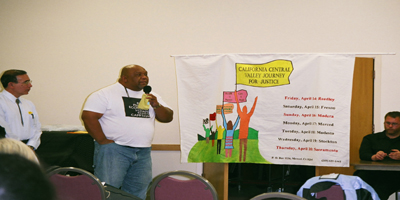
Recently CHAM representatives were in Chowchilla on a "Journey for Justice". The event included panels and speakers addressing the increase in the numbers of prisons and the increased numbers of houseless people in Fresno. Because of CHAM and the work of their allies, the city of Fresno was found guilty of violating the civil rights of houseless people by law enforcement's practice of throwing away their property. The city was forced to pay monetary compensation to those it violated. "When people come together in spirit, we can find the solutions to these problems" says Pastor Togo.

On Saturday October 25th, CHAM will host a forum at their church called, "Reclaiming the Right to Housing". The forum will call for full funding of the National Affordable housing trust fund, a half-million new section 8 vouchers and an immediate moratorium on all foreclosures. The forum will be held at First Christian Church, 80 S. Fifth Street in San Jose, 930 a.m. to 1pm.

Was Jesus a revolutionary, I asked Pastor Sandy. "Absolutely", his voice sang out. Jesus said "blessed are the poor and woe to the rich. Those who are first shall be last and those who are last shall be first". That's the definition of a revolutionary...someone who wants to turn things upside down".

Tags

I Walked for my Family

09/24/2021 - 10:42 by Anonymous (not verified)
Original Author
root
Original Body

Indigenous Peoples Media project on the Longest Walk 2

by Mari Villaluna/Indigenous Peoples Media Project -POOR Magazine

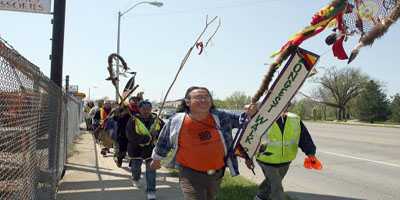
I went on the walk for many reasons. I walked for my family, the Seventh generation, and this land. I walked to carry the prayers of hundreds of indigenous peoples. I walked to learn from elders and spiritual leaders. I walked for the healing of Mother Earth. I walked in the spirit of my ancestors. I walked to carry on the stories. I walked for my descendants.

I started the Longest Walk 2 at D-Q University, which is the Nation's only off-reservation tribal college. It is located in Davis, CA, and staged many Longest Walk 2 events before the Alcatraz Island Sunrise Ceremony. As a student at D-Q University, I felt it was important to go on the same walk that former D-Q U students took 30 years ago. The Longest Walk 2 commemorates the 30th anniversary of the original longest walk while bringing attention to the environmental disharmony of Mother Earth and sacred site issues. In following of the issues of environment and sacred sites, the major issue of tribal sovernity came up time and time again. I started out on the Northern route, which closely followed the route of 1978. The Southern route followed the route of the Sacred Run, which took place in 2006 and went throughout the south. Later on, I would join up with the Southern Route.

The first Nation we met with was the Single Springs Band of Miwoks, and stay for a few days on their rancheria. The youth there were so inspiring, and I learned much from them. One youth named Sammie gave me the energy to run, and told me to never be embarrassed of singing. That day I taught Sammie the D-Q U school song and we ran a quarter of a mile. Sammie taught me a Miwok song, which I sang everyday on the walk for him and his cousins. We even made up our own Longest Walk 2 rap. Now at the end of the walk I can run up to 6 miles, and I sing all the time. I carried these two lessons with me everyday.

The next stop was with the Washos in Lake Tahoe. Where I meet a woman named Roach who later on adopted me as her sister, gifted me with regalia, and provided a woman's space. I enjoyed talking with her and the excitement she had about the walk. I was reminded of how walking is important as a prayer but how dancing for your people is just as important. I then went on to Fallon and met with many Paiutes, and met a young girl named Kiesha Tom who taught me all about her sacred sites of Sand Mountain, and Grimes Point. She is still one of the most intelligent minds I have ever met. We then made our way to Western Shosone terrority, where I learned about the testing, mining, and fighting for land that is happening within their lands. This is also where I met a elder named Darlene who taught me much about what it means to be a woman.

During the state of Nevada, my grandmother told me "It is your turn to now pray for me." She shared with me about how it was hard for her to walk. I then decided not only would I walk, but I would run for my grandmother's healing. It felt very hard to run that first mile I ever ran, and I had to learn how to breathe while running. Sometimes I was the only woman running alongside many guys, but I never forgot why I ran. I ran for my grandmother's healing and her prayers.

Next was Utah, where we attended a pow-wow at the Salt Lake City's Indian Center. This Center reminded me much of my own community back in the San Francisco Bay Area. Then was Colorado, where I had to relearn how to run because of the elevation. I remember looking at the sky in Colorado and thinking the the clouds were the most beautiful anywhere I have seen in the world. The community that touched me the most was at the Ute museum. There were only 4 Natives that lived in this area but they did so many things for us and is still one of the most memorable times I had. This is also where I met my Longest Walk 2 praying partner, Adriano lives on the Southern Ute Reservation.

Next was Kansas, my favorite place was the Mid America Indian Center in Wichita, Kansas. There I found out the Longest Walk of 1978 was at that very same location. I won't ever forget the wind in Kansas either, I would always hope that the wind would push me from behind while I was running. I remember the first dance that I had with my praying partner at a Longest Walk 2 benefit blues concert in Kansas City. I remember walking through Pratt, Kansas. 30 years ago the KKK tried to kick out the Longest Walk, and this time the Principal of the middle school let out all his students to walk with us. Many of the students had also been learning about the Longest Walk 2 as curriculum in their classes. A day before, we ran into a youth at the Walmart, and he asked Adriano and I if we were walkers. We replied yes. I then asked him if he was going to walk with us. He said he couldn't because he had in class detention during the day. Adriano told him that this was historic and he should skip it because that would be a historic day. His mother told Adriano to mind his manners. That day we saw that youth and he was carrying a flag that the Longest Walk 2 carries. It was powerful day.

In Missouri, I had decided to leave the Northern route and join with the Southern Route in Oklahoma. I was very excited to meet with the many nations in that state. I got to meet with the Iowas, Choctaws, Cherokees, and Muscogee Creeks. My favorite moment was being part of a stomp dance with the Muscogee Creeks. I was even asked if I was wearing turtle shells on my ankles because of how I was dancing. I learned much about the Trail of Tears and how there was more than one route taken by different nations. This reminded me of the Longest Walk 2, how there are two routes but only one walk.

We walked through Texas and Arkansas in a few days, and then landed in Louisiana. While in Louisiana, I got a big surprise that Adriano came down to visit me. I spent five days with the United Houma Nation, which was the Nation in Southeast Louisiana that was affected by Hurricane Katrina and Rita. While there, I listened to Creole music, ate lots of white rice, and chilled with elders. The elders found out that Adriano and I jumped in the Bayou and swam around. They told me that I was silly and that didn't I know that there are alligators and snakes in the Bayou. I found out then. I learned about the struggles of the Houmas trying to re-gain control of their Indian Mound, and how soil erosion is affected thier land. We went to a island called Jean Charles Island which is full of only Houma citizens. Micheal, a Houma citizen remarked that if land loss and soil erosion keep going at its current pace that in one generation that island will be gone. I told Adriano "Wow, one day our grandchildren might never see this land. Thats why we are walking to bring light to this." I learned about how thier Nation is not federally recognized and how that played a role in dealing with FEMA. They were one of the last to receive FEMA funds in Southeastern Louisiana. After those five days, I was so sad to leave. When leaving I was told to come back by anytime, and that I would fit in really well in with the Houmas, well except for my Bayou adventure.

Next was New Orleans, the first stop was the Superdome. I went inside with other walkers and we said how we wanted to walk throughout the dome to the security desk. We were told how we couldn't even be standing inside and were quickly escorted to leave. We then joined up with the walk, and walked throughout the 9th ward. We made a lunch stop there, and helped a resident to rebuild the foundation of his home. That was a moment I'll never forget. It was interesting to see how one part of New Orleans, like the 9th Ward was still rebuilding, and while an area like the French quarter seemed intact.

Next we got to hang out with the Choctaws in Missouri. I met an elder there who told me the story about her grandmother who walked the Trail of Tears all the way to Oklahoma and didn't like it so she walked all the way back to Missouri. I had an opportunity to play stickball with other Choctaw women. Stickball is the predecessor to the game of lacrosse. I enjoying playing and getting the ball away from other players. After playing, I was invited by the Stickball Coach to come back and be part of their team in their yearly stickball tournament.

Then there was Alabama, and I remember the 20 mile walks that we did in the hot southern climate. I loved it when it would rain. In Tennesse, the walk stayed at a Buddhist peace pagoda in the Smoky Mountains. Then in North Carolina, I left to go visit Adriano on the Northern Route in Pennsylvania. There in a sweatlodge in Pennsylvania, Adriano and I made our lifetime commitments to each other. I got married and had to leave to go back to the southern route to continue working on the Manifesto for Change. We made a sacrifice of separating for the bigger picture of why we were walking, to bring the prayers of all the Nations and people we met to Washington D.C.

In Virginia, I met a group called Mexicanos Sin Frontares, Mexicans without borders. I told them about the prophecy of the eagle and condor uniting, and that vision is held at D-Q University. That one day again, Natives will be Natives as they were before, without borders. They were helping to fulfill that prophecy without even hearing about it. The late sleepless nights of working on the Manifesto for Change increased with the walk approaching to Washington D.C.

Finally, the routes converged and became one walk again as we had left Sacramento, CA. We walked into Greenbelt Park, MD and the energy was high. I was so excited to see my husband and others on the Northern Route once again. It was good to catch up and spend time with my new family.

I walked through the conditions of snow, mountains, hot, rain, sleet, and lighting. Many times I barely slept. I thought about leaving the walk many times. I cried when I missed my family and friends back home. I spent many nights writing and editing the Manifesto for Change. When July 11, 2008 hit it made all of that worth it. The energy the Longest Walk 2 had was one that I never felt. I have been to many protests/marches and this was very different. I was walking with people who gave up their lives for several months to not just talk the talk but walk the walk. I am honored that I was able to be one of the walkers who helped carry those prayers to Washington D.C.

I walked from that day of Feb 11, 2008 until July 11, 2008 in Washington D.C. I learned about sacrifice while praying. In giving up things, I gained knowledge from elders, learned about issues I never knew, and found more about who I am as a prayerful woman. I met the one the Creator made just for me, and adopted a new family. In 1978, Phillip Deer stated "For some of us, the Longest Walk has never ended." I know this walk and its prayers will carry throughout my life.

--

Mari Villaluna
Coordinator
Indigenous Peoples Media Project of POOR Magazine/POOR News Network

"I believe everything happens for a reason.

People change so that you can learn to let go.

Things go wrong so that you appreciate them when they're right.

You believe less so eventually you trust no one but yourself.

An sometimes good things fall apart so better things can fall together." -Marilyn Monroe

Tags

Revolutionary worker scholar canned!

09/24/2021 - 10:42 by Anonymous (not verified)
Original Author
root
Original Body

by RWS/PNN

I got canned last week. Just like that. My job was helping others find jobs. Now I'm the one without a job. I remember that last day. I helped a man put together a resume. He wanted to get into the maintenance training program of the non-profit I was working for. Another guy walked in and told me about the status of his janitorial gig - a gig I helped him get. He told me he was doing ok, that he was trying to avoid certain negative people. He's trying to better his condition - a man of color trying to get closer to himself, his essence as a black man, a king - in a society that treats you like a damn fool.

We talked about life, his 15-year-old daughter, cell phone and child support payments. I walked him back to the job where we hugged and parted ways.

I put in a year's time into my job at a local non-profit. Its mission, I was told, was housing the houseless and jobbing the jobless. The job was rewarding - I got people jobs and averted a knife attack last December in a supportive housing building operated by the organization; jeapordizing my own safety. But as time went on I realized the organization was less human and more spreadsheet-oriented. One evening after work I jumped into bed and found a spreadsheet where a flannel one should have been. It was a cold night.

Long story short, I got jobs for many people - people formerly homeless and/or incarcerated. Unfortunately, my supervisor was typical of what you find in non-profits in San Francisco - aloof as a piece of ivory in a display case. She walked the halls as if she owned them - like a missionary. And of course, she had the privilege of travelling all over the world, "just to get away".

While I was cultivating relationships with community folk, helping them obtain employment, I was being scrutinized for trifling things - like not affixing my assigned magnet to the in and out board to notify the office where I was at all times. They seemed to pay more attention to this than to the fact that many of my so-called clients were getting jobs. It was bizarre. I was terminated without being given a reason. I was told to clear my stuff out. Just like that.

The day after my termination I took a bike ride through the Tenderloin. I must have run into everyone I'd ever known at my former job. Some were working, some not. It was like going back in time. I went to the EDD office to apply for unemployment. I saw one of my former "clients". We exchanged nods. It was like going back in time. Seeing them was a gift. The friendships we'd forged had not been terminated. We shook hands and hugged without the client/service provider relationship hanging over our heads. This is as it should be.

I kept riding my bike, newly canned from the work world. I sought out the real workers. One guy was in the Embarcadero. His set up was a microphone stand and PA system. From a tape recorder played the music of James Brown. He spun and swayed his hips and slid effortlessly across the pavement in a pair of tight slacks, silk shirt and spit shine shoes. He tapped the mic stand and it rose and fell on command in a limbo-like trance. In a coffee can was his money - 2 dollars and change. He sang, "It's too funky in here! Give me some air!". At that moment the door to one of those fancy downtown French toilets opened and the toilet tech appeared with a dopey smile on his face. It was perfect timing because the tech surely must have needed air. The brother was earning his money. If James Brown was soul brother #1, than this guy was soul brother #2.

I rode for miles. I went back to the tenderloin and through the Mission. What would I do without a job? I stopped at Union Square Park and lay in the grass. I looked up at the sun. It was taking a nap so I joined in. I awoke and jumped back on my bike.

I saw a man blowing balloons and twisting them into beautiful shapes. He walked about handing them out to children passing by. The kids held them like giant candy. One parent told his son to return the balloon when the balloon man said; "Any donation is appreciated". The balloon seemed to turn into broken glass in the boy's hands as he handed it back.

There should be a place where folks who want to blow balloons can blow them. I think balloons are flowers that don't need soil to grow. I think those who blow balloons for children should unionize their collective breath into a balloon blowers union and create and shape another world without broken glass.

Tags

Racists Go Home

09/24/2021 - 10:42 by Anonymous (not verified)
Original Author
root
Original Body

The Minute-men group comes to San Francisco to protest--hundreds turn out to counter protest and the one African Descendent protestor is arrested.

by Dee Allen/PoorNewsNetwork

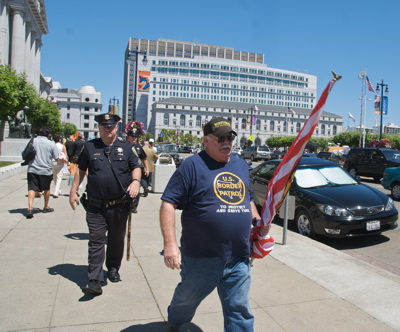
The chants, "Racists go home" and "Smash the Minutemen, smash the border" echo in front of S.F. City Hall, where over 300 activists in solidarity with migrant/immigrant peoples gather in counter-protest of the Minutemen Project. A dozen Minutemen stand to the side, then on top of the steps of City Hall, protesting San Francisco's sanctuary policy of immigrant/migrant youth, calling Mayor Newsom and members of the District Attorney's office "accessories to murder". I stood in solidarity with the immigration activists, making a stand not only for immigration rights but against racism, too.

The Minutemen Project is a group of private individuals who patrol the U.S.-Mexican border for undocumented immigrants and who have played a key role in attracting anti-immigration media to the border. They are, in essence, a White supremacist group with a special focus on immigration and border issues. The Minutemen pose a significant threat to immigrants coming to the U.S., many of whom are escaping the poverty that has washed over their homelands due to economic globalization and the parasitic relationship the International Monetary Fund and World Bank have with developing countries' economies.

As a Black man making a stand against the Minutemen, it is not only about making a stand against racism, but also making a stand for Black, Brown, and multi-racial unity. Issues pertaining to immigration do not end or begin at the Mexican border. The counter-protest is also deeply personal to me in that my paternal grandfather's family is from southern Italy and were forced to change their names on Ellis Island in order to the enter the U.S. in the early twentieth century. The history of immigration of all our families is saturated with the same type of oppression the Minutemen force on La Raza people at the border.

Marching along side people of all race and all communities, I feel proud of the bold statement our unity is making. I begin to chant along with the crowd, feeling excited by the harmony of our voices and then I feel something else- a heavy hand gripping my arm, pulling me out of the safety of the crowd.

I look up to face a white cop, about six feet tall with a blond buzz-cut and black wrap-around sunglasses meant to intimidate. His name reads Kevin Abbey, badge number 1087. A protesting Black man being dragged out of the crowd by a white cop; I knew instantly this was bad. When he finally lets go of my arm I turn to leave the march, to get out of a situation that any person of color knows can escalate out of their favor

.

As I walk away from City Hall, I heard a sudden shout behind me, "Get him!", followed by confusion and a comment from one officer: "I don't know what we are getting him for but we have to get him." Five officers descend on me, four of them White. There are two of them holding each arm, twisting my arms until they feel like they are going to break, with one White cop yelling in my ear, "Do not resist arrest! Do not resist arrest!", although I could barely move. After that, I was quickly tossed into a black-and-white paddy wagon.

They take me to the Fillmore police station, then S.F. County Jail on two fraudulent misdemeanor charges: Battery of a Police Officer and Obstruction of Justice. The battery charge is from a claim that I committed battery on a officer and the obstruction of justice is for allegedly resisting arrest. Although there are two different versions by two different cops about what happened at the march, I was still held for two days until I am released.

For whatever reason, I was singled out. I was one of two people, out of 300, arrested at the protest. They saw me and somehow thought I was weaker and smaller than them, and Black, so they caught me. Being arrested by White cops at a protest against a White supremacist group shows me racists protect their own. For those of us of color in San Francisco, the S.F.P.D. are our Minutemen, patrolling the borders of our city keeping Brown and Black people separate from others. The uniform maybe different, the place may be different, but the action and need to separate is the same.

_____________________________________________________

Dee Allen has plead not guilty to the charges. The misdemeanors in this case are punishable by $2000 and/or 6 mos. in jail and will create a police record. Here's what you can do to intervene on Dee's behalf: Call the SF District Attorney's office and demand that the charges against Dee (his legal name is Donnell Lamont Allen) be dropped immediately. In particular ask for Greg Barge, director of the misdemeanor division.
415.553.1751 -- D.A.'s office, General Inquiries, 8am-5pm.415.553.1752 -- D.A.'s office, General Inquiries, after hours.415.553.1862 -- D.A.'s office, managing attorney, misdemeanor trial division
[The direct line for the managing attorney for the misdemeanor trial division is 415.553-1266. Ask for Greg Barge.]

Contact Jeff Adachi, SF Public Defender, and ask him to intervene directly on Dee's behalf. State your outrage over the fact that two cops can allege whatever they want in a criminal complaint and can impose such troubles on an upright man who has been unjustly singled out as a target for ongoing harassment.

jeff.adachi@sfgov.org415.553.1671 -- general inquiries/SF Public Defender's office

Also contact SF police commissioners, particularly those who are our side:davidcompos@yahoo.com
theresasparks@aol.com
pdejesus@kazanlaw.com
Again, state your outrage over the fabrication in the criminal complaints of two SF cops, the nature of racial profiling exacted in Dee's arrest and demand that the two misdemeanor charges be dropped.

Write a letter addressed to the D.A.'s office attesting to Dee's character. State how you know Dee, and why you love/value/respect him. Again, demand that the charges against him be dropped. Hilary Ronen of La Raza Centro Legal is currently collecting the letters:Hillary RonenLa Raza Centro Legal474 Valencia Street, Suite 295San Francisco, CA 94103

Tags

The Violence of ICE

09/24/2021 - 09:45 by Anonymous (not verified)
Original Author
root
Original Body

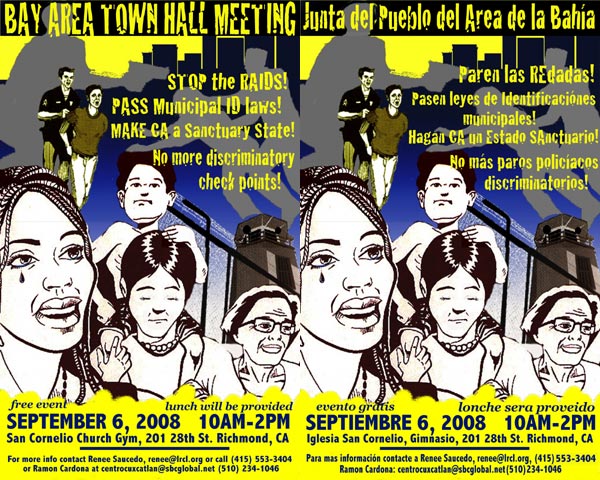
Migrant/Immigrant workers and community members organize a town hall meeting against the violence of immigration raids

by Guillermo Gonzalez/Voces De Inmigrantes en Resistencia- Prensa POBRE

For English scroll down

Yo soy el hijo de una ola… una ola de trabajadores indocumentados… una ola ascendiendo y descendiendo… Toda mi vida hemos estado montandos esta ola, una ola de incertidumbre, una ola de altibajos, a veces sin saber si las altas fueron bajas o si las bajas fueron altas. Una ola que se celebró un momento, y fue culpadó a otro. Una ola que emigraro a estas tierras trabajando duro y dando a sus hijos algo que nunca tuvo, la oportunidad - una oportunidad para permanecer a flote; una oportunidad para comenzar nuestra vida en tierra firme. Estoy en tierra y veo las olas. Veo una ola de Pilipinos, una ola de chinos, un a ola de indios… veo una ola indígena a través de ojos indígenas. Ellos son hermosas. Yo soy la ola.

Esta es mi oportunidad - a navegar a través de instituciones de educacion, mientras escribiendo para POOR Magazine. Yo soy un residente legal de un país que criminaliza a mi familia y mi comunidad. ¿Dónde irá mi ola? Veo ahora una nueva ola - fea, fascista; una multitud envuelta en el patriotismo. Esta ola es Control de Aduanas e Inmigracion (ICE). Los ataques a la zona de la Bahía ha resultado en más de 400 detenciones de personas migrantes. El 2 de mayo de 2008, ICE ataco 11 taquerías de El Balazo adonde arrestaron 63 trabajadores inocentes. Los efectos de esta ola terrible prevalecen en nuestra comunidad. El temor, la incertidumbre y la paranoia que siente cada uno de los trabajadores y sus familias no se desaparecen, si no manchan el corazón y la mente. "Adonde iremos si nos capturan? ¿Qué haremos? Tengo miedo. He oído historias" .. . Lo vivimos.

Esta ola de opresión ha ido más allá de lo que creíamos posible. Una ola terrible - como la ola que nos hizo huir nuestra tierra. He leído acerca de un tiempo similar - un tiempo cuando personas fueron golpeadas en la calle por nada-un tiempo cuando las personas diferentes tubieron derechos sólo en papel. Suficiente es suficiente. Miro alrededor y veo que Jim Crow nunca murió, simplemente cambió su nombre a ICE. Él modifico sus técnicas de violencia, pero él sigue siendo el mismo, con la misma cara, con la misma gente que le apoya con mensajes de odio. Un día alguien va a leer acerca de nuestra situación, nuestro tiempo, nuestra ola… y ellos también leeran que a veces, suficiente es suficiente.

Hace algún tiempo, nuestra ola fue celebrada. Apoyada por el trabajo duro que hacemos por salarios bajos. Todavía trabajamos duro y apenas nos pagan, pero ahora, somos llamados delincuentes. Los culpables de la crisis económica. Blancos para el abuso. Hemos vivido con esto por un tiempo. Pero ahora esta hasta nuestro cuello, y estamos haciendo algo al respecto.

A principios de mayo de este año, los miembros inmigrantes de las comunidades del Área de la Bahía, organizaciones de defensa y derechos de inmigrantes, se reunieron para elaborar estrategias de cómo los condados del Área de la Bahía podrían colaborar para poner fin a las redadas de Control de Aduanas e Inmigracion (ICE), que siguen aterrorizando a todas las comunidades migrantes y tienen un impacto directo a nuestra economía local. Consideramos estas medidas de ejecución como una forma consciente de persecución masiva, que penalizan nuestras comunidades y separadan nuestras familias. El número de detenciones y deportaciones de este año ha creado un clima de temor que también pone en peligro la seguridad pública. Las comunidades de inmigrantes tienen miedo de denunciar los delitos, ir a las clínicas de salud - incluso enviar a sus hijos a la escuela. Como un líder en su comunidad, esperamos que puedan unirse a nosotros y hacer más para crear soluciones regionales a un problema que afecta a todas las comunidades en la mayor área de la Bahía.

La Junta del Pueblo del Area de la Bahia será un foro que reúne a politicos y familias que han sido afectados por estos ataques. Residentes inmigrantes de condados de San Francisco, Contra Costa, Alameda, Solano y Marín tendrán la oportunidad de compartir con politicos los efectos de los ataques, así como hacer peticiones concretas sobre cómo los funcionarios electos puedan responder.

La Junta del Pueblo del Area de la Bahia sera en Richmond en el gimnasio de la Iglesia San Cornelio, 201 28th St. Richmond, una ciudad que tiene una población que es predominantemente de inmigrantes y comunidades de color. Muchas familias inmigrantes se han movido a Richmond, porque no pueden vivir en lugares como San Francisco y Silicon Valley por los precios de renta tan altos. Richmond está experimentando en esfuerzos para aprobar una ID Municipal, pero esta también luchando contra las acusaciones de la policía injustas que apuntan a parar inmigrantes cuando estan manejando.

En Engles

I am the son of a wave… a wave of undocumented workers… a wave rising and falling… All my life we've been riding this wave, a wave of uncertainty, a wave of ups and downs, sometimes not knowing if the ups were downs or if the downs were ups. A wave that is praised one moment, blamed at another. A wave that migrated to this land working hard and giving their offspring something they never had, opportunity--an opportunity to stay afloat; an opportunity to begin our lives on solid ground. I stand ashore and I see the waves. I see a Pilipino wave, a Chinese wave, an Indian wave…I see an indigenous wave through indigenous eyes. They are beautiful. I am the wave.

This is my opportunity--navigating my wave through institutions of higher learning while writing for POOR Magazine. I am a legal resident of a country that criminalizes my family and my community. Where will my wave go?
I see another wave now--ugly, fascist; a mob cloaked in patriotism. This wave of Immigration, Control, and Enforcement (ICE) attacks in the bay area has resulted in over 400 arrests of migrant people. On May 2nd, 2008, ICE attacked 11 of El Balazo taquerias which resulted in over 63 arrests of innocent workers. The effects of this dreadful wave prevail in our community. The fear, uncertainty, and paranoia felt by each worker and their families do not fade, they stain the heart and the mind. "Where we will we go if they catch us? What will we do? I’m scared. I’ve heard stories".. .We ride.

This oppressive wave has gone beyond what we thought possible. A terrifying wave--like the wave that made us flee our home-land. I read about a similar time--a time when people were getting beat on the streets for nothing—a time when people who were different had rights on paper only. Enough was enough. I look around and see that jim crow never died, he just changed his name to ICE. He modified his techniques of violence, but he’s still the same guy with the same face with the same people backing him up with messages of hate. One day someone will read about our plight, our time, our wave… and they too will read that sometimes, enough is enough.

Some time ago, our wave was praised. Celebrated for working hard for cheap wages. We still work hard and hardly get paid anything, but now, we are criminals. Scapegoats for the economic crisis. Targets for abuse. We lived with this for a while. But now it is up to our necks, and we are doing something about it.

In early May of this year, members of the Bay Area immigrant communities, and immigrant rights advocacy organizations, gathered to strategize how Bay Area counties could collaborate to stop the current Immigration, Control, and Enforcement (ICE) raids, which continue to terrorize entire communities and have a direct impact on our local economy. We view these enforcement activities as a massive form of conscious persecution, which criminalize our communities and separate our families. The record number of detentions and deportations this year has created a climate of fear which also threatens public safety. Immigrant communities are fearful of reporting crimes, going to health clinics-- even sending their children to school. As a leader in your community, we hope you can join us and do more to create regional solutions to a problem that impacts all communities in the greater Bay Area.

The Bay Area Regional Town Hall Meeting will provide a forum that brings together elected officials and families that have been impacted by these raids. Immigrant residents of San Francisco, Contra Costa, Alameda, Solano and Marin Counties will have the opportunity to share with elected officials the impacts of the raids, as well as make concrete requests on how elected officials can respond.

The Regional Town Hall Meeting will be held in Richmond (exact location to be announced), a city which has a population that is predominantly immigrant and communities of color. Many immigrant families have moved to Richmond because they can no longer afford live in places like San Francisco and the Silicon Valley. Richmond is experiencing exciting efforts to pass a Municipal ID, but is also dealing with allegations of unfair police check points which target immigrant drivers.

For more information download flyer for Town Hall Meeting

Tags

Homeless and Denied

09/24/2021 - 09:45 by Anonymous (not verified)
Original Author
root
Original Body

by Willie Warren

Friends and volunteers too;
Who still want their housing,
And not sure what to do.
You've done all needed steps,
To get a place to live;
The Public Housing folks,
Find reasons not to give.
They check into your past,
To see if you qualify;
They don't stop to think,
If you don't, you won't try.
Sometimes you get the feeling,
They think that you have lied;
You feel the shadow of,
Being homeless and denied.

While you're with your worker,
Thoughts flow a two-fold way;
You think about your shelter,
And the bed where you lay.
Or if you sleep outside,
Along a road well ridden.
Has your campsite been found?
Or is it well hidden
Then your worker tells you,
You’re not getting the place;
You did hard time in a,
Correctional law space.
Or amends unfinished,
For court not yet been tried;
Lengthening your lifetime,
As homeless and denied.

Objecting to this rule,
Puts delays in your sights;
Now fueling your quest is,
Constitutional Rights.
You leave the Housing Place,
With efforts flowing strong;
To find defense masters,
And correct this great wrong.
First, find an advocate,
That has a current list;
Of those who are seasoned,
In Housing laws to assist.
This keeps the housing hopes,
From ended or have died;
Time to build a defense,
For homeless and denied

Now you need a lawyer,
To start this long process;
And file for equal rights,
With certainty, not stress.
Free or cheap attorneys,
That have a sliding scale;
On retainer fees cost,
To help justice prevail.

Evidence collection,
And all papers concerned;
Are case filing weapons,
To prevent getting burned.
Negotiating calls,
With patience are applied;
Designed to change the course,
Of homeless and denied.

A challenging lawyer,
Agrees to take your case;
This brightens the future,
Of achieving homebase.
The lawyer makes a plan,
To find some salvation:
Federal laws give rights,
To this entire nation.
Signing up for schooling,
To save the soul from scorn
And find the correct path,
To proove you’ve been reborn.
Showing that all your goals,
Are inspired from inside;
It brings defense muscle,
To homeless and denied.

Your former legal guard,
The office of Parole;
Possesses your records,
And maintains silent role.
Acquaintances letters,
And some from certain friends;
Sweeten the strategy,
Introducing new trends.
Thirteen has the magic,
To help a judge believe;
That rebirth has moved in,
And made criminal leave
The stage is now all set.
A lawyer must now ride;
The art and skil to win,
With himeless and denied.

All evidence gathered,
Has been forwardly plunged;
Amends can get settled,
Or felonies expunged.
Housing Office is called,
To make sure there’s no goof;
Back to your Case Worker,
With all new correct proof.
Qualifying returns,
Finally with success;
Your unit is assigned,
You’ve won this game of Chess.
Shelters and camping ends,
Human rights regain pride;
Freedom from thr column,
Called Homeless and denied.

Tags

(Parcel) G stands for Generations Being Housed

09/24/2021 - 09:45 by Anonymous (not verified)
Original Author
root
Original Body

Parcel G proposal to house LGBT elders is fought by NIMBY-ism

by Bruce Allison/PNN elder and poverty scholar

Back when San Francisco was celebrating the beginning of the roaring 20's, a decade of peace and prosperity, the lower Haight district was one of the top places for citizens to enjoy.

Fast forward to 2008. San Francisco is continuing the legacy of anti-discrimation and respect for all by opening units of affordable housing that would be open to lesbian, gay, bisexual and transgender seniors in San Francisco as well as those that are straight.

The property being used as the site for this affordable housing unit is about 3 sq. acres and though it may seem small, in San Francisco it is considered to be quite large. This land was originally the campus of the University of California, San Francisco. In the 1920s, the property was given to the University of California, Berkeley in which they had designed into an extension campus. In 2004, UC Berkeley chose to abandon this property and gave it up to the city in order build affordable housing for seniors and people with disabilites

.

To take this a step further, OpenHouse, a non-profit organization based in San Francisco that provides opportunities and programs for LGBT seniors in the Bay Area, has proposed to make the property of 55 Laguna Street into affordable housing for but not exclusively to LGBT seniors. Though not given preferential treatment, seniors that are LGBT are given priority because many have complained about being harassed by landlords and not given places to live. The area media income required to live in these units would possibly equal 30%.

This past March, the plans for these affordable housing units were put in front of the Board of Supervisors at City Hall. Though the NIMBY(Not in My Neighborhood) citizens voiced their discontent by arguing that seniors that are mostly 70-80 will group together and form a gang that will attack the other citizens in the neighborhood, they were igonored. The Board of Supervisors voted for the plans for affordable housing for LGBT seniors and construction is set to begin in 2009.

Tags

When Welfare Becomes Hellfare

09/24/2021 - 09:45 by Anonymous (not verified)
Original Author
root
Original Body

by Vivian Hain/PNN poverty scholar in residence and welfareQUEEN

As a welfare QUEEN and superbabymama, I have overcome unbelievable obstacles in my life on many levels--rising up from houselessness and domestic violence to recently earning my B.A. I've successfully completed four years in formal institutions of learning after having to fight the welfare department for my right to be there while living in poverty with the help of LIFETIME (Low-Income Families Empowerment Through Education). I didn't realize that I would have to fight for my right in having the true ability to properly transition off of welfare

Having graduated with my B.A. in Public Policy in December 2007, I felt it was time to begin planning for my future in a way that would help me to get to the next level in my life--which would open new doors of opportunity for me. Though I have still been attending community college, taking courses that would update my present skills in multimedia, I was also working at the college as a part-time teacher's aide, so that I could gradually transition off welfare and into the workforce. As a very low-income single parent with children, transitioning off welfare is very hard, especially when the welfare department doesn't help parents who are trying to seek stable career opportunities. But, imagine all of a sudden, getting arbitrarily cut of!

In July 2008, when the welfare department decided to kick me off welfare, instead of sending me the new version of the official forms I needed to give to my doctor so that I could continue receiving care, the welfare department arbitrarily cut me off without advance notice. It is illegal to cut anyone off of public assistance without advance notice. This created extreme financial hardship for my family and me. It also caused me to get behind on my PG&E bill. For more than two weeks I was not able to contact anyone who I needed to talk to regarding my case and the fact that they had cut me illegally off welfare. Immediately, LIFETIME was on the case, advising me to file an appeal and, as my authorized representatives,, tirelessly attempted to contact the Alameda County of Social Services, only to get no response for days�

The next month was nearing and still LIFETIME or myself were not able to reach anyone to discuss my case. So, as my last resort with the help and advice of LIFETIME, I went to my County District Supervisor Keith Carson's office to make a formal complaint on what was happening to me and how everyone at the welfare department had literally dropped the ball regarding my case. I met with County Supervisor Keith Carson's Legislative Aide Aisha Brown. She sat down with me and listened to everything I told her as she took notes. She also asked me for all of the names of my social workers and their supervisors and told me that she would make some phone calls to find out why they did what they did to me.

Before I knew it, she made a single phone call to the welfare office and within fifteen minutes of leaving County Supervisor Carson's Office, I got a phone call from Ms. Brown, telling me that my cash-aid should be reinstated within minutes. She told me that if I had any problems with receiving my welfare benefits to contact her immediately. I was so relieved! This took a massive weight off of my shoulders that had been on me for a month! I am very thankful to LIFETIME for their help and to County Supervisor Keith Carson's office and to his Legislative Aide Aisha Brown for getting me my welfare benefits. "No family should ever have to go through what I went through, yet it is good to know that we have true allies out there who will bat for us."

Tags