Story Archives

Letter to the World Bank by a formerly houseless Poverty Skolar

09/24/2021 - 11:01 by Anonymous (not verified)
Original Author
root
Original Body

by Jack Tafari/by way of Street Roots

Introduction

It all started when Israel Bayer who I knew as Street Roots’ creative director asked if I’d like to speak at the Crisis Innovation’s Fair 2004 in London in the UK which he’d learned of through Michael Stoops who he knows at the National Coalition for the Homeless in Washington, DC.

Upon conferring with Dignity’s Treasurer and outreach co-coordinator Tim McCarthy who some know as tight-fisted and "a bit of a Luddite" according to Amy Haimerl’s feature article Pitching Tents in Denver’s Westword magazine and attorney Marc Jolin who many know as Dignity’s defender and Jo O’Rourke of the British charity Crisis UK who I knew from the contact information Israel provided about the hows and whys, I accepted the invitation to speak as a keynote speaker.

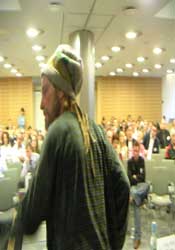
The juxtaposition of keynote speakers at the conference was as startling as the venue at the ABN AMRO Bank in the heart of London’s financial district was stunning. Who would have thought a poorly-educated Rasta and former doorway dweller would ever share a podium with a Harvard and Brown educated PHD senior social scientist of the World Bank? I know JAH who is my light and my salvation and who lifteth I up from the dust of the Earth and causeth I to sit at a table with Princes of Men is ever-living and all-powerful. And God alone guides our steps and protects His children.

Not all of what Dr Woolcock said during his presentation of the "social capital" theory at the conference which guides WB policy I agree with, particularly the vertical linking up and down between those at the bottom and those at the top of the social order. Using the vertical metaphor of a ladder it seems many rungs for the poor to climb from our present location in social space to the top rung where Michael Woolcock is perched. My reasoning was to write Michael the accompanying letter and go straight to the top as we now know each other from the conference.

Letter to the World Bank

Dear Michael,

My name’s Jack Tafari and you might remember that we shared a podium at last October’s CRISIS Innovations Fair on Homelessness and Social Exclusion in London, that we met and chatted over glasses of wine at Crisis’ Skylight Café the night before the conference.

The little village named Dignity where I come from and we talked about is poor at least in terms of monetary capital. We raise funding mostly by writing grants, a skill our grant-writing committee is just learning, and by passing the hat in various ways. We need funding to better serve our community and build the green, sustainable urban village of Our Proposal.

Your presentation of the theory of social capital at the conference, Michael, was strong and compelling, an eye-opener to one such as myself. I see Dignity’s formation now with different eyes and recognize our early bonding among next doorway neighbours for what it was in the terminology of the construct, also the networking across the wider community of our early campaign to gain support to extricate ourselves from those doorways and win sanction from the City. It really is in the power of who you know.

My presentation went less well, I’m afraid, as I hadn’t slept that well the night before. I’d spent the night on the streets of Brixton in S. W. London shivering under a market tarp on some cardboard I’d found due to a miscommunication with our hosts, something CRISIS UK rectified right away upon learning of it. Sleep deprivation is common enough among us homeless people who lack roofs over our beds. But be that as it may.

I’m glad we had the opportunity to meet at the Skylight, Michael, as it establishes a link between our organizations and thought we might network a little as per your theory. I’m wondering if the World Bank would consider extending Dignity Village a capitalization loan of US $1,000,000 to purchase the land on which to build the magnificent eco-village we envision and have sought for so long. I should think you’d be proud to see your "social capital" model in action.

You concluded your presentation by saying "The logic we believe we work to is that we start with an idea, debate the idea, try to measure it, and turn it into practice. A key part of moving forward is recognizing that it also flows the other way. At the World Bank, our directors sometimes spend a week in a village. After a week of going to collect water from a hole in the ground, some come back with the equivalent of a religious conversion and want to start basing policy on practice."

On behalf of our directors whose council I chair, I’d like to invite you and your directors to spend a week in our village. We’ve had many distinguished visitors and guests including a US Vice Presidential candidate and don’t worry, Michael, you won’t have to collect your water from a hole in the ground. Our village is built largely with the recycled scraps of what many people throw away and although the asphalt we live on blisters in the summer and floods in the winter, Dignity has the basic amenities.

We could talk about the possibility of such a loan with your visit, its terms, work out repayment schedules and so forth. I wouldn’t expect the equivalent of a religious conversion among your directors after spending a week in Dignity, but we could share great discussions about basing policy on practice.

Warm regards,

Jack Tafari

Chairman

Dignity Village, Inc

9325 NE Sunderland Road

Portland, OR 97211

(503) 281 1604

(503) 249 6927

http://outofthedoorways.org

Criminal Reality
by Jack Tafari
Reprinted from the September 2004 issue of Street Roots

Call me criminal

Me seh call me criminal

Call me criminal beca’ me live inna de street

haffi scuffle ev’ry day fe get someting fe eat

Doan come a hypocrite

like no Sunday ginnal

Iman live inna de street

Gwan, call me criminal

Wage dem a low, price a rent fly so high

people barely see de shadow flyin’ by

When yuh cyaan afford de int’rest

never mind de principal

go live inna de street

dem a go call yuh criminal

Dem would a call yuh criminal

a nex’ dutty criminal

Gwan, call me criminal ca’ me live inna de street

haffi scuffle ev’ry day fe get somet’ing fe eat

fe put food inna mi belly

an’ shoes pon mi feet

Me seh call me criminal

ca me live inna de street

De workers of iniquity

mus’ wuk overtime

fe enact more laws

waan mek homelessness a crime

When so much poor people

livin’ pon de street today

at de stroke of a pen

dem increase de criminae


Create more criminal

Brand new criminal

Whole heap a criminal


Gwan, call me criminal ca’ me live inna de street

haffi scuffle ev’ry day fe get nuff food fe eat

Doan come a hypocrite

like no Sunday ginnal

Ah live inna de street

Me seh call me criminal

Ah beg yuh listen, politician, Mr. Francesconi
nah baddah blame poor people fe yuh poor policy
It is de Homeless System weh yuh haffi address
mek a institution outa homelessness


System mek we criminal

Mek poor people criminal


Me seh call me criminal beca’ me live inna de street

haffi scuffle ev’ry day fe get someting fe eat

Doan come a hypocrite

like no Sunday ginnal

Ah live inna de street

Me seh call me criminal

Tags

My Cycle of Life- Hand Crafted by Oppressors

09/24/2021 - 11:01 by Anonymous (not verified)
Original Author
root
Original Body

A PNN Youth in Media Narrative

by Kristen Darrelle Chambliss

My cycle of life was hand-crafted by oppressors who hate me. The cycle they put together was to fail. With only a few ways to escape it and they are to go to a professional sport, sell illegal drugs, or death. My vision is to change that and get my education and succeed in life. I will never be like the others who I call sellouts who sell drugs and their bodies on the street. Or ones who walk on the street and act like they know everything and have twenty and hundred dollar bills in their pocket, and see everyone else around them not to be on their level. We are not different.

This all goes back to what one of my teachers Mr. Zarazua was talking about how living in a poor society leads to poor education, the leads to a low paying job. Growing up for me was and still is hard for me. For eighteen months when I was a little baby me, my sister, and my brother was taken away from my mother and put into a foster home. After she got us back for a few years we kept moving form home to home looking for a good place to live in east Oakland. Time after time the bills got higher and more people became homeless. If it wasn’t for my mother, a single parent who loves and supports me, a young black man, I would be dead or in the streets selling illegal drugs.

With every school I went to, I did the best ii could to get my education. The schools that I went to had barely enough money to stay open. Now it is even worse in the new year. Schools across the nation are being shut down while people, innocent people, die oversees. I might not be the best person that I can be but people will never hear about me being arrested after a drive-by shooting, or in a courtroom with a first, second, or third strike against me.

I will break the cycle of failure and try my best to help those around me who needs it. Many people say that he or she will succeed in life but end up in getting caught up in the system. Do I believe that you can change your destiny? Well just ask and I will tell you that you can. I’m not saying that it is not hard but it can happen.

Tags

Introdukshan

09/24/2021 - 11:01 by Anonymous (not verified)
Original Author
root
Original Body

by Jack Tafari

Introdukshan

Me seh what a weh de policebwoy dem a gwan

inna disya Oregon,

disya Salem, Oregon

Seem seh ev'ryweh me tu'n appear Babylon

inna disya Oregon,

disya Salem, Oregon

Dem approach I fram mi lef'

an' dem come fram mi right

an' dem ax so much question is mus' book dem write!

Dem waan know mi name an' weh me come fram

weh Iman did born

an' weh me a galang

weh me got inna mi pocket dem

an' up under mi tam

an' when me eat mi brukfas' even weh me 'ave fe nyam!

Now Ah could a get vex

an' gaan pon de attack

but listen carefully 'ow me answer dem back

Me seh, "Mi name is Jack Tafari,

me nah come fe do no wrong

mi name mean Peace inna de Amharic tongue

an' when yuh look inna mi pocket nuh

yuh nah go find no gun

ca due to Jah protekshan now

me nah go walk wi' one

Now some claim seh me is a Englishman

an' some nex' one seh me is a 'merican man

but case yuh never know

me is a conscious man

an' Ah did born right yahso inna Creation

So run mi damn ID nuh, man,

den leggo mi han'

an' come out a mi life wi' yuh bagga question

Me seh run mi damn ID nuh

an' den leggo mi han'

an' come out a mi life wi' yuh bagga question"

Me seh what a weh dem policebwoy deh a gwan

inna disya Oregon,

disya Salem, Oregon

Tags

A Walk of Resistance Through Poverty, Homelessness and Homicide

09/24/2021 - 11:01 by Anonymous (not verified)
Original Author
root
Original Body

Low-income Youth and adults from five Bay Area neighborhoods write and produce their own film focusing on the violence, poverty and racism affecting their communities

by Byron Gafford and Tiny

When the side

Of the road is

Marked by death.

With pictures, balloons,

Teddy bears, alcohol bottles,

And Candles.

Where drive by shootings

Occur leaving bodies

Where they drop.

An excerpt from WHEN THE SIDE OF THE ROAD IS MARKED BY DEATH by Byron Gafford, poet,author and co-director of A Walk of Resistance through Poverty, Homelessness and Homicide a POOR Press PRoduckshun ©2005

"Another death occurred on the block in my neighborhood…that's Bertha Lane"
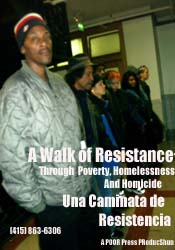
Poet, author and poverty scholar, Byron Gafford and I were meeting to discuss a showing of our new film at a workshop we were going to run at Unity High School in Oakland next week when he unveiled his newest group of poetryjournalism based on a drive-by shooting of a young African Descendent male in his Bayview neighborhood. The disturbing thing is, this shooting and Byrons' new poetry were the very issues that we had focused on in our short narrative documentary film; A Walk of Resistance through Poverty Homelessness and Homicide.

"It was a year ago when another young man was gunned down on the same street not far from this recent shooting" Byron continued on to relate the fact that since this most recent shooting another shrine appeared which included the remnants of this young mans' short life; Pictures, Balloons, Teddy Bears, Alcohol Bottles and candles for the spirit that remains.

Homicide (murder) is the leading cause of death for Black youth;14-24 years of age and the second leading cause of death for Latino youth in the US. "

The saddest thing of all is Byron and I weren't surprised. In the process of making the collaborative film which was co-written, co-directed and co-filmed by the youth and adult poverty scholars in POOR Magazine's Digital Resistance Program we all brought our personal experience as residents of the Bayview, the Mission, The Tenderloin and across the bay in Oakland to the planning process, which included the experience of having friends and family shot down in their youth. We also explored related issues such as the root causes of poverty, racism, gentrification, media stereotyping, substance abuse redlining, police harassment and homelessness and how these issues have a direct impact on the youth and their families trying to survive in these communities.

After discussing all of these issues we did research on the actual numbers of families in poverty, facing homelessness, and being killed by a firearm in Amerikka. Our findings were truly frightening.

In 2003 the number of Americans living in poverty rose by 1.3 million"

Our research made us more determined to try to affect change in our respective communities through education, awareness and grassroots media production. So after all the poverty skolars/ filmmakers were schooled in the basics of how to operate a camera, direct , edit and write a film they set about producing POOR's recent form of media resistance. A Walk of Resistance, that is.

The film is told in 8 multi-generational, cross cultural voices, walking through five neighborhoods opening with Byrons' journey through Double Rock (Housing Projects), progressing to a bi-lingual tour of East Oakland's youth violence told from the poetic perspective of immigrant youth skolar Muteado and proceeding back to the tenderloin with the voices of houseless African Descendent elders and houseless and at-risk families, and back to liquor stores on Third street in the Bayview ending with a visual and meditative tour through Sundial Park and an ironic voice from POOR's grandmama. A walk of Resistance is truly educational, speaking the truths of poverty and oppression, struggle and survival from the folks who experience it firsthand

Don’t be afraid those
Are the spots where
A mothers child lost
There life…..BY GUN FIRE.

A walk of Resistance Through Poverty, Homelessness and Homicide is in DVD format /running time 15 min. To book a showing or purchase a copy please call POOR Magazine at (415) 863-6306 or email us. As well as a piece of literary and media art in film we also view it as an educational tool for low-income youth and adults, so the Filmmakers are also interested in conducting live presentations/panels and workshops on these issues at schools, community organizations , film festivals or other venues.

Tags

Violencia en Nuestras Comunidades

09/24/2021 - 11:01 by Anonymous (not verified)
Original Author
root
Original Body

An immigrant mother and resident of Sunnydale responds to the ongoing violence in her community.

by Teresa Molina/Reportera para Prensa POBRE

For English please scroll down

Era una tarde humeda y fria como cual quier tarde del mes de diciembre. Estaba en la parada del autobus en frente de los projectos de Sunnydale en San Francisco donde vivo esperando para ir a trabajo. A mi derecha se encontraban dos personas que temblaban de frio igual que yo. En ese instante nos tiramos al piso sin importar que nos golperamos y que acabaramos ensima de uno y de otro.

Escenas como las que acabo de describir son frecuentes en los proyectos de Sunnydale. La violencia es tan usual en este vecindario que la gente ya esta acostumbrada a ver heridos, muertos, a esquivar las balas y a tener miedo. Lo ironico es que solo la gente que vivimos alli nos damos cuenta de lo que pasa. Los medios de comunicacion no se molestan en darnos la importancia de reportar sobre nuestras situacion. En esta sociedad, comunidades pobres y de color como mi familia son aislados y marjinados. Esta misma marjinacion y desolacion que existe en mi vecindario es en si violencia contra mi comunidad.

A simple vista el vecindario aparenta ser tranquilo. Es usual ver gente afuera sonriendo, sentados platicando como si todo estubiese bien. Pero todos los dias al salir de mi casa veo una escena que se contrasta con grupos de personas que beben cerveza y usan drogas en las calles. Al continuar mi partida noto que las casas son de colores verdes, azules y rosados como pasteles. La pintura de las viviendas estan descascaradas como la cascara quebrada de un huevo herbido al prepararse para comer. En la calle siempre hay bolsas de plastico de basura que hacen que el vecindario huela a ropa mojada y a comida echada a perder. La unica escuela que exciste en mi vecindario es una escuela primaria con paredes similares a las viviendas. Solo ay una tienda que suele vender verduras, carne y comida preparada a precios inflados. No tenemos bibliotecas, centros de recreaciones para niños y jovenes, no tenemos lavanderias, no tenemos nada.

“En lugares como Sunnydale la gente no tiene oportunidades economicas, de salud y de educacion. Los pobres somos vistos como basura y la pobresa se ve como un poblema psicologo”, nos conto Sharon Hewit, directora de la organizacion comunitaria Comunidad de Liderasgo Academico de Respuesta de Emergencia (CLAER).

CLAER es una organisacion de base comunitaria que da servicios directos a familias afectadas por la violencia. Tienen programas de abogacia, recaudan fondos para familias y hacen trabajo de capacitacion de liderasgo de su base. Esta organizacion esta localizada en una zona aislada del Sureste de San Francisco por el Cow Palace y de los proyectos Sunnydale que son los mas grandes de la ciudad. Pero sin embargo nunca se escucha sobre las condiciones en las que viven la gente alli. Segun Sharon esto es problematico.

Tensiones raciales son comunes en zonas como Sunnydale. Al preguntarle a Sharon que piensa sobre la violencia entre Latinos y Afroamericanos ella contesta " Pienso Mierda. No ay violencia de Morenos contra Morenos ni Latinos contra Morenos, ni Morenos contra Latinos. Lo que pasa es que eso nos hacen creer los medios de comunicacion. Nos dicen que la violencia la traemos en nuestros genes. La razon por la que se pelean es por que viven juntos y son vecinos. Si gente blanca estubiera en esa situacion economica ellos se pelearian tambien. ¿Por que no se habla de la violencia entre blancos?"

Sharon Hewitt nos informa que la violencia es un sintoma social que surge cuando ay falta de justicia. Para combatir la violencia, Sharon cree que necesitamos abrir espacios de dialogo y analisar los factores exteriores. Sharon nota que es dificil combatir la violencia que surje en las calles cuando tenemos un gobierno que se vasa en ella. Esta violencia es propagada por este gobierno hacia sus ciudadanos y las personas de Iraq pormedio de la guerra. Tenemos que analisar el papel de los medios de comunicacion y como toleran la violencia y los asesinatos. Segun Sharon tenemos que cambiar la constitucion de este pais, en particular el derecho de tener armas. Este articulo de la constitucion Estado Unidense es irrelevante ya que se usa contra nuestras familias.

Como madre de cinco hijos, e inmigrante de bajos ingresos, tengo que proporsionar vivienda economica a mi familia pese la violencia. Al analysar esta situacion de violencia, me eh preguntado ¿que es la violencia? La violencia no solo es propagada por los balazos y el miedo. La violencia se impone en nuestras comunidades dia tras dia y es la de no tener accesso a escuelas, a tiendas, a programas para jovenes y al cuidado de nuestra salud. Las raises de la violencia bienen de la marginazion, del racismo, de la pobresa y de la injusticia, que son impuestos por el systema. El gobierno nos muestra violencia y a la gente no nos queda otro remedio que sobrevivir al responder con mas violencia.

CLAER esta localizada en el 299 Sunnydale Avenue en San Francisco.

Violence in our Communities

It was a cold and moist afternoon like any other December day. I was standing at the bus stop in front of the Sunnydale Housing projects in San Francisco where I live waiting to head out to work. To my right there were two people shivering from the cold just like me. All of a sudden, we heard bullets buzzing next to our ears. At that moment we hit the ground without caring if we hurt ourselves while landing on top of each other.

Scenes like the one I described are frequent in the Sunnydale projects. The violence is so common in this neighborhood that the people are used to seeing people getting hurt, people dying and to dodge the bullets. Ironically, only the people who live in this area know of the situation. The media does not bother reporting our situation. In this society, poor communities of color, poor families such as mine, are marginalized and isolated. This kind of marginalization and desolation that has existed in my neighborhood is in of it self violence against my community.

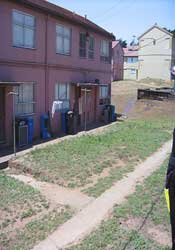
On the surface the neighborhood appears to be tranquil. It is common to see people outside their homes smiling and sitting down while enjoying a conversation with out a worry in the world. However, everyday as I leave my home I see a contrasting scene of people in the streets drinking beer and doing drugs. As I walk on, I notice that the homes are of pastille green, blue and pink; the paint of many is chipped and cracked like the shell of a boiled egg that is about to be eaten. Out on the streets there’s always ripped plastic trash bags which make the neighborhood smell like wet clothes and spoiled food. The only school that exists in the neighborhood is an elementary school whose walls are similar to those of the homes. There is only one store that sells vegetables, meat and prepared food at an inflated cost. We don’t have libraries, youth centers, we don’t have laundromats, we don’t have anything.

“In places like Sunnydale people don’t have the economic, health and education opportunities. Poor people are seen as trash and poverty is seen as a mental problem” said Sharon Hewit, director of CLAER (Community Leadership Academy of Emergency Response), a community organization.

CLAER is a community based organization that provides direct services to families who are affected by violence. They have advocacy programs, they raise money for affected families and develop member leadership. This organization is located in an isolated area in Southeast San Francisco by the Cow Palace and by the largest projects in the city: the Sunnydale projects. Ironically, we never hear about the conditions that people live in this area. To Sharon, this is problematic.

Racial tensions are common in areas like the Sunnydale projects. When Sharon was asked her opinion on brown and black violence she answered that she doesn’t think “Shit. There is no brown on black violence, black on brown, or black on black violence. What happens is that is what the media makes us believe. They tell us that we carry the violence genes. The reason why they fight is because they are neighbors. If white people where in the same economic situation they would fight amongst each other too. Why don’t we ever hear about white on white violence?”

Sharon Hewitt informs us that violence is a social symptom that surges when there is a lack of justice. To stop the violence, Sharon believes that we must open up spaces for dialogue and that we need to look at outside factors. She notes that it is difficult to fight the violence that surges in the streets when we have a government that is based on violence. This violence is perpetrated by this government towards its people and the Iraqi people through the war. At the same time we need to analyze the role of the mass media and how it tolerates violence and homicides. According to Sharon we have to change the constitution and the right to bear arts for this amendment in the US Constitution is archaic and is constantly used against families.

As a low income immigrant mother of five children I have to provide housing for my family regarding of violence and fear. While analyzing the issue of violence, I have asked myself, what is violence? Violence is not only propagated by bullets and fear. The violence we live in our communities day in and out is manifested by the lack of schools, stores, youth programs, and health centers. The roots of violence come from the marginalization, racism, poverty, and from the injustice that is imposed by the system. The government shows us violence and as people we don’t have any choice but to respond with violence.

CLAER is located on 299 Sunnydale Avenue in San Francisco.

Tags

Poverty Voyeurism and other acts of default colonizers

09/24/2021 - 11:01 by Anonymous (not verified)
Original Author
root
Original Body

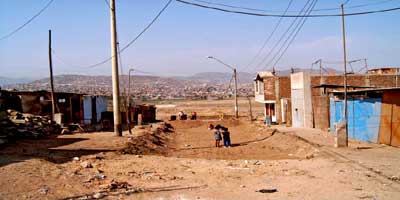
by By the poverty scholars in Villa El Salvador, Lima Peru; Writer Facilitator Amanda Smiles/PNN

I struggle to smile as the tall gringo shoves the lens of his camera in my face. Focusing on my small, crowded classroom, and the tiny, eager faces of my students, I ignore the expensive clicks and hisses his camera makes as he steals his image of poverty. This gringo, whose name I do not know, because he has only introduced himself once, hurriedly, behind is costly black box, has recently arrived in Villa El Salvador, a shanty town of Lima, Peru. He is a volunteer, come to witness the poverty that is more than a Pulitzer worthy photo- it is our lives.

It is summer here in Peru, sticky, sultry summer, when the children are out of school and the parents still have to work. In Villa, poverty is in our roots, we have all grown up in homes made of no more than plywood, tarps, and tin roofs, so we all know the importance of education. This small, but vital, community run school, ensures that our children continue to learn even without textbooks. At the best, our children are given another chance that our poverty has robbed of them…at the last they are guaranteed one full meal a day, something this does not come easy in these parts.

The gringo’s camera wheezes again, as he captures another moment of our “romantic” lives. In some cultures they believe a photograph steals one’s soul. I believe the gringo’s photographs are stealing our history, because how can you sum up our entire struggle in a single photograph?

Villa El Salvador was founded in the 1970’s, after a mass migration of peasants from the highlands left many families homeless in Lima. A group of families squatted on private land, during a key weekend when an important international meeting was held in Lima, preoccupying the police. This lended several days for more families to assemble on the land, and by the time the government had time to react, it was impossible to evict them. Eventually, after several armed conflicts in which the peasants didn’t budge, the government compromised and moved them to the sand dunes, now Villa, and legally gave them the land.

I watch as the gringo moves on into the toddler’s room, where instead of helping to hold and feed the little ones, he will continue on with his camera.

Once the land was given to the families, it was divided evenly amongst the squatters and everyone was given the same size plot to build on. Land was also set asides for school, hospitals, parks, and, eventually, a university. Groups of homes were divided into sectors and each sector elected a Sectary of Education, Health, Economy, and Security, who would take up and solve community issues. Also, these Sectaries met with the general sectaries of the entire community of Villa, to plan and organize the future of Villa. These Sectaries included the Sectary of Women, Youth, and Human Rights.

During the 1980’s, when the terrorist group the Shining Path massacred and committed genocide throughout Peru, a second wave of migration to Lima occurred. Again, poor peasant families from the highlands journeyed to Lima, leaving their homes and farms in order to flea the reign of terror the Shining Path held over the Andes.

These families, poor and with only what they could carry, came to Villa for support. In response, the community organized soup kitchen, in which everyone took turn participating in. Mother’s clubs, run by women, organized the Vaso de Leche program, which delivered milk to poor families throughout Lima, ensuring that every child drank one glass of milk a day.

The children gather around the gringo in the playground, begging to have their picture taken. I wish, instead of photos, which the gringo has graciously offered to post online, a luxury far from our reality here, he could offer them a glass of milk. Clean food and water are what our children need, not their photos on the Internet.

When the Shining Path finally burned its way into Lima, it was Villa El Salvado that was terrorized the most. By its very existence, Villa was the antithesis to the Shining Path, whose mission was to destroy everything in the wake of poverty and corruption. Villa, on the other hand, chose to build and create solutions to help its people. The Shining Path pinned Villa as its enemy, planting bombs in important buildings, like the Vaso de Leche storage warehouse, and assassinating some of Villas most influential community leaders.

Still, the community of Villa resisted the Shining Path and took an active role in speaking out against terrorism. Community leaders continued to organize, despite death threats, protests were staged, and programs like Vaso de Leche remained running, even through the Shining Path deemed them “treacherous”:

Due to its resistance to the Shining Path, Villa won international recognition and awards for human rights and in 1986 was nominated for the Nobel Peace Prize. More importantly, though, during Peru’s darkest hour of the 20th century, Villa burned as an inextinguishable candle, illuminating the lives of Peru’s poor with hope.

Today, we are still taking an active role in planning for our future. Last year, the community finalized plans for the next 15 year, where we want Villa to be in 2021. Any person elected in Villa must follow these guidelines set forth by the community, ensuring that the needs of the residents are met and that we will continue to strive.

The gringo heads toward the courtyard, making his way out of the school. For a man who has everything, wealth, education, fair skin, he has, surprisingly, left our community with nothing. Yet, our community, which began with nothing, not even land, and still sustains on barely any resources, has given everything we can to create a ladder, or at least a safety net, out of poverty. While the gringo is now a ghost here, we have our history, of hope and resistance, etched in the scars of our streets, left behind for our children, when their turn comes.

Tags

I wouldn’t have made it through school without them

09/24/2021 - 11:01 by Anonymous (not verified)
Original Author
root
Original Body

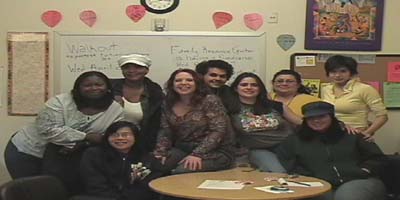
The Betty Shabazz Family Resource Center at City College of San Francisco provides free child care for low-income single parents who are students and needs the communities’ help to stay open

by Tiny/PoorNewsNetwork

"I wouldn’t have made through College without them", When I told my good friend Martina that I was writing a story on the Betty Shabazz Family Resource Center at City College of San Francisco she revealed a little known fact to me about her educational background, " I was barely making it financially with my two kids and then trying to go school on top of that, there would have been no way without their great program" My friend is now a graduate student at Howard University and there is no stopping her. I was thrilled to hear her experience but the disturbing part of it is how close low-income single parents teeter on the edge of survival and how important places like the Family Resource Center really are….

"Do you have Calworks?"

"I already told you I can’t qualify for Calworks….but I am very low-income, I am working poor and I am trying to go school to improve my situation isn’t there some support you can give me?.."

"Well , then there’s nothing we can do for you…"

Martina’s revelation brought me back to a horrible conversation I had in December of Last year. I had been told that " nothing we can do for you" line far too many times in my homeless, poverty stricken life but somehow this time it cut even deeper. The bearer of that disaffected news was an Extended Opportunity Programs and Services (EOPS) "advocate" at City College of San Francisco who seemed to have a case of job burnout. The "help" I was asking for was a referral for a child care subsidy, a center or something to help pay for the exhorbitant costs of child care if I wanted to go to school. But in the end the lack of help and flagrant disinterest I got from (EOPS) was just one of many "no’s" that I and countless other low-income mothers and fathers receive daily when we try to get any kind of support and in particular when we seek affordable child care

Currently the rate of most child care providers is running at approximately $10-12 per hour. If you are only earning $12-15.00 per hour that is over 90% of your salary, and for middle income folks its hovering at %75. The other sad fact is single mothers and fathers are not rewarded by this society to care for their own children, i.e., parenting, even in the supposed modern, conscious and aware 21st century is still not viewed as a valid form of "work" even though those of us doing that parenting know its one of the hardest jobs you will ever do. Welfare dictates that single parents get a job, any job as soon as their baby reaches 8 months old

And to further that inane logic, if you are on Calworks, the system (i.e. welfare) values child care "work" at below minimum wage, i.e, the going rate they pay for child care is $4.50 per hour under two which drops to $4.00 once children reach the grand old age of two. And of course this whole situation is so shameful when you compare it to countries like Canada, France, Germany and many parts of Europe which provides free, yes I said free, child care for all parents.

So with my head hanging very low and barely able to muster up a goodbye me and my stroller bound son stumbled out of the EOPS bungalow onto the CCSF campus. With tired feet I pushed the stroller outside into the bright, cool January sun. We climbed slowly up a hill to a hidden elevator in the back of the building and began the ascendance up to the Student Union plaza. As the creaking metal doors of the elevator opened, the corner of my eyes caught the faster than light movement of several baby legs through a floor to ceiling glass wall in front of me.

I shook my head thinking my mind was playing tricks on me, but then when I looked back someone was waving at us through the glass. "Tiny, how are ya doin?"
It was the singsong voice of my companera, Tracy Faulkner, former welfare mom, fellow activist and tireless advocate for the rights of poor single parents

Within seconds I had poured my dilemma out to her. "Well, Tiny it looks like you came to the right place do you know about the PEP project?"

"NO!?"

"The Parent Education Project (PEP) is a project of The Betty Shabazz Family Resource Center that provides parents with 9 hours of free child care per week and in exchange we only ask the parents to volunteer 2 hours of their time per week." Tracy who is the executive director of the Center went on to tell me that although there was a waiting list I had a chance of getting in for the upcoming semester.

"Oh my god, that would make school possible….Thank-you wonderful people"

That was over five months ago and since then, thanks to the innovative service provision of the Family Resource Center I have been able to pursue a formal education. The center includes a family friendly computer lab, and the amazing PEP project that allows working poor parents like myself to get free child care while we are in school.

"I wouldn’t have made it through school without this place" I spoke to Liz, another one of the staff about her experience. Liz, who like most of the multi-cultural women and men who work at the center began as a low-income mother on Calworks trying to pursue an education when she enrolled in the program.

"Dr. Betty Shabazz was herself a low-income single mother who with help from the community was able to raise her children and pursue an education and now has a Ph.d
We are trying to be ‘the community’ for the parents who come to our center" In a recent conversation I had with Tracy about the Center’s current financial needs she described the reason for the Centers’ namesake.

"Due to current budget cuts we are barely surviving and we need to raise funds just to provide our kids with snacks and pay for printer cartridges so the students can print out their papers for school in our computer lab" Tracy went on to explain that there is a huge demand for the Center to be open in the summer because otherwise parents can’t attend summer school at City College. I heartily agreed knowing that my now-frolicking 19 month old son in the next room will not only miss this great place but I won’t be able to afford to send him anywhere else which means I won’t be able to go to school.

As I left the Center that day the words of all the mothers and fathers I spoke to floated through my mind with one line being a constant, "I wouldn’t have made it through school without their support" which is why its up to the community to make sure that support is always there….

The Family Resource Center is having a fundraiser on Wednesday, april 20th at 6:00 pm at Sadies’ Flying Elephant at 491 Potrero Av ( at Mariposa) in SF ($10 donation at the door or whatever you can pay- 21 and over) For more information you can call the Betty Shabazz Family Resource Center at (415) 239-3109 or if you miss the fundraiser you can send them a donation in the form of a check or money order made payable to Student Parents United and send it to The Family Resource Center 50 Phelan Avenue Box # SU205 San Francisco Ca 94112.

Tags

Undergrounding- A Bayview Tale of Resistance

09/24/2021 - 11:01 by Anonymous (not verified)
Original Author
root
Original Body

Bayview Residents Demand City Funds

by Ace Tafoya/PoorNewsNetwork

An 86-year old Bayview Hunters Point resident, was baffled when she received a letter from the City of San Francisco’s Department of Public Works Bureau of Street-Use and Mapping describing a construction project for underground wiring on her street. She was concerned because she didn’t have the money to pay for the project that the letter was describing. After putting $1500 on her credit card, she became so entrenched with worry about the fate of her home and the debt that she had just incurred on a fixed income that she, quite literally, worried herself to death.

Another 62 year-old Bayview Hunters Point resident, took out a high-interest loan at the rate of 19% to pay for the underground wiring.

Imagine their anger and disbelief when they found out that the City had funds to help residents like them pay for this work.

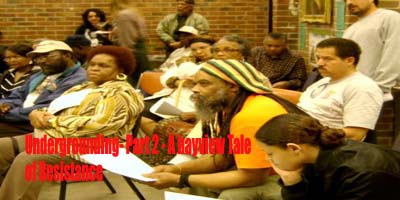
These stories are becoming all too common as the City and County of San Francisco embarks on a number of new projects to redevelop neighborhoods like the Bayview. On Saturday, April 16 on a typical San Francisco morning, POWER (People Organized to Win Employment Rights) and many residents of Bayview Hunters Point gathered at the Bayview Anna E. Waden Branch Library to voice their concerns and brainstorm solutions over the underground wiring and new construction going on in their neighborhood. POWER, an eight-year old membership organization based in the Tenderloin neighborhood, brought together residents in response to concerns they’d heard about this project.

Beginning late last year, residents in the Bayview began receiving letters from the City detailing an underground wiring process that involved placing the utility poles located in the neighborhood underground. The letters stated that homeowners were expected to pay for this work to be done by a certain date, or face the threat of a lien being placed on their homes.

After receiving a tip from a resident, POWER began to research this project and found that the City had a grant program that would subsidize up to $4000 per property for qualifying low-income homeowners. The vast majority of residents had never even heard of the grant program—some had paid for the work to be done out of their retirement savings, or had gone into debt to avoid having a lien placed on their homes. Many of the homeowners in the community are elderly families living on a fixed income.

"Improving the quality of life in San Francisco - we are committed to teamwork, customer service and continuous improvement in partnership with the community," reads the Department of Public Works Bureau of Street-Use and Mapping stationary. Judging by the presence of more than fifty residents and concerned citizens of Bayview-Hunter's Point at the community meeting, this mission statement is debatable.

"I can't believe City Hall," shouted Regina Douglas, a founding member of POWER and a former resident of the Bayview. "We don't have to look (at) Iraq. We've got terrorism right here at City Hall."

Douglas’ comments echoed many at the neighborhood meeting Saturday morning. Many expressed concerns for their elderly parents and relatives who have been receiving these letters and are taking extraordinary measures to try and make ends meet—and on top of it all, they are attempting to scrape together the money to pay for a project that many residents say they neither asked for nor knew about.

"We are organizing, we're together out here, we are going to make sure everyone entitled to it, gets it," Espanola Jackson, a long-time activist said, referring to the grants available to low-income residents, but hidden from public notice by city lawmakers conveniently.

"(We need) the Mayor's Office on Housing, the Public Utilities Commission and PG&E to explain to this community why nobody knew they had money available," Julie Browne, a lead organizer with POWER called out as she sauntered back and forth across the brick-filled meeting room.

Most of this underground construction will be done by PG&E, unless residents find an independent contractor to do it themselves. The smoke from PG&E’s power plant engulfs a community already crippled by high unemployment, police surveillance, and the highest asthma rate in the country. POWER members and residents of the Bayview are forced to ask: Why do the politicians and local representatives continue to ignore and terrorize this community? Why are we being forced to pay a corporation that has crippled this community, when that same corporation should be paying us reparations?

"They (City Hall) want you to give up...They want your house, they're doing everything they can to take it," cried Leboriae Smoore, a resident of the Bayview since 1974. "So you have to fight back to keep it!"

That's what this neighborhood meeting was called for – to fight back against the City agencies and corporations that promote the racist housing policies which push working class communities of color out of the city. We demand equality. We demand attention. We demand respect.

Residents of the Bayview and members of POWER will get the attention that they deserve—in fact, they will turn out in full force at 6pm Wednesday, April 27 at the Southeast Facilities Commission meeting which is being held at Southeast Community College in the Bayview. It is here at this meeting that representatives from PG&E will try again to explain why residents in the Bayview, a community with a median income of $18,000 per year, is being forced to pay for a project that they never even asked for, either with money, or with their homes.

If you received a letter requiring you to pay for your utility wiring to be placed underground, contact POWER today at (415) 864-8372 to find out more about the City’s CERF grant program. Or contact the city directly at (415) 252-3180.

Tags

Deadly De-Hydration

09/24/2021 - 11:01 by Anonymous (not verified)
Original Author
root
Original Body

Houseless folks in Arizona die due to inhuman heat and severe lack of shelter beds

by Michael Woodard/PNN poverty Scholar

"Hey joe… joe… JOOOOOOE!" But he didn't answer back, as I screamed at my friend to wake up, rivers and oceans of sweat crawled down my back. Every stitch of my tattered clothing clung to my overheated body, adhesed by days of Phoenix's inhuman 110 and above summer heat.

Old Black Joe, as he called himself ever since he landed on Arizona's homeless streets several years ago, was an African Descendent elder with a bad story, a sad story and left-behind life, just like all of us have, but in Joe's case, somehow it was sadder, at least to me. Joe was decidedly un-political, and if you tried to talk to him about the plight of the Black man in Amerikka, he would tell you once very politely in his well-enunciated, Southern hotel bell-man trained English, to hush, if that didn't stop you he would tell you again but this time it wouldn’t be so polite.

Of course I learned fast cause I wanted to be Joes' friend, he was full of some of the best Lousiana-Cajun-African folk-tales and it made Summer on the streets of Arizona a little less painful.

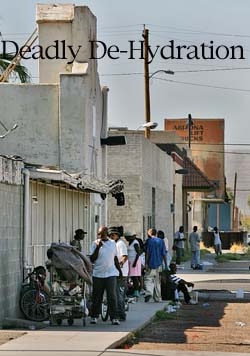
But this Summer was different. Instead of a few days each week above 100 degrees, 110, 112, 115, and even the whopping 116 degree weather has rolled on and on for over three weeks. That kind of weather is hard for everyone but the little known story, is the houseless victims who are literally stuck outside, on the sidewalk with little or no access to water, air conditioning or even the much sought after, shade, die. So far this summer the homeless death count is over 14 people

Now, the story is complicated; first it begins with the root causes of homelessness and poverty in Amerikka, leading to the break down of the psyche, the power and the humanity of black people, brown people and poor white people, which leads to mental illness, and substance abuse, but the other equally important issue is the fact that there is a serious shortage of shelter beds in Arizona and in the heat, which in some ways is more dangerous than cold weather for folks living outside, is actually deadly.

According to Bill Manson, development coordinator for Central Arizona Shelter Services (CASS), an estimated 8,000 homeless people live in Maricopa County, where Phoenix and its suburbs sit, but only 1,600 shelter beds are available citywide. Add to that, there are a lot of houseless folks, like Joe and up until last week, me, so oppressed, so tortured by their many past lives and spirits, that they refuse the help that is available, i.e., in the depth of some of the worst heat there were government workers, social service agencies and volunteers driving across the city giving out fluids and medical care out and some of the folks they reached refused the help.

I guess for me the wake-up call was the death of Joe, who after I kept yelling at for almost an hour that 115 degree afternoon in July, until I realized he wasn't waking up. Ever again.

Tags

Get on the Bus while you still can

09/24/2021 - 11:01 by Anonymous (not verified)
Original Author
root
Original Body

The people are planning a city wide fare strike to combat the upcoming MUNI fare hikes

by Tiny/PNN

"Excuse me Ma’am, you need to board in the front of the bus, Ma’am did you hear me? – you need to get on in the front of the bus……Ma’am….Ma’am…!!"

At the last angry command, the more than a little bent over African descendent elder who wore only one duck-taped shoe and a pair of soiled pink polyester pants, mumbled a frightened response to the ground. In one very weathered hand she clutched a ball of fabric that was her waistband, and in the other a fragment of air where a purse, cane or other acroutremount used to dwell.

After one more attempt the tiny woman, all to familiar to abuse by institutionally racist and classist power, limped away on her one shoe into the thick white-yellow afternoon glare. The "undercover" MUNI police, recognizable by their "uniform" of khaki pants and maroon golf shirt, stationed surreptitiously at several bus stops across the City, continued on, after the lady was scared away, to "insist" that an African descendent youth, Asian youth and white homeless man, trying to access affordable transportation in the richest city in the world, get on the front of the bus

Of course, the reverse racist/classist irony of the 21st century assault on the civil rights of people of color by enforcing these peoples’ location on the bus (i.e., not "letting" these Black folk sit in the back of the bus) wasn’t lost on me, or the irony that most of the enforcers of these "laws" were themselves other poor and/or working class folk of color (MUNI employees) and finally, that in 2005, the crime is poverty, and the abused folks of ALL colors and cultures, share the common trait of being very poor

"They put a lot of people out there to do that ad-hoc "policing" who are on disabled leave, you know, sick or injured" Trying to get the "scoop" on this subversive police-ing I spoke with Bari McGruder one of a group of MUNI drivers who were at a rally in solidarity with a broad coalition of working folks, elders and disabled San Franciscans opposing and resisting proposed MUNI fare hikes which, if implemented, will mean rate increases of 25-50 cents per rider. And in advance of fare hikes, MUNI launches their "secret" fare police-ing program

Bari went on to break down her position on the hikes, "I think these fare hikes are unfair to minority, seniors and students," Bari McGruder and Victor Greyson, both long-time MUNI employees received notices from MUNI executive Michael Burns as well as from the union, sanctioning them for speaking out in the media against the layoffs, fare hike, service cuts, and other attacks on workers.

In December of 2004 the Municipal Transportation Authority (MTA) proposed a rate hike to 1.75 per ride to offset its 24 million dollar budget deficit. Due to an organized effort by Coalition for transit Justice members the MTA agreed to drop the fare hikes down to 1.50 fare per rider and only a .15 cent increase for senior, students and disabled riders and agreed to keep the fast pass for all passengers at the current rates. Although this was a huge victory for riders, the fare increases will still have a serious impact on low-income riders

Even at 1.50 per ride, this fare increase will make it more difficult for very low-income folks like me to ride the bus on a regular basis, and considering that poor folks make up a great majority of bus riders, who was the MTA targeting for these rate hikes. Yes its true that in San Francisco conscious privileged people with homes and high paid jobs ride the bus cause they want to, afterall, its better for the environment, but so do poor immigrants, fixed income elders, youth, poor workers, disabled and houseless folks with no homes. We all have different reasons, but we all ride

"All services are hurting because of California’s budget" was MTA’s statement about the 2003 MUNI rate hikes from 1.00 to 1.25 MUNI. At that time MUNI cited the fact that they needed to offset their then 55 million dollar deficit

Of course all public services in California are facing budget deficits but let’s take a moment to connect the dots, or rather, the corporate welfare recipients, i.e, Enron who stole all of California’s surplus with its fake energy crisis and The govenator who didn’t go after Enron for that stolen revenue cause he owns interests in energy stocks and who decided that Hummer owners and other California cars needed to pay less tax which took a major local revenue source away from desperately needy city budgets.

And isn’t that, "We have no more money" plea what The Golden Gate Transit Authority said when they raised the Golden Gate bridge toll to 5:00 dollars and cut their bus service in Marin in half, resulting in the golden gate bridge becoming uncrossable for most poor Bay Area residents while poor immigrant workers of Marin are forced to risk their life walking home from work on the freeways in the middle of the night

As well, Corporate-esque MTA board members are voting against their own best interests when they make public transportation increasingly costly for poor workers because cheap transportation enables the urban/suburban apartheid they rely on to get through their daily lives, i.e., the travel by bus of poor service workers like maids and dishwashers from the poor areas of the city to the wealthy neighborhoods across town where people like them reside.

So what can we, as conscious citizens do to resist these unjust rate hikes, perhaps we should look to the examples by other big cities such as Chicago and Italy who in the face of similar hikes to their public transportation systems’ fares launched city-wide fare strikes. In the case of the Chicago Transit Authority (CTA), the proposed hikes were the result of a corporate takeover of the CTA and had the most dire impact on the poorest citizens of Chicago.

In San Francisco, the fare hikes are planned for the end of August or early September and a coalition of San Franciscans called Social Strike are organizing a City-Wide fare strike which includes not paying the fare AND working with muni operators to keep the buses rolling

As the corporatization of our Amerikkan cities enables the criminalization of the poor, these kinds of resistance are crucial, or in the case of poor folks, perhaps the only way that we will be able to continue to access basic city services at all.

To get involved in the Social Strike call them at (415) 267-4801 or email them at info@socialstrike.net or check their website at www.social strike.net

Tags